Explainable Autonomous Driving AI 2026 — When Cars Show Why They Stop, Robotaxi Costs Change
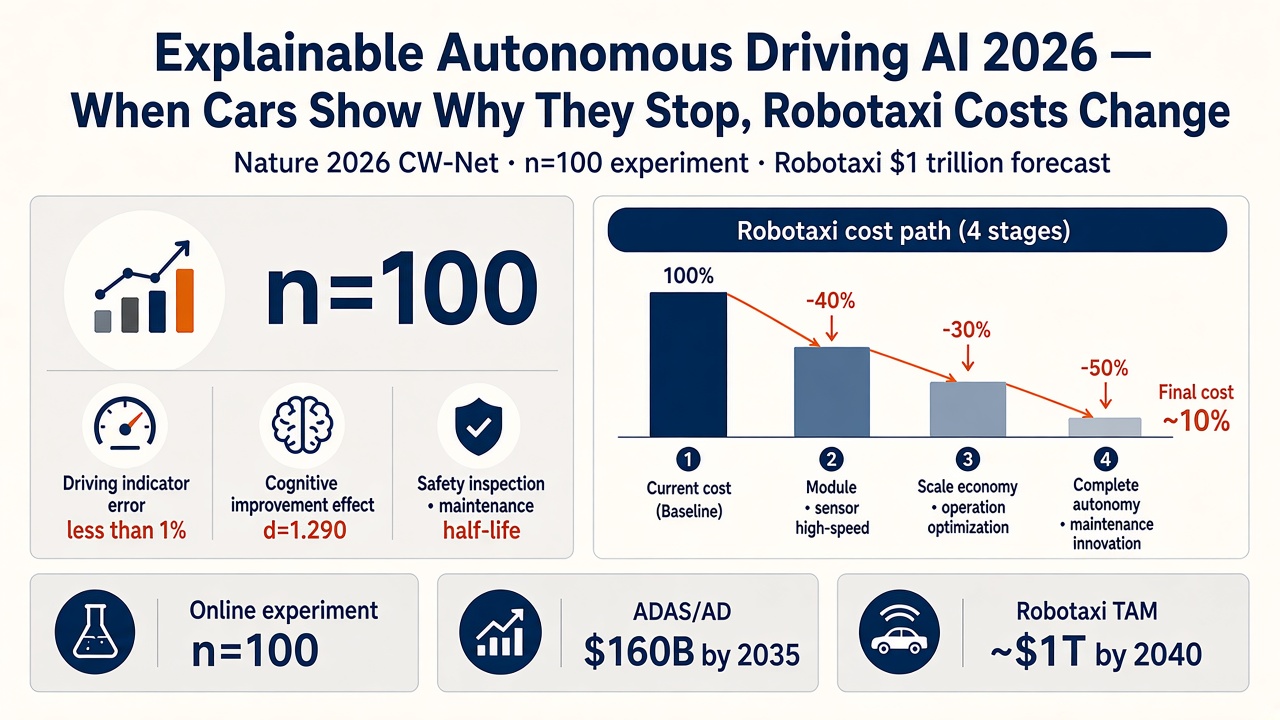
Explainable autonomous driving AI 2026 just became a real engineering story, not only a lab slogan. A Nature paper published on September 2, 2026 shows a system that helps people understand why a self-driving car stops, slows, or misreads a scene. The issue is one of transportation’s most expensive bottlenecks: whether AI can explain safety and trust well enough for humans to act on it.
The paper does not prove revenue for any robotaxi company. It proves a technical pathway: explainable AI can improve people’s mental models of autonomous-vehicle behavior in real deployments. Market size and business impact are projections drawn from sources such as McKinsey, Morgan Stanley, NHTSA, and Waymo.
Explainable autonomous driving AI 2026: what changed?
Modern autonomous vehicles increasingly rely on deep learning planners. These systems can choose human-like trajectories, but their internal reasoning is difficult to read. That is a safety problem. If a car suddenly stops and the human supervisor cannot tell why, the supervisor cannot easily predict what will happen next.
The Nature paper introduces Concept-Wrapper Network, or CW-Net. In plain language, it inserts human-readable concepts into the planner, such as close to cyclist, approaching stopped vehicle, or close to another vehicle. This is not just a post-crash explanation. The final driving decision is routed through those concepts, so the explanation is closer to the decision itself.
That distinction matters. Many explainability tools explain a model after it has already acted. The explanation may sound plausible without being faithful to the model’s real decision process. CW-Net tries to make the explanation causally tied to the planner’s behavior.
-
1
Road scene
Vehicles, pedestrians, cyclists, lanes
-
2
Black-box planner
Generates and scores candidate paths
-
3
Concept layer
Stopped vehicle, cyclist proximity, and more
-
4
Driving choice
Final path chosen through concepts
-
5
Human prediction
Understands why and predicts what comes next
The other important point is performance. Explainable systems are often criticized for trading accuracy for readability. The paper reports less than a 1 percent difference across major simulated driving metrics after CW-Net was wrapped around the planner. The claim is not slower but explainable. It is closer to nearly the same driving performance, with a clearer reason trail.
Why real-car deployment matters
The strongest part of the paper is that it was not limited to a toy setup. The researchers deployed CW-Net on an actual autonomous vehicle with a safety driver and also used data collected from public roads in Las Vegas. In autonomous driving, simulation-only evidence is useful but incomplete. Real roads are messier.
In one case, the vehicle repeatedly stopped near a pickup and drop-off area. The driver first thought the stop was caused by the zone itself. CW-Net indicated that the planner was reacting to being close to another vehicle. When the car was moved away from parked vehicles, that concept probability dropped and the vehicle moved again.
In another case, the car stopped next to a traffic cone. The explanation suggested that the system was behaving as if it were approaching a stopped vehicle. Removing the cone did not remove the stopping behavior. The explanation did not mean the car was right. It revealed what the car was wrong about.
The online evidence also mattered. In one study, explanations improved mental models for 8 of 9 experts and 27 of 30 non-experts. In a larger n=100 study based on Las Vegas public-road scenes, CW-Net improved situational awareness during surprising events, with Cohen d values of 1.290 for perception, 0.996 for comprehension, and 0.606 for projection.
Bar chart of effect sizes for situational-awareness gains in the Nature CW-Net study. Nature n=100 online study using Las Vegas public-road scenes. d is effect size.
Why this becomes a robotaxi cost issue
Robotaxis are often framed as a labor-cost story: remove the driver and reduce the fare. That is only part of it. The harder cost stack includes safety drivers, remote assistance, incident response, insurance, regulatory approval, simulation validation, and data-center spending. Driving well is not enough. The industry must explain why systems fail.
NHTSA estimated that motor vehicle crashes cost the United States $340 billion in economic costs in 2019. Including quality-of-life losses, the societal harm was nearly $1.4 trillion. A single Nature paper does not reduce that bill. But if explainable AI helps operators and engineers understand failures faster, it can support lower validation cost and better prevention over time.
Insurance could also change. Human-driven insurance prices driver behavior. Autonomous mobility increasingly prices software behavior. Insurers will want to know which situations a system handles poorly, whether an update reduced risk, and how responsibility should be allocated among the OEM, software supplier, fleet operator, and insurer.
-
1
Failure reason
See what the car misread
-
2
Validation time
Prioritize tests and simulation
-
3
Regulation and insurance
Explain risk more concretely
-
4
Operating cost
Potentially leaner assistance and response
-
5
Market scaling
Affects robotaxi and ADAS scaling
The market is growing, but safety validation is the bottleneck
McKinsey projected in June 2026 that the global advanced driver-assistance systems (ADAS) and autonomous-driving (AD) software and electronics market could reach about $160 billion by 2035, growing at roughly 16 percent annually. It also projected the ADAS/AD processing semiconductor market to grow from about $5.6 billion in 2025 to more than $46 billion by 2035.
Morgan Stanley Research estimated the robotaxi total addressable market at roughly $1 trillion by 2040, with about 2.5 million robotaxis potentially in service worldwide by 2035. But it also flagged regulation, safety concerns, and high investment needs as risks that could slow profitability.
Commercial rollout is already moving. Waymo announced on September 1, 2026 that it was welcoming first public riders in Denver, San Diego, and Tampa, bringing fully autonomous trips to 14 cities. Its Safety Impact Data Hub reports lower crash rates than human benchmarks, but those figures should be read with attention to methodology, operating areas, and data comparability.
Observed facts
CW-Net tested with real vehicle and public-road-based scenes
Nature
NHTSA · US crash economic cost: $340B in 2019
Waymo · 14 cities with fully autonomous trips as of Sept. 2026
Forecasts and interpretation
ADAS/AD software and electronics around $160B by 2035
McKinsey
Morgan Stanley · Robotaxi TAM around $1T by 2040
Industry read · Safety validation, insurance, and chips are scaling bottlenecks
Which industries move first — from robotaxis to insurance
Robotaxi operators are the first group. Explainability can help them decide which intersections, construction zones, or cyclist-heavy areas need updates. If safety drivers and remote-assistance teams understand events faster, operating costs may fall.
Automakers and suppliers are next. In Level 2+ systems, the driver keeps hands-on responsibility while software assists with acceleration and steering. In Level 3 systems, the vehicle can take over under defined conditions. Clearer explanations can reduce overtrust and make assisted driving easier to certify, package, and sell as a premium safety feature.
Semiconductor and cloud companies are also exposed. Autonomous driving is becoming an AI infrastructure problem. More simulation, larger models, and real-time inference increase demand for in-vehicle NPUs, or neural processing units, plus memory bandwidth and software optimization. Explainability could reduce some validation cost, but it also adds pressure to run richer AI workloads inside the vehicle.
Insurance and legal markets could be reshaped as well. If autonomous systems produce better explanation records, risk can be priced more granularly. Some consumer auto insurance may shrink, while fleet liability, software performance insurance, and business-to-business coverage could grow.
What the paper proved, and what it did not
The paper proved that CW-Net can be deployed on a real autonomous vehicle and can improve human understanding in selected scenarios. It showed mental-model and situational-awareness gains, while reporting less than a 1 percent change across major simulated driving metrics. My economic interpretation is separate: explainability can lower the cost of human judgment for safety drivers, developers, insurers, and regulators.
It did not prove that every AV architecture will benefit equally. It did not prove full regulatory acceptance or robotaxi profitability. More concepts, less labeling burden, and better driver-interface design remain open problems. More explanation is not automatically better; useful explanation means the right reason at the right moment.
- Outlook: as robotaxis scale, explainable validation tools could create new demand across software, chips, and insurance.
- Caution: this research does not guarantee profits or stock gains for any specific company.
The next race is showing the why
Autonomous-driving competition has long focused on miles, disengagements, sensors, and crash rates. A new question is joining the list: when the car makes a surprising move, can humans understand why?
That is why this Nature paper matters. It reframes autonomy as a cost-of-trust problem. If that cost falls, service areas, insurance pricing, regulatory approval, and AI infrastructure investment can all change. If explanations do not translate into safer deployment, the market can be huge and still scale slowly.
For a similar science-to-industry lens, see our pieces on self-driving laboratories and Nature BTR and ADC target expansion. The common point is not that one paper creates a market overnight. It is that good papers reveal which industrial cost bottleneck might change next.
My read: before cars fully drive like humans everywhere, the industry may need cars that explain their mistakes in a way humans can actually use.
Autonomy is not only a driving problem. It is a cost-of-trust problem.
Sources
- Nature: Explainable deep learning improves human mental models of self-driving cars
- Nature News & Views: Self-driving cars make mistakes, and now users can see why
- McKinsey: Reinventing autonomous driving in the age of generative AI
- NHTSA: Traffic Crashes Cost America $340 Billion in 2019
- NHTSA: Standing General Order on Crash Reporting
- Morgan Stanley: Robotaxis Enter the Fast Lane
- Waymo: Welcoming our first riders in Denver, San Diego, and Tampa
- Waymo Safety Impact Data Hub
For information only — this is not a recommendation to buy or sell any asset.
Comments 0