Tin flow battery: Li’s team reports 205 Wh/L in anolyte—can storage costs fall?
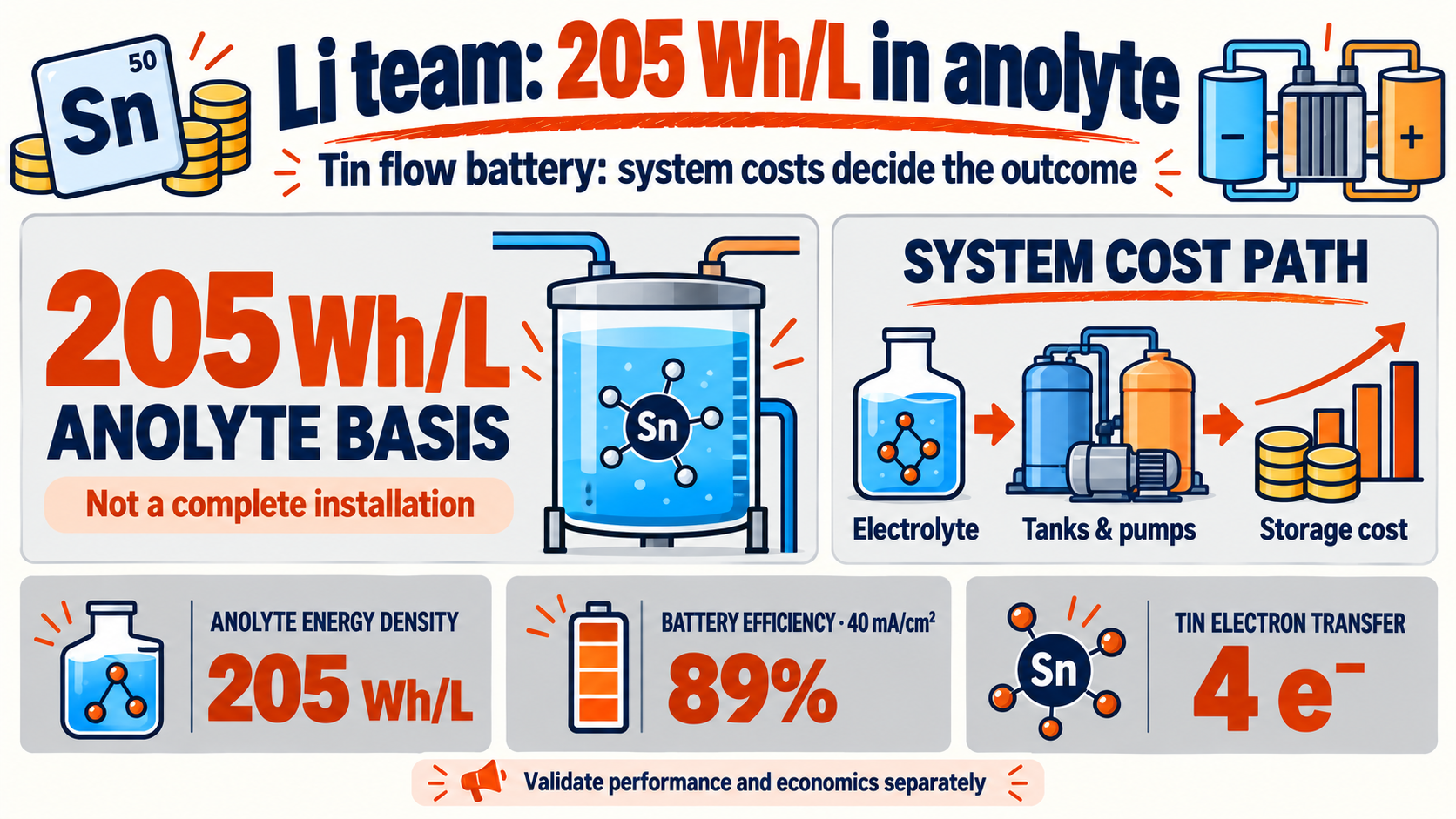
Xianfeng Li and colleagues at the Dalian Institute of Chemical Physics report a tin flow battery with an anolyte energy density of 205 Wh/L. Published in Nature Chemistry on October 9, the study suggests a route to more compact storage. Whether it lowers a utility’s costs requires a separate calculation. Source: Nature Chemistry · 2026-10-09
Moving surplus solar electricity from midday to evening takes equipment, space and energy. The more efficient solar cells become, the bigger that storage problem gets. Some electricity is lost along the way. This makes the study an interesting engineering question: how far can a change around a metal ion travel through to the size and operating bill of a storage plant? Related: Perovskite solar cells at 26.5% · Related analysis
Li, Xie and Chen: who did what
The corresponding authors are Li, Congxin Xie at DICP, and Shengli Chen at Wuhan University. Co-first authors Yue Ao and Xiaoxiao Wang carried out the investigation and contributed to methodology and visualization, according to the author contributions. Source: Nature Chemistry · Author contributions
Li’s work extends beyond electrolytes to membranes and assembly. A membrane limits unwanted mixing while allowing useful ions to pass. In 2020, his group reported improvements to membranes and assembly in a vanadium flow battery stack. Source: DICP · 2020 stack study
That history matters. A useful electrolyte must work with electrodes, pipes and seals. For Li’s team, the challenge extends from demonstrating a reaction to making all those components operate together. The interfaces can determine whether a promising chemistry becomes useful equipment.
Why tin flow batteries struggle to use all four electrons
A flow battery circulates electrolyte through a reaction unit to charge and discharge. Conventional vanadium systems change the state of dissolved metal ions. Tin also uses metal deposition and dissolution. Its storage capacity therefore cannot be expanded indefinitely just by adding liquid: the electrode must accommodate deposited metal. Source: Engineering · Flow battery basics
Li, Xie and Chen addressed a problem in tin’s reaction pathway. Tin can potentially exchange four electrons, but part of that sequence was difficult to reverse. A rechargeable battery needs a reaction that can travel in both directions, rather than simply store a large charge once. Source: DICP · Research summary
The work involving Ao and Wang changed the ions surrounding tin. Adding iodide to a chloride solution reduced the structural rearrangement involved in electron transfer. The approach makes an available reaction easier to reverse, rather than merely adding more storage material. Source: DICP · Coordination tuning
The abstract reports a redox peak separation of 978 mV under the chloride condition and 97 mV under the iodide condition. This is the separation between forward and reverse reaction signals during an electrochemical measurement. It supports improved reaction behavior; it is not an equivalent multiplication of storage capacity or plant efficiency. Source: Nature Chemistry · Electrochemical data
Source: Nature Chemistry abstract. Smaller separation brings the reaction signals closer; this is not a capacity or efficiency comparison.
What the 205 Wh/L figure leaves out
Li’s team also tested a full battery paired with a bromine electrode. The denominator in 205 Wh/L is anolyte volume. It excludes the other electrolyte, tanks, pumps and power electronics. Comparing it directly with a packaged lithium-ion system would mix different measurement boundaries. Source: Nature Chemistry · Anolyte basis
The paper also reports 89% energy efficiency at 40 mA/cm². This measures energy recovered relative to energy supplied in the battery test. It should not be treated as a plant’s grid-to-grid efficiency without accounting for pumping and power-conversion losses. Source: Nature Chemistry · Efficiency conditions
Reported in the paper
Anolyte: 205 Wh/L
Volume basis
Efficiency condition · 89% at 40 mA/cm²
Needed for a project
Include catholyte, tanks and auxiliaries
Total footprint
Operating performance · Include pumping and conversion losses
The distinction does not diminish the result. Reducing the space needed for anolyte could help at constrained sites. But land and construction savings depend on how much of the complete installation actually shrinks. Keeping the laboratory denominator intact is the starting point for a credible business case.
The cost case extends beyond the liquid
The following is economic interpretation, not a cost result from the paper. Even if this electrolyte becomes commercial, utilities will not buy it on liquid price alone. The relevant calculation includes installation and operation, divided by the electricity actually delivered over the equipment’s life.
A smaller volume could save on tanks and space. More demanding electrolyte management could offset those savings. Feedstock costs, materials compatible with bromine, and control of species crossing the membrane all need evaluation. Using water does not automatically make every handling requirement inexpensive.
-
1
Liquid volume
Potentially less liquid for a given capacity
-
2
Equipment design
Preserve performance in electrodes, tanks and pipes
-
3
Repeated operation
Account for losses, maintenance and replacements
-
4
Customer cost
Compare costs over lifetime electricity delivered
There is also a productivity angle. More reliable storage within the same factory footprint could give operators greater flexibility over when to draw power. It does not automatically increase factory output. Tariffs, price spreads and utilization determine the benefit. This is a possible application, not a factory result demonstrated by the study.
Can it compete with an industry already cutting costs?
The market Li’s team would enter is already moving. IEA’s Electricity 2026 reports battery storage project costs of about USD 150/kWh in 2024. The report year and data year differ. This is neither a quote for the tin battery nor a current price for a particular Korean installation. Source: IEA · Electricity 2026
Corporate plans provide another benchmark. In November 2025, Fluence and LEAG announced a 4 GWh storage project in Germany. It illustrates the scale of the established storage industry. It is not an adoption of this tin chemistry, and the announcement is not proof of completion. Source: Fluence & LEAG · Nov 7, 2025
The incumbent benchmark will not stand still while Li’s team validates scale and durability. Existing suppliers can improve production and installation too. Buyers may care more about repairs and enforceable performance guarantees than the novelty of a feedstock.
Potential Korean opportunities extend beyond electrolyte makers to pumps, corrosion-resistant piping, membranes and power conversion. Those are conditional supply opportunities. Without a verified license or supply contract, there is no basis here to identify a particular company as a beneficiary. This article analyzes technology and industry structure, rather than recommending an investment.
The next test is the complete installation
To displace part of the existing storage market, tin flow batteries need evidence of sustained performance with large electrodes. Deposition behavior, electrolyte changes and component replacement intervals matter. The abstract and institutional material reviewed here do not establish commercial lifetime or a percentage reduction in storage cost.
Longer term, electrolyte diagnostics, recovery and reuse could become services. That business would require the team’s reaction to remain stable through repeated operation, with recovery cheaper than replacement. It is a possible source of service revenue, not an established market demonstrated here.
Our earlier discussion of thin solid-state battery electrolytes also separated material performance from manufacturing economics. This time the relevant equipment includes liquids, pipes and installation space for stationary storage. Li’s team has expanded tin’s possibilities. The complete installation must now establish their economic value. Related: Solid-state electrolyte membranes · Related analysis
Validate electrolyte economics through the complete system, its lifetime and its costs.
Sources and further reading
- Ao et al., Nature Chemistry (2026): Reversible Sn4+/Sn0 anode for high-energy-density flow batteries
- DICP 에너지저장연구부: 네 전자 전달 주석 음극 (2026-10-14)
- DICP: LI Xianfeng 연구자 소개
- DICP: 저비용 고출력 바나듐 흐름전지 스택 (2020-06-12)
- IEA Electricity 2026 — Flexibility
- Fluence·LEAG: 독일 4GWh 저장 프로젝트 발표 (2025-11-07)
- Yin & Li, Engineering: The Flow Battery for Stationary Large-Scale Energy Storage
For information only — this is not a recommendation to buy or sell any asset.
Comments 0