Protease design hits a 10-billion-fold speed-up — will it lower drug costs?
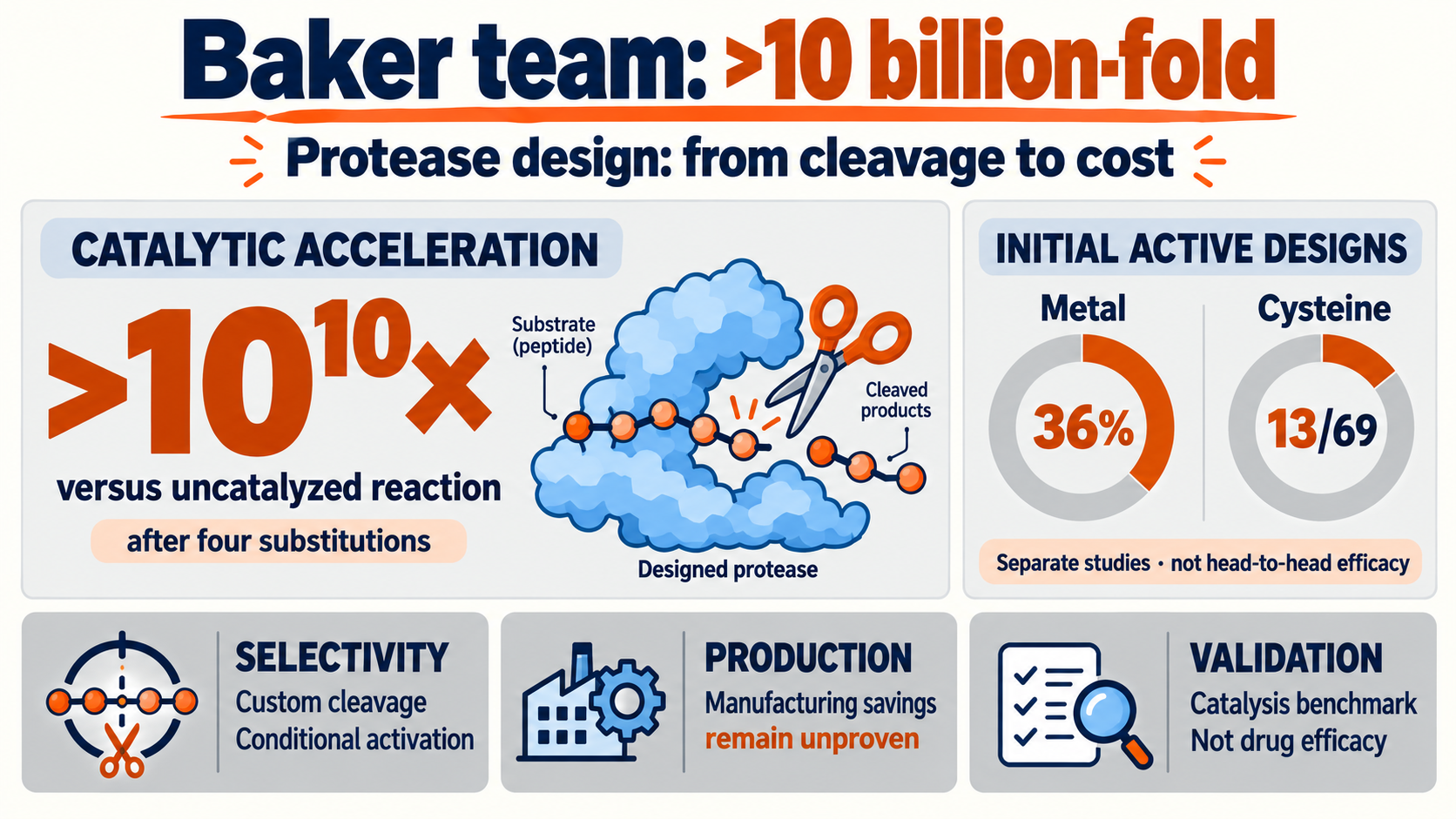
Protease design is moving from building protein shapes to making proteins cut at chosen sites. David Baker, Anqi Chen and Kejia Wu at the University of Washington’s Institute for Protein Design reported this advance in Nature on October 14, 2026. Their designed metalloenzyme accelerated cleavage more than ten billion-fold over the uncatalyzed reaction after four amino-acid substitutions. Its economic value depends on how much of that control survives the move from laboratory assays to manufacturing and medicine. Source: UW Medicine · 2026-10-14
A protease is an enzyme that cuts the bonds connecting amino acids in a protein. De novo design starts with a new protein design rather than simply modifying an existing enzyme. Two questions matter for an eventual product: can it cut the intended target reliably, and what does it cost to establish and manufacture that performance?
Baker, Chen and Wu: who did which part
Baker’s IPD brings together computational protein design and experimental testing. Chen and Wu are joint first authors of the metalloprotease paper; Wu, Donald Hilvert at ETH Zurich and Baker are corresponding authors. Chen and Wu also produced and characterized the designs. Source: Nature · 저자 기여
The companion cysteine-protease study has Hojae Choi as first author; he designed and characterized the enzymes. Samuel J. Pellock contributed to the computational pipeline and supervised the research. These results required both model development and experimental biochemistry. Source: Nature · Choi et al.
Chen and Wu’s metalloprotease work first appeared as a 2025 preprint. The final Nature paper adds subsequent improvements and applications. The two versions should not be treated as interchangeable records. Source: 2025 프리프린트 · 선행 버전
Protease design must do more than bind
Binding a protein and cutting it are different engineering tasks. Cutting requires reactive atoms to meet in a productive arrangement while the target moves. Chen and Wu used zinc to help activate water beside a substrate-binding pocket. Choi’s parallel approach put a cysteine amino acid at the catalytic center. Source: UW Medicine · 두 촉매 경로
RFdiffusion generates candidate protein structures under design constraints. A candidate still needs an amino-acid sequence, physical production and a measurement of what it actually cuts. Experimental validation is the bridge between a plausible structure and a usable enzyme. Source: 프리프린트 · 설계·실험 방법
-
1
Choose a bond
Specify target and reaction site
-
2
Design structure
Generate structure and sequence candidates
-
3
Build and test
Measure cleavage and activity
-
4
Validate use
Assess selectivity, stability and production
The engineering opportunity is a wider choice of cleavage sites. A process that previously had to accommodate an available enzyme might instead commission an enzyme around the product. Whether that flexibility translates across targets remains a separate validation question.
What does a ten-billion-fold acceleration compare with?
The metal-enzyme study reports over 100 million-fold acceleration initially and over ten billion-fold after four substitutions, relative to the uncatalyzed reaction. Disease-target designs reached up to one billion-fold. These are not improvements over commercial enzymes or measures of drug efficacy. Source: Nature · 최종 초록
Initial screens found activity in 36% of 135 metal designs and 13 of 69 cysteine designs, about 19%. The assays and design sets differ. The chart describes hits within each study, not a head-to-head ranking. Source: Nature · 시스테인 초록; 금속 수치는 앞 문단 원문
Sources: Nature papers, Oct 14, 2026. Different assays; not a ranking or clinical success rate. 19% is rounded.
For a developer, the relevant denominator is a usable candidate. Synthesis, expression and analysis costs include failed designs. Even an active hit can require substantial work if it loses activity during storage or cuts unwanted proteins. A screening hit rate is neither a clinical success probability nor a cost-saving percentage.
A buyer will ask about enzyme dose, processing time and recovered product per batch. Baker’s group has expanded the starting points for that optimization. It has not supplied an industrial cost sheet.
Cutting TDP-43 and Aβ is not yet a treatment
The metal study includes in-vitro cleavage of full-length TDP-43 and experiments on an amyloid-beta-derived peptide. TDP-43 also has normal cellular functions. Cutting these samples does not demonstrate clearance of pathological deposits in a patient’s brain. Source: Nature · Extended Data 8–9
Choi also demonstrated target cleavage in cultured mammalian cells. That is a meaningful extension into a cellular environment, but delivery and safety after administration to a patient remain separate questions. Source: Nature · 배양 세포 결과
A therapeutic program would need to examine preservation of normal proteins, the effects of cleavage fragments and delivery to the required tissue. Lower manufacturing and administration burdens are possible if adequate efficacy can be achieved at lower doses. That is an economic hypothesis to test, not a demonstrated saving.
Calling this an established third treatment modality after antibodies and small molecules would be premature. The advance expands programmable cleavage as a design option. Displacement of existing treatments will depend on disease-specific clinical outcomes and total treatment cost.
A market for controlling when a drug becomes active
Conditional activation offers another commercial route. Cytokines are signaling proteins; a caged cytokine has its activity restrained until a cleavage event releases it. Hojeong Shin designed and performed the cytokine-activation experiments in the metal-protease study. Source: Nature · 조건부 활성화·저자 기여
Designing the enzyme and its cleavage site together could support control with less interference from other biological reactions, the aim of bioorthogonal control. A custom enzyme is not automatically tumor-selective. Its distribution and persistence must also be engineered.
There is a financing precedent in the adjacent market. AbbVie and Xilio announced a tumor-activated immunotherapy collaboration in February 2025, with $52 million in total upfront payments including a $10 million equity investment. This is evidence of commercial interest in conditional activation, not a deal for Baker’s technology. Source: AbbVie · 2025-02-12
Xilio describes a platform that uses tumor-associated proteases to remove drug masks. Commercial development of Chen and Wu’s approach could add a custom protease to the design. More control also means more components to validate. Neither approach has established a cost advantage over the other here. Source: Xilio · 작동 방식
Use tumor proteases
Endogenous tumor-associated enzyme
Cutter
Development task · Optimize mask and cleavage linker
Custom enzyme–drug pair
Designed protease
Cutter
Development task · Validate enzyme, linker, delivery and pair
One possible business model is joint development of an enzyme, a matched cleavage sequence and the assays that validate the pair. That could create design and testing revenue as well as reagent sales. This is an editorial scenario; it is not an observed market size or order book.
For Korean CDMOs, the cost question extends beyond the bioreactor
A CDMO develops and manufactures medicines for other companies. Samsung Biologics’ May 2025 update said its newly opened Plant 5 added 180,000 liters of capacity. That is a dated example of Korea’s manufacturing investment, not proof that the facility is suitable for these enzymes or has secured a related contract. Source: 삼성바이오로직스 · 2025-05-16
Consider a manufacturing application for Baker’s designs. Selective cleavage could reduce product loss during processing and raise recoverable output per batch. A shorter reaction might also free equipment sooner. Those mechanisms suggest research reagents and high-value process aids as possible early applications, subject to validation.
There are offsetting costs. Removing residual enzyme or reliably stopping further cleavage may add purification steps. Poor enzyme-production yield can erase downstream gains. A process aid and an enzyme administered directly to patients also face different validation needs.
A useful cost model is total batch spending on production, purification, testing and disposal divided by saleable output. This is an analytical framework, not a measurement from the paper. A more expensive enzyme may pay for itself through yield; a faster reaction may fail to pay if testing costs rise more.
-
1
Potential benefit
Less product loss or processing time
-
2
Added costs
Enzyme production, removal and testing
-
3
Final comparison
Cost per saleable unit at matched quality
Quality assessment must distinguish quantity from function. ICH Q6B separates protein amount from biological activity. Applied to a custom protease, that distinction makes reproducible cleavage activity important alongside protein content. Source: ICH Q6B · 역가와 양
If a treatment combines an enzyme with a caged drug, developers may need to validate each component and their combined behavior. Assay development adds cost within GMP, the system for consistent medicine manufacturing and quality control. For Korean suppliers, the opportunity may depend as much on reliable analytical and purification methods as on capacity.
This connects with our earlier MassNet article on protein-analysis tools: more design candidates increase the value of reliable experimental characterization. Related: MassNet · 단백질 분석과 검증비
Our article on in-vivo CAR-NK manufacturing examined how costs move when production changes location. Likewise, eliminating a step with a designed protease would not by itself establish a lower total treatment cost. Related: CAR-NK · 제조와 품질검사 비용
The next milestone is repeatable performance
Chen, Wu and Choi have shown that designed proteins can perform targeted cleavage. The next assessment should examine transfer to new targets, unwanted cleavage in complex samples and consistent activity at larger scale. Therapeutic development adds delivery, safety and efficacy requirements.
A more concrete displacement hypothesis is the entry of new suppliers into selected research-reagent and precision-processing niches. Where existing enzymes are inexpensive and adequate, switching has little appeal. New markets may emerge first where a custom cleavage step enables a product that was previously difficult to make.
Baker’s group has delivered an impressive chemical result. Commercial success requires translating it into recovered product, passing batches and, for a medicine, patient outcomes. That translation is where programmable cleavage can become economic value. This article interprets research results and cost structures; it is not a recommendation to buy or sell any company mentioned.
Assess custom cleavage by the total cost of producing and validating a usable product.
Sources and further reading
- Chen·Wu et al., Computational design of metalloproteases, Nature (2026-10-14)
- Choi et al., De novo design of cysteine proteases, Nature (2026-10-14)
- UW Medicine, Molecular scissors open path to new therapies (2026-10-14)
- AbbVie–Xilio collaboration announcement (2025-02-12)
- Xilio Therapeutics: tumor-selective activation platform
- Samsung Biologics, Plant 5: Re-shaping biopharma operations (2025-05-16)
- FDA, ICH Q6B specifications guidance
- EMA, ICH Q6B
- Chen et al., 2025 preprint in PMC
For information only — this is not a recommendation to buy or sell any asset.
Comments 0