Chitosan receptors found — can Wang’s team turn fungal sensing into cheaper crop protection?
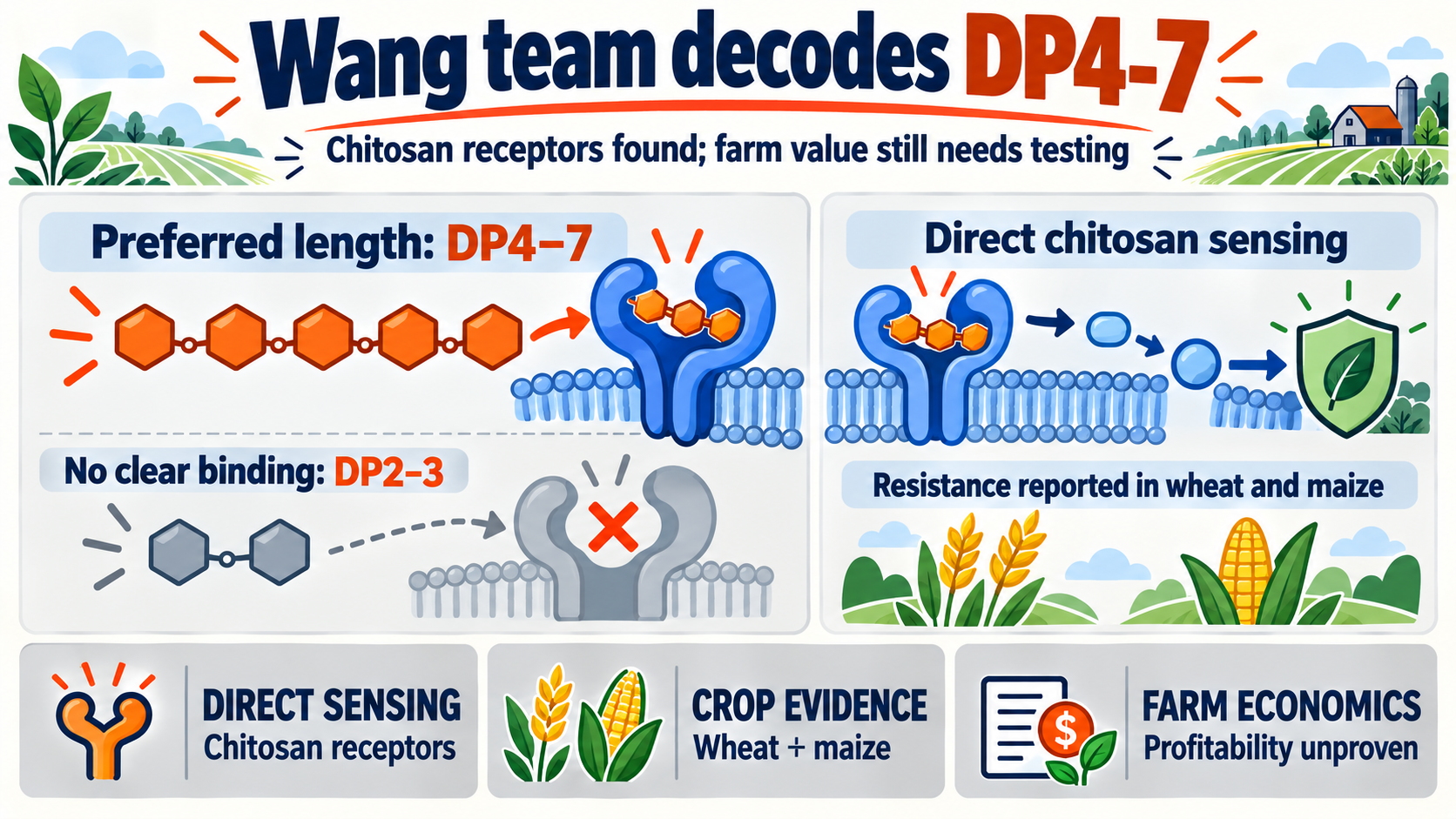
Yiming Wang’s team at Nanjing Agricultural University has identified the OsFID1–OsFID2 chitosan receptor system. Reported in Science in October 2026, the work explains how plants detect a fungal signal, with a preference for chains of four to seven sugar units (DP4–7). Its economic promise lies in what this mechanism could change about crop protection and seed development. Source: 난징농업대 연구 발표
For a farmer, disease resistance becomes valuable when it protects saleable harvests or lowers treatment costs enough to cover any seed premium. This discovery supplies a scientific starting point for that calculation. It does not yet supply the farm budget.
Who are Wang’s team and collaborators
Wang is the corresponding author; Keyi Huang and Jingni Wu are joint first authors. Collaborators include Sun Tae Kim of Pusan National University and Kenichi Tsuda of Huazhong Agricultural University. The institutional announcement identifies these participants but does not assign individual binding assays or crop experiments to them. Source: 연구진 명단
Wang and Tsuda previously worked together on a 2024 Cell Reports study of how a beneficial bacterium activates plant immunity. That work examined a defense-signaling pathway. The new study addresses the initial recognition of a fungal material outside the plant cell. Source: Cell Reports 2024
What the chitosan receptor recognizes
Chitosan is a chain of sugar units. It is related to chitin, a fungal cell-wall material, but differs chemically. It is also distinct from cellulose in plant cell walls. The signal identified by Wang’s team is chitosan.
According to the institutional report, OsFID1 captures chitosan in the apoplast, the space outside the cell membrane. OsFID2 sits at the membrane and helps convey recognition inward. DUF26 names a structural domain in these proteins. The arrangement connects extracellular detection to cellular defense. Source: 국가중점실험실 기전 설명
-
1
Chitosan
Fungal signal
-
2
OsFID1
Extracellular recognition
-
3
OsFID2
Membrane signaling
-
4
Defense
Immune activation
A notable result in the study co-led by Huang and Wu is chain-length selectivity. DP counts linked sugar units. Within the tested range, OsFID1 preferred DP4–7, while DP2–3 showed no clear binding. That does not establish equivalent activity for every chitosan product, or rule out all longer chains. Source: DP 결합 시험
DP2–3
No clear binding
Finding
DP4–7
Preferred binding
Finding
Rice already has a known chitin-recognition complex, OsCERK1–OsCEBiP. The announcement reports no detected interaction between it and the new receptor pair. This supports a distinct recognition module, without establishing that every downstream defense signal is independent. Source: 기존 수용체와 비교
From wheat and maize experiments to farm performance
Wang’s team reports improved fungal resistance after expressing rice OsFID1 in wheat and maize. Expression means using the genetic information to make the protein. The reported transfer concerns OsFID1; it is not evidence of a commercial seed carrying an introduced pair of genes. Source: 작물 이전 결과
Broad-spectrum resistance does not mean permanent protection against every fungus. Pathogens, varieties and weather can change performance. We could not access the Science full text or supplements, so we have not established assay-level effect sizes or the scope of field testing. No pesticide-reduction or yield-gain percentage is claimed here.
If development costs fall, screening comes first
One potential industrial use of Huang and Wu’s work is candidate screening. This is an economic inference, not a measured cost result. Binding and defense-response assays could help select which formulations or genetic variants deserve more expensive field testing.
Strong binding alone does not make a useful farm product. Persistence on leaves, rain exposure and storage stability still matter. Enriching selected chain lengths could also raise purification and quality-control costs. Savings in discovery need to exceed these added manufacturing costs.
Seed development has a different cost structure. Even with a promising gene, breeders must retain yield and quality in local varieties. Work may shift from finding a candidate to choosing where and how strongly it should operate. Lower discovery costs do not automatically mean lower total development costs.
Defense elicitor
Screening iterations
Possible saving
Remaining costs · Purification, stability, formulation
Resistant seed
Gene discovery
Possible saving
Remaining costs · Variety development, field validation
Chitosan products already sell — what still needs proof
Wang’s team did not invent agricultural uses of chitosan. In 2022, the US EPA added it to the active ingredients eligible for the minimum-risk pesticide exemption. Products must meet the relevant composition and other conditions. This does not establish approval for engineered seeds or products sold in Korea. Source: EPA 2022 발표
Commercial investment is already under way. Syngenta reports double-digit growth in its biologicals business in 2025 and a newly operational production facility in Orangeburg, South Carolina. The category also includes biostimulants and nutrient-efficiency products. Those figures are not a chitosan market forecast or revenue guidance for this discovery. Nothing here is a recommendation to buy or sell any company’s shares. Source: Syngenta 2025 실적
Potential opportunities include reproducible ingredients, crop-specific testing services and seeds carrying resistance traits. Replacing some fungicide use would require comparable harvest reliability. We have not verified a licensing agreement between Syngenta and this research team.
Would Korean growers retain the savings?
Sun Tae Kim’s participation connects the project to Korean research. It does not demonstrate commercial performance in Korean rice or wheat varieties. Local development would need to test regional pathogens alongside sale-relevant qualities such as rice eating quality and wheat processing performance. These are proposed validation requirements, not results of the paper.
The relevant measure is net income per unit of land: avoided treatment costs plus the value of protected harvests, less seed premiums, added management and any yield or quality loss. Benefits can shrink in low-disease years. Pricing a seed from severe-outbreak results alone could overstate the average grower benefit.
The next economically useful evidence is a side-by-side comparison with established crop protection. Does the new approach preserve saleable yield and quality at lower total cost under matched disease pressure? Wang’s team has advanced the explanation of recognition. Breeders, formulation scientists and field researchers must now establish whether that knowledge pays on farms.
Evaluate agricultural value by net income per unit of land.
Sources and further reading
For information only — this is not a recommendation to buy or sell any asset.
Comments 0