Earth’s core temperature at 3,430 K: what Geballe’s iron experiments mean for the geodynamo and geothermal costs
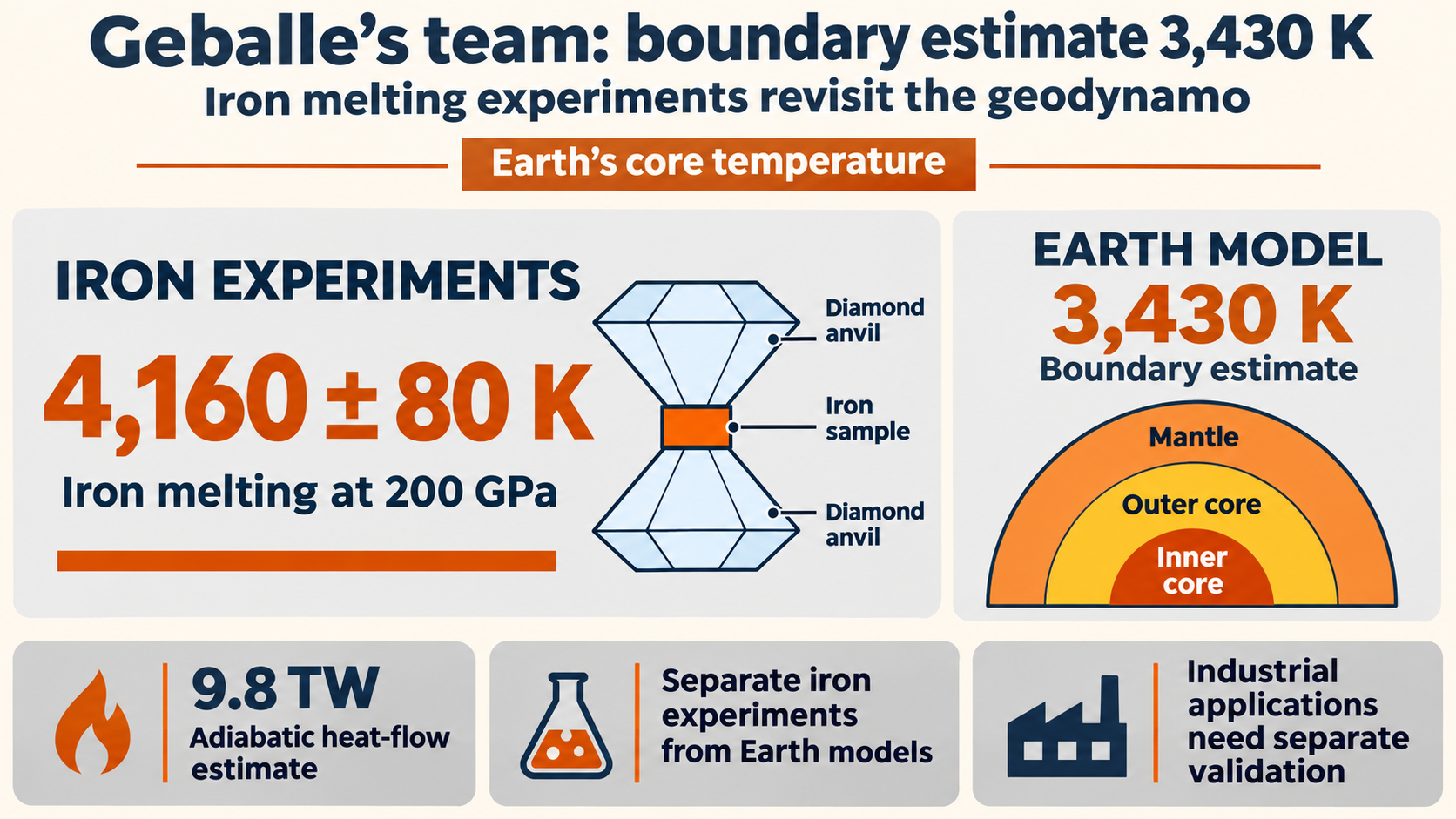
Zachary M. Geballe of Carnegie Science’s Earth and Planets Laboratory and his collaborators have reported iron experiments that challenge estimates of Earth’s core temperature. The Science abstract reports a melting temperature of 4,160 ± 80 K at 200 GPa and infers a core–mantle boundary temperature of 3,430 K. Does that answer an old question about Earth’s magnetic field, and does it touch geothermal costs? Honestly, the two answers are quite different. Source: Science 논문 — 원문 접근 재확인 필요 Source: Zachary Geballe ORCID
The two temperatures describe different things: a laboratory melting point and a modeled planetary boundary temperature. They do not show that Earth has suddenly cooled or directly measure heat available to a geothermal power plant.
Zachary Geballe and the Carnegie high-pressure team
Geballe has spent years developing ways to detect melting under extreme pressure. A 2021 paper used brief electrical heating pulses to detect the latent heat of melting in platinum—the energy absorbed when a solid becomes liquid. This offered a signal tied to the phase change itself. Source: 잠열 기반 융점 측정 선행연구
Suzy M. Vitale, Jing Yang, Francesca Miozzi and Michael J. Walter coauthored a 2024 microassembly study with Geballe. It addressed the placement of electrodes and insulation around tiny samples. They also appear in the iron project’s early data record. The material accessible for this article does not establish each person’s contribution to the final paper. Source: 저자 데이터 저장소 Draft 1 Source: 미세 조립 다이아몬드앤빌 선행연구
What changes when the sample is heated electrically?
A diamond anvil cell squeezes a tiny sample between diamond tips. Joule heating passes current through the sample so that electrical resistance generates heat. A microsecond is one millionth of a second; heating and measurement therefore need tightly synchronized instruments.
Electrical heating can combine the heat source and electrical measurement in one experiment. It does not automatically guarantee accuracy. Changes in sample shape or electrode position can distort the result. This is why the microassembly work involving Vitale and colleagues matters. Source: 미세 조립 다이아몬드앤빌 선행연구
The new abstract reports more than 300 reproducible melting measurements. Repetition helps distinguish a repeatable signal from chance. Shared calibration errors can nevertheless survive repeated measurements, so independent replication remains important. Source: Science 논문 — 원문 접근 재확인 필요
-
1
Compress
A tiny iron sample between diamonds
-
2
Heat and measure
Brief current pulses; thermal and electrical signals
-
3
Extrapolate
Extend pressure and composition to core conditions
Earth’s core temperature: from measurement to inference
The reported 4,160 ± 80 K melting point applies to iron at 200 GPa. The abstract gives a melting-curve slope of 6 K/GPa at this pressure. That slope matters when extending the result toward deeper core conditions. Source: Science 논문 — 원문 접근 재확인 필요
Earth’s core is not pure iron. Geballe and colleagues extrapolated in pressure and alloy composition and combined this with electrical resistivity measurements. Their inferred results are 3,430 K at the core–mantle boundary and a 9.8 TW adiabatic heat flow in the outer core. Source: Science 논문 — 원문 접근 재확인 필요
Reported iron measurement
200 GPa
Conditions
Melting point · 4,160 ± 80 K
Planetary model inference
3,430 K
Core–mantle boundary
Adiabatic heat flow · 9.8 TW
Adiabatic heat flow describes conductive heat transport along a reference temperature profile for a convecting core. How actual heat loss compares with that reference matters for thermal convection. It is not recoverable generating capacity. Nor can the melting point’s ±80 K uncertainty simply be assigned to the inferred boundary temperature; extrapolation adds uncertainty.
Revisiting the power source of the geodynamo
The geodynamo is the process that maintains Earth’s magnetic field through motion of electrically conducting liquid in the outer core. Solidification of the inner core can supply heat and compositional buoyancy today. Explaining the magnetic field before that solid inner core existed is harder.
The authors suggest that their lower temperature and adiabatic heat-flow estimates make a thermally powered early dynamo feasible. They also infer a fully solid lowermost mantle today. Both are conclusions from applying laboratory results to a planetary model, rather than direct observations of those regions. Source: Science 논문 — 원문 접근 재확인 필요
The closest economic opportunity is better measurement
The relatively direct commercial opportunity is high-pressure measurement. If precise electrodes and synchronized thermal and electrical measurements work across other materials, laboratories and instrument suppliers could improve testing services. This is an industrial inference, not a demonstrated sales opportunity or cost saving.
The assembly challenge studied by Vitale and colleagues is also an economic challenge. Fast measurements do not ensure low costs if sample preparation is slow or failures are frequent. Productivity improves only if a laboratory obtains more usable data from its staff and equipment time. The relevant metric is total cost per usable result.
Possible applications include sample fabrication, fast measurement electronics and high-pressure materials testing. The evidence does not establish a market size or scalable manufacturing process. Replacement of laser-heated systems would require comparative performance and maintenance data; cross-checking results is a clearer near-term use.
-
1
Independent replication
Verify accuracy across instruments and samples
-
2
Research productivity
Compare time and cost per usable result
-
3
Field validation
Test prediction errors and failed-well reduction
Which numbers actually move geothermal costs?
There is a substantial gap between Geballe’s core-temperature inference and a geothermal project. Developers need site-specific rock temperatures, fluid pathways, drilling success rates and construction costs. The US Department of Energy identifies exploration and resource characterization as ways to reduce risk. A revised core model cannot by itself rewrite a plant’s economics. Source: DOE Exploration and Characterization
Fervo reported in July 2026 that Sawtooth 7 reached total depth in 21 days. Although this is a company-reported result, reducing time spent drilling has a concrete connection to equipment and crew costs. It is not an outcome of Geballe’s research, and no causal link to the core-temperature estimate has been established. Source: Fervo 2026년 7월 시추 발표
The IEA’s 2024 report presents a conditional pathway in which policy support and oil-and-gas expertise help cut next-generation geothermal costs by around 80% by 2035, to roughly $50/MWh. This is an industry scenario, not an achieved price or a calculation based on the 3,430 K estimate. Source: IEA The Future of Geothermal Energy
If those cost reductions materialize, dispatchable geothermal power could serve a larger market and create demand for drilling and reservoir-management expertise. How much existing generation it replaces depends on local resources, grid conditions and contracts. Field validation is the missing link between a scientific finding and an industrial growth forecast.
What would it take to matter for Korean exploration?
The same distinction applies to Korean seabed exploration and seismic observation. Improving a model of core evolution is different from choosing drilling locations, survey-vessel schedules or station layouts. This research review found no evidence that those budgets are tied to a high-core-temperature assumption.
Operational users already have reference magnetic models such as NOAA’s World Magnetic Model for navigation. Better explanation of the field’s origin does not automatically improve present-day instrument corrections or mineral exploration success. A new model must first be tested against observations and existing methods. Source: NOAA World Magnetic Model
A plausible long-term benefit for Korea is stronger measurement capability, materials data and subsurface interpretation. Economic value becomes measurable if those capabilities later reduce unnecessary surveys or failed wells. The current evidence does not identify a corporate beneficiary or a percentage saving for Korean geothermal projects.
What still has to be checked before 3,430 K holds up
The key tests are independent replication of the melting curve and validation for alloys closer to Earth’s core. Robust measurements and models could change our understanding of the magnetic field’s history and mantle state. Industrial assessment then needs throughput, sample-preparation costs and field-prediction accuracy.
A note on sources: figures for the new paper follow the author abstract listed on PubMed. The Science full text, supplement and final data record could not be checked directly at the time of writing. Earlier papers, the initial data record and institutional and company sources were checked separately. Details such as resistivity units and conditions, individual author contributions and extrapolation uncertainty may be refined in the full paper. This article explains research and is not a recommendation to buy or sell any security.
Iron melting, planetary history and project economics each require their own validation.
Sources and further reading
For information only — this is not a recommendation to buy or sell any asset.
Comments 0