TIMM50 cancer immunotherapy — 3 conditions for Puigserver’s finding to change treatment costs
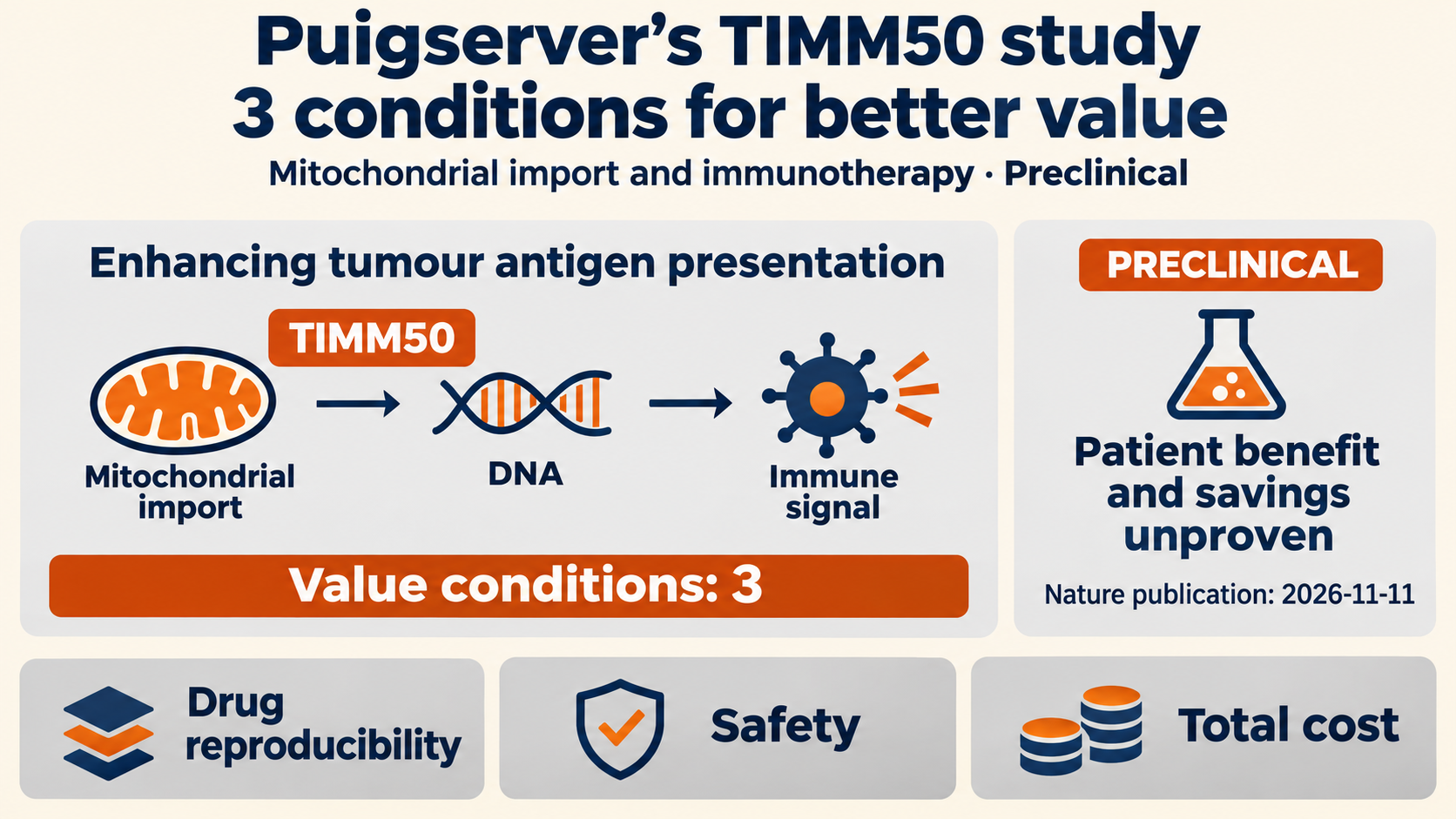
Pere Puigserver’s team at Dana-Farber Cancer Institute reported a TIMM50 study in Nature on November 11, 2026 that links disrupted mitochondrial protein import to stronger antitumour immunity in melanoma models. This is preclinical evidence, not a proven treatment for patients. Its economic potential depends on three conditions: reproducing the effect with a drug, achieving acceptable safety, and delivering value across the full course of care. Source: Nature: Mitochondrial protein import defects enhance tumour immunogenicity
Would adding another medicine reduce the cost of cancer care? The immediate effect would usually be a larger drug bill. The calculation could change if the addition helped patients who otherwise would not respond and reduced later treatment. That possibility, and the evidence still needed to support it, make this research interesting.
Why a metabolism lab turned to cancer immunotherapy
Puigserver’s laboratory studies how nutrient handling and energy metabolism shape cell survival and disease. Its stated research questions include whether changing tumour metabolism can support antitumour immunity. That explains why a metabolism laboratory is working on immunotherapy. Source: Puigserver Lab: Research
Nature lists Thomas D. Jackson first, alongside Jonathan M. Palozzi, Puigserver and other collaborators. The available author information identifies the team, but does not establish who performed each individual experiment; this article does not assign those roles. Source: Nature 2026 article catalogue
The laboratory’s 2025 Nature Cancer work examined tumour immunogenicity after depletion of the respiratory complex I subunits Ndufs4/6. Immunogenicity means the capacity to provoke an immune response. The TIMM50 work extends this line of inquiry to the import of proteins into mitochondria. Source: Puigserver Lab: Publications
Why could reducing TIMM50 make a tumour easier to detect?
Mitochondria support cellular energy production. Here, “import” means moving proteins made elsewhere in the cell into mitochondria. TIMM50 is part of the TIM23 machinery involved in that process. Source: Nature: Mitochondrial protein import defects enhance tumour immunogenicity
Jackson and colleagues connect TIMM50 depletion to mitochondrial DNA escape, activation of the DNA-sensing cGAS–STING pathway and secretion of interferon beta. Signalling through the type I interferon receptor and JAK–STAT then increases MHC-I antigen presentation. MHC-I displays protein fragments at the cell surface for immune inspection. Source: Nature: Mitochondrial protein import defects enhance tumour immunogenicity
-
1
Import disrupted
TIMM50 depletion
-
2
mtDNA escapes
DNA leaves mitochondria
-
3
Immune signalling
cGAS–STING → IFNβ
-
4
More antigen presentation
IFN receptor/JAK–STAT → MHC-I
Mitochondrial-derived vesicles were implicated: depletion of the vesicle-associated factors SNX9 or RAB9 reduced DNA-dependent interferon signalling. This does not establish vesicles as the only escape route or make mitochondrial damage a universally useful cancer strategy. Source: Nature: Mitochondrial protein import defects enhance tumour immunogenicity
How it differs from checkpoint blockade: releasing restraint vs improving recognition
Checkpoint inhibitors block proteins that restrain immune activity. PD-1 inhibitors interrupt inhibitory signalling affecting T cells, immune cells capable of attacking tumours. Releasing that restraint and improving recognition of the target are distinct tasks. Source: NCI: Immune Checkpoint Inhibitors
Puigserver’s approach focuses on antigen presentation within the tumour, creating a rationale for combining it with checkpoint blockade. The paper reports synergy in melanoma models; it does not quantify the response improvement patients would experience. Source: Nature: Mitochondrial protein import defects enhance tumour immunogenicity
PD-1 inhibitor
Blocks inhibitory immune signalling
Main action
Evidence · Established clinical drug class
TIMM50 approach
Enhances tumour antigen presentation
Main action
Evidence · Preclinical melanoma models
The industrial interpretation is a potential add-on that could broaden the benefit of existing antibodies. An established treatment can provide a starting point for development, but its approval does not establish the safety or efficacy of a new combination. That remains a separate development task.
Why add a new approach to an already effective treatment?
Existing clinical results set the context for Puigserver’s finding. In the final CheckMate 067 analysis reported by Jedd Wolchok and colleagues, 10-year overall survival in advanced melanoma was 43% with nivolumab plus ipilimumab, 37% with nivolumab, and 19% with ipilimumab. The trial randomized 945 patients. These are results for established checkpoint inhibitors, not TIMM50 treatment. Source: NEJM: Final, 10-Year Outcomes with Nivolumab plus Ipilimumab in Advanced Melanoma
CheckMate 067, NEJM 2024. Not TIMM50 results. Overall survival is not cure rate; this does not establish superiority over nivolumab.
Durable survival is a major achievement, but benefits are not universal. Overall survival is neither response rate nor cure rate. The descriptive comparison of the combination against nivolumab gave a death hazard ratio of 0.85, with a 95% confidence interval of 0.69–1.05. The 43% and 37% figures alone do not establish statistical superiority. Source: NEJM: Final, 10-Year Outcomes with Nivolumab plus Ipilimumab in Advanced Melanoma
Safety also affects costs. The US National Cancer Institute explains that an immune system activated against cancer can attack healthy tissues. An economic assessment of a new combination must therefore consider extra monitoring, hospital care and treatment interruptions, alongside tumour control. Source: NCI: Side Effects of Immunotherapy
Three conditions for changing treatment costs: reproducibility, safety, total cost
The following is development analysis, not a result measured in the paper. The first condition is drug reproducibility. Reducing a protein experimentally is different from administering a medicine that alters its function at the intended intensity and for the intended duration.
A developer would need to connect tumour exposure, altered import function and a change in antigen presentation. Killing cultured cells is not enough to show that the intended mechanism has been reproduced. Testing that chain early could reduce spending on candidates that do not work as intended. This is a possible improvement in research productivity, not a saving calculated by the study.
The second condition is safety, specifically tumour selectivity. Normal cells also contain mitochondria, so a dose that produces the desired tumour effect must be tested for effects on healthy tissues and immune cells. Tumour-directed delivery or limited treatment courses are possible development strategies. Neither should be treated as a solved problem on the basis of this paper.
The third condition is total cost per patient. Add the new drug, selection tests, administration, monitoring and adverse-event care, then subtract care avoided later. A negative difference would mean cost savings. Higher spending could still be cost-effective if survival and quality of life improved sufficiently; that is different from being cheaper.
Added costs
New drug and selection tests
Drug and tests
Care · Administration, monitoring, toxicity care
Potentially avoided costs
Could fall if efficacy is established
Later treatment
Hospital care · Could fall with less progression
There is also a countervailing effect. Better treatment may expand eligibility or lengthen time on therapy. Value per patient could improve while the insurer’s total budget rises. The useful evidence would therefore combine survival, quality of life, treatment duration, hospital use and subsequent therapy, rather than a single price figure.
Where could Korean biotech create value?
Puigserver’s target sits beside a large established treatment business. Merck reported $31.680 billion in combined 2025 sales of Keytruda and Keytruda Qlex. This covers multiple cancers and markets. It is neither the melanoma market size nor a revenue forecast for a TIMM50 drug. Source: Merck: Fourth-Quarter and Full-Year 2025 Financial Results
A concrete Korean example is Samsung Bioepis. On November 6, 2026, it presented phase 3 results for SB27, its proposed pembrolizumab biosimilar. The company reported equivalent objective response rates at week 24 in metastatic non-squamous non-small cell lung cancer, with chemotherapy in both arms. A biosimilar is developed to demonstrate high similarity to a reference biologic. Source: Samsung Bioepis: SB27 Phase 3 at SITC 2026
SB27 does not target TIMM50, and the announcement does not establish a collaboration with Puigserver’s team. It demonstrates Korean participation in the existing checkpoint-antibody business. Price competition from biosimilars and incremental benefit from a TIMM50 combination are separate business challenges. Actual pricing and access would depend on regulatory, launch and reimbursement conditions.
Potential new business could include specimen analysis as well as medicines. Developers would need to determine whether a tumour retains the relevant signalling machinery and whether treatment produces the intended change. Hospitals, testing companies and trial-service providers could contribute. More tests alone do not create value: the results must improve treatment selection enough to justify their cost.
Valuation should not start by multiplying antibody sales by an arbitrary market share. The useful milestones are a candidate that reproduces the mechanism, a workable separation between tumour and normal-tissue effects, and predictive evidence for patient selection. These could strengthen future licensing discussions. No deal value or development-success probability linked to this research has been established here.
The next test is the added benefit for patients
The significance of the work by Jackson, Puigserver and colleagues is the connection between intracellular protein import and immune recognition. Its industrial value would have to be demonstrated through a safe medicine and a measurable addition to patient benefit. A costly add-on needs sufficient benefit; greater activity with unacceptable toxicity would not be enough.
The challenge of turning a target into a medicine also appears in our article on MYC noncoding RNA targets. Our discussion of NeoCOAST-2 in lung cancer considers the distance between a treatment indicator and patient benefit. These are distinct studies, but each requires separating an encouraging biological result from an economic outcome. This article explains research; it is not a recommendation to buy or sell any company’s shares, nor medical advice.
The value of the TIMM50 finding must be demonstrated through a safe drug and added patient benefit.
Sources and further reading
- Nature: Mitochondrial protein import defects enhance tumour immunogenicity
- Nature 2026 article catalogue
- Puigserver Lab: Research
- Puigserver Lab: Publications
- NEJM: Final, 10-Year Outcomes with Nivolumab plus Ipilimumab in Advanced Melanoma
- Merck: Fourth-Quarter and Full-Year 2025 Financial Results
- Samsung Bioepis: SB27 Phase 3 at SITC 2026
- NCI: Immune Checkpoint Inhibitors
- NCI: Side Effects of Immunotherapy
For information only — this is not a recommendation to buy or sell any asset.
Comments 0