iMAS Sutureless Vessel Joining — 78% Faster in Rats, but Will Surgery Cost Less?
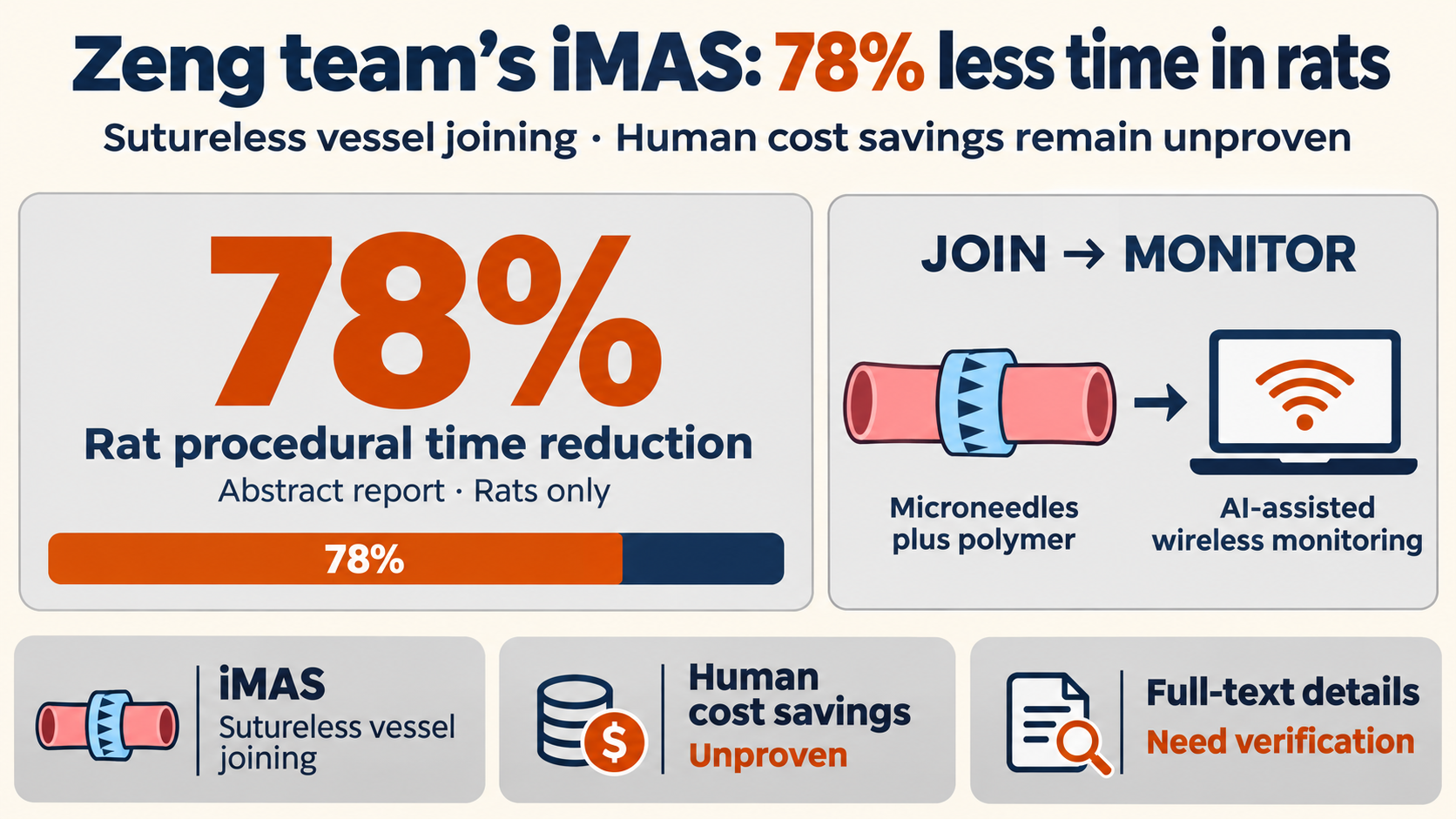
Wen Zeng, a professor at Army Medical University in China, and first-listed author Fangchao Xue are among the researchers behind iMAS, a sutureless vessel-joining system. Its public abstract reports a 78% reduction in procedural time in rats. Does that mean surgery costs fall by 78%? No. Saving minutes on one step and saving money for a hospital are separated by a long chain of conditions. Source: Science 초록 재수록 Source: Wen Zeng
Anastomosis means joining vessel ends so blood can flow again. With small vessels, this requires precise handling. Completing the connection is only part of the job: clinicians must also know whether circulation remains intact during recovery. The time spent making the join and the time taken to notice trouble are different problems. Source: SUNY Upstate 임상 설명
The people behind the work
Zeng’s researcher profile identifies him as a professor at Third Military Medical University, also known as Army Medical University. Xue, Shanlan Zhao, Hao Tian and Malcolm Xing appear with him in the new author list. The accessible record does not establish their individual experimental responsibilities or the current paper’s corresponding-author designations. Source: 연구자 프로필 Source: Science 저자 목록 재수록
Their earlier work gives the collaboration a clearer history. A 2024 Nature Communications paper studied a hydrogel suture that combined cardiac monitoring with drug delivery. A hydrogel is a water-rich polymer material. That paper credits Zeng and Xing with conceptualization and supervision, Xue and Zhao with methodology and writing, and Tian with methodology and investigation. Those credits belong to the 2024 study. Source: 2024 선행 논문
The recurring question is what a repair material can tell us after it has been implanted. The authors described this interest in their own account of the earlier project. That history makes it useful to evaluate iMAS along two separate axes: how reliably it makes a connection, and how well it reports what happens afterward. Source: 연구진의 선행 연구 해설
How iMAS approaches a wet, moving interface
The abstract describes a hydrophobic polymer combined with tetrahedral microneedles, inspired by root anchoring, plus AI-assisted wireless monitoring. It also reports less neointimal hyperplasia in rats: excessive tissue growth inside the vessel. Source: Science 초록 재수록
The engineering implication is that load-bearing geometry matters alongside adhesive chemistry. Sticking to wet tissue and surviving repeated movement are separate tests. A microneedle design also raises questions about local injury, blood-contacting surfaces and later narrowing. These are evaluation criteria for translation, rather than a claim that the paper has settled each one.
The commercial comparison matters. Synovis MCA’s FLOW COUPLER already combines a joining ring with ultrasound Doppler monitoring. Doppler detects changes in ultrasound signals associated with moving blood. The manufacturer describes an external lead between the probe and monitor. The relevant question for Zeng’s team is therefore what its material and monitoring approach add to an existing category. Source: Synovis FLOW COUPLER
FLOW COUPLER
Mechanical ring
Join
Monitor · Doppler with external lead
iMAS
Microneedles and polymer
Join
Monitor · AI-assisted wireless sensor
The material reviewed here does not establish a head-to-head comparison with that commercial system. A useful purchasing comparison would match vessel type and size, operator experience and follow-up. Beating a suturing benchmark would not by itself establish superiority over every available coupler.
Why 78% cannot be applied to an entire operation
Before converting the reported result into money, the denominator needs attention. The abstract refers to procedural time in rat models. The exact timing boundaries and absolute comparator times were not available for this review. It does not establish a 78% reduction in the duration of a complete human transplant operation. Source: Science 논문 식별 링크 Source: 확인한 초록
Consider an illustrative calculation, not a patient result. Suppose an operation lasts 240 minutes and joining vessels accounts for 30 minutes. Applying a 78% reduction only to those 30 minutes saves 23.4 minutes. Total time becomes 216.6 minutes, a reduction of about 9.8%. This example explains the arithmetic; it does not forecast iMAS performance in humans.
Assume 240 minutes total, with a 78% reduction only in 30 minutes of joining: 240−30×0.78=216.6. Not observed animal or human times. · Axis starts at 200, not zero
The value of saved time depends on the hospital. Christopher Childers and Melinda Maggard-Gibbons estimated average operating-room costs of roughly $36–$37 per minute using California hospital financial data for fiscal 2014, in a 2018 JAMA Surgery study. They also emphasized that much of the cost is difficult to change in the short term. This historical US average is not a current Korean cost estimate. Source: JAMA Surgery 원가 연구
An earlier finish does not automatically reduce depreciation or regular staffing costs. It may matter more if it avoids overtime or creates a usable slot for another operation. That also requires anesthesia staff and recovery capacity. This is where a faster joining technique could improve productivity, subject to operational constraints.
When an early warning on narrowing or rejection can cut recovery costs
The abstract describes predictive identification of stenosis and transplant rejection. Stenosis means narrowing; rejection is an immune response to transplanted tissue. These are different conditions. An abnormal circulation signal does not, by itself, establish its cause. Source: Science 초록 재수록
The practical chain matters more than an isolated accuracy claim. A clinician must receive the alert, assess it, arrange appropriate investigations and act while the graft can still benefit. False alarms can instead add tests and overnight calls. Earlier detection and better patient outcomes require separate evaluation.
-
1
Abnormal signal
Reaches clinicians in time
-
2
Assessment and action
Requires a clinical pathway and staff
-
3
Avoided injury
Demonstrate improved graft salvage
-
4
Net cost evaluation
Subtract the added costs
The accessible abstract does not quantify warning lead time, missed cases or false alarms. Another question is whether performance holds in new subjects and settings. Closely related signals from one subject must not inflate evaluation by appearing across training and test data. These are questions for verification, not findings of a flaw in this particular study.
A market spanning materials, sensors and hospital workflows
If Zeng and colleagues’ approach becomes a product, it would compete beyond sutures. Synovis MCA already offers joining devices and monitors, as well as the disposable FLOW NOW monitoring device used with its monitor platform. That portfolio illustrates an existing consumables-and-equipment business structure. It is not evidence of a commercial relationship with iMAS. Source: Synovis FLOW NOW
One possible business model would combine disposable adhesive components and sensors with reusable receivers and analysis software. This is an industrial inference, not a disclosed iMAS plan. Material suppliers would need consistent manufacturing and performance after sterilization; sensor suppliers would need reliable signals; software suppliers would need alerts that fit clinical work. Successful transmission alone is not a complete service.
For a hospital, the decision is whether avoidable time costs and expected complication costs exceed additional equipment, training, monitoring and response costs. Expected complication savings must include the change in event probability. Counting the full cost of a rare complication as a saving on every procedure would exaggerate the business case.
Substitution would likely be selective. A device might replace some suturing or coupler use in well-defined cases if reliability and economics are demonstrated. Surgeons would still need skills to rescue failed connections. The reviewed sources do not establish an iMAS price, licensing deal, funding round or demonstrated human benefit. They provide no basis for naming a listed company as a financial beneficiary.
What Korean adoption would have to demonstrate
Transplantation and microsurgical reconstruction are plausible areas to investigate in Korea. Reconstruction can involve moving tissue to repair a defect and reconnecting its small vessels. Zeng’s animal results cannot simply be extended to every transplant operation: vessel type, size and condition determine the device’s task.
KONOS reports 3,096 deaths while awaiting transplantation in 2024. Donor scarcity is a separate constraint from surgical equipment. Faster joining cannot directly eliminate a waiting list. A Korean evaluation should define eligible operations and compare total procedure time, reoperation, length of stay and incremental device costs. Source: KONOS
Trauma evacuation and military use are more distant scenarios. Motion, communications failures, storage and sterile handling would require their own evaluation. Wireless operation does not automatically establish suitability outside a hospital. Reliable performance in a controlled clinical environment would come first.
The question iMAS raises is compelling: can a joining device save time while helping clinicians notice problems during recovery? The economic answer will require more than adhesive strength or an AI label. It will depend on usable time gained, grafts actually rescued and the added resources needed to achieve both.
Source scope, as of November 14, 2026: the Science findings were checked through a reproduced PubMed abstract. The publisher’s full text, supplementary information and supplied news report could not be retrieved. Sample size, follow-up, detailed AI metrics and individual 2026 author contributions remain unverified. The cost illustration and business models above are analysis, not outcomes established by the paper. This article is not investment advice regarding any company or security, nor medical guidance.
The economic case depends on usable time gained, better recovery and the resources needed to deliver both.
Sources and further reading
- Xue et al., Science (2026), DOI: 10.1126/science.aed8712
- Science 논문 초록·저자 목록 재수록 (PubMed PMID 43019420)
- Xue et al., Nature Communications 15, 864 (2024)
- Wen Zeng — 연구자 본인 프로필
- Zeng·Xing·Xue·Zhao·Tian, Behind the Paper (2024-01-31)
- Synovis MCA — FLOW COUPLER Device and System
- Synovis MCA — FLOW NOW Device
- Childers·Maggard-Gibbons, Understanding Costs of Care in the Operating Room (2018)
- 국립장기조직혈액관리원 — 장기·조직기증의 필요성
- SUNY Upstate — A device to connect veins (2020)
For information only — this is not a recommendation to buy or sell any asset.
Comments 0