PEM electrolysis catalyst: what a claimed 6.8-fold degradation difference means for hydrogen costs
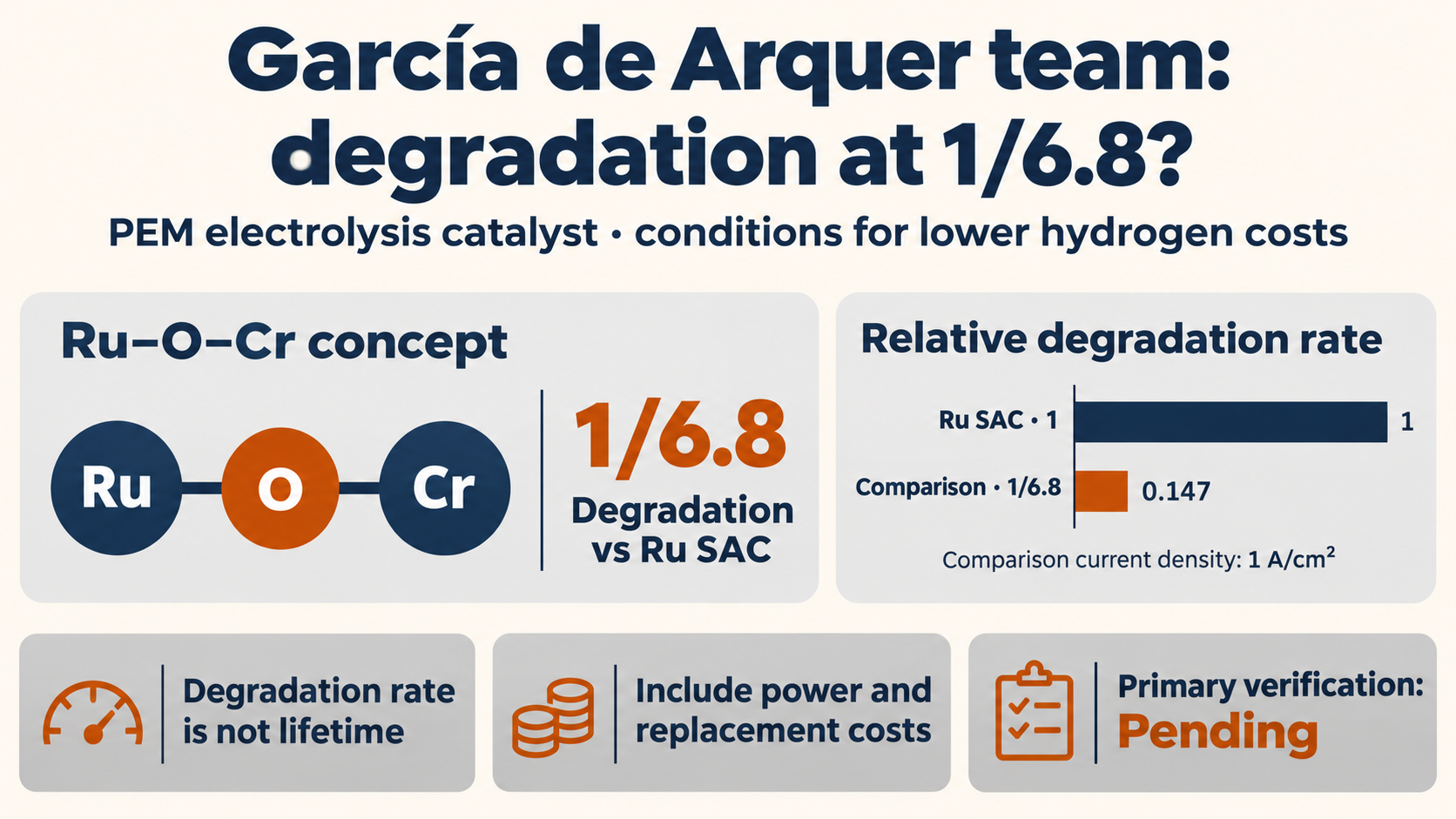
Slower degradation in a PEM electrolysis catalyst could reduce hydrogen production costs. But the claimed 6.8-fold difference associated with F. Pelayo García de Arquer’s group at ICFO in Spain cannot be translated into a hydrogen price reduction. Costs depend on fewer replacements and sustained output for the electricity consumed. Source: Nature Materials · 원문 확인 대상
The Ru−O−Cr design and the 6.8- and 14.4-fold comparisons discussed here remain claims from a paper summary. We could not check the Nature Materials abstract, figures or author contributions directly. The discussion below therefore treats those claims conditionally and separates them from industry evidence verified with DOE and IEA.
The people behind the work: why ICFO is pursuing lower precious-metal use
García de Arquer’s ICFO group has worked on catalysts for energy conversion. In 2024, it reported a cobalt-based PEM electrolysis approach in Science. Reducing dependence on scarce metals is a continuing research question, although that cobalt catalyst and the present ruthenium–chromium design are distinct approaches. Source: ICFO · 2024년 선행 연구
Bibliographic leads identify T. Chen, K. Wang and Lu Xia as participating authors. First-author and corresponding-author designations, along with responsibility for synthesis, measurements and calculations, remain unverified. The lab’s earlier work does not establish individual roles in this study. The question is whether fewer metal atoms can sustain performance without dissolving during operation. Source: Nature Materials · 저자 정보 확인 대상
Why the oxygen electrode matters in PEM electrolysis
PEM stands for proton exchange membrane. Electricity splits water, producing hydrogen at one electrode and oxygen at the other. The membrane conducts protons and helps separate the gases. The new study targets the oxygen-producing anode. Deterioration there can increase the voltage needed to maintain hydrogen output.
A single-atom catalyst disperses ruthenium (Ru) atom by atom to use the metal efficiently. The proposed distinction is to change its atomic neighbors as well as its loading. The summary describes a Ru−O−Cr structure in which nearby chromium (Cr), connected through oxygen, moderates excessive ruthenium oxidation. Oxidation and reduction involve losing and gaining electrons; the proposal couples these changes between the metals. Source: Nature Materials · 설계 검증 대상
-
1
Oxygen evolution
Oxidizing conditions at the anode
-
2
Ru−O−Cr
Coupled redox changes
-
3
Ru stabilization goal
Limit overoxidation and dissolution
If verified in the paper and subsequent experiments, the approach would connect reaction activity with resistance to metal dissolution. The available material does not establish whether chromium is consumed or how reversibly its oxidation state changes. DOE likewise specifies that reducing precious-metal loading must not compromise performance or durability. Source: DOE · PEM 기술 목표
What is needed to turn a degradation ratio into a lifetime claim
The unverified comparison puts the new catalyst’s degradation rate at 1/6.8 of a Ru single-atom control and 1/14.4 of commercial RuO₂ at 1 A/cm². Current density is current per electrode area. It helps describe reaction throughput per area, but does not establish plant-scale performance or operating life. Source: Nature Materials · 비교 수치 검증 대상
At 1 A/cm²; lower is better. Ratios from the paper summary, awaiting primary verification; not lifetime or cost multiples.
Degradation rate describes how quickly performance worsens. The chart normalizes the summary’s claimed ratios to new catalyst = 1 and awaits verification. It contains neither measured absolute rates nor uncertainty ranges. A claimed comparison against commercial RuO₂ cannot establish superiority over commercial iridium catalysts.
Estimating replacement intervals requires test duration, absolute degradation rates and an end-of-life criterion. A membrane or support may fail before the catalyst. DOE requires considering starts, stops and dynamic operation where the application calls for them. Procurement would therefore need evidence under actual operating conditions, beyond a constant-current comparison. Source: DOE · 내구성 평가 조건
Why a cheaper catalyst may leave hydrogen costs unchanged
If the Ru−O−Cr approach scales, there are three potential cost effects: less precious metal in the initial equipment, fewer replacements and outages, and better preservation of electrical efficiency. Whether all three benefits occur together remains to be demonstrated.
-
1
Metal loading
Initial material cost
-
2
Replacement and outages
Maintenance and saleable output
-
3
Voltage stability
Electricity cost during operation
The relevant metric is levelized cost of hydrogen, or LCOH: discounted lifetime costs divided by discounted lifetime hydrogen output. It differs from LCOE, the cost metric for electricity generation. A cheaper catalyst can coexist with expensive hydrogen if electricity is costly or equipment sits idle.
Consider an illustrative system consuming 50 kWh per kilogram of hydrogen. At KRW 100/kWh, electricity alone costs KRW 5,000/kg. At 80 it costs 4,000; at 120 it costs 6,000. These are assumptions, not this catalyst’s measured efficiency or an observed Korean electricity tariff.
Assumes 50 kWh/kg. Not measured catalyst performance, actual tariffs or total hydrogen cost.
Replacement economics follow the same logic. Cheaper electrode material does not eliminate labor, inspection or downtime. Better stability could save more than material cost if it also prevents outages. Ruthenium loading, manufacturing yield, quality-control costs and recoverable metal value all belong in the calculation.
Electricity prices and utilization also depend on renewable generation and storage. Lower generation costs and longer power availability could help electrolysis, but storage adds losses and capital expense. Related reading covers perovskite solar-cell efficiency and manufacturing costs and tin flow-battery storage economics.
New materials need committed customers
Hydrogen producers need customers as well as better materials. IEA’s 2026 review reports that global installed electrolysis capacity doubled in 2025 to exceed 4 GW. Its discussion of China describes surplus capacity, consolidation and a decline in new final investment decisions for production projects in 2025. Global installation growth and conditions facing Chinese suppliers are different measures. Source: IEA · Global Hydrogen Review 2026
Existing refining and industrial uses still dominate hydrogen demand in the same report. Our inference is that replacing the production route for existing users may be a nearer opportunity than entirely new uses. Low-emissions ammonia and synthetic fuels could benefit later, but infrastructure and willingness to pay a premium remain necessary. These are industry inferences, not experimental findings. Source: IEA · 수요와 투자 조건
Catalyst and membrane-electrode assembly suppliers could gain opportunities in material supply or process licensing. The assembly combines the membrane and catalyst electrodes. No licensing deal, adopting manufacturer or order volume for this Ru−O−Cr research has been verified. Opportunity is not revenue, and ruthenium remains a precious metal with its own supply constraints.
Performance guarantees Korean equipment buyers should examine
In January 2022, the Korean government announced a 10 MW-class electrolysis demonstration initiative. This is historical evidence of policy direction, not proof of present completion or achieved performance. Applying this approach to Korean equipment would require translating laboratory comparisons into verifiable large-stack contract terms. Source: 산업통상자원부 · 2022년 실증 발표
Buyers can ask for guaranteed electricity consumption, responsibility for replacement after performance loss and limits under variable renewable power. Material suppliers should demonstrate uniform electrode production, batch consistency and the effects of dissolved metals on membranes and water treatment. These are commercialization checks, not defects established in the study.
The useful test of this research claim is how long less metal can sustain the same performance. Verified experimental conditions and reproduction in larger equipment are needed before calculating savings from fewer replacements or outages. For now, the relevant calculation combines electricity, utilization and replacement costs; the 6.8-fold claim is not a price forecast.
Catalyst economics depend on how long useful performance can be sustained.
Sources and further reading
For information only — this is not a recommendation to buy or sell any asset.
Comments 0