Tohoku earthquake: 14 years of seafloor observations and the cost of preparedness
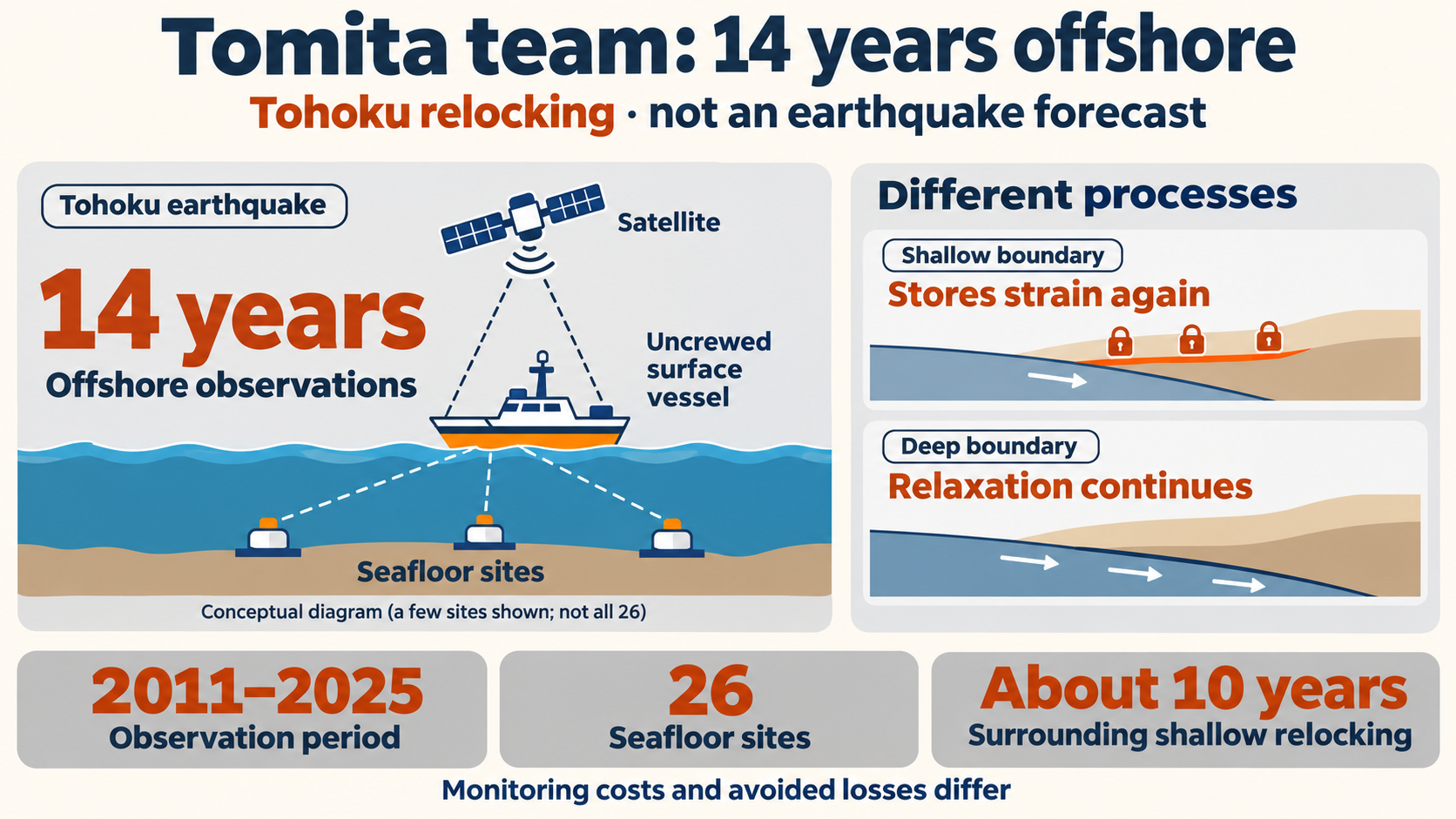
Tohoku University researcher Fumiaki Tomita and colleagues report that shallow plate locking has returned to roughly its pre-earthquake state. Their Science study, published on November 5, 2026, follows 14 years after the Tohoku earthquake. It informs preparedness, without providing a date for the next earthquake. Source: Tohoku University — 2026-11-06 research announcement
It is tempting to treat a recent giant earthquake as the start of a long safe interval. Continued ground movement alone cannot establish that risk is dissipating. That distinction matters when weighing monitoring budgets and the cost of business interruption.
The people behind the work
Tomita, at Tohoku’s International Research Institute of Disaster Science, is the corresponding author. Collaborators include Motoyuki Kido, JAMSTEC’s Takeshi Iinuma and the University of Tokyo’s Naoki Uchida, alongside Canadian researchers. The public announcement does not specify each author’s detailed analytical contribution. Source: Tohoku University — 2026-11-06 research announcement
Instrumentation was part of Tomita’s scientific problem. His 2021 paper demonstrated Wave Glider positioning with accuracy and precision comparable to earlier research-vessel observations. It also described how expensive ship time constrained observation frequency. Operating costs were limiting the continuity of science. Source: Tomita et al. (2021), GNSS-Acoustic Observations Using a Wave Glider
What seafloor geodesy adds after the Tohoku earthquake
Seafloor geodesy tracks changes in the positions of seabed markers. GNSS-A combines satellite positioning at the surface with acoustic travel times to underwater instruments. Repeated measurements reveal displacement. Source: JAMSTEC (2020-09-30): autonomous seafloor observations
Tomita’s team combined 26 offshore sites with land observations and repeating-earthquake information in a numerical model. Measurements above the offshore source help distinguish processes that are difficult to separate from land alone. Source: Tohoku University, JAMSTEC, ERI — detailed release, 2026-11-05
-
1
Surface position
Satellite positioning
-
2
Seabed ranging
Acoustic travel time
-
3
Repeat surveys and model
Separate deformation processes
The advance is not simply another sensor detecting shaking. It is the ability to distinguish long-running deformation processes and infer the boundary’s condition. Conditions between instruments and at depth remain model-dependent; this is not a direct image of every patch of fault.
Relocking is a condition, not a countdown
Locking means friction holds the plate boundary while continued plate motion stores deformation. Post-earthquake slow slip can release deformation, while deeper rock also deforms gradually as stress relaxes. The latter process is called viscoelastic relaxation. Source: Tohoku University — 2026-11-06 research announcement
The detailed release distinguishes early renewed loading across much of the major rupture from surrounding shallow areas that relocked over about a decade as afterslip largely ended around 2021. Deeper creep and relaxation persist. Relocking was not simultaneous everywhere. Source: Tohoku University, JAMSTEC, ERI — detailed release, 2026-11-05
Inferred condition
Renewed strain accumulation
Shallow interface
At depth · Relaxation and creep persist
Separate assessment needed
No date or annual probability
Timing
Economic loss · Asset and contract models needed
These findings do not yield next year’s probability or the next event’s magnitude. A fault capable of accumulating strain is not necessarily close to rupture. Locking alone does not determine the total stored stress or the conditions that will initiate failure.
An average recurrence interval is not a safety warranty. The institutional release cites roughly 500–900 years. The 2025 magnitude 8.8 Kamchatka event recorded by USGS is a reminder to examine other subduction-zone histories, but its timing cannot be transferred to Japan. Source: USGS — 29 July 2025 Mw 8.8 Kamchatka earthquake
The first economic effect is less dependence on ship time
A 2020 JAMSTEC announcement involving Iinuma, Hino and Kido offers an operational benchmark: an autonomous vehicle visited 14 sites in about 40 days, with cost per observation potentially one-tenth or less of traditional methods. This is a historical method comparison, not a 90% saving on the entire Science project. Source: JAMSTEC (2020-09-30): autonomous seafloor observations
Indexed from JAMSTEC’s 2020 “one-tenth or less” statement. 10 is an upper bound, not total project cost.
The industrial implications are conditional. Fewer crewed survey days could support more frequent sampling within the same budget. Opportunities could extend from instruments to remote operations, acoustic-sensor servicing, positioning software and validated data services.
Total cost still includes deployment, recovery, replacements, communications and data gaps caused by bad weather. Ships retain installation and maintenance roles. The likely substitution concerns particular repetitive survey tasks, rather than the research-vessel industry as a whole.
A credible investment case needs contracted demand, sustained accuracy and lower total cost per usable observation. Disaster losses are not a market-size estimate. Tomita’s scientific result does not establish revenue growth or share-price gains for any vendor.
For Korean companies, interruption can start abroad
The first Korean industrial connection is component dependence. A 2016 Federal Reserve analysis describes Japanese manufacturing output falling about 15% in March 2011 and recovering by August, with shocks transmitted abroad through intermediate inputs. This is historical evidence, not an estimate of current Korean losses. Source: Federal Reserve (2016-05-02): supply-chain transmission of the Tohoku shock
The Korean application is an inference outside the paper. A manufacturer using material qualified from only one Japanese factory could lose output despite an intact domestic plant. Comparing single and dual sourcing requires qualification time, inventory costs and delayed-delivery losses as well as purchase prices.
Better observations do not automatically prevent these losses. Information must change sourcing or recovery decisions. The World Bank’s review of the disaster emphasizes business continuity planning: preparing to sustain and restore essential operations. Source: World Bank (2021-03-11): a decade of lessons from the Great East Japan Earthquake
Coastal facilities and nuclear plants need separate assessment. Relocking off Japan’s Pacific coast alone does not establish a higher tsunami height or nuclear risk at a specific Korean site. Local bathymetry, wave propagation and facility protection must be evaluated. Supply-chain exposure and direct physical hazard are different budget questions.
What could change insurance and prevention budgets?
Tomita’s result can inform an insurer’s scientific review, but it is not a pricing formula. Loss models also depend on asset concentration, vulnerability and policy terms. Reinsurance, which shares insurers’ large losses, depends on these conditions too.
Swiss Re’s 2025 report models a repeat of the Great East Japan event under then-current exposure and insurance conditions: roughly $300 billion in economic losses and $80 billion insured. The gap shows that insurance would not cover everything. These are neither actual 2011 losses nor a forecast for the next earthquake. Source: Swiss Re Institute, sigma 1/2025 — Japan earthquake scenarios
Swiss Re sigma 1/2025. Insured loss is a subset, not additive. Not a forecast or actual 2011 loss.
Swiss Re’s 2026 discussion likewise considers adaptation and insurance together: expanding exposed assets can outpace improvements in resilience. Monitoring earns its value by informing what to strengthen and which losses to retain, not by stopping earthquakes. Source: Swiss Re Institute, sigma 1/2026 — adaptation and insurance
Prevention appraisal should compare the same time horizon and assets: the present value of monitoring, operations and interventions against the expected loss those decisions can avoid. Counting the entire disaster loss as a monitoring benefit would be wrong. Much damage cannot be avoided through measurement alone; other reductions require effective warnings, evacuation or engineering.
The verified material does not quantify this network’s net benefit to Korea or an insurance premium change. Research-cost savings and avoided disaster losses must be evaluated separately. The practical aim is preparation that remains worthwhile across multiple recurrence scenarios. These industrial implications are not an investment recommendation.
Tomita’s team changes how we read the aftermath of a giant earthquake, not the calendar of the next one. The next questions are practical: can observations be sustained, and are institutions ready to act when new evidence changes the assessment?
Source access: the DOI and bibliographic details were checked against the university announcement. The publisher blocked direct access, so the account of this study relies on the detailed institutional release; the full supplementary uncertainty analysis was not independently reviewed. Source: Tohoku University, JAMSTEC, ERI — detailed release, 2026-11-05
Turning evidence of relocking into resilience requires sustained observation and practical preparation.
Sources and further reading
- Science (2026): Seafloor geodesy delineates fast megathrust relocking after the giant 2011 Tohoku earthquake
- Tohoku University — 2026-11-06 research announcement
- Tohoku University, JAMSTEC, ERI — detailed release, 2026-11-05
- Tomita et al. (2021), GNSS-Acoustic Observations Using a Wave Glider
- JAMSTEC (2020-09-30): autonomous seafloor observations
- Federal Reserve (2016-05-02): supply-chain transmission of the Tohoku shock
- Swiss Re Institute, sigma 1/2025 — Japan earthquake scenarios
- USGS — 29 July 2025 Mw 8.8 Kamchatka earthquake
- World Bank (2021-03-11): a decade of lessons from the Great East Japan Earthquake
- Swiss Re Institute, sigma 1/2026 — adaptation and insurance
For information only — this is not a recommendation to buy or sell any asset.
Comments 0