Solid-state battery electrolyte film: what 28 μm could mean for cost
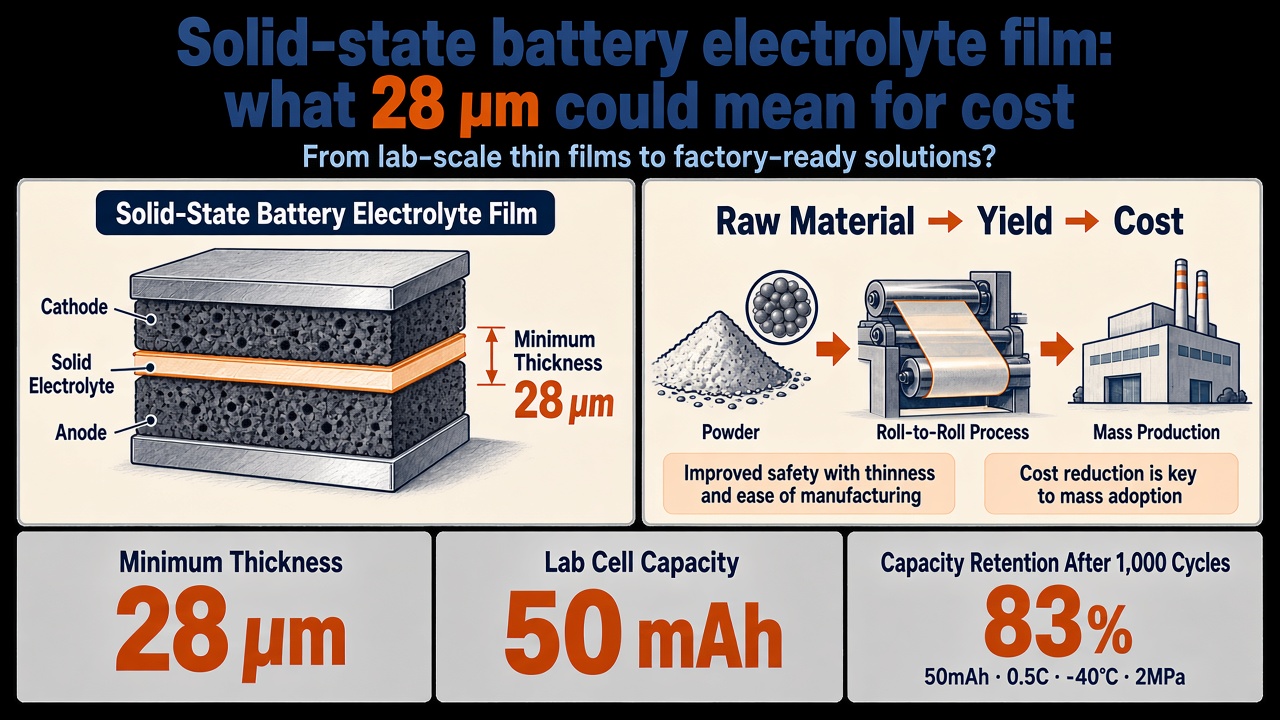
A new solid-state battery electrolyte film study reports a minimum thickness of 28 μm. Published online by Nature Communications on September 10, it raises a practical question: can a promising material become a film that factories can make reliably? That connection between material performance and manufacturing cost is the story here. Source
A torn film consumes material without producing something a customer can use. Making the layer thicker can make handling easier, but it also leaves less room for energy-storing material inside a fixed battery volume. Thinness matters only if the film survives production.
This is not a demonstration of a production-ready electric-car battery. The discussion separates experimental evidence, independently documented industry developments, and conditional economic analysis.
Why does solid-state battery electrolyte film thickness matter?
An electrolyte lets lithium ions move inside a battery. An ion is an electrically charged atom. During charging and discharge, ions travel between the electrodes while electrons flow through the external circuit. An all-solid-state battery uses solid material for this internal ion pathway.
For the same material and area, a thinner layer shortens the path and reduces its resistance to ion transport. The electrolyte is not the main energy-storing ingredient, so using less of it can also free space for active material. These are engineering opportunities, rather than a measured increase in vehicle range.
Continuity matters just as much. Defects can undermine performance and reliability. The useful engineering target is therefore a combination: low thickness, good ion transport and enough mechanical integrity for manufacturing.
The manufacturing step is the innovation
Turning electrolyte powder into a sheet requires a binder, a polymer that holds particles together. The researchers use α-pinene in a quasi-dry process to improve PTFE binder distribution, flexibility and densification. Source
Wet processing spreads material from a liquid mixture and then removes the liquid. Dry processing seeks to reduce or avoid that liquid burden. Here, an additive assists shaping, so “quasi-dry” should not be read as completely liquid-free. Source
Wet
Coat a liquid dispersion
Forming
Cost question · Liquid removal and recovery
Additive-assisted quasi-dry
Additive-assisted distribution and shaping
Forming
Cost question · Heating, pressing and usable yield
The broader manufacturing lesson is straightforward. Holding particles together and allowing ions through are two requirements that must work together. A good chemical composition is only part of the answer; mixing and shaping determine how much of its promise survives in a finished component.
The same distinction appears in other industries. Our article on screen-printed perovskite solar cells also explores the connection between laboratory performance and a practical manufacturing route. Related: screen-printed perovskite solar cells
Read the conditions behind the 1,000-cycle result
The paper gives a minimum thickness of 28 μm and a maximum demonstrated area of 30 × 10 cm²; these should not automatically be treated as one specimen. A 50 mAh single-layer LTO/NCM93 pouch cell retained 83% capacity after 1,000 cycles at 0.5 C, 40°C and 2 MPa. Source
Milliamp-hours measure charge capacity; 50 mAh equals 0.05 Ah. A 0.5 C rate uses a current equal to half the designated reference capacity per hour. The pressure keeps the cell compressed. None of this establishes the same lifetime in a large vehicle cell operating across ordinary driving conditions.
Scale introduces additional questions. Can pressure remain uniform over a larger area? Do defects accumulate as layers are added? Customers buy a battery with predictable quality, not an electrolyte film’s best individual result.
Where could the cost savings come from?
The following is economic inference. First, thinner films could reduce electrolyte consumption per unit area, assuming comparable composition and density. That would not reduce the entire battery price in the same proportion: electrodes, current collectors and assembly remain separate costs.
Second comes yield: the share of production that becomes saleable output. If films tear less often and have more consistent thickness, the same material and working time could produce more usable sheets. That benefit could matter more than the saving in material per sheet.
For illustration only, hold input cost constant and raise yield from 80% to 90%. Input cost per usable unit falls by about 11.1%, calculated as 1 minus 80 divided by 90. These are hypothetical yields, not measurements reported by the researchers or CATL.
-
1
Stable shaping
Assume fewer tears and less variation
-
2
More usable output
More saleable output per input
-
3
Include extra costs
Additive, heat, pressing, inspection
-
4
Commercial value
Verify pack cost and reliability
Third are equipment and processing time. Less liquid removal could help, but the reported method still includes treatment at 120°C for 20 minutes and pouch-cell pressing at 370 MPa. Manufacturing pressure is distinct from the 2 MPa used during cycling. Source
A cost comparison should include additive purchase and handling, heat treatment, pressing equipment and inspection, all divided by usable output. Faster film formation does not guarantee faster factory output if another step becomes the bottleneck.
The market is growing, but the competition is getting cheaper
The IEA’s Global EV Outlook 2026 reports 1.2 TWh of EV battery deployment in 2025. Average battery prices fell 8%, while lithium iron phosphate, or LFP, exceeded 55% of EV battery deployment. A growing market creates opportunity, but established products also set a demanding cost benchmark. Source
All-solid-state and LFP describe different things: electrolyte form and cathode chemistry. The commercial comparison is between a particular solid-state design and established mass-produced LFP-based products. The solid-state label alone does not establish a cost advantage.
There is concrete industrial investment. On January 29, 2026, Idemitsu announced its final investment decision and construction start for a large solid-electrolyte pilot facility. Commercialization with Toyota in 2027–2028 is a company target. This is not an announcement that either company has adopted the paper’s process. Source
The paper also lists CATL researchers and funding. That indicates industrial research involvement, but participation is different from product adoption. It does not provide a basis for forecasting company revenue. Source
Equipment opportunities may arrive before mass-market cars
One possible entry route is through customers who place a high value on weight and space, such as premium vehicles or constrained devices. That is a hypothesis about willingness to pay, not proof that the tested cell is suitable for those uses.
Equipment demand could come earlier: consistent additive mixing, thickness-controlled rolling and defect inspection. For Korean material and equipment suppliers, customer qualification and repeat orders would be more informative than a broad association with solid-state batteries.
Replacement would probably be selective. Adoption in suitable products could reduce demand for some liquid-processing steps while creating spending on pressing, inspection and environmental control. Cost reduction can therefore redistribute equipment spending as well as reduce it.
Our article on self-driving laboratories provides another perspective on research becoming productive work. Faster discovery and faster manufacturing affect different costs, but both need to fit a real workflow to create economic value. Related: self-driving laboratories and research productivity
The next useful number is production yield
The next evidence to look for is continuous production length and speed, defect rates and durability in larger multilayer cells. Pack performance should include the weight and cost of any pressure-maintaining hardware. Those measurements connect an improved film to what a buyer actually pays.
The work addresses the conversion of a promising powder into a usable thin film. Its industrial value will depend on reproducible output at scale. A route toward lower cost is worth investigating; the saving itself still needs to be measured in production.
Sources were checked as of September 16, 2026. The paper is a peer-reviewed article in press and may receive final editorial changes. Industry scenarios and the yield example are analysis, not investment recommendations.
The value of a thin film must be verified in usable factory output and battery pack cost.
Sources and further reading
For information only — this is not a recommendation to buy or sell any asset.
Comments 0