국제유가 100달러 — 한국 경제에 오는 다섯 번의 청구서Oil Near $100 — Five Bills Coming Due for South Korea
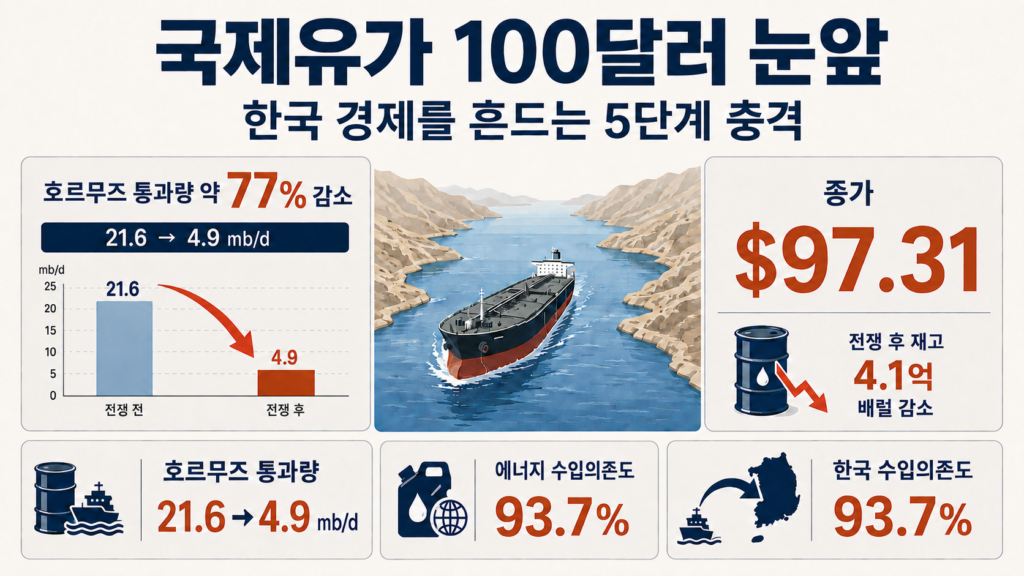
국제유가 100달러가 다시 눈앞에 왔습니다. 2026년 9월 7일 브렌트유는 배럴당 97.31달러에 마감했고, 장중에는 98.06달러까지 올랐습니다. 한국에서는 주유소 가격만 볼 일이 아닙니다. 수입대금, 원화, 기업 마진, 소비, 금리와 증시가 차례로 영향을 받습니다.
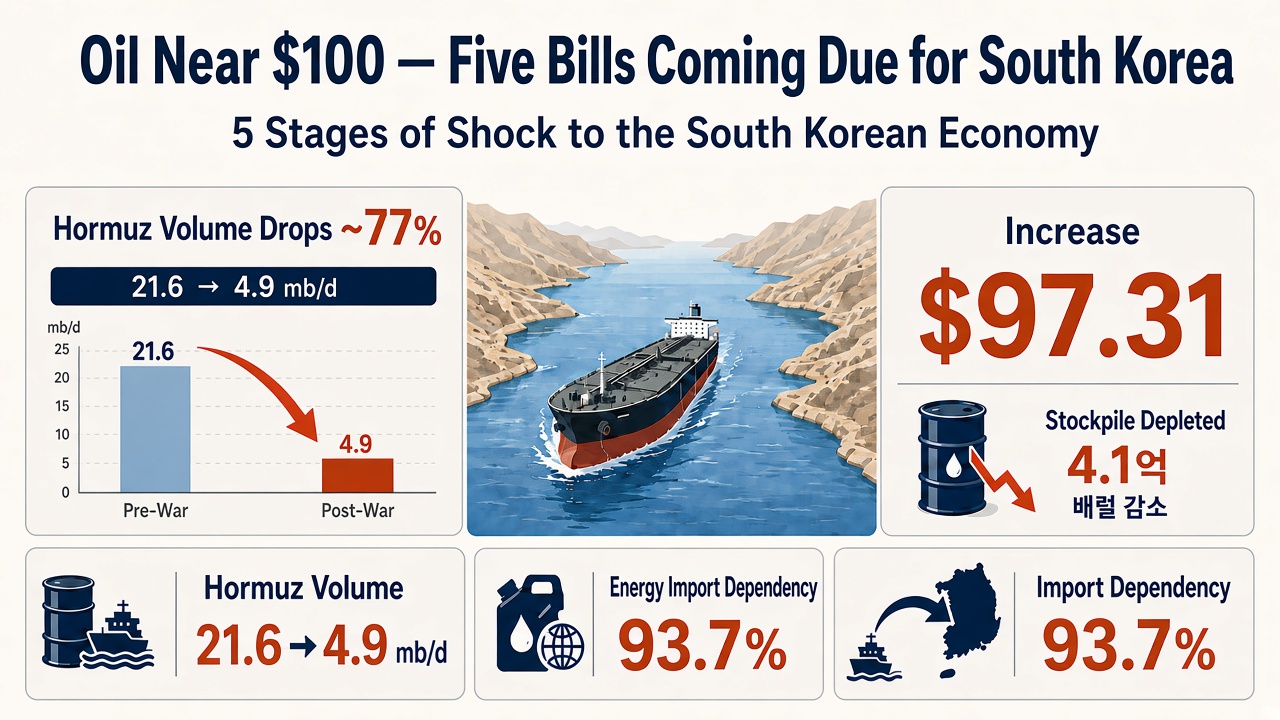
Oil at $100 is back within sight. Brent settled at $97.31 a barrel on September 7, 2026, after touching $98.06 intraday. For South Korea, this is not merely a gasoline story. The shock can travel through the import bill, the won, company margins, household spending, interest rates, and equities.
이번 상승은 단순한 공포 거래와 다릅니다. 실제 원유 이동량이 줄었고, 생산시설은 멈췄으며, 재고도 빠르게 소진되고 있습니다. 그 청구서를 하나씩 뜯어 봅니다.
먼저 선을 하나 긋겠습니다. 97.31달러는 확인된 시장 가격입니다. 반면 유가가 곧 100달러를 넘을지, 어느 기업 주가가 오를지는 전망입니다. 공식 통계와 제 해석은 구분해 두었습니다.
국제유가 100달러, 왜 이번에는 무게가 다른가
유가는 오늘 필요한 석유와 오늘 공급할 수 있는 석유의 차이에 민감합니다. 배 한 척이 공격받았다는 뉴스 자체보다, 그 뉴스 때문에 유조선이 멈추고 산유국이 저장할 곳을 잃어 생산을 줄이는지가 더 중요합니다.
미국 에너지정보청(EIA)은 호르무즈 해협의 원유·석유액체 통과량이 2025년 4분기 하루 2,160만 배럴에서 2026년 2분기 490만 배럴로 줄었다고 추정했습니다. 약 77% 감소입니다. 이 해협은 걸프 지역 석유가 아시아로 나오는 좁은 문입니다.
여기에 재고가 줄었습니다. 국제에너지기구(IEA)에 따르면 7월 세계 관측 석유 재고는 6,900만 배럴 감소했습니다. 전쟁이 시작된 뒤 누적 감소량은 4억1,000만 배럴입니다. 창고가 넉넉할 때는 공급 차질을 버틸 수 있지만, 창고가 비면 작은 사고에도 가격이 크게 움직입니다.
-
1
항로 차질
호르무즈 통과량 급감
-
2
생산 중단
저장·수출이 막혀 감산
-
3
재고 감소
전쟁 후 4.1억 배럴 감소
-
4
가격·마진 상승
원유와 연료가 함께 압박
원유 부족만 보면 절반밖에 안 보입니다
원유는 그대로 자동차나 비행기에 넣을 수 없습니다. 정유공장에서 휘발유, 경유, 항공유로 바꿔야 합니다. 이때 원유 가격과 완제품 가격의 차이를 정제마진이라고 부릅니다. 정제설비가 부족하거나 제품 수송이 막히면 원유가 조금 내려도 경유와 항공유는 비쌀 수 있습니다.
IEA는 7월 세계 정제 처리량이 1년 전보다 하루 약 500만 배럴 적었다고 집계했습니다. 러시아·중동·아시아의 경유 수출 감소분은 하루 130만 배럴로, 세계 해상 경유 교역의 약 20%에 해당합니다. 그래서 이번 충격은 ‘원유 가격’과 ‘쓸 수 있는 연료 가격’이 따로 움직일 수 있습니다.
World Bank 자료도 같은 방향을 가리킵니다. 8월 원유 가격은 5.7% 올랐지만 에너지 가격지수는 8.8%, 천연가스는 10.1% 상승했습니다. 하나의 병목이 전력과 운송, 비료 같은 여러 원가로 번지고 있다는 뜻입니다.
한국에는 어떻게 들어오나: 다섯 번의 가격 전달
한국은 에너지의 93.7%를 수입에 의존합니다. 1차 에너지에서 석유가 차지하는 비중도 37.6%입니다. 원유 도입처를 미주와 아시아로 넓혔지만, 2023년 기준 중동 비중은 71.9%였습니다. 공급 다변화는 충격을 줄여 주지만 없애 주지는 못합니다.
전달 순서는 비교적 분명합니다. 정유사가 달러로 원유를 삽니다. 수입액이 늘면 무역수지 개선 폭이 줄 수 있습니다. 달러 수요가 커지면 원화에 약세 압력이 생깁니다. 원화가 약해지면 같은 97달러짜리 원유도 원화로는 더 비싸집니다. 유가와 환율이 서로 밀어 올리는 구간입니다.
-
1
원유 수입액
달러 지출 증가
-
2
무역수지·원화
원화 약세 압력
-
3
기업 원가
연료·물류·원료 상승
-
4
소비자물가
시차를 두고 전가
-
5
소비·금리·증시
내수 둔화·할인율 상승
그다음은 기업입니다. 운송비와 포장재, 플라스틱 원료, 전기·가스 비용이 올라갑니다. 기업은 처음에는 이익을 줄여 버팁니다. 충격이 길어지면 제품 가격을 올립니다. 마지막에는 가계가 기름값과 생활비를 더 내고 다른 소비를 줄이게 됩니다.
이전 글에서 설명한 원/달러 환율의 작동 방식을 함께 보면 수입물가가 왜 두 번 움직이는지 이해하기 쉽습니다. 국내 증시의 변동성 경로는 코스피 변동성 해설과도 연결됩니다.
누가 벌고, 누가 비용을 떠안나
정유사는 무조건 수혜라는 말부터 조심해야 합니다. 유가가 빠르게 오르면 보유 재고의 평가가치가 높아질 수 있고, 경유·항공유 부족으로 정제마진이 커지면 이익에 도움이 됩니다. 하지만 원유 조달이 끊기거나 정부의 가격 안정 조치가 강해지면 좋은 구간은 짧아질 수 있습니다.
석유화학은 상황이 다릅니다. 나프타 같은 원료 가격은 오르는데 중국발 공급과 약한 최종 수요 때문에 제품 가격을 충분히 올리지 못하면 마진이 줄어듭니다. 같은 ‘기름 회사’처럼 보여도 정유와 화학의 손익은 반대로 움직일 수 있습니다.
항공·해운·육상운송은 연료비가 핵심입니다. 유류할증료를 올릴 수 있는 회사는 일부 비용을 고객에게 넘길 수 있습니다. 계약 운임이 고정됐거나 경쟁이 심한 회사는 먼저 이익이 줄어듭니다. 자동차·타이어·포장·음식료도 물류비와 원재료비를 통해 늦게 영향을 받습니다.
상대적 방어 가능
재고이익·정제마진 가능
정유
효율 설비 · 절감 투자 수요
비용 압박 우선
나프타 원가 상승
석유화학
항공·운송 · 연료비 상승
내수 소비 · 가계 여유자금 감소
기업 투자는 더 천천히 반응합니다. 유가가 며칠 오르는 정도라면 설비투자 계획은 바뀌지 않습니다. 그러나 높은 가격과 환율이 한두 분기 이어지면 현금흐름이 약한 기업부터 증설을 미루고 재고를 줄입니다. 에너지 효율 설비, 선박 연료 절감, 전력망과 저장장치 투자는 오히려 앞당겨질 수 있습니다.
소비·물가·금리에는 시차가 있습니다
한국은행은 2026년 소비자물가 상승률을 2.7%로 전망하면서 고유가가 비석유 공업제품과 서비스 가격으로 번질 수 있다고 설명했습니다. 중동 협상이 장기 교착되면 물가가 기본 전망보다 올해 0.3%포인트, 내년 0.5%포인트 높아질 수 있다는 시나리오도 제시했습니다.
여기서 중요한 단어는 ‘시차’입니다. 국제유가가 오늘 올라도 주유소 재고, 장기 도입계약, 세금과 공공요금 조정 때문에 소비자 가격은 한꺼번에 바뀌지 않습니다. 반대로 국제유가가 내려도 이미 오른 운송비와 외식비가 바로 원상복귀하지는 않습니다.
가계에는 사실상 보이지 않는 세금처럼 작용합니다. 출퇴근과 난방에 더 쓴 돈만큼 외식, 의류, 여가 소비가 줄어듭니다. 소비가 약해지면 내수 기업 매출에는 악재입니다. 그런데 물가는 높아져 중앙은행이 금리를 낮추기도 어려워집니다. 성장에는 약하고 물가에는 강한, 정책당국이 가장 다루기 불편한 충격입니다.
증시가 유가 뉴스에 흔들리는 두 가지 이유
주식 가격은 앞으로 벌 이익과 그 이익의 현재가치를 함께 반영합니다. 고유가는 비용을 올려 예상 이익을 낮춥니다. 동시에 물가 우려로 시장금리가 오르면 미래 이익을 현재 가치로 바꿀 때 적용하는 할인율도 높아집니다. 성장주의 주가가 유가 뉴스에 민감해질 수 있는 이유입니다.
원화 약세는 수출기업의 원화 매출을 키울 수 있습니다. 하지만 원료와 장비를 달러로 사는 기업에는 비용입니다. 따라서 ‘환율 상승은 수출주 호재’라고 한 문장으로 끝내면 틀릴 수 있습니다. 매출 통화, 원재료 통화, 가격 전가력, 환헤지를 함께 봐야 합니다.
확인된 사실은 브렌트유가 97달러대이고 재고가 줄었다는 점입니다. 여기서 정유주가 오른다거나 항공주가 내린다는 말은 시장의 예상일 뿐입니다. 이미 주가에 반영됐을 수도 있고, 휴전이나 정책 조치 한 번에 방향이 바뀔 수 있습니다. 이 글은 매수·매도 권유가 아닙니다.
유가가 진짜 꺾였는지 확인할 네 가지
EIA는 호르무즈 통행이 9월부터 서서히 회복된다는 가정 아래 브렌트유가 2026년 4분기 평균 78달러, 2027년 평균 69달러로 낮아질 것으로 전망했습니다. 꽤 낙관적인 숫자처럼 보입니다. 다만 핵심은 가격표가 아니라 앞에 붙은 가정입니다.
- 호르무즈와 바브엘만데브의 실제 유조선 통과량이 회복되는지
- 걸프 지역의 중단된 생산이 다시 시작되는지
- 세계 석유 재고가 감소를 멈추고 쌓이는지
- 경유·항공유 정제마진과 해상 운임이 정상화되는지
휴전 발표만으로는 부족합니다. 배가 움직이고, 유전이 다시 돌고, 창고가 채워져야 합니다. 이 네 숫자가 함께 좋아질 때 유가 하락을 공급 정상화로 볼 수 있습니다.
100달러보다 중요한 네 가지 숫자
배럴당 100달러는 눈에 잘 들어오는 기준선입니다. 하지만 한국 경제에는 호르무즈 통과량, 세계 재고, 정제마진, 원/달러 환율이 더 중요합니다. 이 숫자들이 동시에 나빠지면 기업의 비용과 가계의 생활비가 함께 오르고, 금리 인하 여지도 줄어듭니다.
제 판단으로는 이번 국면의 핵심은 ‘얼마나 높이 오르나’보다 ‘얼마나 오래 머무나’입니다. 며칠짜리 100달러보다 두 분기 동안 이어지는 90달러대 유가가 기업 투자와 소비에는 더 아플 수 있습니다.
출처와 참고 링크
- Reuters, 2026년 9월 7일 국제유가 보도
- IEA, 2026년 8월 Oil Market Report 및 9월 2일 해상 병목 모니터
- EIA, 2026년 8월 Short-Term Energy Outlook
- World Bank, 2026년 9월 Commodity Markets
- 한국은행, 2026년 5월 경제전망
- 한국에너지공단·에너지경제연구원 에너지 통계
100달러라는 선보다 더 중요한 것은 높은 유가가 머무는 시간입니다.
출처
- Reuters — Oil prices rise to six-week highs, September 7, 2026
- IEA — Middle East Maritime Chokepoints Shipping Monitor
- IEA — Oil Market Report, August 2026
- EIA — Short-Term Energy Outlook: Global oil markets
- EIA — Short-Term Energy Outlook, August 2026
- World Bank — Commodity Markets, September 2026
- Bank of Korea — Korea Economic Outlook, May 2026
- Korea Energy Agency — National energy statistics
- Korea Energy Agency and KEEI — Crude sourcing and refining statistics
- KEEI — Energy Supply and Demand Trends, August 2026
- IMF — Managing Director statement after the G20 meeting
This move is more than a fear premium. Physical oil flows have fallen, production has been shut in, and inventories are being depleted. This article separates what is known from what remains a forecast.
Why oil near $100 carries more weight this time
Oil prices respond to the gap between barrels needed today and barrels available today. A tanker attack matters mainly when it stops shipping, deprives producers of storage, and forces wells to shut.
The U.S. Energy Information Administration estimates that crude oil and petroleum-liquid flows through the Strait of Hormuz fell from 21.6 million barrels per day in the fourth quarter of 2025 to 4.9 million in the second quarter of 2026. That is a drop of roughly 77%.
Inventories are also thinner. The International Energy Agency says observed global oil stocks fell by 69 million barrels in July and by 410 million barrels since the war began. A full warehouse absorbs disruption. An emptying one makes prices react sharply to the next incident.
-
1
Shipping disruption
Hormuz flows plunge
-
2
Production shut-ins
No outlet for barrels
-
3
Inventory draw
410m barrels since war
-
4
Prices and margins
Crude and fuels tighten
Crude scarcity is only half the story
Crude cannot be poured directly into a car or aircraft. Refineries turn it into gasoline, diesel, and jet fuel. The gap between crude costs and product prices is the refining margin. When refineries or product shipping are constrained, fuel can remain expensive even if crude eases.
The IEA says July refinery throughput was almost 5 million barrels per day below a year earlier. Diesel exports from Russia, the Middle East, and Asia were down 1.3 million barrels per day, about 20% of global seaborne diesel trade.
The World Bank’s September update points in the same direction: crude rose 5.7% in August, while its energy index climbed 8.8% and natural gas rose 10.1%. One bottleneck is spreading into transport, power, and fertilizer costs.
How the shock reaches South Korea
South Korea imports 93.7% of its energy, and oil supplies 37.6% of primary energy. Diversification toward the Americas and Asia helps, but the Middle East still supplied 71.9% of crude imports in 2023.
The transmission chain is straightforward. Refiners buy crude in dollars. A larger import bill can narrow the trade surplus and add pressure on the won. A weaker won then makes the same $97 barrel more expensive in local currency. Oil and the exchange rate can reinforce each other.
-
1
Import bill
More dollar spending
-
2
Trade and won
Depreciation pressure
-
3
Business costs
Fuel, freight, inputs
-
4
Consumer prices
Pass-through with lag
-
5
Spending, rates, stocks
Weaker demand, higher rates
Companies initially absorb higher freight, packaging, feedstock, power, and gas costs through lower margins. If the shock persists, they raise prices. Households then spend more on fuel and essentials and less elsewhere.
Our earlier explainers on the won-dollar exchange rate and KOSPI volatility provide more detail on those two channels.
Winners, losers, and important exceptions
Refiners are not automatic winners. A rapid oil rise may generate inventory gains, and scarce diesel or jet fuel can widen refining margins. Yet interrupted crude supply or stronger price controls can shorten that favorable window.
Petrochemicals face a different equation. If naphtha feedstock costs rise while oversupply and weak demand prevent product-price increases, margins shrink. Refining and chemicals can therefore move in opposite directions even inside the same company.
Airlines, shipping, trucking, packaging, and food producers are exposed through fuel or logistics. Firms with fuel surcharges and pricing power can pass on part of the increase. Those locked into fixed-price contracts absorb it first.
Potential buffers
Inventory gains, wider cracks
Refining
Efficiency · Demand for savings
Cost pressure first
Higher naphtha cost
Petrochemicals
Airlines and transport · Higher fuel expense
Domestic demand · Less discretionary income
Investment responds more slowly. A brief spike rarely cancels a factory. If oil and the exchange rate stay high for two quarters, cash-constrained companies may postpone expansion and cut inventories. Spending on energy efficiency, grid equipment, storage, and fuel-saving ships may accelerate instead.
Consumption, inflation, and rates move with a lag
The Bank of Korea forecasts 2026 headline inflation at 2.7% and says the oil shock can spread into non-petroleum goods and services. Its prolonged-conflict scenario adds 0.3 percentage point to 2026 inflation and 0.5 point in 2027 versus the baseline.
The key word is lag. Retail inventories, supply contracts, taxes, and regulated tariffs prevent an instant pass-through. The reverse is also true: restaurant prices and freight charges may not fall promptly after crude does.
For households, expensive energy behaves like an invisible tax. Money spent commuting or heating cannot be spent on restaurants, clothes, or leisure. Growth weakens while inflation stays firm, making rate cuts harder.
Equities price both earnings and discount rates
Higher oil lowers expected earnings for cost-sensitive firms. It can also push bond yields higher through inflation fears, raising the discount rate used to value future profits. That second channel explains why long-duration growth stocks can react to oil headlines.
A weaker won may lift exporters’ translated revenue, but it raises costs for companies buying inputs and equipment in dollars. Investors need to examine revenue currency, input currency, pricing power, and hedges rather than assuming every exporter benefits.
The verified facts are that Brent is in the high $90s and inventories have fallen. A rally in refiners or a decline in airlines is a market inference, not a fact. Prices may already reflect it, and diplomacy can reverse the trade quickly. This is not investment advice.
Four signals that would confirm a real turn
The EIA forecasts Brent at an average $78 in the fourth quarter of 2026 and $69 in 2027, conditional on Hormuz traffic recovering gradually from September. The condition matters more than the target.
- Actual tanker traffic through Hormuz and Bab el-Mandeb
- Restart of shut-in Gulf production
- A turn from global inventory draws to builds
- Normalization in diesel and jet-fuel margins and shipping rates
A ceasefire headline is not enough. Ships must move, wells must restart, and storage tanks must refill before a price decline can be called supply normalization.
The number that matters more than $100
The $100 line is memorable, but duration matters more. A few days above $100 may hurt less than two quarters in the $90s. For Korea, the important dashboard is tanker traffic, inventories, refining margins, and the won—not one round number.
Sources and further reading
- Reuters, September 7, 2026 oil-market report
- IEA Oil Market Report and maritime chokepoint monitor
- EIA Short-Term Energy Outlook, August 2026
- World Bank Commodity Markets, September 2026
- Bank of Korea Economic Outlook, May 2026
- Korea Energy Agency and KEEI statistics
Duration matters more than the round $100 line.
Sources
- Reuters — Oil prices rise to six-week highs, September 7, 2026
- IEA — Middle East Maritime Chokepoints Shipping Monitor
- IEA — Oil Market Report, August 2026
- EIA — Short-Term Energy Outlook: Global oil markets
- EIA — Short-Term Energy Outlook, August 2026
- World Bank — Commodity Markets, September 2026
- Bank of Korea — Korea Economic Outlook, May 2026
- Korea Energy Agency — National energy statistics
- Korea Energy Agency and KEEI — Crude sourcing and refining statistics
- KEEI — Energy Supply and Demand Trends, August 2026
- IMF — Managing Director statement after the G20 meeting
이 글은 정보 제공 목적이며, 특정 자산의 매수·매도를 권유하지 않습니다.
For information only — this is not a recommendation to buy or sell any asset.
댓글Comments 0