중국 수출 25% 급증 — 1,191억달러 흑자가 한국 기업을 압박하는 이유China Export Growth Hits 25% — How a $119 Billion Surplus Pressures Korean Industry
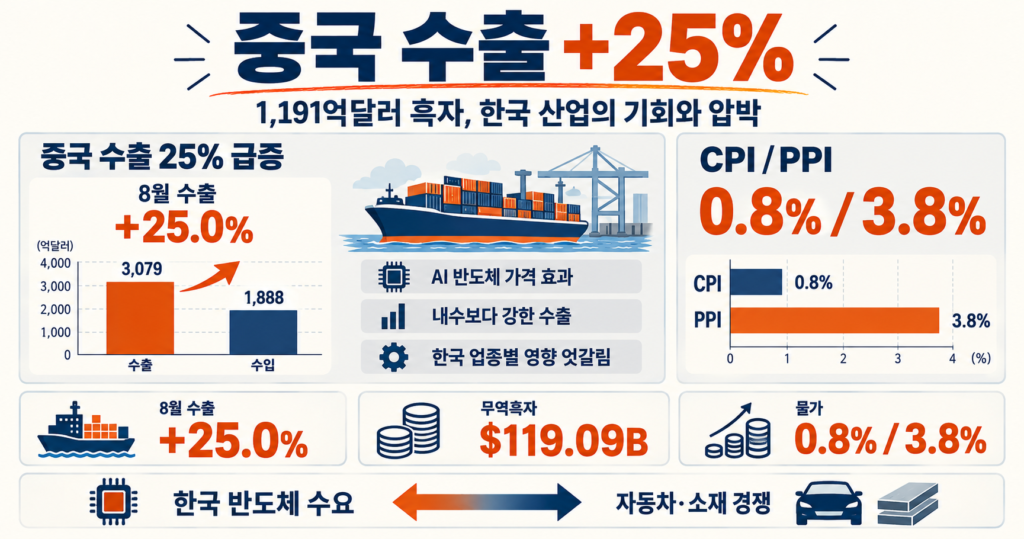
중국 수출 25% 급증이 다시 세계 시장의 가격표를 바꾸고 있습니다. 중국의 2026년 8월 수출은 전년 동월보다 25.0% 늘었고, 무역흑자는 1,190억9천만달러로 커졌습니다. 한국에는 반도체 수요가 늘어날 기회이면서 자동차·철강·화학 제품의 가격 경쟁이 더 거세질 수 있다는 경고입니다.
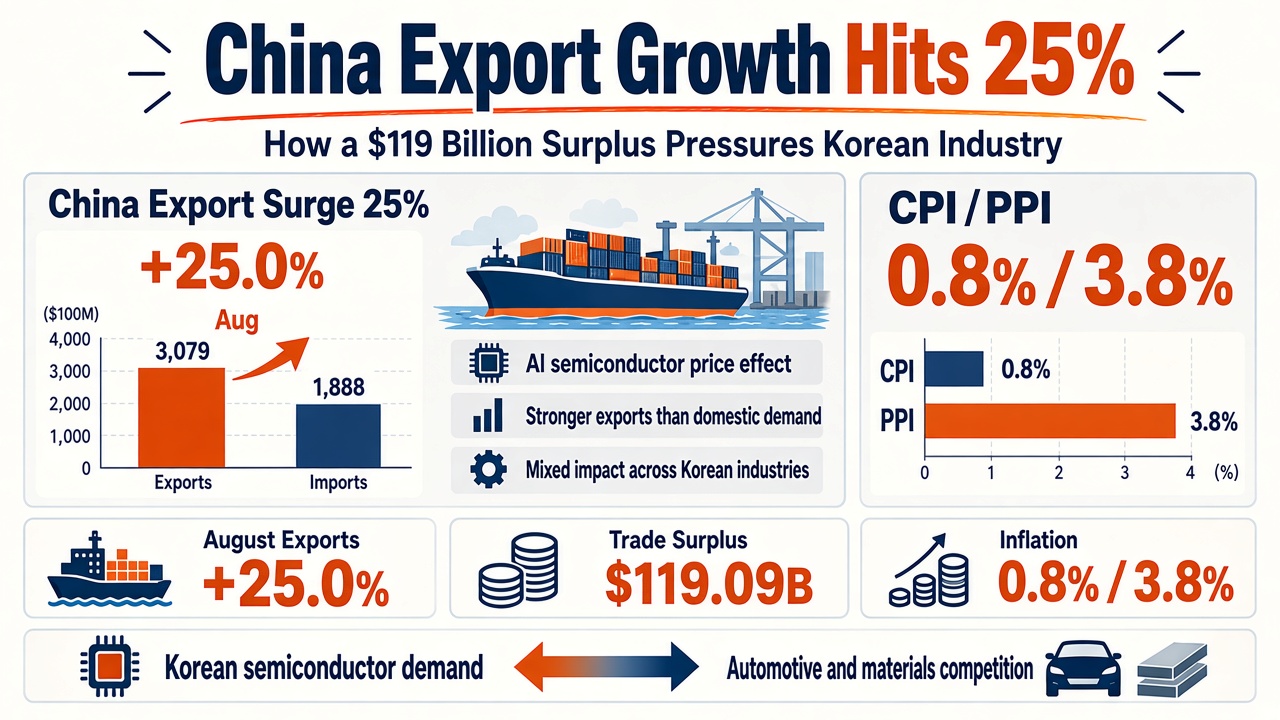
China export growth is changing global price competition again. Exports rose 25.0% year on year in August 2026 and the trade surplus widened to $119.09 billion. For Korea, that is both an opportunity for semiconductor demand and a warning that competition in autos, steel and chemicals may intensify.
숫자만 보면 중국 내수가 살아난 듯합니다. 수입도 28.2% 늘었기 때문입니다. 그런데 다음 날 나온 소비자물가는 0.8% 상승에 그쳤고, 식품 가격은 1.4% 내렸습니다. 공장과 무역은 뜨거운데 가계의 장바구니는 아직 미지근합니다.
이 글은 확인된 통계와 앞으로의 가능성을 구분합니다. 특정 종목의 매수·매도를 권하는 글은 아닙니다.
중국 수출 25% 급증, 무엇이 팔렸나
중국 해관 자료를 달러로 보면 8월 수출은 약 4,014억달러, 수입은 약 2,824억달러였습니다. 수입 증가율이 더 높아도 수출의 출발 금액이 훨씬 크기 때문에 흑자는 전월 1,125억달러에서 1,190억9천만달러로 늘었습니다. 월급과 지출이 모두 늘었지만 월급의 절대 증가액이 더 컸다고 생각하면 쉽습니다.
1~8월 위안화 기준 상품 교역액은 34조7,800억위안으로 17.6% 증가했습니다. 수출은 20조1,700억위안, 수입은 14조6,100억위안이었습니다. 한 달의 우연이라기보다 올해 누적된 흐름에 가깝습니다. 품목을 열어 보면 성격이 더 뚜렷합니다. 자동차 수출액은 43% 늘었고 집적회로 수출액은 129.8% 뛰었습니다. 다만 집적회로는 수출 물량이 8% 줄었다는 Caixin 분석이 함께 나왔습니다. 수출액 130% 증가를 전부 생산량 증가나 기술력 향상으로 읽으면 안 됩니다. AI용 칩 부족과 가격 상승이 매출액을 크게 부풀린 부분이 있습니다.
중국 8월 수출 25%와 수입 28.2% 증가 비교. 달러 기준. 무역흑자 1,190.9억달러. · 축이 0이 아니라 23에서 시작합니다
미국 관세가 막았는데, 왜 중국 수출은 더 늘었나
가장 눈에 띄는 변화는 판매처입니다. 8월 중국의 동남아 수출은 30.2%, 중남미는 17.5%, EU는 6.6% 늘었습니다. 미국 한 곳의 문턱이 높아지자 기업들은 판매처와 조립 거점을 넓혔습니다. 관세는 교역을 없애기보다 경로를 돌아가게 만들 때가 많습니다.
팔리는 물건도 달라졌습니다. 저가 소비재만 늘어난 것이 아닙니다. 자동차, 반도체, 컴퓨터 장비처럼 단가가 높은 제품이 앞에 섰습니다. 중국 제조업이 세계의 조립공장에서 설계·자동화·전기차까지 올라온 결과가 숫자에 섞여 있습니다.
거기에 내수가 받쳐 주지 못합니다. 부동산 침체와 약한 사회안전망은 가계가 돈을 쓰기보다 저축하게 만듭니다. 기업 입장에서는 국내에서 다 팔기 어려운 생산량을 해외에서 소화해야 합니다. IMF가 중국에 산업지원 일부를 줄이고 사회지출과 소비를 늘리라고 권한 이유입니다.
-
1
부동산 침체·높은 저축
가계 소비가 약함
-
2
산업지원·설비투자
생산능력 확대
-
3
AI·자동차 수출
해외에서 물량 소화
-
4
대규모 무역흑자
무역마찰 위험 확대
CPI 0.8%와 PPI 3.8%, 두 물가가 말하는 것
소비자물가지수(CPI)는 가계가 사는 상품과 서비스 가격을 봅니다. 생산자물가지수(PPI)는 공장에서 출고되는 제품 가격을 봅니다. 8월 중국 CPI는 0.8% 올랐지만 PPI는 3.8% 상승했습니다. 생산재 가격은 5.0% 오른 반면 생활재 가격은 0.5% 내렸습니다.
이 간극은 원자재와 수출 제조업에서 비용과 가격이 오르지만, 기업이 그 부담을 중국 소비자에게 모두 넘기지는 못한다는 뜻으로 읽힙니다. 가계 수요가 강하면 판매가격을 올리기 쉽습니다. 수요가 약하면 기업이 마진을 줄이거나 해외 판매를 늘리게 됩니다.
소비자물가 CPI +0.8%
가계가 사는 가격
·
· · 식품 -1.4%
· · 내수는 아직 온건
생산자물가 PPI +3.8%
공장 출고 가격
·
· · 생산재 +5.0%
· · 원자재·수출 가격 압력
여기까지는 확인된 사실입니다. 이 흐름이 오래 이어질지는 전망의 영역입니다. 에너지 가격이 안정되고 부동산이 회복되면 소비가 따라올 수 있습니다. 반대로 내수가 약한 채 생산만 늘면 값싼 수출품이 세계 시장에 더 많이 나오고 무역분쟁도 커질 수 있습니다.
한국 반도체에는 수요와 경쟁이 동시에 옵니다
중국 AI 서버 생산이 늘면 한국 메모리에 기회가 열립니다. 한국이 강한 고대역폭메모리(HBM)와 고성능 메모리 수요가 커질 수 있기 때문입니다. HBM은 AI 연산장치 옆에서 대량의 데이터를 빠르게 주고받는 메모리입니다. 중국의 수입 증가가 장비와 부품 조달을 포함한다면 한국 수출기업 매출에도 도움이 됩니다.
하지만 집적회로 수출액 129.8% 증가는 중국이 완제품뿐 아니라 반도체 자체에서도 더 큰 판매자가 되고 있음을 보여 줍니다. 지금은 가격 효과가 크고 최첨단 제품의 기술 격차도 남아 있습니다.
그렇다고 경쟁 압력을 가볍게 볼 수는 없습니다. 범용 메모리, 전력반도체, 자동차용 칩에서 중국 공급이 늘면 한국 업체의 판매가격과 시장점유율을 누를 수 있습니다.
그래서 다음 실적 발표에서는 중국 매출 증가만 볼 일이 아닙니다. 판매량, 평균판매가격, 재고, 중국 업체의 생산능력을 같이 봐야 합니다. AI 투자와 고용의 엇갈림을 다룬 이전 글처럼, 매출 증가가 국내 고용과 투자로 얼마나 번지는지도 따로 확인해야 합니다.
자동차·철강·화학은 제3국에서 더 세게 부딪힙니다
한국 자동차 기업이 중국 현지에서만 경쟁하는 시대는 지났습니다. 중국 자동차 수출이 43% 늘면 동남아, 중남미, 유럽에서 같은 고객을 놓고 맞붙습니다. 중국 업체가 가격을 낮추면 한국 기업은 할인으로 대응하거나 배터리 효율, 서비스망, 브랜드로 차이를 만들어야 합니다. 어느 쪽이든 마케팅비와 보증비용이 늘 수 있습니다.
철강과 석유화학은 더 직접적입니다. 중국 내 건설과 소비가 충분히 회복되지 않으면 남는 생산량이 해외로 나옵니다. 수출 단가가 낮아질수록 한국 업체의 제품 가격도 눌립니다. 원료 가격이 오르는 동시에 판매가격이 내려가면 이익률은 양쪽에서 압박받습니다.
해운에는 물동량 증가가 도움이 될 수 있습니다. 그러나 관세와 반덤핑 조사가 늘면 항로가 바뀌고 비용도 커집니다. 유가와 한국 기업 비용에서 살펴본 연료 부담까지 겹치면, 운임 상승이 곧바로 순이익 증가로 이어진다고 단정하기 어렵습니다.
수요 기회
HBM·고성능 메모리
·
· · AI 전력·장비
· · 해운 물동량
경쟁 압력
자동차 제3국 경쟁
·
· · 철강·화학 판매가격
· · 범용 반도체 공급
물건값은 싸지고 월급은 불안해진다
중국산 제품의 공급 확대는 한국 소비자에게 싼 상품을 제공해 생활물가를 낮출 수 있습니다. 반면 국내 제조업의 판매와 고용이 약해지면 소득을 통해 소비를 누릅니다. 물건값에는 호재지만 월급에는 악재가 될 수 있는, 불편한 조합입니다.
기업투자는 업종별로 갈립니다. AI 메모리와 전력장비는 주문이 이어질 수 있지만, 공급과잉이 예상되는 범용 소재는 새 공장 계획을 늦출 가능성이 있습니다. 은행도 수출 증가율보다 차주의 재고와 현금흐름을 더 꼼꼼히 볼 것입니다.
환율은 한 방향으로 단정하기 어렵습니다. 중국 교역 호조가 아시아 수출 경기 개선으로 읽히면 원화에 도움이 될 수 있습니다. 반대로 무역마찰과 위안화 약세 우려가 커지면 원화도 함께 흔들릴 수 있습니다.
증시에서는 중국 매출 비중만으로 수혜주를 고르기 어렵습니다. 가격 결정력과 재고 관리가 좋은 기업이 더 높은 평가를 받을 가능성이 있습니다.
앞으로 볼 숫자 네 가지
첫째, 수출액과 수출물량을 분리해 봐야 합니다. 반도체처럼 가격이 급등하면 금액만으로 실제 생산을 오해하기 쉽습니다. 둘째, 중국 소매판매와 주택 거래가 회복되는지 확인해야 합니다. 내수가 살아야 수출 의존이 낮아집니다.
셋째, 한국의 대중국 중간재 수출과 대동남아 완제품 수출을 함께 봐야 합니다. 중국 공장에 부품을 파는 이익과 제3국에서 중국 완제품과 경쟁하는 손실이 동시에 생기기 때문입니다. 넷째, EU·미국·신흥국의 관세와 반덤핑 조치를 확인해야 합니다. 1,191억달러 흑자가 커질수록 정책 대응도 빨라질 수 있습니다.
제 판단으로는 중국 수출 25% 급증은 단순한 중국 경기 회복 신호가 아닙니다. AI 가격 상승, 시장 다변화, 약한 내수가 합쳐진 결과입니다. 한국 투자자에게 더 중요한 질문은 ‘중국이 잘 팔았나’가 아니라 ‘우리 기업이 중국에 부품을 파는 쪽인가, 중국과 같은 물건을 파는 쪽인가’입니다. 그 차이가 다음 분기 실적을 가를 가능성이 큽니다.
중국이 잘 팔았다는 사실보다, 우리 기업이 중국에 부품을 파는지 중국과 같은 완제품을 파는지가 더 중요합니다.
출처
- Reuters — China exports surge 25% in August
- China State Council / GAC — January–August goods trade
- Caixin Global — AI prices and chip export volume
- Associated Press — August destinations and products
- China NBS — August 2026 CPI
- China NBS — August 2026 PPI
- IMF — China’s pivot to consumption-led growth
- IMF Working Paper — Industrial policy and global imbalances
- WTO — 2026 global goods trade update
- 내부 글 — AI 투자와 고용의 엇갈림
- 내부 글 — 유가와 한국 기업 비용
Imports also rose 28.2%, which might suggest a broad domestic recovery. Yet consumer inflation was only 0.8%, while food prices fell 1.4%. Factories and trade are hot; the household shopping basket is not.
The statistics below are verified. Statements about future markets and earnings are scenarios, not investment recommendations.
What drove China’s 25% export surge?
In dollar terms, August exports were roughly $401.4 billion and imports about $282.4 billion. Imports grew faster in percentage terms, but exports started from a much larger base. The surplus therefore rose from $112.5 billion in July to $119.09 billion.
In yuan terms, goods trade reached 34.78 trillion yuan in January through August, up 17.6%. Exports were 20.17 trillion yuan and imports 14.61 trillion yuan. This was more than a one-month statistical accident. The product mix is crucial: auto export value rose 43%, while integrated-circuit exports jumped 129.8%. Caixin reported that chip export volume actually fell 8%. The 130% value increase therefore reflects a powerful price effect linked to AI-chip scarcity, not simply more physical output.
Comparison of China’s August export growth of 25% and import growth of 28.2%. Dollar terms. Trade surplus: $119.09B. · Axis starts at 23, not zero
Why did tariffs fail to stop the export machine?
China changed destinations. Exports to Southeast Asia rose 30.2%, Latin America 17.5% and the EU 6.6%. A tariff can redirect trade through new markets and production routes rather than eliminate it.
China also moved toward higher-value products. Autos, semiconductors and computing equipment now sit alongside traditional consumer goods. Years of manufacturing investment have expanded Chinese capabilities in automation, electric vehicles and technology.
Weak domestic demand is the other side of the story. A prolonged property downturn and a limited safety net encourage households to save. Producers then need foreign customers to absorb capacity. That is why the IMF recommends shifting resources from inefficient industrial support toward social protection, property adjustment and consumption.
-
1
Property slump and saving
Weak household demand
-
2
Industrial support and capex
More capacity
-
3
AI and auto exports
Foreign demand absorbs output
-
4
Large trade surplus
More trade friction
CPI at 0.8%, PPI at 3.8%: a two-speed economy
The consumer price index tracks what households buy. The producer price index tracks prices at the factory gate. In August, Chinese CPI rose 0.8%, while PPI increased 3.8%. Producer-goods prices climbed 5.0%, but consumer-goods prices at the factory gate fell 0.5%.
The gap suggests rising costs and prices in raw materials and export manufacturing are not passing evenly to Chinese households. When consumer demand is weak, firms have less pricing power at home. They may accept lower margins or push harder into overseas markets.
Consumer CPI +0.8%
Prices households pay
·
· · Food -1.4%
· · Domestic demand still mild
Producer PPI +3.8%
Factory-gate prices
·
· · Producer goods +5.0%
· · Raw-material and export pressure
Those are the confirmed numbers. Whether this pattern persists is a forecast. Stable energy costs and a property recovery could allow consumption to catch up. If domestic demand remains weak while production expands, more output may be pushed abroad and trade defenses may strengthen.
Korean semiconductors face demand and competition
More Chinese AI-server production can lift Korean memory demand. High-bandwidth memory, or HBM, sits next to AI processors and moves large datasets quickly. If China’s import boom includes equipment and components, Korean suppliers can gain revenue.
But the 129.8% jump in integrated-circuit export value also signals that China is becoming a larger semiconductor seller. The current gain is price-heavy, and technology gaps remain at the frontier.
That does not make the competitive pressure trivial. More Chinese supply in commodity memory, power chips and automotive semiconductors can pressure Korean pricing and market share.
Investors should therefore separate China revenue from shipment volume, average selling prices, inventory and Chinese capacity. As discussed in our analysis of AI investment and jobs, stronger sales do not automatically produce broader employment or investment.
Autos, steel and chemicals meet China in third markets
Korean automakers no longer compete with Chinese brands only inside China. A 43% rise in Chinese auto exports means more direct contests in Southeast Asia, Latin America and Europe. Korean firms may discount or spend more on battery efficiency, service networks and brand differentiation.
Steel and petrochemicals face a more direct risk. If Chinese construction and consumption remain soft, excess production can move abroad. Falling export prices pressure Korean selling prices. When raw-material costs rise at the same time, margins are squeezed from both sides.
Shipping may benefit from higher cargo volumes, but tariffs and anti-dumping cases can reroute trade and raise costs. Add the fuel burden described in our oil-price analysis, and higher freight rates do not automatically translate into higher profit.
Demand opportunity
HBM and advanced memory
·
· · AI power and equipment
· · Shipping volumes
Competitive pressure
Autos in third markets
·
· · Steel and chemical pricing
· · Commodity-chip supply
Cheaper goods, weaker paychecks — the Korean trade-off
More Chinese supply can lower prices for Korean consumers. But if it weakens domestic manufacturing sales and employment, household income suffers. Cheaper goods and weaker paychecks can arrive together.
Capital spending will diverge. AI memory and power equipment may retain orders, while commodity-material producers delay new plants if oversupply persists. Banks will care less about headline export growth than about borrower inventories and cash flow.
The won could move either way. Strong Chinese trade can support Asian export currencies, but escalating trade conflict or yuan depreciation can pull the won lower.
In equities, China exposure alone is a weak screen. Firms with pricing power and disciplined inventory management may command a premium over companies that merely report high China exposure.
Four numbers to watch next
First, separate export value from volume. A price surge can make semiconductor exports look stronger than physical production. Second, watch Chinese retail sales and housing transactions. Domestic recovery is necessary to reduce reliance on exports.
Third, compare Korea’s intermediate-goods exports to China with its finished-goods exports to Southeast Asia. Selling parts into Chinese factories and competing with Chinese finished products can happen simultaneously. Fourth, monitor tariffs and anti-dumping actions. A $119 billion monthly surplus raises the probability of policy responses.
China’s 25% export surge is not a simple recovery signal. It combines AI-related price inflation, market diversification and weak domestic absorption. For Korean investors, the better question is whether a company sells inputs to China’s factories or sells the same finished product against them. That distinction could shape the next earnings cycle.
What matters is not merely that China sold more, but whether a Korean company supplies Chinese factories or competes with their finished products.
Sources
- Reuters — China exports surge 25% in August
- China State Council / GAC — January–August goods trade
- Caixin Global — AI prices and chip export volume
- Associated Press — August destinations and products
- China NBS — August 2026 CPI
- China NBS — August 2026 PPI
- IMF — China’s pivot to consumption-led growth
- IMF Working Paper — Industrial policy and global imbalances
- WTO — 2026 global goods trade update
- 내부 글 — AI 투자와 고용의 엇갈림
- 내부 글 — 유가와 한국 기업 비용
이 글은 정보 제공 목적이며, 특정 자산의 매수·매도를 권유하지 않습니다.
For information only — this is not a recommendation to buy or sell any asset.
댓글Comments 0