Bank of Korea Rate Hike — 2.50% to 2.75%, Won, Rate Gap & Housing (Views 1)

The Bank of Korea rate hike on July 16, 2026 raised the policy rate from 2.50% to 2.75% (+0.25%p). It was the first hike since January 2023—about three and a half years—and the seven Monetary Policy Board members voted unanimously.
The same day, the Seoul USD/KRW fixing at 3:30 p.m. was 1,480.4 (intraday in the 1,470s)—a different zone from early July near 1,560 and the 1,500s. The Korea–US rate gap versus the Fed’s upper bound (3.75%) narrowed from 1.25%p to 1.00%p.
This piece starts with what the policy rate is, then connects FX, mortgages, housing, household debt, and East Asia (China, Japan, energy) only where sourced numbers reach. Further hikes and house prices stay conditional. This is not advice to buy, sell, or convert any currency, bond, property, or stock.
What is the policy rate — and why it touches FX and mortgages
The Bank of Korea’s base rate is the policy interest rate that anchors how the central bank and commercial banks price short-term funds. When that anchor moves, deposit and lending rates customers see tend to follow with a lag.
Home mortgages are the channel households feel most. A large floating-rate share means policy moves can pass into monthly interest faster. Fixed-rate loans still reprice for new borrowers when market rates and bank spreads shift.
FX is messier. A narrower Korea–US gap can ease some “Korea looks worse on carry” pressure—but USD/KRW also moves with the dollar itself (DXY), foreign equity flows, and exporters selling dollars. Rates alone do not set the won.
Policy rate — where it reaches
FlowPolicy rate transmission flow to mortgages and FX. Conceptual only. Lags/weights vary by loan type and flows. Not advice.
Bank of Korea rate hike — what July 16 decided
The BOK cited firmer growth (exports and investment), inflation likely above the 2% target for a while, and financial-stability risks (FX volatility, Seoul-area housing, household debt). The statement said the Board needs to continue a rate-hiking stance.
June 2026 CPI was +3.2% YoY (May +3.1%); core (ex food and energy) held at 2.5%. Growth this year may “substantially exceed” the May forecast of 2.6%, and June exports cleared $100 billion for the first month on record, per the governor’s opening remarks.
Markets had widely priced a July 25bp hike. So this was not an “expected hike vs surprise hold” gap—it was a priced hike that arrived. The open question is how fast to go at the Aug 27, Oct 22, and Nov 26 meetings.
Governor Shin said August remains “all options open” until inflation convincingly converges to target. The Bank also lifted its financial intermediary support facility rate from 1.00% to 1.25%. The official text is the BOK Monetary Policy Decision (July 16, 2026).
2024–2026 path — four cuts, eight holds, then a hike
To place the hike in the cycle, string the prior cuts and holds. From October 2024 through May 2025, four cuts took the rate from 3.50% to 2.50% (−1.00%p total).
- 2024-10-11: 3.50 → 3.25 (cut)
- 2024-11-28: 3.25 → 3.00 (cut)
- 2025-02-25: 3.00 → 2.75 (cut)
- 2025-05-29: 2.75 → 2.50 (cut)
- 2025-07 ~ 2026-05: held at 2.50 (eight holds, ~14 months)
- 2026-07-16: 2.50 → 2.75 (hike)
At the May meeting, 19 of 21 six-month-ahead dots sat above 2.50%—a signal consistent with July’s hike. The bar chart below is that path in numbers only.
Policy rate path — %
BarBOK policy rate path 2024–2026 cuts holds hike bar. BOK decisions/press. Cuts from Oct 2024 → 2.50 May 2025 → eight holds → 2.75 on Jul 16, 2026. Not advice.
Won, Korea–US gap, DXY — numbers that overlapped this week
USD/KRW approached ~1,560 in early July, rose into the 1,500s mid-month (BOK wording), then eased toward the upper 1,400s as supply/demand improved. Around July 8, intraday prints near 1,498 broke below 1,500; the July 16 fixing was 1,480.4.
On July 17 (Constitution Day holiday session), the market printed about 1,478.50 near 3:30 p.m. Thin holiday volume warrants caution, but the latest zone is around 1,480—and below the 1,500s.
The Korea–US gap here is Fed target 3.50–3.75% (held June 17, 2026) using the 3.75% upper bound minus the BOK rate: 1.25%p at 2.50% → 1.00%p at 2.75%. Yonhap frames that as the smallest gap in about three years and four months since March 2023.
DXY scores how strong the dollar is versus a basket of majors. Roughly 100.493 on July 16 (−0.751) and 100.674 on July 17. That day, the BOK hike plus softer US PPI weakened Fed-hike bets—DXY soft and won-firming pressure showed up together. The link is regime-dependent; we do not claim one long-run correlation. For dollar/equity regimes, see also our US market correction & DXY history note.
FX & rate gap — around the hike
CompareEarly–mid July
Jul 16–17 (post-hike)
USD/KRW and Korea–US rate gap before after hike compare. USD/KRW: early Jul ~1,560 → Jul 16 1,480.4 · Jul 17 ~1,478.5. Gap vs Fed 3.75%: 1.25→1.00%p. DXY Jul 16 ~100.5. No single cause claim.
Mortgages, housing, household debt — the domestic channel
The BOK statement flagged Seoul-area house-price gains and faster household-debt growth as financial-stability risks. Household credit (provisional) hit a record 1,993.1 trillion won at end-Q1 2026 (+14 trillion QoQ). Housing-related loans were 1,178.6 trillion (+8.1 trillion).
Bank household loans rose +7.6 trillion in June 2026 (largest in about 22 months); mortgages alone +4.3 trillion (stock ~945 trillion). The governor cited financial-sector household loan growth near 8–9 trillion a month.
Mortgage rates were already climbing. Big-five banks’ new fixed mortgage quotes around July 9 ran about 4.65–7.37% (vs 4.26–7.10% end-May). After the hike, some banks raised floating spreads/ceilings (e.g. KB +0.15%p in press reports).
Korea Real Estate Board (week of July 13): Seoul apartment sales +0.30%, jeonse +0.28%—a 75th straight week up. Hwaseong Dongtan +0.73% that week. KB (week of July 6): Seoul sales +0.22% (second week of slower gains); Dongtan +1.36% (down from 2.27% prior).
On June 30 the government designated Dongtan, Giheung, and Guri as regulated/speculation zones (effective July 1), cut LTV for first-home buyers from 70% to 40%, and largely barred mortgages for owners already holding homes. Land-transaction permits from July 5 add owner-occupancy rules that curb gap investing. The governor said monetary policy alone cannot “fix” house prices—macroprudential tools complement. A hike can constrain demand via interest costs and expectations, but size and lag are not forecastable here.
Household loan flows — ₩ tn
BarHousehold credit bank loans mortgage growth bar. Jun bank HH +₩7.6tn · mortgages +₩4.3tn. Governor: financial-sector ~₩8–9tn/mo. Stock ₩1,993tn & LTV 70→40% in body. Not advice.
East Asia — only facts that touch the won or inflation
China’s Q2 2026 GDP grew +4.3% YoY (Q1 +5.0%), under the 4.5–5% annual target band. Weak domestic demand and property versus strong exports (June exports ~+27% YoY in reports) can affect Korea indirectly via global demand, commodities, and risk appetite. We do not claim China GDP caused the BOK decision.
Japan: the BOJ hiked on June 16, 2026 (press); USD/JPY around 162 near July 16–17; the finance minister warned of “appropriate steps” if needed. Yen moves can spill into KRW via KRW/JPY crosses and Asian FX co-movement.
US–China trade (e.g. the 10% universal tariff sunset around July 24) and Middle East energy appear in the BOK statement. Oil and inflation expectations can feed CPI → the BOK path. That overlaps our oil, Iran, Hormuz piece. Taiwan/North Korea lack direct FX-number quotes in that week’s official BOK/Seoul FX texts, so we do not stretch them here.
What to watch next — August and October as if/then only
If July was priced, the next variable is hike pace. Below is if/then framing—not targets or trade signals. For a Fed wallet frame, see our Fed hold / wallet impact note.
- If CPI stays sticky in the 3%s and household loans keep running hot → the “continue hiking” line and open August option read heavier.
- If growth/exports soften more than expected or markets get volatile → the Board may slow timing/pace (the statement already ties decisions to data checks).
- If DXY strengthens again and foreign equity outflows rise → a narrower rate gap alone may not stabilize the won.
Next meetings — three if/then lanes
FlowBOK further hike conditional scenario flow. Not a forecast or target. Calendar: Aug 27 · Oct 22 · Nov 26. Inputs: CPI, HH loans, growth, DXY, foreign flows. Not advice.
In one line: the meeting’s point is not “did they hike?”—it is that policy is back at 2.75% with a stated hiking stance. FX sits near 1,480 / below 1,500; the gap is 1.00%p; housing and debt move with rates and regulation together. Numbers will keep updating.
Educational/informational only. No recommendations on FX timing, mortgage refinancing, apartment trades, or bond/equity weights.
The hike is one node — won, the US–Korea gap, mortgages and housing each need their own numbers.
Sources
- BOK — Monetary Policy Decision & Opening Remarks (July 16, 2026)
- Yonhap — Full text of BOK July monetary policy statement
- 연합뉴스 — 한은 기준금리 0.25%p 인상(종합)
- 연합뉴스 — 환율 두 달 만에 최저(1,480.4원)
- 연합인포맥스 — 2026-07-17 달러-원 마감
- 조선비즈 — 7월 통화정책방향 의결문
- 연합뉴스 — 가계신용 1,993조
- 연합뉴스 — 6월 은행 가계대출 7.6조↑
- 조선일보 — 한국부동산원 7월 2주
- 뉴시스 — 동탄·기흥·구리 규제
- BBC — China Q2 GDP 4.3%
- FXStreet — Yen intervention warning / USDJPY
- Federal Reserve — FOMC June 17, 2026
- 국가데이터처 — CPI
한국은행 금리 인상 — 2.50→2.75%, 원/달러·한미차·집값까지 (조회수 1)
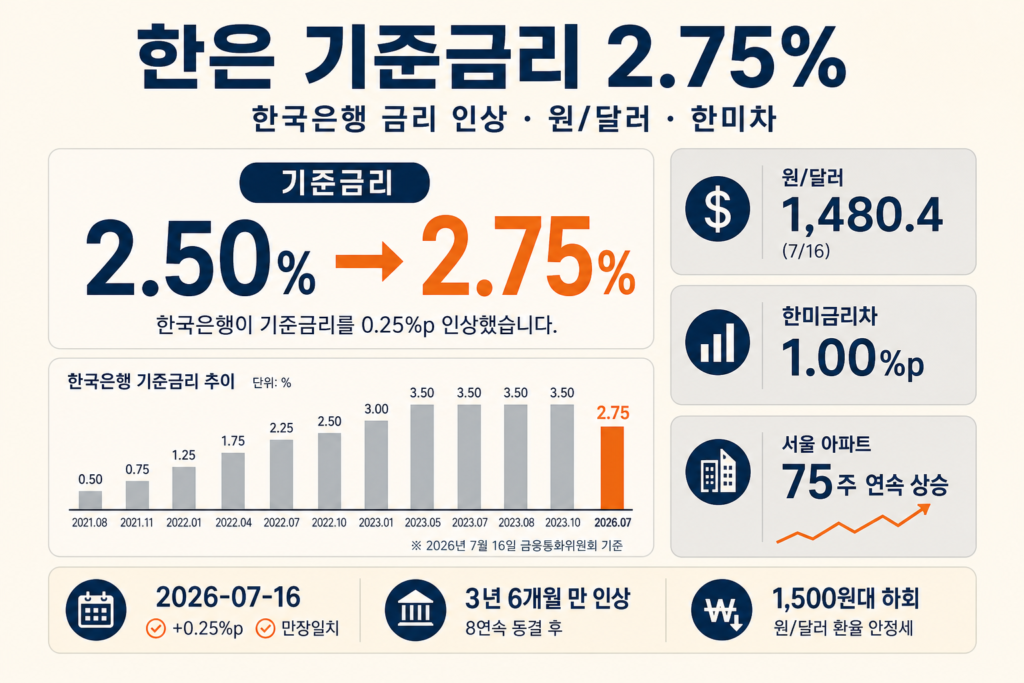
한국은행 금리 인상은 2026년 7월 16일 금융통화위원회에서 기준금리를 연 2.50%에서 2.75%로 0.25%p 올린 결정입니다. 2023년 1월 이후 약 3년 6개월 만의 인상이고, 금통위원 7명 만장일치였습니다.
같은 날 서울 외환시장 원/달러는 오후 3시30분 기준가 1,480.4원(장중 1,470원대)으로, 7월 초 1,560원권·1,500원대와는 다른 구간에 있습니다. 한·미 금리차(연준 상단 3.75% 대비)는 1.25%p에서 1.00%p로 줄었습니다.
이 글에서는 기준금리가 무엇인지부터 풀고, 환율·주담대·집값·가계부채·동아시아(중국·일본·에너지)가 어디에 닿는지만 출처 있는 숫자로 이어 씁니다. 추가 인상 시기나 집값 방향은 조건부로만 적습니다. 특정 통화·채권·부동산·주식의 매수·매도·환전 권유가 아닙니다.
기준금리가 뭔가요 — 왜 환율·주담대에 닿나
기준금리는 한국은행이 시중은행과 돈을 빌리고 빌려줄 때 기준으로 삼는 정책금리입니다. 은행이 자금을 조달하는 비용의 ‘기준점’에 가깝습니다. 그 점이 움직이면, 은행이 고객에게 매기는 예금·대출 금리도 시차를 두고 따라가기 쉽습니다.
주택담보대출(주담대)은 그중에서도 가계가 가장 크게 느끼는 통로입니다. 변동금리 비중이 높으면 기준금리 변화가 이자 부담으로 더 빨리 옮겨갑니다. 고정금리도 시장 금리·가산금리에 따라 새로 빌릴 때의 조건이 달라집니다.
환율 쪽은 조금 다릅니다. 한국 금리가 올라 미국과의 격차가 줄면, ‘한국 자산을 상대적으로 덜 불리하게 보는’ 압력은 생길 수 있습니다. 다만 원/달러는 달러 자체 강약(DXY), 외국인 주식 수급, 수출업체 달러 매도 같은 재료가 한꺼번에 움직입니다. 금리만으로 환율이 정해지지 않습니다.
기준금리 — 어디에 닿나
흐름도기준금리에서 주담대·환율로 이어지는 전가 흐름도. 개념 설명용. 시차·비중은 대출 유형·수급에 따라 다름. 투자·환전 권유 아님.
한국은행 금리 인상 — 7월 16일 결정은 무엇이었나
한은은 성장(수출·투자 중심 강화), 물가(상당 기간 목표 2%를 웃돌 가능성), 금융안정(환율 변동성·수도권 주택·가계부채)을 이유로 0.25%p 인상이 적절하다고 판단했습니다. 통방문에는 앞으로 금리인상 기조를 이어나갈 필요가 있다고 적혔습니다.
물가 숫자부터 보면, 2026년 6월 소비자물가(CPI)는 전년 동월 대비 +3.2%(5월 +3.1%)입니다. 식료·에너지를 뺀 근원은 2.5%로 전월과 같았습니다. 성장 쪽에서는 올해 성장률이 5월 전망(2.6%)을 ‘상당폭 상회’할 수 있다고 했고, 6월 수출은 월 1,000억 달러를 처음 넘겼다고 총재 개회사에 나옵니다.
시장은 이미 7월 25bp 인상을 넓게 반영해 둔 상태였습니다. 그래서 ‘인상 기대 vs 동결’ 갭이 아니라, 선반영된 인상이 현실화된 사례에 가깝습니다. 남은 질문은 8월(8/27)·10월(10/22)·11월(11/26)에 얼마나 더 올릴지입니다.
신현송 총재는 기자회견에서 8월 인상 여부에 “모든 가능성을 열어두겠다”, 물가가 목표 수준에 안정적으로 수렴한다는 확신이 들 때까지 대응하겠다고 했습니다. 금융중개지원대출 금리도 1.00%→1.25%로 기준금리와 맞춰 올렸습니다. 공식 결정은 한은 영문 통화정책 결정문(2026-07-16)에서 확인할 수 있습니다.
2024~2026 금리 경로 — 인하 네 번, 동결 여덟 번, 그리고 인상
이번 인상을 사이클 위치에서 보려면, 직전 인하·동결 구간을 한 줄로 이어 보는 편이 쉽습니다. 2024년 10월부터 2025년 5월까지 네 차례 인하로 기준금리는 3.50%에서 2.50%까지 내려갔습니다(합계 −1.00%p).
- 2024-10-11: 3.50 → 3.25 (인하)
- 2024-11-28: 3.25 → 3.00 (인하)
- 2025-02-25: 3.00 → 2.75 (인하)
- 2025-05-29: 2.75 → 2.50 (인하)
- 2025-07 ~ 2026-05: 2.50 유지 (동결 ×8, 약 14개월)
- 2026-07-16: 2.50 → 2.75 (인상)
5월 금통위 점도표에서는 6개월 후 기준금리 점 21개 중 19개가 2.50%보다 높은 쪽에 찍혀 있었습니다. 7월 인상과 방향이 맞았던 사전 신호입니다. 아래 막대는 그 경로를 숫자로만 보여 줍니다.
기준금리 경로 — %
막대한국은행 기준금리 2024–2026 인하 동결 인상 경로 막대. 한은 통화정책방향·보도 기준. 2024-10 인하 시작 → 2025-05 2.50 → 8회 동결 → 2026-07-16 2.75. 투자 권유 아님.
원/달러·한미금리차·DXY — 같은 주에 겹친 숫자
원/달러는 7월 초 1,560원 근처에 다가갔다가, 중반에는 한은 통방문 표현대로 1,500원대까지 올랐고, 이후 수급이 나아지며 상단 1,400원대로 내려왔습니다. 7월 8일 전후 장중 1,498원대로 1,500원을 밑돌기 시작했고, 7월 16일 종가권은 1,480.4원입니다.
7월 17일(제헌절 휴일 거래)은 오후 3시30분 전후 약 1,478.50원으로 보도됐습니다. 거래량이 적은 날이라 해석은 신중해야 하지만, 최신 관측 구간은 1,480원대 전후이고 1,500원대는 하회한 상태입니다.
한·미 금리차는 연준 목표 범위 3.50–3.75%(2026-06-17 동결)의 상단 3.75%와 한은 기준금리를 뺀 값으로 보면 됩니다. 한은 2.50%일 때 1.25%p → 인상 후 2.75%로 1.00%p. 연합뉴스 정리로는 2023년 3월 이후 약 3년 4개월 만의 최소 격차권입니다.
DXY(달러 인덱스)는 달러가 주요 통화 바구니 대비 얼마나 강한지를 점수로 본 지표입니다. 7월 16일 약 100.493(−0.751), 17일 약 100.674. 같은 날 한은 인상과 미국 PPI 둔화로 연준 추가 인상 기대가 약해지며 DXY 하락·원화 강세 압력이 동시에 관찰됐습니다. 둘의 관계는 국면마다 달라서, 장기 상관계수 하나로 단정하지 않습니다. 달러·증시 레짐 맥락은 미국 증시 조정·DXY 역사 글과도 이어 볼 수 있습니다.
환율·한미차 — 인상 전후
비교7월 초~중반
7/16–17 (인상 직후)
원달러·한미금리차 인상 전후 비교. 원/달러: 7월 초 ~1,560 → 7/16 1,480.4 · 7/17 ~1,478.5. 한미차: 연준 상단 3.75% 대비 1.25→1.00%p. DXY 7/16 ~100.5. 인과 단정 금지.
주담대·집값·가계부채 — 기준금리가 닿는 국내 경로
한은 통방문은 수도권 주택가격 상승세와 가계부채 증가세 확대를 금융안정 리스크로 명시했습니다. 숫자부터 보면, 2026년 1분기 말 가계신용(잠정)은 1,993조1천억 원으로 역대 최대였고, 전분기 말 대비 +14조 원입니다. 그중 주택관련대출은 1,178조6천억(+8조1천억)입니다.
은행권만 보면 2026년 6월 가계대출이 +7조6천억 원(약 1년 10개월 만 최대 증가)이었고, 주담대만 +4조3천억(잔액 약 945조)입니다. 총재는 금융권 가계대출이 월 8~9조 원대 고증가세라고 언급했습니다.
주담대 금리는 이미 올라 있는 구간이었습니다. 5대 은행 신규 주담대 고정금리는 7월 9일 전후 연 4.65~7.37%(5월 말 4.26~7.10% 대비 상·하단 상승). 7월 16일 인상 직후 일부 은행은 변동형 주담대 가산·상단을 올리기도 했습니다(보도 기준 국민은행 +0.15%p 등).
집값 쪽은 한국부동산원 7월 2주(7/13 기준)에서 서울 아파트 매매 +0.30%, 전세 +0.28%로 75주 연속 상승입니다. 화성 동탄은 같은 주 +0.73%. KB 주간(7/6)은 서울 매매 +0.22%로 2주 연속 둔화, 동탄 +1.36%(직전 주 2.27%에서 축소)로 보도됐습니다.
정부는 6월 30일 발표로 화성 동탄·용인 기흥·구리를 조정대상지역·투기과열지구로 지정(7/1 효력)하고, 무주택 LTV를 70%→40%로 낮추며 유주택 주담대를 원칙적으로 막았습니다. 토지거래허가(7/5~)로 실거주 의무를 걸어 갭투자도 제한합니다. 총재는 집값만 통화정책으로 ‘잡는다’기보다 거시건전성 정책과 서로 보완한다고 했습니다. 금리 인상이 이자 비용·기대를 통해 수요를 제약할 수는 있어도, 효과와 시차는 확정 예측 대상이 아닙니다.
가계대출 증가 — 조 원
막대가계신용·은행 가계대출·주담대 증가 비교 막대. 6월 은행 가계대출 +7.6조 · 주담대 +4.3조. 총재: 금융권 월 8~9조대. 가계신용 잔액 1,993조·LTV 70→40%는 본문. 투자·매매 권유 아님.
동아시아 — 원화·물가에 닿는 팩트만
중국 2026년 2분기 GDP는 전년 동기 대비 +4.3%로 1분기(+5.0%)보다 둔화했고, 연간 목표 4.5–5%를 밑도는 쪽에 가깝습니다. 내수·부동산은 약한 편이고 수출은 강한 편(6월 수출 전년비 약 +27% 보도)입니다. 이 조합은 글로벌 수요·원자재·위험선호를 통해 원화·자본 흐름에 간접으로 닿을 수 있습니다. 한은 결정을 중국 GDP가 직접 만들었다는 식의 인과는 쓰지 않습니다.
일본은 일본은행이 2026년 6월 16일 금리를 올렸다는 보도가 있고, 7월 16일 전후 달러/엔은 약 162엔대였습니다. 재무상은 “필요 시 적절한 조치”라는 구두 개입 경고를 냈습니다. 엔화 움직임은 원/엔 재정환율·아시아 통화 동조 경로로 원화에 파급될 수 있습니다.
미·중 통상(보편 관세 10% 만료 시점 7/24 전후 논의 등)과 중동·에너지는 한은 통방문에도 명시된 축입니다. 유가·인플레 기대가 흔들리면 물가 → 한은 경로로 이어질 수 있습니다. 유가·지정학 변수는 유가·이란·호르무즈 글과도 겹칩니다. 대만·북한 관련은 당주 한은·서울 환시 공식 결정문에 직접 인용된 환율 수치 링크가 제한적이라, 여기서는 추정으로 늘리지 않습니다.
앞으로 볼 조건 — 8월·10월은 ‘만약’으로만
시장이 이미 7월 인상을 반영했다면, 다음 관심은 추가 인상 속도입니다. 아래는 목표가·매매 신호가 아니라, 데이터가 어떻게 나오면 어떤 해석이 가능해지는지 정리한 if/then입니다. 연준 쪽 지갑 프레임은 연준 동결·지갑 영향 글과 맞춰 보면 읽기 쉽습니다.
- 만약 CPI가 3%대에서 잘 안 내려오고 가계대출 고증가가 이어지면 → 한은이 말한 ‘인상 기조’와 8월 가능성 발언이 더 무겁게 읽힐 수 있습니다.
- 만약 성장·수출이 예상보다 약해지거나 금융시장 변동성이 커지면 → 시기·속도를 더 천천히 잡을 여지도 생깁니다(통방문도 데이터 점검을 전제로 함).
- 만약 DXY가 다시 강해지고 외국인 주식 유출이 커지면 → 한미차 축소만으로 원화가 안정된다고 보기 어렵습니다.
다음 회의 — 조건부 세 갈래
흐름도한은 추가 인상 조건부 시나리오 흐름도. 확정 예측·목표가 아님. 일정: 8/27·10/22·11/26. 재료: CPI·가계대출·성장·DXY·외인 수급. 투자 권유 아님.
한줄로 말하면, 이번 회의의 핵심은 ‘인상했는지’가 아니라 2.75%로 긴축 재진입했고, 기조를 이어갈 수 있다고 써 둔 점입니다. 환율은 1,480원대·1,500원 하회, 한미차는 1.00%p, 집값·가계빚은 금리와 규제와 같이 움직이는 축입니다. 숫자는 계속 갱신됩니다.
본문은 교육·정보 목적입니다. 환전 시점, 주담대 갈아타기, 아파트 매매, 채권·주식 비중을 추천하지 않습니다.
인상은 한 점이 아니라, 원·한미차·주담대·집값이 각자 숫자로 이어지는 축입니다.
출처
- BOK — Monetary Policy Decision & Opening Remarks (July 16, 2026)
- Yonhap — Full text of BOK July monetary policy statement
- 연합뉴스 — 한은 기준금리 0.25%p 인상(종합)
- 연합뉴스 — 환율 두 달 만에 최저(1,480.4원)
- 연합인포맥스 — 2026-07-17 달러-원 마감
- 조선비즈 — 7월 통화정책방향 의결문
- 연합뉴스 — 가계신용 1,993조
- 연합뉴스 — 6월 은행 가계대출 7.6조↑
- 조선일보 — 한국부동산원 7월 2주
- 뉴시스 — 동탄·기흥·구리 규제
- BBC — China Q2 GDP 4.3%
- FXStreet — Yen intervention warning / USDJPY
- Federal Reserve — FOMC June 17, 2026
- 국가데이터처 — CPI
답글 남기기