Solid-state battery electrolyte film: what 28 μm could mean for cost (Views 2)
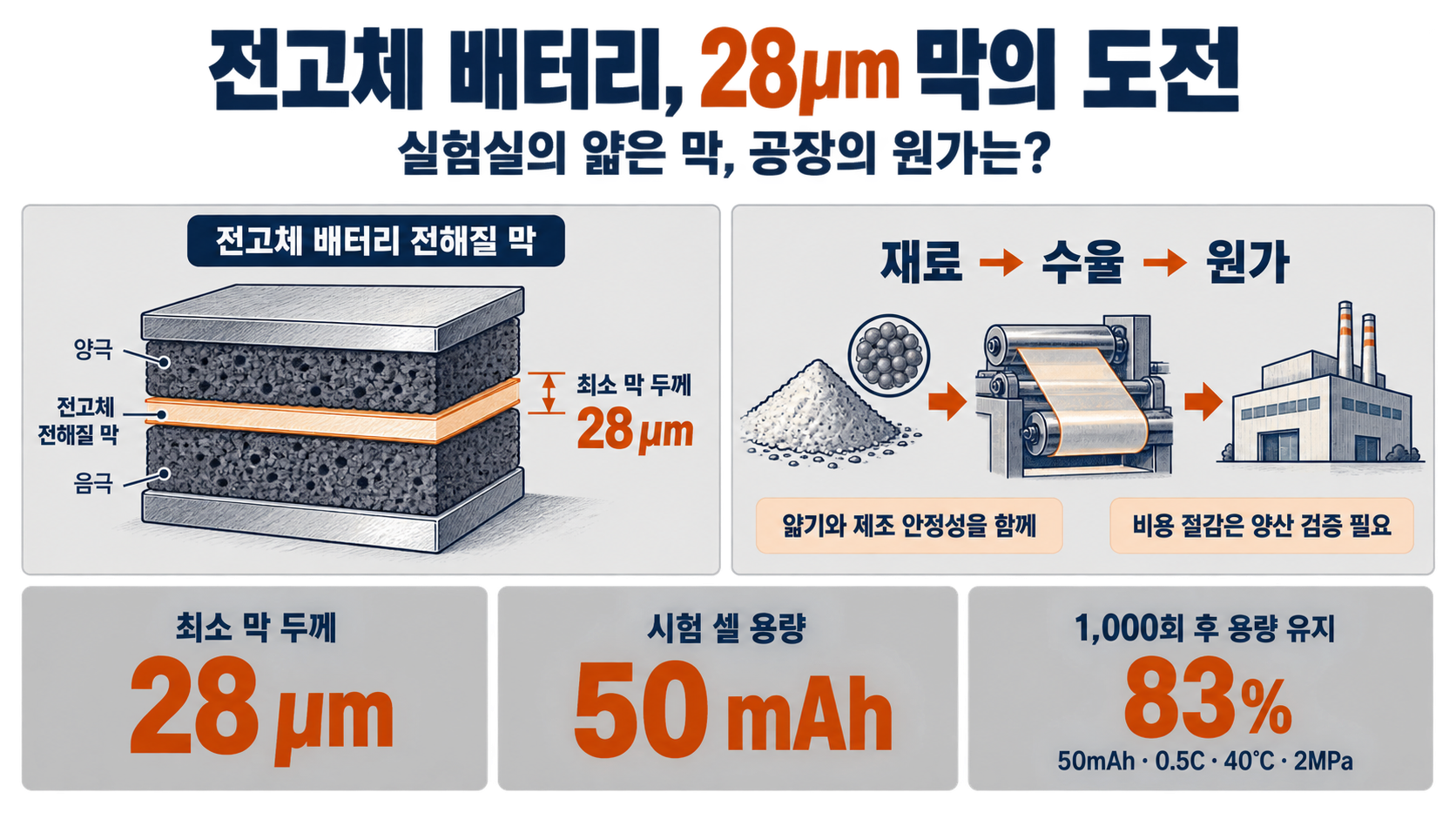
A new solid-state battery electrolyte film study reports a minimum thickness of 28 μm. Published online by Nature Communications on September 10, it raises a practical question: can a promising material become a film that factories can make reliably? That connection between material performance and manufacturing cost is the story here. Source
A torn film consumes material without producing something a customer can use. Making the layer thicker can make handling easier, but it also leaves less room for energy-storing material inside a fixed battery volume. Thinness matters only if the film survives production.
This is not a demonstration of a production-ready electric-car battery. The discussion separates experimental evidence, independently documented industry developments, and conditional economic analysis.
Why does solid-state battery electrolyte film thickness matter?
An electrolyte lets lithium ions move inside a battery. An ion is an electrically charged atom. During charging and discharge, ions travel between the electrodes while electrons flow through the external circuit. An all-solid-state battery uses solid material for this internal ion pathway.
For the same material and area, a thinner layer shortens the path and reduces its resistance to ion transport. The electrolyte is not the main energy-storing ingredient, so using less of it can also free space for active material. These are engineering opportunities, rather than a measured increase in vehicle range.
Continuity matters just as much. Defects can undermine performance and reliability. The useful engineering target is therefore a combination: low thickness, good ion transport and enough mechanical integrity for manufacturing.
The manufacturing step is the innovation
Turning electrolyte powder into a sheet requires a binder, a polymer that holds particles together. The researchers use α-pinene in a quasi-dry process to improve PTFE binder distribution, flexibility and densification. Source
Wet processing spreads material from a liquid mixture and then removes the liquid. Dry processing seeks to reduce or avoid that liquid burden. Here, an additive assists shaping, so “quasi-dry” should not be read as completely liquid-free. Source
Approaches to making solid-state battery electrolyte film
CompareWet
Additive-assisted quasi-dry
Conceptual comparison; quasi-dry processing still requires additive removal.
The broader manufacturing lesson is straightforward. Holding particles together and allowing ions through are two requirements that must work together. A good chemical composition is only part of the answer; mixing and shaping determine how much of its promise survives in a finished component.
The same distinction appears in other industries. Our article on screen-printed perovskite solar cells also explores the connection between laboratory performance and a practical manufacturing route. Related: screen-printed perovskite solar cells
Read the conditions behind the 1,000-cycle result
The paper gives a minimum thickness of 28 μm and a maximum demonstrated area of 30 × 10 cm²; these should not automatically be treated as one specimen. A 50 mAh single-layer LTO/NCM93 pouch cell retained 83% capacity after 1,000 cycles at 0.5 C, 40°C and 2 MPa. Source
Milliamp-hours measure charge capacity; 50 mAh equals 0.05 Ah. A 0.5 C rate uses a current equal to half the designated reference capacity per hour. The pressure keeps the cell compressed. None of this establishes the same lifetime in a large vehicle cell operating across ordinary driving conditions.
Scale introduces additional questions. Can pressure remain uniform over a larger area? Do defects accumulate as layers are added? Customers buy a battery with predictable quality, not an electrolyte film’s best individual result.
Where could the cost savings come from?
The following is economic inference. First, thinner films could reduce electrolyte consumption per unit area, assuming comparable composition and density. That would not reduce the entire battery price in the same proportion: electrodes, current collectors and assembly remain separate costs.
Second comes yield: the share of production that becomes saleable output. If films tear less often and have more consistent thickness, the same material and working time could produce more usable sheets. That benefit could matter more than the saving in material per sheet.
For illustration only, hold input cost constant and raise yield from 80% to 90%. Input cost per usable unit falls by about 11.1%, calculated as 1 minus 80 divided by 90. These are hypothetical yields, not measurements reported by the researchers or CATL.
Conditions for film improvements to lower cost
FlowAuthor analysis, not a measured cost-reduction result.
Third are equipment and processing time. Less liquid removal could help, but the reported method still includes treatment at 120°C for 20 minutes and pouch-cell pressing at 370 MPa. Manufacturing pressure is distinct from the 2 MPa used during cycling. Source
A cost comparison should include additive purchase and handling, heat treatment, pressing equipment and inspection, all divided by usable output. Faster film formation does not guarantee faster factory output if another step becomes the bottleneck.
The market is growing, but the competition is getting cheaper
The IEA’s Global EV Outlook 2026 reports 1.2 TWh of EV battery deployment in 2025. Average battery prices fell 8%, while lithium iron phosphate, or LFP, exceeded 55% of EV battery deployment. A growing market creates opportunity, but established products also set a demanding cost benchmark. Source
All-solid-state and LFP describe different things: electrolyte form and cathode chemistry. The commercial comparison is between a particular solid-state design and established mass-produced LFP-based products. The solid-state label alone does not establish a cost advantage.
There is concrete industrial investment. On January 29, 2026, Idemitsu announced its final investment decision and construction start for a large solid-electrolyte pilot facility. Commercialization with Toyota in 2027–2028 is a company target. This is not an announcement that either company has adopted the paper’s process. Source
The paper also lists CATL researchers and funding. That indicates industrial research involvement, but participation is different from product adoption. It does not provide a basis for forecasting company revenue. Source
Equipment opportunities may arrive before mass-market cars
One possible entry route is through customers who place a high value on weight and space, such as premium vehicles or constrained devices. That is a hypothesis about willingness to pay, not proof that the tested cell is suitable for those uses.
Equipment demand could come earlier: consistent additive mixing, thickness-controlled rolling and defect inspection. For Korean material and equipment suppliers, customer qualification and repeat orders would be more informative than a broad association with solid-state batteries.
Replacement would probably be selective. Adoption in suitable products could reduce demand for some liquid-processing steps while creating spending on pressing, inspection and environmental control. Cost reduction can therefore redistribute equipment spending as well as reduce it.
Our article on self-driving laboratories provides another perspective on research becoming productive work. Faster discovery and faster manufacturing affect different costs, but both need to fit a real workflow to create economic value. Related: self-driving laboratories and research productivity
The next useful number is production yield
The next evidence to look for is continuous production length and speed, defect rates and durability in larger multilayer cells. Pack performance should include the weight and cost of any pressure-maintaining hardware. Those measurements connect an improved film to what a buyer actually pays.
The work addresses the conversion of a promising powder into a usable thin film. Its industrial value will depend on reproducible output at scale. A route toward lower cost is worth investigating; the saving itself still needs to be measured in production.
Sources were checked as of September 16, 2026. The paper is a peer-reviewed article in press and may receive final editorial changes. Industry scenarios and the yield example are analysis, not investment recommendations.
The value of a thin film must be verified in usable factory output and battery pack cost.
Sources and further reading
전고체 배터리 전해질 막 — 28μm가 바꿀 제조비의 조건 (조회수 2)
전고체 배터리 전해질 막을 28μm, 즉 0.028mm까지 얇게 만든 연구가 나왔습니다. 9월 10일 Nature Communications에 선공개된 논문입니다. 눈여겨볼 대목은 얇기 자체보다, 이런 막을 공장에서 얼마나 안정적으로 만들 수 있느냐입니다. 재료 성능이 제조비로 이어지는 경로를 짚어보겠습니다. 출처
배터리 공장에서 막이 찢어지면 비싼 재료를 쓰고도 판매할 제품을 얻지 못합니다. 반대로 튼튼하게 만들려고 막을 두껍게 하면 같은 배터리 안에 전기를 저장할 재료를 넣을 공간이 줄어듭니다. 얇으면서 잘 만들어지는 막이 필요한 이유입니다.
다만 이번 연구가 전기차용 배터리의 양산 완성을 뜻하지는 않습니다. 아래에서는 논문에서 확인한 실험 결과, 외부 자료로 확인한 산업 움직임, 그다음에 가능한 경제적 효과를 구분합니다.
전고체 배터리 전해질 막, 왜 얇게 만들어야 할까요?
전해질은 배터리 안에서 리튬 이온이 오가는 통로입니다. 이온은 전하를 띤 원자입니다. 충전과 방전 때 이온은 전해질을 지나 양극과 음극 사이를 움직이고, 전자는 외부 회로를 흘러 기기를 작동시킵니다. 전고체 배터리는 이 통로를 고체 재료로 만듭니다.
막이 얇아지면 이온이 건너갈 거리가 짧아집니다. 같은 재료와 면적이라는 조건에서는 이동을 방해하는 저항도 줄어듭니다. 또 전해질은 전기를 저장하는 주재료가 아니므로, 차지하는 부피를 줄일수록 배터리 내부 공간을 더 효율적으로 쓸 여지가 생깁니다.
하지만 막 전체가 끊김 없이 이어져야 합니다. 미세한 결함이 생기면 성능과 신뢰성을 해칠 수 있습니다. 따라서 두께 하나만 낮추는 실험보다, 얇기·이온 전달·기계적 강도를 함께 맞추는 일이 공학적으로 중요합니다.
새 재료보다, 가루를 막으로 만드는 방법에 주목했습니다
고체 전해질 가루를 넓은 막으로 만들 때는 입자를 붙잡아 주는 바인더가 필요합니다. 바인더는 접착제 역할을 하는 고분자입니다. 이번 연구는 α-pinene이라는 유기 첨가제로 PTFE 바인더의 분산과 막의 유연성·치밀화를 돕는 준건식 공정을 제안했습니다. 출처
습식 공정은 액체에 재료를 분산해 바른 뒤 액체를 제거하는 방식입니다. 건식 공정은 그 액체 사용을 줄이거나 없애려는 접근입니다. 이번 준건식 방식은 첨가제로 성형을 돕습니다. 완전히 액체를 쓰지 않는 방식이라고 부르면 차이를 놓치게 됩니다. 출처
전고체 배터리 전해질 막을 만드는 접근
개념 비교습식
첨가제 보조 준건식
공정 개념 비교입니다. 준건식도 첨가제 제거 공정이 남습니다.
이 차이를 일반적인 제조 문제로 바꿔 보면 이해하기 쉽습니다. 입자를 단단히 붙이는 기능과 이온을 잘 통과시키는 기능을 동시에 만족시켜야 합니다. 재료의 조성만 좋아도 부족합니다. 같은 재료라도 어떻게 섞고 누르고 펴느냐에 따라 실제 제품의 성능이 달라질 수 있습니다.
다른 제조 분야에서도 비슷한 질문이 나옵니다. 본 사이트의 페로브스카이트 태양전지 인쇄 공정 글도 실험실 성능을 생산 방식과 연결해 읽는 데 도움이 됩니다. 관련 글: 페로브스카이트 태양전지 인쇄 공정
1,000회 충방전, 시험 조건까지 읽어야 합니다
논문은 최소 두께 28μm와 최대 시연 면적 30×10cm²를 제시합니다. 두 기록이 반드시 동일한 한 장에서 나온 값이라고 단정하지 않겠습니다. 50mAh 단층 파우치 셀은 0.5C·40°C·2MPa에서 1,000회 후 용량 83%를 유지했습니다. 음극은 리튬티타네이트(LTO), 양극은 니켈 함량이 높은 NCM93입니다. 출처
mAh는 저장할 수 있는 전하량의 단위입니다. 50mAh는 0.05Ah입니다. 0.5C는 정해진 기준 용량의 절반에 해당하는 전류로 시험한다는 뜻입니다. 2MPa는 셀을 누르는 압력입니다. 그러므로 이 결과를 자동차가 보통 기온에서 아무 압착 장치 없이 1,000번 충전해도 같은 성능을 낸다는 뜻으로 옮길 수 없습니다.
양산 단계에서는 셀을 크게 만들고 여러 층으로 쌓아야 합니다. 작은 시험 셀에서 균일했던 압력이 넓은 면적에서도 유지되는지, 층을 더 쌓아도 결함이 누적되지 않는지 살펴야 합니다. 고객이 구매하는 것은 전해질 막의 최고 기록이 아니라, 일정한 품질을 보장하는 배터리입니다.
원가가 내려간다면, 어디에서 내려갈까요?
여기부터는 연구 결과에 바탕을 둔 경제적 추론입니다. 첫 번째 경로는 재료 사용량입니다. 같은 면적과 조성을 유지하면서 막을 얇게 만들 수 있다면 전해질 투입량을 줄일 수 있습니다. 다만 막의 두께가 줄어든 비율만큼 배터리 전체 가격이 내려가는 것은 아닙니다. 양극·음극·집전체·조립 비용은 별도로 남습니다.
두 번째는 수율입니다. 수율은 투입한 재료 가운데 판매 가능한 제품으로 완성되는 비율입니다. 얇은 막이 덜 찢어지고 두께도 일정하게 나온다면 같은 원료와 작업시간으로 더 많은 양품을 만들 가능성이 있습니다. 재료비 절감보다 이 효과가 더 중요할 수도 있습니다.
가령 투입비가 같고 수율만 80%에서 90%로 오른다고 가정해 보겠습니다. 양품 하나가 부담하는 투입비는 약 11.1% 줄어듭니다. 80을 90으로 나눈 뒤 1에서 빼면 됩니다. 이 숫자는 원가 구조를 설명하기 위한 가상 계산이며, 논문이나 CATL이 발표한 수율·절감률이 아닙니다.
막 개선이 원가로 이어지는 조건
흐름도저자의 경제적 추론입니다. 원가 절감률을 실측한 도표가 아닙니다.
세 번째는 설비와 생산시간입니다. 액체를 제거하는 부담이 줄면 공정 비용이 낮아질 여지가 있습니다. 그러나 이번 논문에는 첨가제 제거를 위한 120°C·20분 처리와 파우치 조립 때 370MPa 압착이 포함됩니다. 운전 중 압력인 2MPa와 제조 압력은 다른 숫자입니다. 출처
따라서 공정 이름만 보고 건조 설비가 필요 없어졌다고 계산하면 안 됩니다. 첨가제 구매·회수, 가열 시간, 압착 장비, 품질 검사까지 합친 양품 면적당 비용을 비교해야 합니다. 생산량이 늘어도 검사와 압착에서 대기시간이 길어지면 기대한 생산성 향상이 줄어들 수 있습니다.
시장은 커지지만, 기존 배터리 가격도 내려갑니다
IEA의 Global EV Outlook 2026에 따르면 2025년 세계 전기차 배터리 탑재량은 1.2TWh였습니다. 같은 해 평균 배터리 가격은 8% 하락했고, 리튬인산철(LFP)은 전기차 배터리 탑재량의 55%를 넘었습니다. 시장 규모는 기회이지만, 기존 제품의 가격 경쟁력은 새 기술이 넘어야 할 조건입니다. 출처
전고체와 LFP는 같은 기준으로 나눈 분류가 아닙니다. 전고체는 전해질의 형태를, LFP는 양극 재료를 가리킵니다. 여기서 비교하는 대상은 특정 전고체 셀 설계와 이미 대량 생산되는 LFP 기반 배터리입니다. 전고체라는 이름만으로 저가 시장을 대체할 수 있다고 보면 안 됩니다.
산업의 투자는 이미 구체적으로 움직이고 있습니다. Idemitsu는 2026년 1월 29일 고체전해질 대형 파일럿 설비의 최종 투자 결정과 건설 시작을 발표했습니다. Toyota와의 2027~2028년 실용화는 회사가 밝힌 목표입니다. 이는 이번 논문의 첨가제나 제조법을 채택했다는 발표가 아닙니다. 출처
이번 논문에도 CATL 소속 연구진과 연구비 지원이 명시돼 있습니다. 소재 성능을 제조와 연결하려는 기업의 관심을 보여주는 정황입니다. 다만 공동연구와 제품 채택은 별개이며, 이를 특정 회사의 향후 매출로 환산할 근거는 아직 없습니다. 출처
새 시장은 완성차보다 공정 장비에서 먼저 열릴 수도 있습니다
가능한 초기 수요를 생각해 보면, 가격보다 무게와 부피에 더 높은 가치를 두는 제품이 후보가 될 수 있습니다. 프리미엄 차량이나 공간 제약이 큰 기기가 그런 예입니다. 이는 이번 시험에서 해당 용도를 입증했다는 뜻이 아니라, 높은 초기 원가를 감당할 수 있는 고객이 누구인지에 대한 추론입니다.
그보다 먼저 수요가 생길 수 있는 곳은 생산 공정입니다. 첨가제를 균일하게 혼합하는 장비, 막 두께를 관리하는 압연 장비, 눈에 보이지 않는 결함을 찾는 검사 기술이 필요해질 수 있습니다. 국내 소재·장비 기업을 볼 때도 전고체 관련이라는 분류보다 고객 검증과 반복 주문 여부가 더 유용한 판단 근거가 됩니다.
기존 산업의 대체도 한 번에 일어나지는 않을 가능성이 큽니다. 새 공정이 유리한 제품부터 도입되면 액체 처리 설비의 일부 역할이 줄어들 수 있습니다. 동시에 압착·검사·환경 제어에는 새로운 지출이 생깁니다. 원가 절감은 설비를 없애는 문제이면서, 어떤 설비에 돈을 옮겨 쓰는지의 문제이기도 합니다.
연구의 산업화를 이런 관점으로 읽고 싶다면 자율 실험실 관련 글도 함께 볼 만합니다. 발견 속도를 높이는 기술과 공장의 생산성을 높이는 기술은 서로 다른 비용을 바꾸지만, 실제 작업 흐름에 들어가야 가치가 생긴다는 점은 같습니다. 관련 글: 자율 실험실과 연구 생산성
다음에 확인할 숫자는 양산 수율입니다
앞으로는 연속 생산 길이와 속도, 불량률, 더 큰 다층 셀의 수명 데이터가 함께 나오는지 보겠습니다. 압력을 유지하는 장치의 무게와 비용까지 포함한 배터리 팩 성능도 필요합니다. 이 자료가 있어야 막의 개선이 소비자가 지불하는 가격까지 이어지는지 판단할 수 있습니다.
이번 연구의 가치는 가루 상태의 좋은 재료를 얇고 다루기 쉬운 막으로 바꾸는 문제에 있습니다. 산업적 성패는 그 막을 얼마나 많이, 얼마나 일정하게 만들 수 있는지에 달려 있습니다. 얇아진 막이 제조비를 낮출 가능성은 열렸지만, 절감액은 아직 공장에서 확인할 숫자로 남아 있습니다.
자료 확인 기준일은 2026년 9월 16일입니다. 논문은 동료심사를 통과한 선공개본이며 최종 편집본으로 교체될 수 있습니다. 본문에 제시한 산업 전망과 수율 예시는 해석이며, 특정 종목의 매수·매도를 권하는 글이 아닙니다.
얇은 막의 가치는 공장에서 얻는 양품과 배터리 팩의 원가로 확인해야 합니다.
답글 남기기