Korea GDP Growth 3.3% — 140k Jobs, Why the Chip Boom Hasn’t Reached Employment Yet
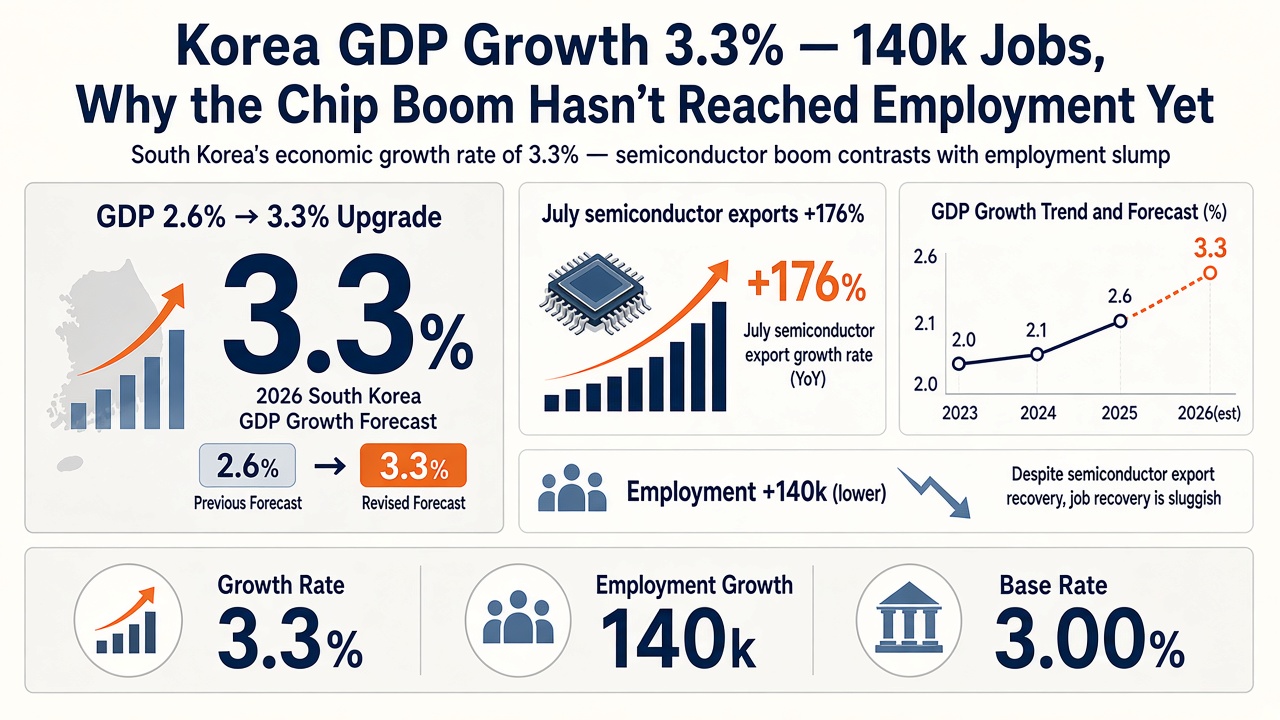
Korea GDP growth 3.3% — on August 27 the Bank of Korea raised its 2026 growth forecast from 2.6% to 3.3%, the highest since 2021. On the same day it cut the expected rise in employment from 180,000 to 140,000 jobs. Exports are hot; the jobs outlook cooled.
July exports rose 62.8% year on year; semiconductor exports alone jumped 176.3%. The BOK also hiked the policy rate from 2.75% to 3.00%. Why did GDP and jobs forecasts split, and how does the chip boom reach your wallet? We follow the path. Official BOK forecasts are separated from market guesses. Not investment advice.
Korea GDP growth 3.3% — what drove the upgrade
GDP measures the total value of goods and services produced in a year. When exports and factory investment surge, GDP moves fast. The August revision centers on semiconductor demand tied to global AI infrastructure spending.
Customs data show July exports at about $98.9 billion, up 62.8% y/y. Semiconductor exports were about $41.2 billion, up 176.3%. The BOK lifted its goods-export growth forecast to 9.7% and facility investment growth to 6.8%. It now expects a record $450 billion current-account surplus in 2026.
Globally, the IMF’s July WEO projects 3.0% growth in 2026, arguing AI investment partly offsets Middle East energy shocks. The World Bank’s June outlook is more cautious at 2.5%. Korea sits on the tech-supply-chain side of that split — but higher oil and rates can still squeeze import prices and financial conditions, as the World Bank warns.
BOK August forecast revision — GDP 3.3% vs 140k jobs bar chart. 2026 forecasts vs May revision direction.
140k jobs — why growth and hiring diverge
Employment counts how many people are working. GDP can run above 3% while hiring lags. It depends which sectors drive growth and how labor-intensive they are.
Chip fabs and data-center capex are capital-heavy. One trillion won of semiconductor revenue creates fewer jobs than the same revenue in restaurants or construction. The BOK said growth is led by exports and investment, and cut its construction investment growth forecast from 0.6% to 0.2%. Construction is job-rich but facing higher costs, rates, and unsold homes outside the capital.
The BOK cited Middle East war effects and weak construction for the lower jobs forecast. Service hiring is still rising slowly, but the overall gain is smaller. It expects 200,000 more jobs next year — a timing story: exports and capex first, broader hiring later.
-
1
AI capex
Global DC & chip demand
-
2
Chip exports
Jul +176% y/y
-
3
GDP & capex
3.3% growth forecast
-
4
Bonuses
Larger in 2027 (BOK)
-
5
Jobs & spending
+140k → +200k jobs
Youth jobs and AI — what the BOK issue note says
On August 18 the BOK published Issue Note 2026-19 on youth employment. From June 2022 to June 2026, jobs for people aged 15–29 fell by 285,000; 268,000 of those losses (94%) were in high-AI-exposure sectors such as information services, publishing, and computer programming.
The BOK did not blame AI alone. It pointed to post-pandemic hiring normalization, preference for experienced workers, and more remote work. Over the same period, jobs for people in their 50s rose by 230,000 — more than 173,000 of those gains were in the same AI-exposed industries. The entry-level career ladder looks weaker.
This does not directly cause the GDP upgrade, but it fits the bigger picture: growth is concentrated in chips while hiring does not spread evenly — including for young workers in office and service roles. That is one reason headline growth can feel disconnected from daily life.
3.3% GDP lane
Chip exports & capex
Driver
Speed · Fast (already in data)
Jobs · Relatively few per won
140k jobs lane
Construction & vulnerable sectors
Weak spot
Structure · Weaker youth entry jobs
Outlook · +200k in 2027
Rate 3.00% — why hike when growth is strong?
The policy rate is the anchor for bank lending and deposit pricing. On August 27 the BOK raised it 25 basis points to 3.00%, the second hike in two months.
Strong growth did not mean easier policy. The BOK still forecasts 2.7% CPI this year and 2.5% core inflation — above its 2% target. Seoul home prices and household debt are also concerns. Governor Shin stressed preemptive action before inflation and debt risks spread.
3.3% growth and a 3.00% rate can coexist when the boom is export- and capex-led while inflation and housing risks remain. Morgan Stanley (Aug 28) flagged possible further hikes to 3.5% — a bank view, not a BOK promise.
Macro snapshot — 3.3% growth, 3.00% rate, 2.7% CPI bar chart. Rate & CPI per BOK Aug 27 outlook/decision. · Axis starts at 2.4, not zero
When do chip bonuses turn into spending?
Chip giants’ earnings and capex are already in the GDP numbers. Stocks swung sharply in August before partial recovery. The BOK noted easier FX conditions as foreign equity outflows eased and USD/KRW fell toward the high 1,370s.
The consumption handoff is mostly a 2027 story in the BOK’s telling: larger bonuses could lift household income, then spending and hiring. If bonuses flow into property or stocks instead, the consumption recovery may disappoint. Next year, domestic demand and exports may each contribute about half of growth.
Three watch items: whether the chip cycle lasts into 1H 2027 (BOK base case), how far rates rise above 3% (inflation and housing), and whether hiring tracks the 140k forecast through 2H 2026. When bonuses hit bank accounts is when consumption starts to feel real.
Confirmed facts, open questions — the Sep–Oct checklist
- Confirmed: 2026 GDP 3.3%, jobs +140k, policy rate 3.00%, July chip exports +176.3% (customs, BOK)
- Confirmed: $450bn current-account surplus, CPI forecast 2.7% (BOK Aug outlook)
- Outlook: 2027 GDP 2.9%, jobs +200k, chip expansion through 1H 2027 (BOK)
- Inference: further hikes possible (Morgan Stanley et al.); bonus-to-consumption speed uncertain
- Watch: export and jobs prints Sep–Oct, MPC minutes, memory prices and chip cycle
Korea GDP growth 3.3% is good news on paper. It also means growth is narrow — exports and investment first, jobs and consumption on a longer path. The chip boom reaches wallets and payrolls after corporate results, bonuses, and hiring data — not the day the forecast is published.
Related: BOK hike · FX · housing, Semiconductor leverage volatility, KOSPI outlook · global equities. Educational only.
3.3% is GDP today — 140k jobs is who gets paid tomorrow. Read exports first, payrolls second.
Sources
- 연합뉴스 — 성장 3.3%·고용 14만(8/27)
- 한국은행 — 통화정책방향·8월 경제전망(8/27)
- 한국은행 — BOK 이슈노트 2026-19 청년고용·AI
- 아시아경제 — 7월 수출·반도체 +176%
- 조선일보 — 한은 성장률 3.3% 상향
- 이데일리 — 반도체 파급·내년 고용 전망
- 연합뉴스 — 청년 일자리 94% AI 고노출 업종
- IMF — WEO Update July 2026
- Reuters — World Bank 2.5% outlook
- 파이낸셜뉴스 — Morgan Stanley BOK hike view
- Internal: 2026-09-01-korea-gdp-33-employment-semiconductor-session-01.md
For information only — this is not a recommendation to buy or sell any asset.
Comments 0