ECB Rate Hike 2026 — Why 2.50% Matters for Korean Companies
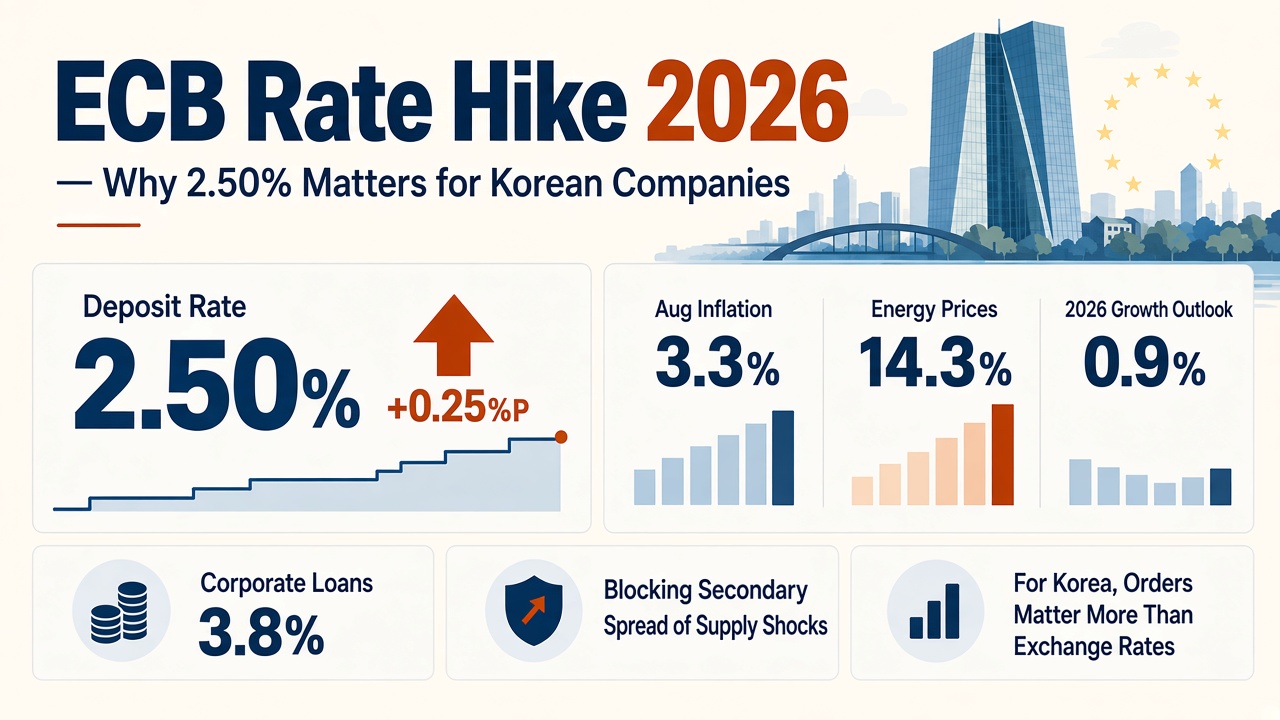
The ECB rate hike in 2026 lifted the euro-area deposit rate to 2.50%. On September 10, the central bank raised rates by 25 basis points despite forecasting growth of only 0.9% this year. With August inflation at 3.3% and energy inflation at 14.3%, it chose to stop a second wave of price pressure before it spread.
A rate hike cannot produce oil or bring in more gas. The target is the chain that follows: higher energy and freight costs raise other prices, workers seek compensation, and firms pass wage costs back to customers.
That chain separates the likely winners and losers across earnings, consumption, investment and currencies. Published numbers are identified as facts; the effects on Korean companies and markets are conditional analysis, not investment advice.
ECB rate hike 2026 — what exactly changed?
The ECB raised all three policy rates. The deposit facility rate is now 2.50%, the main refinancing rate 2.65%, and the marginal lending rate 2.90%, effective September 16. Together, they anchor the price of money for euro-area banks.
The pass-through was already visible. New bank lending rates for companies rose from 3.6% in May to 3.8% in June and July. The cost of market-based corporate debt stood at 4.0% in July.
-
1
ECB +25bp
Deposit rate 2.50%
-
2
Bank funding
Loan rates rise
-
3
Demand & capex
Sensitive spending slows
-
4
Price pass-through
Second rounds ease
Why raise rates against a supply shock?
This episode did not start with consumers spending too much. An ECB model attributes almost all of the 1.5-percentage-point increase in headline inflation between January and May 2026 to adverse energy supply shocks. Fiscal and monetary policy made small negative contributions.
The ECB still has a reason to act. Higher fuel, freight and electricity bills feed into food and manufactured goods. Workers seek higher pay to recover lost purchasing power. If companies then raise prices again, inflation can persist after energy prices stabilise.
Higher rates slow that loop by making housing, inventories and investment more expensive. They do not repair supply, but they reduce the room to pass every cost increase through.
2021-22
Post-lockdown surge
Demand
Supply · Bottlenecks + energy
Policy · Fiscal and monetary support
2026
+1.5pp
Inflation rise
Main driver · Almost entirely energy supply
Policy contribution · Fiscal -0.2pp; monetary -0.1pp
Why the ECB thinks a 0.9% economy can absorb the hike
The ECB projects growth of 0.9% in 2026, 1.4% in 2027 and 1.5% in 2028. It upgraded the first two years after second-quarter activity proved more resilient than expected.
Unemployment held at 6.4% in July. Defence and infrastructure spending supported manufacturing orders, confidence and services recovered, and AI-related activity appeared in digital services, business investment and exports. Those buffers created room for a modest increase.
This is a baseline, not a promise. The ECB sees growth risks tilted down and inflation risks tilted up. Another supply disruption, a cold winter or low gas storage could lift prices. Financial stress could instead freeze credit and pull growth below the forecast.
ECB inflation and growth forecasts for 2026-28. ECB staff baseline projections for 2026-28, not outcomes.
Corporate earnings — costs rise together, revenue splits apart
Energy-intensive and highly leveraged companies feel the first squeeze. Chemicals, glass, paper, metals and transport pay more for power and refinancing. Companies without pricing power can lose margin even when revenue holds steady.
Policy-backed orders behave differently. Defence, grids, infrastructure, automation and data-centre projects depend more on budgets and long procurement cycles than on household confidence.
Capital may therefore move away from low-margin, energy-heavy production and very long-payback private projects toward efficient capacity and policy-backed investment. The result is a change in the mix of investment, not a collapse in every category.
How the squeeze reaches households, housing and stocks
Households lose purchasing power through energy bills while higher mortgage rates weaken housing demand. Mortgage rates were 3.5% in June and July, and mortgage lending growth eased to 3.0% in July. If jobs remain firm, cars, appliances and travel are likely to soften before essentials.
In equities, cash, debt and pricing power matter. Higher long-term yields reduce the present value of distant earnings, which weighs on growth stocks. A stronger euro can lower imported energy costs, but currencies also respond to US rates and risk appetite. Our analysis of US 10-year yields and corporate funding costs explains that second channel.
Korean companies and the won — orders matter more than the exchange rate
The impact arrives through currency translation, demand and financing. A stronger euro can enlarge reported revenue when converted into won, but local wages and components are also paid in euros. Translation gains are not operating profit.
Orders matter more. Weaker European purchases can reduce export volumes and factory utilisation for Korean autos, batteries, machinery and appliances. Groups financing European factories or consumer credit also face higher local borrowing costs.
Battery and EV plants require large upfront investment, so even a 25-basis-point change in direction can alter hurdle rates and project timing.
Defence, power-grid and automation orders may remain more resilient. The WTO goods barometer stood at 102.0, above its 100 baseline, while electronics reached 104.9. Investors should separate discretionary exports from policy-backed capital goods.
Five numbers that separate facts from forecasts
The confirmed figures are a 2.50% deposit rate, 3.3% August inflation, 14.3% energy inflation, 6.4% unemployment and a 3.8% corporate lending rate. The ECB’s 3.0% inflation and 0.9% growth figures for 2026 are forecasts, not outcomes.
Now watch whether energy passes into core inflation and wages. Core inflation eased to 2.4% in August, while compensation per employee slowed to 3.3% in the second quarter from 3.5% in the first. A wage-price spiral has not been confirmed.
Business lending rates, credit growth, euro-area consumption and Korean EU orders come next. If energy falls and core prices settle, the hike may prove to be short-lived insurance. If energy and credit costs remain high together, earnings, investment and consumption can weaken at the same time. Our oil-at-$100 analysis traces the parallel route into Korea.
The signal is larger than 25 basis points. The ECB chose to defend inflation expectations before an energy shock became embedded. Korean investors should track European orders, local funding costs and policy-backed demand separately from the euro exchange rate.
This 25-basis-point move cannot lower energy prices. It is designed to slow the spread from energy into wages and the rest of the price system.
Sources
- ECB — Monetary policy decisions, 10 September 2026
- ECB — Combined monetary policy decisions and statement
- ECB Blog — Why the drivers of inflation matter
- Reuters — Lagarde comments at ECB press conference
- AP — Europe’s central bank acts to quell inflation
- IMF — World Economic Outlook Update, July 2026
- WTO — Goods Trade Barometer, September 2026
- 내부 글 — 미국 10년물 금리와 기업 조달비용
- 내부 글 — 유가 100달러와 한국 경제
For information only — this is not a recommendation to buy or sell any asset.
Comments 0