JPMorgan Q3 2026 earnings: a $5.57 miss, but higher interest-income guidance
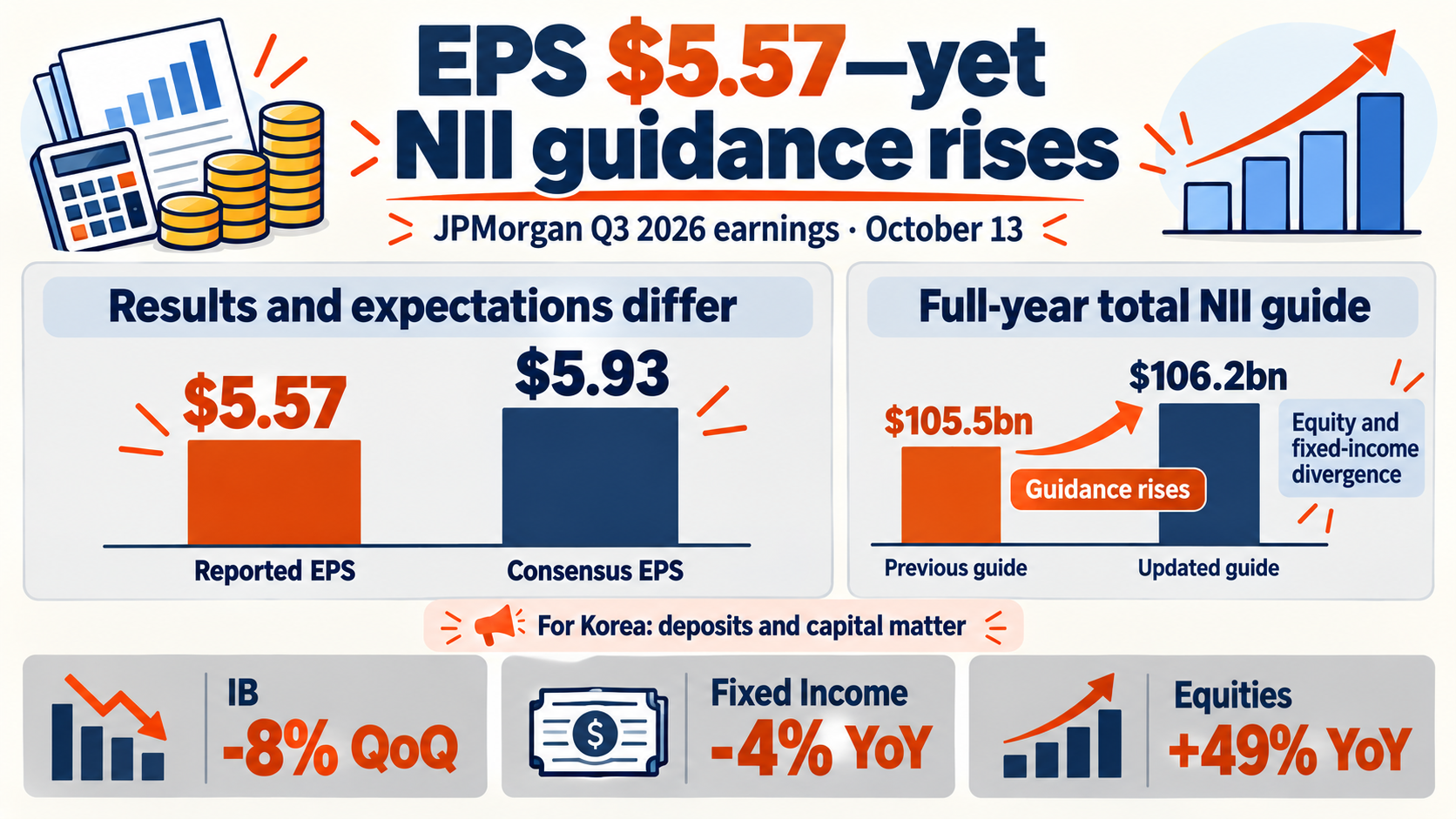
JPMorgan Q3 2026 earnings came in at $5.57 per share, below the $5.93 market estimate. Yet the bank raised its annual net interest income outlook on October 13. For investors in Korean financial stocks, the useful question is which businesses are earning more—and which costs are catching up. Source: JPMorganChase — 3Q26 Earnings Supplement Source: AP — Big banks post strong Q3 profits, but warn higher rates and inflation could bite Source: JPMorganChase — 3Q26 Earnings Presentation, pp. 6, 9
This report is not, by itself, evidence that the US economy has stalled. Lending income, equity-market services and fees from arranging corporate transactions are moving at different speeds. Separating them helps explain both bank valuations and the cost of business financing.
JPMorgan Q3 2026 earnings: why growing profits can miss
An earnings miss does not mean a loss. It means profit fell short of expectations set before the announcement. Earnings per share divides income available to shareholders by the share count; diluted EPS also accounts for potentially dilutive shares.
Reported EPS was above the $5.07 earned a year earlier. The bank also presented $5.75 excluding investment-securities losses. That adjusted figure remained below the reported estimate, but reported and adjusted EPS should not be treated as identical measures. Consensus providers can apply different adjustment conventions. Source: JPMorganChase — 3Q26 Earnings Press Release Source: AP — Big banks post strong Q3 profits, but warn higher rates and inflation could bite
EPS: reported, adjusted and estimate (USD). Q3 2026. Reported 5.57; company-adjusted 5.75; AP-reported estimate 5.93. Accounting conventions differ. · Axis starts at 5.4, not zero
Selling investment securities at a loss reduces current profit without necessarily creating a recurring quarterly expense. Reinvesting the proceeds at higher yields can help future interest income. Calculating a payback period, however, requires transaction and reinvestment details that the headline EPS does not provide.
Attributing the entire miss to bad loans or a weakening economy would skip that distinction. Fees and expenses still matter after the unusual item is removed. Because business-level consensus forecasts are not public, this article does not split the miss by division.
Why equities, fixed income and deal fees diverged
Investment-banking fees are earned by advising on acquisitions and arranging securities issuance. They fell 8% from the previous quarter but rose 14% from a year earlier. Slower recent momentum and a larger business than last year can both be true. Source: JPMorganChase — 3Q26 Earnings Supplement
Uncertainty can increase trading while delaying corporate transactions. Clients may buy derivatives to manage price risk, supporting bank revenue. But disagreement over acquisition prices or expensive bond financing can postpone completion. Deal fees depend heavily on completed transactions, not just announcements. This is a business-model explanation, not a claim that interest rates caused the entire quarterly decline.
Within trading, equity revenue rose 49% year over year while Fixed Income Markets revenue fell 4%. Against the previous quarter, however, equities declined 18% and fixed income declined 11%. Strong annual equity growth does not mean revenue rose across every comparison period. Source: JPMorganChase — 3Q26 Earnings Supplement
Trading revenue: year-over-year comparison (USD bn). JPM supplement. Equities 3.331→4.954 (+49%); fixed income 5.613→5.366 (-4%). IB -8% uses a quarterly comparison.
The company identified prime services and derivatives as equity drivers. Prime services provide financing, securities lending and trading support to professional investors. In fixed income, weaker commodities, rates, credit and public-finance revenue was partly offset by currencies and emerging markets. Source: JPMorganChase — 3Q26 Earnings Presentation, pp. 6, 9
For Korean securities firms, the transferable lesson is a question rather than a growth rate. Higher turnover has different consequences depending on the products clients use and whether the firm intermediates trades or retains market risk. Volatile markets do not guarantee stronger trading profits for every financial institution.
Interest-income guidance rose—and so did expenses
Net interest income, or NII, subtracts interest paid on deposits and borrowing from interest earned on loans and other assets. Net interest margin relates that income to interest-earning assets. A larger balance sheet can lift income even without a substantial improvement in margin.
Full-year NII guidance increased from $105.5 billion to approximately $106.2 billion. Excluding Markets, it rose from $96.5 billion to about $97.2 billion. EPS disappointed, yet interest-income guidance went up rather than down—the quarter's real twist. Adjusted expenses, which exclude legal expense, also increased from $107.5 billion to about $108.6 billion. Source: JPMorganChase — 3Q26 Earnings Presentation, pp. 6, 9 Source: JPMorganChase — 2Q26 Form 10-Q outlook (IR filing) Source: Reuters — JPMorgan posts rare profit miss as dealmaking, bond trading lose momentum
Previous
105.5
Total NII
Ex-Markets · 96.5
Adjusted expense · 107.5
October 13
106.2
Total NII
Ex-Markets · 97.2
Adjusted expense · 108.6
The ex-Markets measure is useful because trading can involve interest income offset by derivative gains or losses elsewhere in the accounts. Reading only the interest line can distort trading economics. Excluding that activity offers another view of lending and deposit-taking. Source: JPMorganChase — 3Q26 Earnings Presentation, pp. 6, 9
The company said deposit growth and higher card and wholesale loan balances supported quarterly interest income, partly offset by lower rates compared with a year earlier. That is compatible with recent news of rising rates: the comparison period and the repricing dates of assets and liabilities differ. Source: JPMorganChase — 3Q26 Earnings Press Release
Korean banks face the same accounting logic. If loan yields rise before deposit costs, earnings may benefit temporarily. But customers can move low-cost balances into term deposits or competing products, raising funding costs. Loan growth, deposit mix and repricing schedules need to be read together.
Higher expense guidance alone does not prove deteriorating efficiency. Reuters reported that CFO Jeremy Barnum linked expense growth to revenue exceeding expectations. Some expenses, such as revenue-related compensation, move with activity; others, including systems and staffing commitments, are harder to reduce quickly. Margins can tighten when fee income slows but those commitments remain. Source: Reuters — JPMorgan posts rare profit miss as dealmaking, bond trading lose momentum
Dimon and the Fed: why a resilient economy cuts both ways for banks
On October 13, Chairman and CEO Jamie Dimon described business investment and consumer spending as supports for the US economy while pointing to inflation, fiscal deficits, elevated asset prices, interest rates and geopolitical risks. His message combined current customer resilience with preparation for less favorable outcomes. Source: JPMorganChase — 3Q26 Earnings Press Release
The Federal Reserve’s September meeting minutes, released October 7, also discussed inflation risks and possible further tightening. Our earlier article on the FOMC minutes and dollar financing costs now connects to bank income statements: rates can support interest revenue while increasing borrowers’ burdens and deposit competition. Source: Federal Reserve — September 15–16 FOMC minutes, released October 7
Resilient activity sustains working-capital borrowing, investment and consumer payments. If the same demand keeps inflation persistent, interest rates may remain restrictive for longer. Banks then have to manage stronger current income alongside potential future arrears. The timing gap between those effects matters for the economic outlook.
As of October 13, CNN's Fear & Greed Index read 43.9, in fear: down 2.9 points over a week but up 11.2 over a month. GoldKimp’s October 12 KOSPI measure read 63.0, in greed. US sentiment shows a weekly setback within a monthly recovery; Korea’s level is more optimistic, but comparable Korean weekly and monthly observations are unavailable. Source: CNN Fear & Greed — 2026-10-13 supplied snapshot Source: GoldKimp KOSPI Fear & Greed — 2026-10-12 supplied snapshot
Different methodologies and observation dates prevent converting that sentiment gap into a flow estimate. A check of SentimenTrader on October 14 returned blank Smart Money and Dumb Money values and no observation date, so no inference is drawn from their spread. An earnings miss potentially affecting risk appetite is a different claim from an observed deterioration in Korean banks’ dollar funding. Source: SentimenTrader — Smart Money / Dumb Money Confidence
Applying the result to Korean bank earnings, capital and funding
Korean bank valuations reflect both expected earnings and the risk attached to them. Price-to-book compares the share price with net assets per share. Sustainable profitability and the capacity to return capital can justify a higher valuation for the same book value. One US bank’s miss is insufficient grounds to cut the fair multiple of every Korean financial group.
The relevant checks are each bank’s loan and deposit mix, provisions for credit losses, and capital capacity. Growing profit does not automatically translate into larger distributions if more capital is needed to support risk. Our discussion of Basel III, lending and shareholder distributions provides that background.
Dollar financing is a separate channel. Investors require a spread over the benchmark rate to compensate for credit and liquidity risk on bank bonds. Broad concern about bank earnings could widen that spread. If banks pass higher funding costs into loan pricing, Korean companies’ dollar borrowing and investment economics could be affected.
-
1
Bank risk repricing
If concern spreads across banks
-
2
Dollar funding costs
Credit/liquidity spreads may widen
-
3
New and renewed loans
If lenders pass through the cost
-
4
Investment and spending
Debt-dependent borrowers may adjust first
This is a conditional transmission mechanism. There is no evidence so far that JPMorgan’s announcement actually widened Korean bank spreads. New-issue spreads, the cost of obtaining dollars through FX swaps and the maturity profile of borrowing must be checked separately. Existing fixed-rate debt does not reprice in full overnight.
Corporate effects would also be uneven. Businesses investing from internal cash have more room to absorb tighter financing, while frequent borrowers may defer equipment purchases or acquisitions. Persistent differences in funding capacity could allow stronger firms to acquire assets or gain bargaining power. Consumer demand may also adjust first in categories sensitive to card and installment costs.
Four things to check in the next bank results
The next bank reports should show whether loan growth outpaces deposit-cost pressure, whether deal pipelines convert into fees, and whether expenses adjust with revenue. Provisions and arrears then help distinguish transaction timing from weakening borrower repayment capacity.
The central lesson is business-level divergence. Better interest-income prospects can coexist with disappointing EPS when fees and expenses fall short of expectations. Korean financial stocks likewise need analysis of the assets that earn higher rates and the liabilities that pay them. This article explains disclosures and conditional economic mechanisms; it is not a recommendation to buy or sell a security.
Sources and references
- JPMorganChase — 3Q26 Earnings Press Release
- JPMorganChase — 3Q26 Earnings Presentation, pp. 6, 9
- JPMorganChase — 3Q26 Earnings Supplement
- JPMorganChase — 2Q26 Form 10-Q outlook (IR filing)
- Reuters — JPMorgan posts rare profit miss as dealmaking, bond trading lose momentum
- AP — Big banks post strong Q3 profits, but warn higher rates and inflation could bite
- Federal Reserve — September 15–16 FOMC minutes, released October 7
- CNN Fear & Greed — 2026-10-13 supplied snapshot
- GoldKimp KOSPI Fear & Greed — 2026-10-12 supplied snapshot
- SentimenTrader — Smart Money / Dumb Money Confidence
- SentimenTrader — Confidence Spread methodology
For information only — this is not a recommendation to buy or sell any asset.
Comments 0