Developing-Country External Debt Hits $9.4 Trillion: Why More Borrowing Doesn't Automatically Mean More Orders
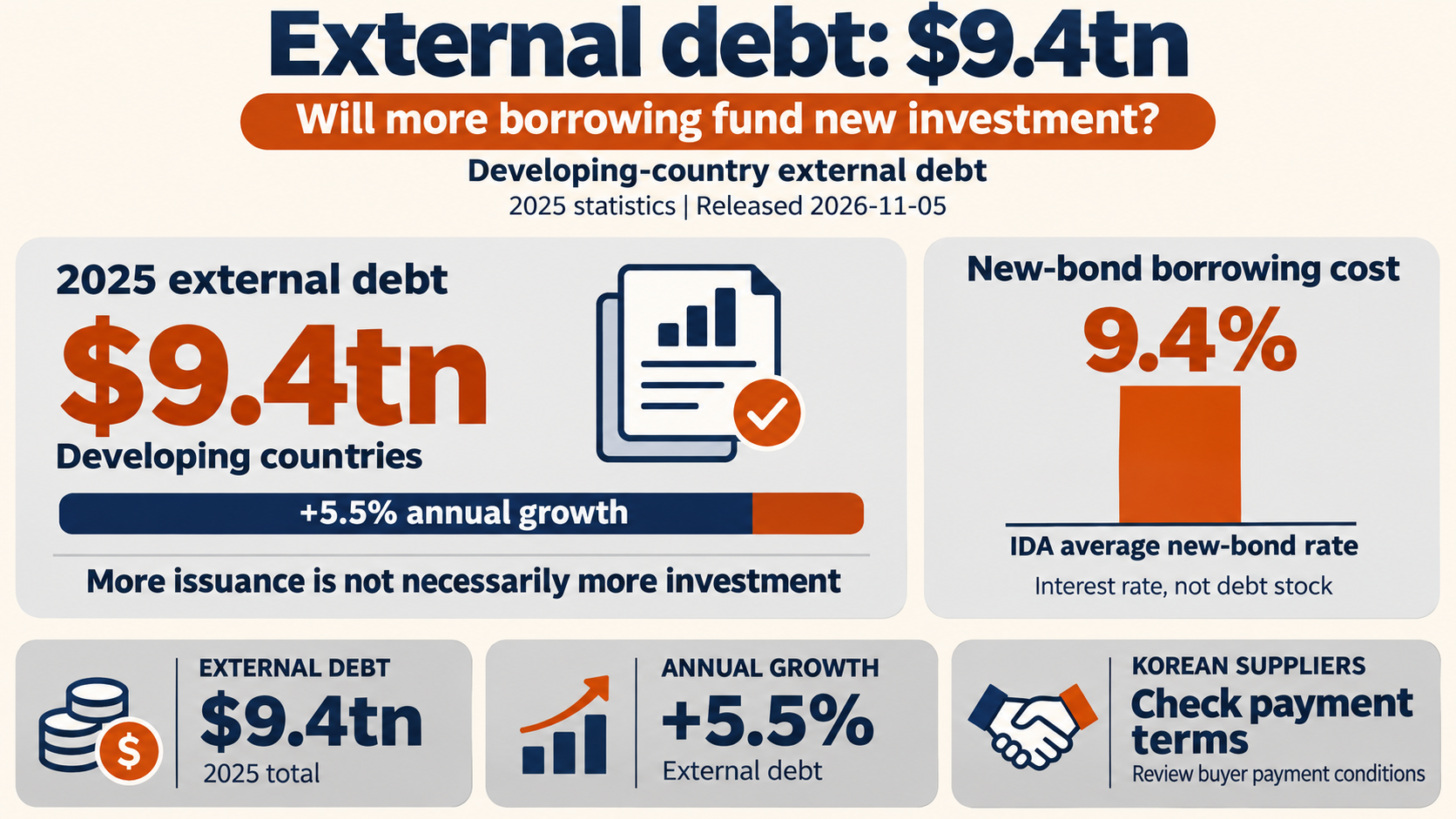
Developing-country external debt reached $9.4 trillion in 2025, up 5.5%, according to the World Bank’s November 5, 2026 release. For Korean suppliers, the next question is where the money goes: into power plants and factories, or into repaying existing debt. Source: World Bank
A successful bond sale provides cash for upcoming payments. But replacing old debt with expensive new borrowing can ease today’s liquidity shortage while tightening tomorrow’s budget. This report is best read through both effects.
External debt growth is not the same as investment spending
External debt is owed by residents, including governments and businesses, to nonresidents. It need not all be denominated in dollars. The developing-country figures here cover the report’s low- and middle-income economies; they are not a measure of every emerging-market asset.
Public entities issued $251 billion in bonds, nearly 35% more than a year earlier. These are not corporate bond issuance figures. Some governments used new issues to repurchase debt nearing maturity. Source: World Bank
This is refinancing. Moving payments into the future reduces a near-term repayment concentration. Yet the full proceeds do not become a budget for new roads. Gross issuance and cash remaining after repayment answer different questions.
Refinancing
Repays or buys back existing debt
·
· · Spreads maturities; limited new investment cash
Productive investment
Pays for equipment and infrastructure
·
· · Returns may improve future repayment capacity
Exchange-rate valuation also matters. More than a quarter of the $303 billion increase in public and publicly guaranteed debt reflected a weaker dollar. An unchanged euro obligation can become larger in dollar terms without delivering any new cash. Source: World Bank
New bonds at 9.4%: access comes at different prices
IDA, the World Bank’s International Development Association, provides concessional finance to eligible poorer countries. Concessional terms can include lower rates and longer maturities. Eligibility does not mean that a country’s privately sold bonds receive those terms.
IDA-eligible countries’ external debt rose 8.1% to $1.3 trillion. Their new bonds carried an average rate of 9.4% in 2025, against 5.5% for IBRD-only countries. These are different country groups, not a rate increase for the same borrower. Source: World Bank Source: Reuters cross-check
The average rate on new private-creditor commitments to IDA-eligible countries was 8.2%. That measure covers more than bonds and should not be conflated with the bond-only figure of 9.4%. Source: World Bank commentary
Average rates on new bonds in 2025. World Bank, Nov 5, 2026. IDA-eligible versus IBRD-only groups; not rates on entire debt stocks.
The difference has several possible drivers. Investors require compensation for default risk and difficulty trading a bond, on top of underlying market rates. Maturity and currency also matter. These group averages do not isolate each factor’s contribution.
Consider an illustration, not a country forecast. Refinancing $1 billion at a rate two percentage points higher adds $20 million in annual interest, assuming unchanged principal and no fees. Without additional revenue, the borrower must cut spending or finance the difference.
Applying the new rate to the entire existing debt stock would exaggerate the immediate burden. Fixed-rate debt may retain its old rate until maturity. The pace of adjustment depends on how much debt needs refinancing and when.
World Bank and IMF warnings: market access does not guarantee fiscal room
On November 5, World Bank Chief Statistician Haishan Fu welcomed the return of private lending but warned that some countries were borrowing and paying more while leaving less for development. Fu and Evis Rucaj’s accompanying official commentary also emphasized transparency: guarantees and complex financing arrangements can obscure repayment obligations. Source: World Bank commentary
IMF Fiscal Affairs Director Rodrigo Valdes said on October 14 that fiscal indiscipline in major advanced economies spills across borders. The IMF urged early action on fiscal risks and targeted, temporary support. The connection is straightforward: expensive financing constrains a government’s ability to support demand. Source: IMF, 2026-10-14
Our earlier article on Fed expectations and long-term financing costs separated policy rates from actual borrowing costs. Sovereign credit risk adds another layer here. This article does not attribute a response to this debt report to the Fed or the Bank of Korea.
Funding markets do not share a single mood. As of November 6 (UTC), CNN’s US Fear & Greed index stood at 23.1, extreme fear, down about 3.3 points from a week earlier and 24.0 from a month earlier. GoldKimp’s Korean measure was 78.7, extreme greed, dated November 5. Comparable Korean weekly and monthly observations were unavailable. Source: CNN Source: GoldKimp
A November 5 repost of a SentimenTrader update shows SentimenTrader Smart Money at 0.65, very optimistic, and Dumb Money at 0.55, neutral. The official homepage displayed no values, so treat these as indicative only. Different sentiment methods and dates cannot establish emerging-market flows. New-issue pricing and successful issuance are better tests of whether risk aversion is restricting funding. Source: SentimenTrader Source: Visible repost headline
For Korean suppliers, cash collection can weaken before orders disappear
The following is conditional analysis for Korean businesses, not an outcome established by the report. A government facing higher interest bills may delay a project or spread out payments. A Korean plant or power-equipment supplier could retain its contract value while waiting longer to collect cash.
Unpaid deliveries remain receivables. While waiting, a supplier must fund materials and wages from its own cash or borrowing. Financing costs can rise, and uncertainty over collection may require provisions. A growing order book therefore need not translate immediately into profit or operating cash flow.
-
1
Higher debt cost
May reduce fiscal room
-
2
Order/payment delays
Infrastructure and equipment postponed
-
3
Longer collections
Working-capital and interest costs
Project finance relies on a project’s future revenue to repay loans. Local-currency electricity revenue paired with dollar debt creates a currency mismatch. A government guarantee offers less protection if the guarantor’s finances weaken too. Projects with foreign-currency revenue, reliable long-term buyers and strong guarantees can be more resilient.
If country risk raises project loan rates and guarantee fees, projects unable to cover costs from expected revenue may shrink or be cancelled. Financing capacity may also change competition. Suppliers able to arrange long-term customer finance could have an advantage in tenders. Smaller intermediate-goods producers with limited working capital may need stricter delivery terms even when demand remains.
Household consumption and investment respond with a lag. Higher taxes or lower subsidies can squeeze disposable income, while delayed private investment can weaken machinery and component imports. Borrowing that fixes electricity shortages could instead raise productivity and future purchasing power. The use of funds and project returns determine the direction.
Watch refinancing terms, not just the debt headline
There is also a recovery signal. World Bank figures show long-term debt flows switching from a $118 billion net outflow in 2024 to a $45 billion net inflow in 2025. Access improved, but this alone does not establish how much cash remained after debt service or whether every country’s budget improved. Source: World Bank
For equities, who pays and when may matter more than the headline share of overseas sales. Longer-duration bonds can be sensitive to rate changes, while credit losses can overwhelm a high coupon. This report alone does not establish a buy or sell case for Korean stocks or emerging-market bonds.
Three checks are useful: the buyer country’s upcoming maturities and new borrowing rates; payment currency and guarantees; and the supplier’s receivables and operating cash flow. Lower refinancing costs and normal collections would ease concerns. More issuance alongside longer payment delays would call for closer scrutiny of order figures.
The $9.4 trillion external-debt total is a starting point. For Korean companies, the more direct question is how much financing becomes real orders and timely payments. This is economic analysis, not an individual investment recommendation.
Sources and references
- World Bank — International Debt Report 2026 보도자료, 2026-11-05
- Haishan Fu·Evis Rucaj — 세계은행 데이터 해설, 2026-11-05
- Reuters / Andrea Shalal — 세계은행 대외부채 보도, 2026-11-05
- IMF — Rodrigo Valdes 재정점검 발언, 2026-10-14
- CNN Fear & Greed — 제공 스냅샷 2026-11-06 UTC
- GoldKimp KOSPI F&G — 제공 스냅샷, 행 기준 2026-11-05
- SentimenTrader — 공식 홈페이지(수치 미표시)
- SentimenTrader 공개 게시물 재전송 — 검색 노출 수치, 2026-11-05
For information only — this is not a recommendation to buy or sell any asset.
Comments 0