Fed FOMC hold outlook — with the ten-year at 4.96%, will borrowing costs ease?
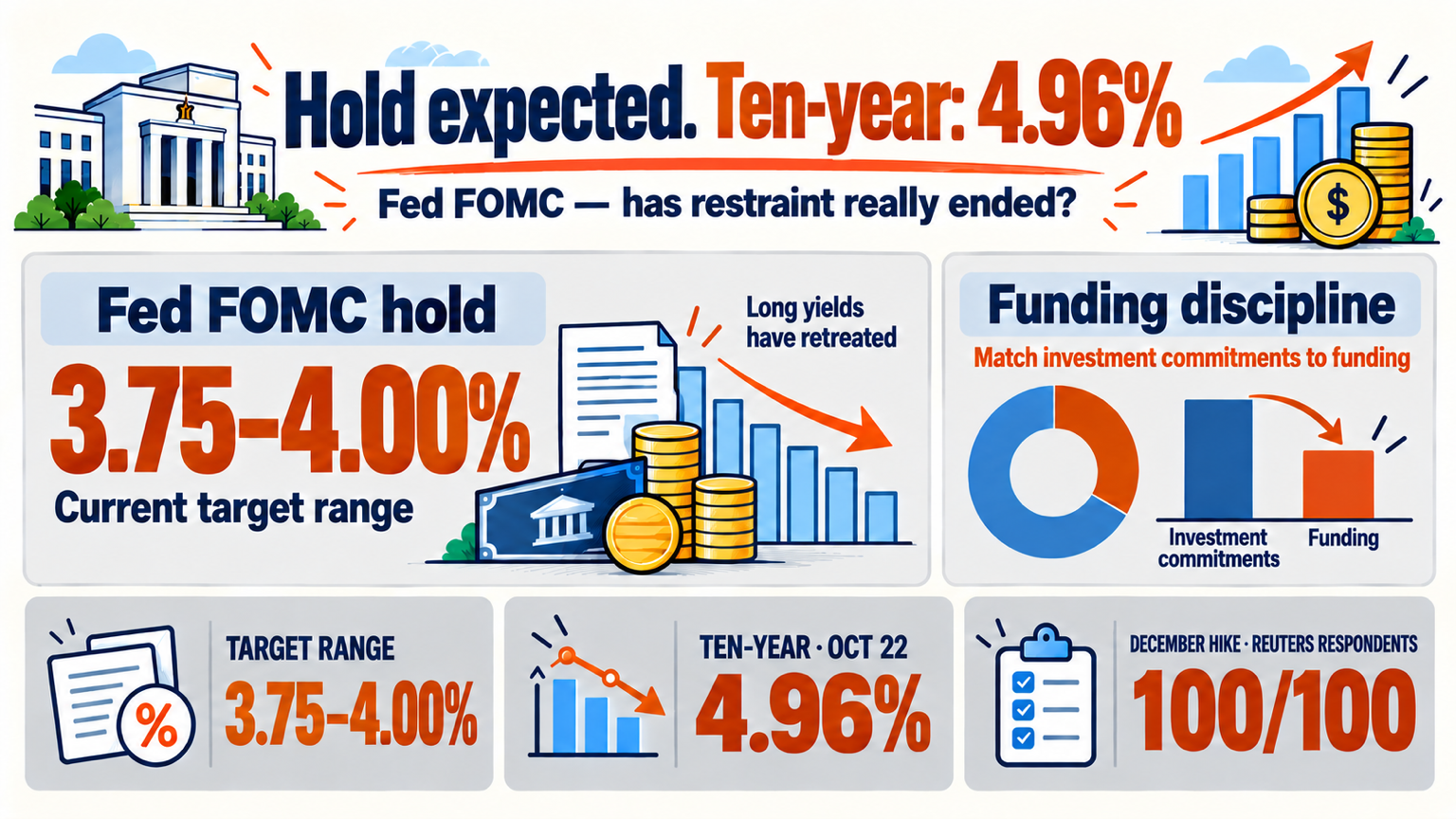
An October Fed FOMC hold is the consensus. In Reuters’ October 16–20 poll, 94 of 100 economists expected no change this month, while all expected a December hike. For Korean companies and investors, the crucial question is whether long-term funding stays expensive after a hold. Source: Reuters — October 16–20 poll, published October 20, 2026
This is a preview written on October 27, 2026. The decision is scheduled for October 28 at 2 p.m. Eastern, or October 29 at 3 a.m. in Seoul, with the press conference half an hour later. A forecast is not a completed decision. Source: Federal Reserve — October 2026 calendar
Fed FOMC hold: why December can still bring a hike
The current target range is 3.75%–4.00%, following a quarter-point increase on September 16. That rate anchors very short-term dollar funding; it does not specify every borrowing rate a company faces over the life of a factory. Source: FOMC — September 16, 2026 statement
The poll describes a possible sequence: pause to assess the last increase, then tighten again if price pressure persists. The bars count economists answering different questions. A respondent share is not a market-implied probability. Source: Reuters — October 16–20 poll, published October 20, 2026
Reuters poll: respondents to two different questions. Survey October 16–20. Not mutually exclusive outcomes or probabilities. · Axis starts at 91, not zero
The roughly 91% hold probability circulating in previews could not be verified against timestamped fed-funds futures data, so this article does not treat it as confirmed. CME FedWatch derives probabilities from futures prices; surveys and prediction-market contracts are different measures. Source: CME FedWatch — methodology; live probabilities unavailable
Ten-year yield from 5.15% to 4.96%: how much restraint remains?
The latest verified series does not show a one-way climb. The Fed’s October 23 H.15 release puts the ten-year yield at 5.15% on October 19, 5.13% on October 21 and 4.96% on October 22. The last move was a 17-basis-point decline. These are constant-maturity observations, not intraday highs or October 26 closes. Source: Federal Reserve H.15 — October 23 release, observations through October 22
That makes the case for a pause conditional. If companies must pay well above Treasury yields to borrow and homebuyers face costly mortgages, demand can already be restrained. Market rates can slow spending while the policy rate stands still. This is an economic interpretation, not the committee’s announced conclusion.
But if expectations of a pause pull bond and loan yields down quickly, restraint weakens. The expectation of waiting can partly erode the case for waiting. The press conference therefore matters for how persistent officials think restraint will be. Financial conditions include rates, equity prices, exchange rates and access to credit.
A long yield reflects expected future short rates plus compensation for holding a long-duration asset, known as the term premium. A rise driven by inflation uncertainty need not restrain demand like an equal rise in real borrowing costs. There is no fixed conversion from a 25-basis-point Treasury move to one policy-rate increase. Who is absorbing Treasury supply is covered in our October ten-year Treasury auction analysis.
Jefferson, Waller and the IMF: a pause, not an all-clear
On October 1, Vice Chair Philip Jefferson noted higher yields across maturities since September and said policymakers might need more time to form their judgment. He also discussed AI investment alongside energy and trade-policy shocks. His remarks support patience, not a promise that tightening is over. Source: Philip Jefferson — October 1, 2026 speech
On October 8, Governor Christopher Waller said additional hikes need not occur at consecutive meetings. The September FOMC statement paired solid activity with elevated inflation. That combination leaves room to pursue disinflation while adjusting the pace as evidence arrives. Source: Christopher Waller — October 8, 2026 speech Source: FOMC — September 16, 2026 statement
AI complicates the trade-off. Data-center construction immediately raises demand for equipment, electricity and construction labor, while productivity savings may arrive later. Energy disruption adds a supply problem that higher rates cannot directly repair. Strong growth does not erase inflation risk, but an energy shock alone does not establish that every investment project is excessive.
In its October 13 financial-stability briefing, the IMF warned that AI earnings disappointments and sovereign-yield shocks could expose vulnerabilities. A practical implication is uneven adjustment: cash-rich companies may keep investing while externally financed projects pull back. Resilient aggregate investment need not mean easy financing for everyone. Leverage risk in the Treasury market is detailed in our IMF hedge-fund leverage warning analysis. Source: IMF — October 13, 2026 GFSR briefing
Korean businesses: match US project commitments to funding
Consider a Korean company planning a US factory. Even with unchanged revenue projections, higher long-term funding costs raise the return needed to justify the project. A company that has committed construction spending but not secured financing is more exposed. This is a contractual mechanism, not a forecast that any named company will cancel a plant.
-
1
Commit spending
Construction and equipment contracts
-
2
Secure funding
Rates and spreads at issuance
-
3
Reassess returns
Phase investment if returns fall short
New long-term dollar bonds are priced against comparable Treasury maturities plus a company-specific credit spread. Short-term floating loans depend more directly on their contractual reference rate and reset date. A wider spread can offset a Treasury decline. Existing fixed-rate coupons do not immediately reset.
This can change competitive positions. Internally financed firms can maintain supplier commitments, while leveraged rivals may phase orders or delay expansion. Yet even a cash-rich customer can postpone purchases if expected AI returns weaken. Korean equipment and materials suppliers need to track both financing and customers’ investment economics.
Credit-sensitive purchases such as homes and cars can respond early. If US households postpone buying because monthly payments are too high, weaker unit sales may outweigh currency benefits for exporters. Lower long yields can support equity valuations, but not necessarily when the decline reflects deteriorating earnings prospects.
The dollar and hedging amid different risk appetites
A hold alone does not establish a stronger-won outlook. If it is already priced, new information comes from the December path and inflation assessment. A more hawkish surprise could support the dollar, but risk aversion and Korean export receipts also matter. Rate differentials do not determine exchange rates on their own.
An FX hedge fixes or limits the future exchange rate. An exporter selling future dollars and a company buying dollars for US investment face opposite transactions. Maturity-matched interest differentials and dollar-funding imbalances affect pricing. A higher ten-year Treasury yield does not raise every company’s hedge cost in the same way.
CNN’s Fear & Greed Index read 26.8, or fear, at 17:58 UTC on October 26. That is up 6.0 points from 20.8 a week earlier but down 10.1 from 36.9 a month earlier. Risk appetite has not regained its month-earlier level despite expectations of a pause. The index does not establish that the FOMC caused those changes. Source: CNN Fear & Greed — October 26 snapshot
GoldKimp’s October 23 KOSPI reading is 72.2, or greed. Different methods and dates preclude a direct numerical comparison, but the sentiment labels contrast. Comparable Korean weekly and monthly history was unavailable. Local optimism cannot guarantee US customer orders or favorable dollar funding. Source: GoldKimp KOSPI Fear & Greed — October 23 observation
SentimenTrader’s public page showed neither Smart Money nor Dumb Money Confidence values nor an update date on October 27. No inference about a divergence between those groups is made here. Observable sentiment readings are context for funding risk, not a substitute for financing data. Source: SentimenTrader — public page checked October 27
After the decision, watch what changes in financing
A hold accompanied by persistent inflation concern would give companies little reason to expand budgets simply because yields eased. A stronger warning about demand could lower yields while weakening export orders. An unexpected hike would require repricing short-term funding first. These are conditional scenarios, not forecasts.
At the Seoul-time announcement, read the inflation and growth assessment, then compare Treasury yields with corporate spreads and actual loan offers. Whether financing has eased becomes clearer in the price of a new contract than in the headline announcing a hold.
Our earlier September FOMC minutes analysis examined the tightening direction and dollar cash flows. This meeting tests the conditions for pausing along that path, especially whether restraint survives a retreat in long yields. This article explains economic mechanisms and does not recommend a trade.
Sources and references
- Federal Reserve — October 2026 calendar
- FOMC — September 16, 2026 statement
- Reuters — October 16–20 poll, published October 20, 2026
- Federal Reserve H.15 — October 23 release, observations through October 22
- Philip Jefferson — October 1, 2026 speech
- Christopher Waller — October 8, 2026 speech
- IMF — October 13, 2026 GFSR briefing
- CNN Fear & Greed — October 26 snapshot
- GoldKimp KOSPI Fear & Greed — October 23 observation
- SentimenTrader — public page checked October 27
- CME FedWatch — methodology; live probabilities unavailable
For information only — this is not a recommendation to buy or sell any asset.
Comments 0