ECB Economic Bulletin: 3.8% Inflation and Tighter Credit Despite a Rate Hold
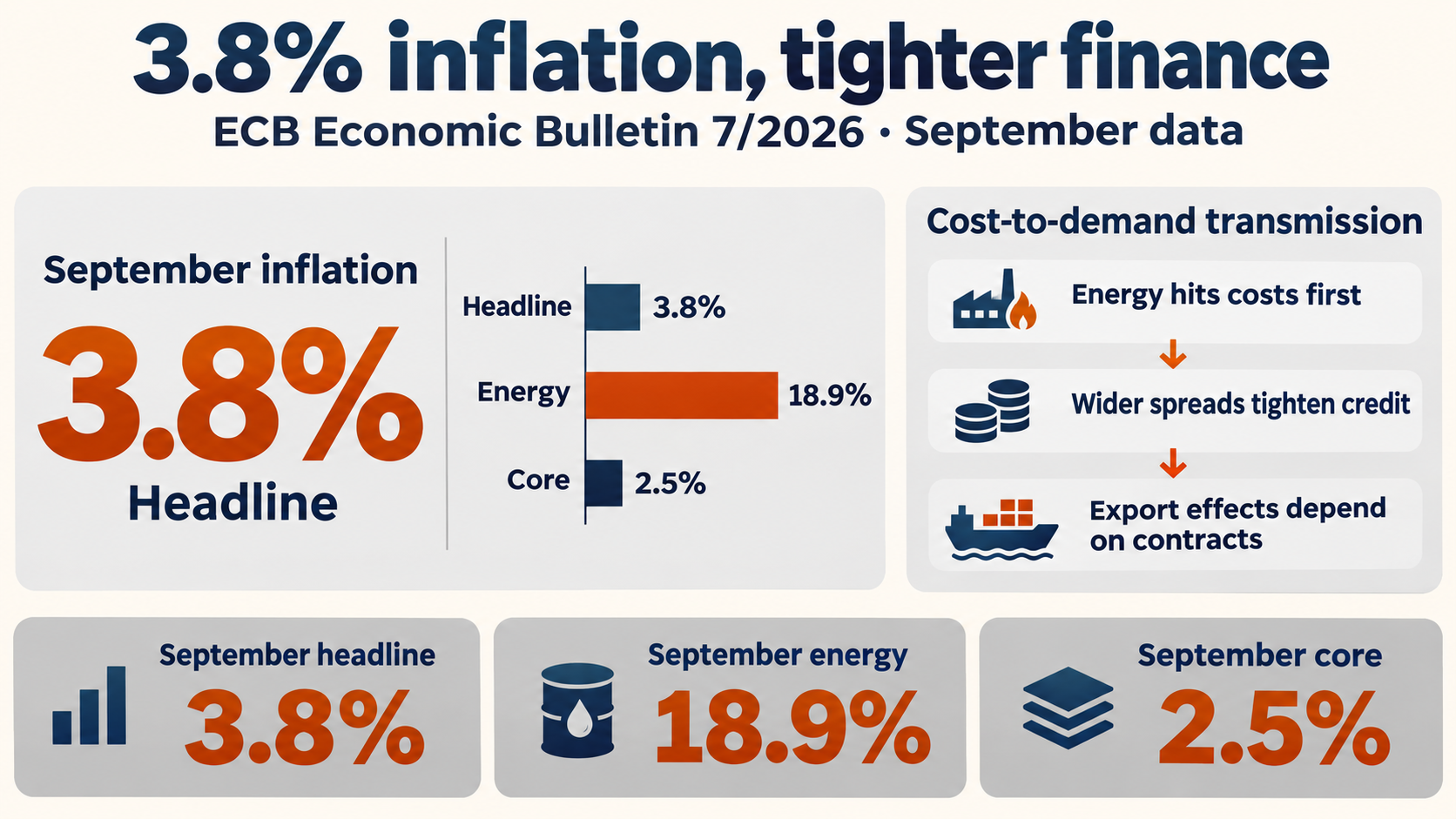
The ECB Economic Bulletin shows how energy inflation and tighter finance can squeeze Europe together. September consumer inflation reached 3.8%, with energy up 18.9% year on year. Korean exporters need to consider purchasing power, financing terms and invoice currencies. Source: Source
Published on November 12, the bulletin explains the October 29 decision to hold rates; it is not a new rate decision. Tighter financial conditions also do not mean every interest rate rose. Source: Source
Reading the ECB Economic Bulletin: dates matter
HICP puts euro-area consumer prices on a harmonised basis. The 3.8% figure refers to September. October’s available flash estimate was already 4.0%, with energy at 20.8%. The bulletin’s reference month and the latest available month differ. Source: Source
September inflation excluding only energy was 2.3%. The usual core measure, excluding energy, food, alcohol and tobacco, was 2.5%. Removing a relatively slow-rising food component can raise the remaining average. These measures are not interchangeable. Source: Source
September inflation: different baskets. Eurostat, September 2026. Core excludes energy, food, alcohol and tobacco. Rates, not contributions.
Energy prices move first; wages and selling prices follow later
Higher crude prices and refining margins can jointly push up pump prices. A refining margin is the price gap between crude inputs and refined products. ECB President Christine Lagarde highlighted energy prices and refining margins at her October 29 press conference. Source: Source
The next step is a business decision. A factory or carrier can raise prices or absorb higher fuel and electricity costs in margins. Fixed-price contracts and customer resistance delay pass-through. A cost shock need not appear in consumer prices in the same month.
Second-round effects arise when workers seek compensation for lost purchasing power and firms pass higher wage bills into prices. But weaker spending can limit those price increases. The same energy shock can therefore raise inflation while weakening activity.
-
1
Energy costs
Input costs rise
-
2
Prices or margins
Absorption reduces margins
-
3
Spending decisions
Less purchasing power and cash
The ECB describes underlying inflation as broadly stable, without a material wage response so far. That is not proof that the shock is over. Future wage negotiations and contract renewals remain important tests. Source: Source
Why a rate hold can still leave firms facing tighter finance
A corporate borrowing rate combines a reference rate with compensation for risk, called a spread. Greater concern about default or fiscal stability can widen spreads even when the reference rate falls. Banks can also tighten collateral requirements or lending limits.
From September 10 to October 28, ten-year OIS reference rates fell, but sovereign and corporate spreads widened. The euro lost 4.2% against the dollar. Expected cumulative policy tightening also declined. Wider spreads, rather than simply more expected hikes, matter here. Source: Source
Thin-margin businesses with debt coming due can feel the squeeze first. Refinancing means replacing maturing debt with new borrowing. Companies that locked in fixed-rate funding for longer may feel it later. Firms in the same sector can therefore have very different exposures.
Our earlier article on French sovereign yields and spreads follows the same channel: sovereign risk can affect bank funding and then corporate credit terms.
Korean cars and chips: inspect the contract before the revenue
The following is transmission analysis, not company earnings guidance. Car buyers respond to monthly payments as well as sticker prices. Higher energy bills and financing costs can delay replacement or shift purchases to cheaper vehicles. Discounts and subsidised finance may protect volumes while hurting margins.
Invoice currency changes the effect of a weaker euro. Dollar-priced chips can become more expensive for European buyers. Korean firms receiving euros need to examine won conversion. A fall in EUR/USD alone does not establish a fall in EUR/KRW; won moves and currency hedges matter too.
As an illustration, a 5% fall in EUR/KRW with unchanged euro revenue reduces that unhedged revenue’s won value by 5%. This is a hypothetical calculation. Euro-denominated local costs would also translate lower, changing the profit effect. Revenue currency alone is insufficient to estimate operating earnings.
Euro revenue, won costs
EUR/KRW and hedges
Check first
Possible effect · Lower won margins
Dollar invoice, EU buyer
Buyer’s euro outlay
Check first
Possible effect · Price pressure or delay
Chip demand also depends on the end market. Automotive and consumer-device orders respond to consumption and inventory adjustments. Data-centre orders depend more on capital budgets and project funding. Under long-term supply agreements, the first effect may appear in renewal prices or delivery schedules rather than current shipments.
Industry structure may shift as well. Cash-rich firms can invest in energy efficiency, while credit-constrained rivals remain exposed to high operating costs. Grid and efficiency suppliers may see opportunities, but an interested customer still needs financing before placing an order.
Lagarde and Georgieva warn, while market sentiment moves on its own
Lagarde said on October 29 that a hike was discussed, but the final hold decision was unanimous. Officials wanted additional evidence. A possible December hike is not a decided hike: both broader price pressure and the demand effects of tighter finance matter. Source: Source
IMF Managing Director Kristalina Georgieva said on October 14 that tightening has a stronger case where above-target inflation coincides with strong activity. She also supported temporary, targeted protection for vulnerable households facing energy costs. Source: Source
The IMF’s October outlook identifies energy importers outside technology value chains as particularly exposed. Korean firms likewise face different combinations of technology demand and energy costs. As in our earlier IMF outlook analysis, national growth alone cannot explain each exporter’s orders or margins. Source: Source
Market sentiment can diverge from these operating pressures. The supplied CNN snapshot for November 12 reads 43.5, or fear: up 23.5 points from a week earlier, but down 1.7 from a month earlier. GoldKimp’s KOSPI reading was 80.7, extreme greed, on November 10. Comparable Korean weekly and monthly readings are unavailable. Source: Source
The methods and dates differ, so the scores are not directly interchangeable. Strong Korean risk appetite nevertheless does not establish a recovery in European purchasing power. If export stocks rally first, orders and financing terms still need separate scrutiny. Source: Source
SentimenTrader’s homepage loaded without values or a date. The latest visible mirrored public headline gives Smart Money 0.67 and Dumb Money 0.46 for November 9, equivalent to 67% and 46%. These are fallback confidence readings, not verified live values, fund flows or ECB hike probabilities. Source: Source
Watch pricing power and cash collection in the next results
The key uncertainty is how long energy costs stay elevated and who absorbs them. Stabilising energy prices with limited wage and services pass-through could ease pressure on purchasing power and margins. Broader pass-through would strengthen the case for further tightening, while firms unable to raise prices could suffer first.
For Korean companies, watch European order backlogs, discounts and receivable collection periods together. A large backlog can coexist with weaker cash flow if delivery or payment is delayed. Debt repricing dates and hedge expiries help explain why the same ECB hold means different things for different businesses.
This article analyses economic transmission. Sector implications are conditional inferences, not recommendations to buy or sell an asset.
Sources and references
- ECB Economic Bulletin 7/2026 (2026-11-12)
- Eurostat: Inflation in the euro area (2026-11-04)
- Christine Lagarde: Monetary policy statement and Q&A (2026-10-29)
- IMF: Global Policy Agenda briefing (2026-10-14)
- IMF World Economic Outlook (2026-10-13)
- CNN Fear & Greed (2026-11-12; supplied snapshot)
- GoldKimp KOSPI Fear & Greed (2026-11-10; supplied snapshot)
- SentimenTrader public homepage
- SentimenTrader public headline mirrored by teapawt (2026-11-09)
For information only — this is not a recommendation to buy or sell any asset.
Comments 0