OPEC Oil Supply Rebounds by 2.04 Million Barrels a Day: Will Korean Refiners Benefit?
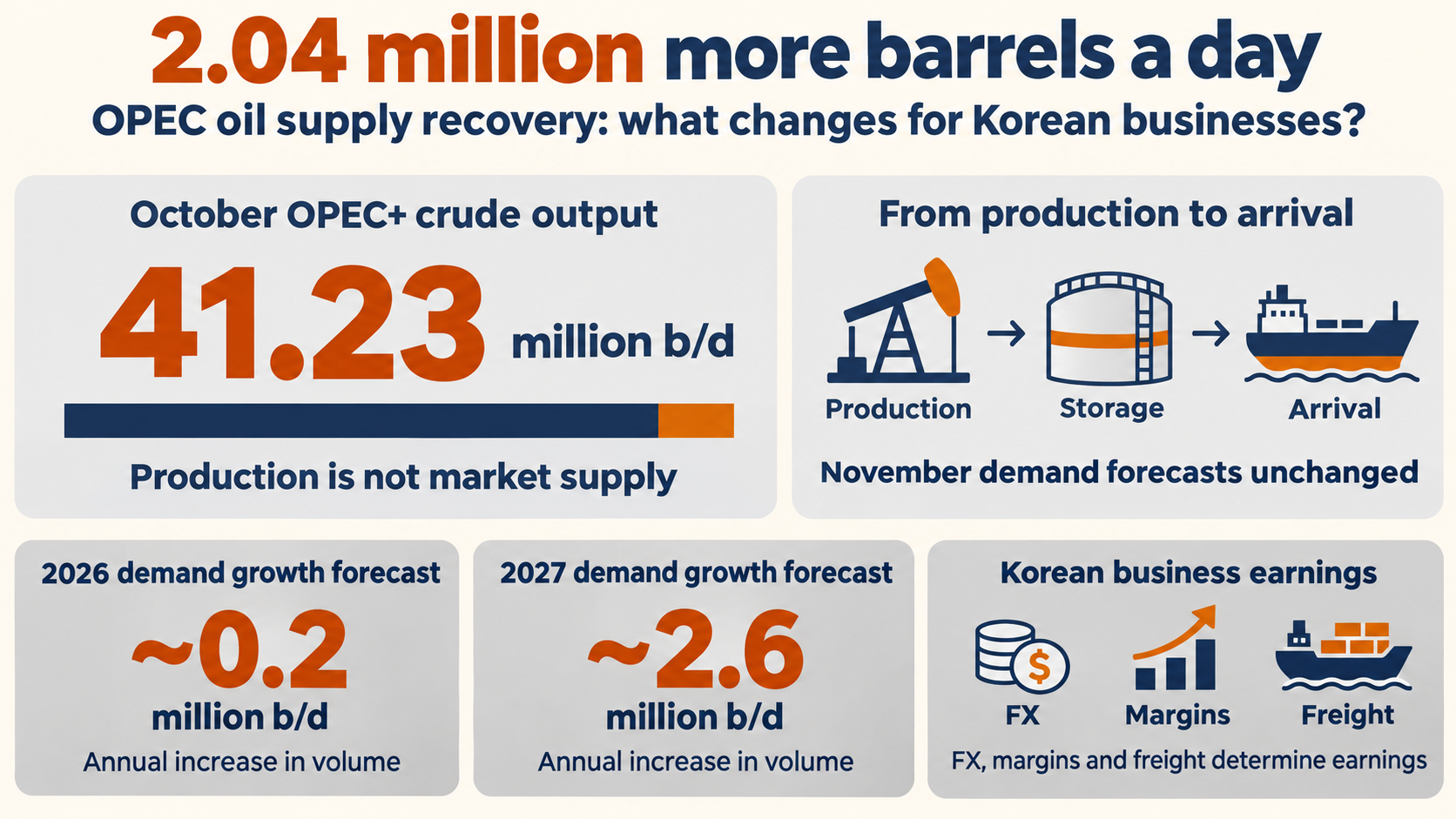
OPEC oil supply is recovering. Reuters reports that the November 11 monthly report put October OPEC+ crude production at 41.23 million barrels a day, up about 2.04 million from September. That can help Korean energy buyers, but refiners and airlines will not benefit in the same way. Source: Reuters / RTÉ · 2026-11-11
Barrels produced, barrels supplied to the market and barrels arriving at a Korean refinery are different quantities. Separating them explains when recovering supply can support spending—and why inventories can pull company earnings in opposite directions.
OPEC oil supply: what “97% of February’s level” actually means
OPEC+ brings together OPEC producers and cooperating countries such as Russia. The 41.23 million figure is a crude-production estimate for that group, not world petroleum supply or exports. Reuters compared it with February’s reported 42.72 million barrels a day, its prewar reference point, and rounded the ratio to 97%.
The arithmetic gives 96.5%, leaving a gap of 1.49 million barrels a day. The comparison below preserves the reported aggregates; it is not recalculated for constant membership. It cannot establish that global supply is 97% normalized.
OPEC+ crude: February reference and October recovery. Reuters / OPEC, Nov 11. Reported aggregates, not constant membership. Calculated ratio: 96.5%. · Axis starts at 40, not zero
Restoring transport routes helps explain the rebound. In its November 3 results, Aramco said the East-West Pipeline provided export flexibility. Spare capacity at a field is of little use when storage fills and terminals cannot ship. Reopening a route can allow existing facilities to run harder. Source: Aramco · 2026-11-03
Where did the extra Saudi barrels go?
Saudi Arabia reported October production of 10.563 million barrels a day. Bloomberg reported market supply of 9.203 million, a difference of 1.360 million. Market supply excludes movements into storage. OPEC’s external-source estimate was 9.194 million, close to the reported market-supply figure. Source: Reuters · 사우디 신고 Source: Bloomberg / Rigzone · 2026-11-11
Saudi Arabia: same month, different definitions. October 2026; OPEC figures reported by Reuters and Bloomberg. Different definitions and sources; do not average. · Axis starts at 8.5, not zero
The first lesson is to check definitions. Averaging a country’s submission with an external estimate does not produce a more accurate production number. Nor is the entire production-to-supply gap an extra export stream available to Korea.
Oil placed in storage is not immediately consumed, but it can provide protection against the next interruption. Oil waiting offshore for transfer or unloading may exist on a balance sheet without relieving a refinery’s shortage. Inventory location and availability matter alongside volume.
-
1
Production
Restore field output
-
2
Storage / loading
Buffers and transport access
-
3
Delivery / refining
Insurance, freight, capacity
-
4
Costs / spending
Depends on FX and products
Demand growth of 0.2 million this year, 2.6 million next: why the gap?
OPEC kept projected global oil-demand growth at about 0.2 million barrels a day for 2026 and 2.6 million for 2027. This was not a fresh November downgrade; after a run of earlier cuts, OPEC left the forecast unchanged. Source: OPEC · 발행 안내 Source: 11월 전망 유지 보도 Source: IEF · 10월 전망 교차확인
OPEC global oil-demand growth forecast. Unchanged November projections, rounded. Annual-average year-on-year changes, not monthly supply changes.
Both figures describe changes in annual average demand from the previous year. Subtracting 2026 demand growth from October’s monthly production increase would not measure a surplus: the time bases differ, and OPEC+ crude is narrower than global oil demand.
Higher energy prices can reduce household travel and raise production costs. Physical shortages can also prevent willing customers from consuming. Restored logistics may release some suppressed demand, while a weak comparison year can amplify the following year’s growth. These are mechanisms for interpreting the forecast, not proof of a coming boom.
The projection is not a market consensus. The International Energy Forum’s October 15 comparison showed OPEC forecasting demand growth for 2026 while the IEA and EIA expected contraction. That comparison is a month old, but it demonstrates how widely institutions differed in assessing the disruption. Source: IEF · 2026-10-15
Lower Korean import costs do not guarantee higher refining profits
For a Korean buyer, the starting cost is the dollar oil price multiplied by the won-dollar exchange rate, with freight, insurance and contract terms added. If oil fell 10% but the exchange rate rose 8%, the won cost would fall only 2.8%. This is an illustration—0.90 times 1.08—not a market forecast.
A refinery buys crude and sells gasoline, diesel and jet fuel. A refining margin measures the spread between product prices and crude costs. Margins can improve when crude falls first and product prices hold up. If product supply normalizes as well, product prices can fall and compress that spread.
Existing inventories complicate the earnings picture. Selling products made from expensive crude at lower prices can hurt results. The accounting effect depends on inventory holding periods and valuation methods. Falling oil alone is therefore insufficient to forecast a refiner’s quarterly profit.
Airlines and transport companies may benefit from cheaper fuel, but jet fuel and diesel must actually become cheaper. Price hedges and fuel-surcharge adjustments can delay the effect. Petrochemical producers similarly benefit from cheaper naphtha only if weak demand does not force even larger cuts to their selling prices.
Freight has its own economics. More exports can raise tanker demand and freight rates. Safer, shorter routes can instead reduce voyage and transfer time, freeing vessel capacity. A crude-production increase cannot by itself predict lower tanker rates, much less container rates.
For industry structure, access to ports, pipelines and overseas storage becomes more valuable. Companies may keep investing in diversified supply and emergency stocks even if spot prices fall. Those resilience investments require cash up front, so rising sales and rising free cash flow need not arrive together.
Aramco, the IMF and market sentiment: why relief lags the recovery
Aramco CEO Amin Nasser said on November 3 that the company was exploring additional overseas storage and alternative export routes. That helps explain the response: increasing output must be accompanied by more ways to deliver it to customers. Source: Aramco · 나세르 발언
In her October 16 speech, IMF Managing Director Kristalina Georgieva described an energy shock depressing growth while an AI boom supported it. She also highlighted the need to rebuild fuel reserves before winter. The implication here is that recovering output may first restore buffers, with relief for consumers arriving later. Source: IMF · 게오르기에바 연설
More stable costs can reduce pressure to raise prices and leave households more money for other spending. That does not automatically bring rate cuts: services inflation, wages and inflation expectations matter too. Our earlier discussion of ECB energy inflation and financing conditions connects this cost channel with the separate burden of financing.
Equity sentiment is not uniformly relieved. The supplied CNN snapshot for November 13 reads 37.8, or fear: up 13.4 points from 24.4 a week earlier, but down 7.8 from 45.6 a month earlier. GoldKimp’s KOSPI gauge reads 80.9, extreme greed, for November 12. Methods and dates differ, and comparable Korean weekly and monthly observations were unavailable. Source: CNN · 제공 스냅샷 Source: GoldKimp · 제공 스냅샷
SentimenTrader’s homepage did not display live values. Publicly mirrored account headlines show Smart Money at 0.64, optimistic, and Dumb Money at 0.51, neutral, on November 11; these are not directly verified current readings from the original site. Sentiment is not evidence of oil demand. Strong Korean risk appetite makes it especially useful to check whether expected energy relief becomes actual margin improvement. Source: SentimenTrader Source: 공개 헤드라인 대체 출처
In the next report, watch deliveries and inventories more than production
In the near term, watch whether loadings and deliveries increase and usable inventories recover. Then follow diesel and jet-fuel spreads, freight, insurance and the won-dollar exchange rate together. Their combined direction determines meaningful cost relief for Korean businesses.
Over a longer horizon, distinguish the cause of demand recovery. Stronger final consumption and industrial production can support Korean exports and investment. A recovery dominated by restocking may fade once inventories are replenished. Our World Bank commodity and inventory analysis provides the annual-outlook context.
OPEC schedules its next monthly report for December 14. The production rebound can ease scarcity. For Korean fuel bills and company earnings, the decisive barrels are those that arrive at an affordable cost and find customers. Source: OPEC · 발행 일정
Information cutoff: November 14, 2026. Official publication notices and institutional releases were checked; report figures were supplemented with Reuters and Bloomberg reporting. Production estimates, forecasts and conditional analysis are distinguished throughout. This is not a recommendation to buy or sell a particular asset.
Sources and references
- OPEC — November 2026 MOMR
- OPEC — MOMR release calendar
- Reuters / RTÉ — OPEC+ output nears prewar rate, 2026-11-11
- Reuters / Business Recorder — Saudi output, 2026-11-11
- Bloomberg / Rigzone — Saudi output and market supply, 2026-11-11
- Aramco — Q3 2026 results, 2026-11-03
- IMF — Georgieva plenary speech, 2026-10-16
- IEF — October report comparison, 2026-10-15
- Sada News — OPEC November demand forecast, 2026-11-11
- CNN Fear & Greed — supplied snapshot, 2026-11-13
- GoldKimp KOSPI F&G — supplied snapshot, 2026-11-12
- SentimenTrader — homepage
- SentimenTrader public headline mirror — 2026-11-11
For information only — this is not a recommendation to buy or sell any asset.
Comments 0