Treasury Bond Bid-Rigging: Korea’s KRW 1.627 Trillion Fine, Loan Rates and Financial Stocks
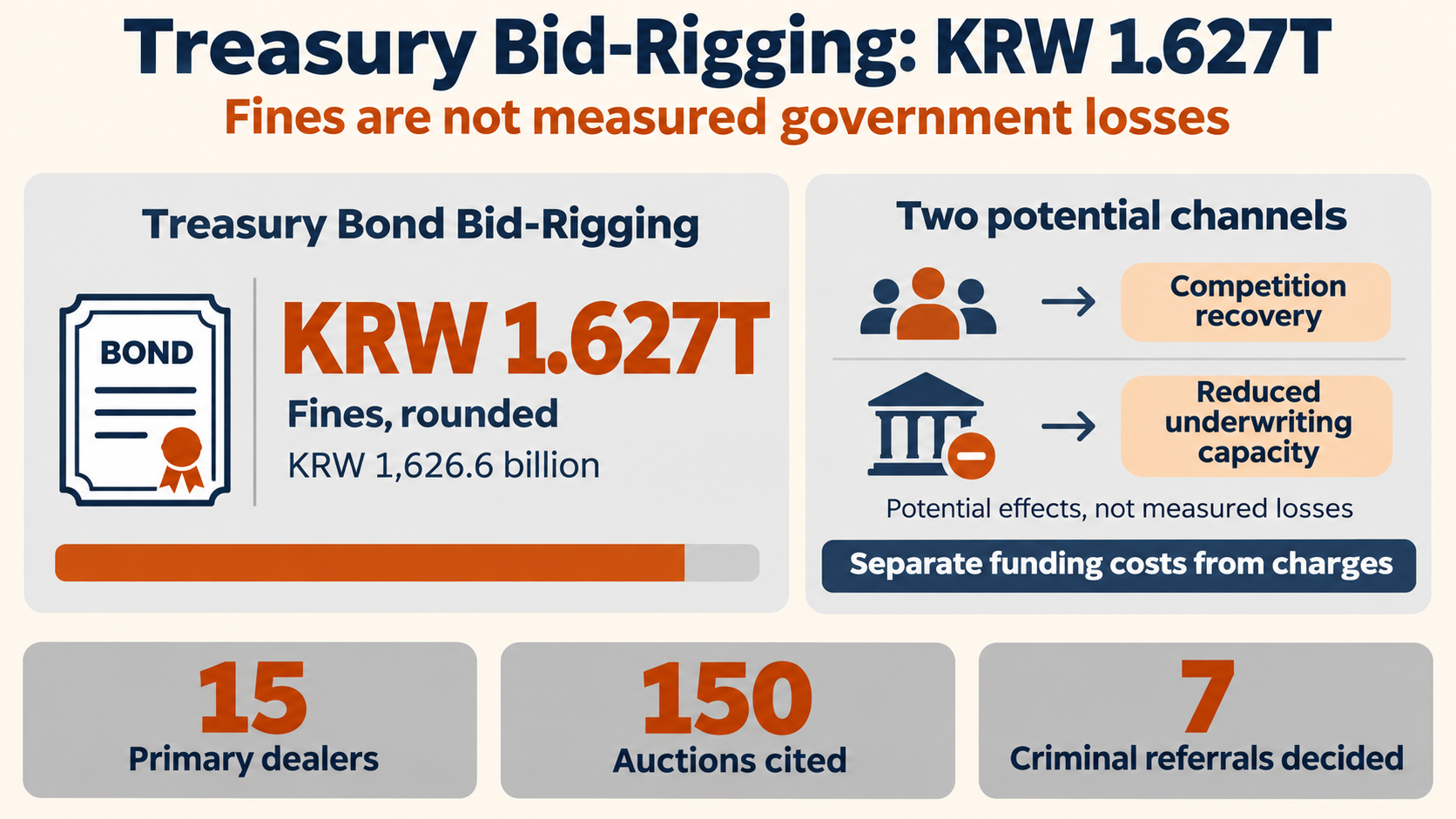
Korea’s Treasury bond bid-rigging case brings approximately KRW 1.627 trillion in announced fines for 15 banks and securities firms. The Korea Fair Trade Commission announced its decision on November 11, 2026. For shareholders, the immediate question is earnings; for borrowers, it is how funding prices are formed. Source: 공정위 발표 재게시·한국공정경쟁연합회, 2026-11-11
The fine is not a measurement of money lost by the government. Regulatory penalties, dealers’ improper gains and additional public interest costs are different quantities. Keeping them separate is essential when considering dividends and borrowing rates.
What the Treasury bond bid-rigging decision establishes
The precise announced total is KRW 1,626,575 million. The KFTC found exchanges of bid information or agreements on yields and quantities in 150 auctions between January 2020 and June 2023. It said 145 involved agreements beyond information exchange. Source: 공정위 발표 재게시·한국공정경쟁연합회, 2026-11-11
The agency also decided to refer seven firms to the Serious Crimes Investigation Agency: Mirae Asset, NH Investment & Securities, KB Securities, Kiwoom Securities, Korea Investment & Securities, Industrial Bank of Korea and Korea Development Bank. These are regulatory findings and referral decisions, not final criminal convictions or a guarantee of the eventual amount paid. Source: 뉴스핌·과징금 산정 및 회사별 금액, 2026-11-11
Why is the total so large? NewsPim reports that the KFTC used auction contract amounts rather than ordinary financial operating revenue as the relevant calculation base. Bond purchase principal can be much larger than trading profits. The fine therefore cannot be used to reverse-engineer the profitability of the conduct. Source: 뉴스핌·과징금 산정 및 회사별 금액, 2026-11-11
Why dealers matter when the government borrows
A Treasury bond allows the government to borrow in return for interest payments. The primary market sells newly issued bonds; the secondary market trades existing ones. Primary dealers, or PDs, are banks and securities firms that buy at issuance and help keep trading available afterward.
The issuer benefits when buyers compete by offering higher prices. For a given stream of principal and interest, a higher purchase price means a lower yield. If dealers coordinate to avoid bidding prices up, the government can face a higher financing cost relative to the proceeds it receives.
The republished KFTC account describes contacts one or two minutes before auction deadlines and handovers of counterpart contacts when staff changed. The economic issue is whether repeated interaction among a limited set of participants helped suppress competition. Underwriting obligations and inventory risks do not by themselves justify advance agreements with rivals. Source: 공정위 발표 재게시·한국공정경쟁연합회, 2026-11-11
How auction pricing can reach corporate borrowers
Corporate bond investors typically require compensation above the yield on a comparable Treasury. This additional yield, called a credit spread, reflects credit risk and trading conditions. If the Treasury benchmark rises, a company’s new borrowing cost can rise even when its spread is unchanged.
-
1
Auction competition
Weaker bidding can lower prices
-
2
Treasury yields
Interacts with secondary markets and macro conditions
-
3
Corporate and bank funding
Benchmark yield plus spread
-
4
Investment and consumption
Conditional on new-loan and refinancing rates
Transmission is not mechanical. Auction and secondary-market prices influence each other, while inflation expectations, anticipated Bank of Korea policy and foreign demand also affect trading. A distortion in one auction need not persist equally across every maturity or corporate bond.
Bank loans add another step because their benchmarks can depend on bank bonds or deposit funding costs. COFIX measures banks’ funding costs and does not simply copy an individual Treasury auction. Nor does this announcement immediately reset existing fixed-rate loans.
For scale, consider a hypothetical borrower refinancing KRW 1 trillion at a rate 0.10 percentage point higher. Annual interest would rise by KRW 1 billion: principal multiplied by 0.001. This is an illustration, not an estimate of the impact of this case.
If a funding shock persists, heavily indebted companies may postpone equipment spending or hiring, widening their investment gap with cash-rich rivals. Household consumption can weaken when new loans or floating-rate resets increase payments. Each of these outcomes depends on actual transmission into borrowing costs.
For financial stocks, focus on the incremental charge
Exposure differs by firm. NewsPim reports fines of KRW 332.178 billion for KB Securities, 242.785 billion for NH Investment & Securities, 214.830 billion for Mirae Asset Securities, 147.306 billion for Shinhan Securities and 135.845 billion for Industrial Bank of Korea. The chart covers only the five largest reported amounts, not all 15 firms or a ranking of financial strength. Source: 뉴스핌·과징금 산정 및 회사별 금액, 2026-11-11
Five largest reported fines — KRW 100 million. NewsPim, November 11, 2026. Five of 15 firms; not profits or public losses.
Previously recognized provisions matter for earnings. If a firm has already booked an expected expense, the whole announced fine is not necessarily a new quarterly loss. Expense recognition and cash payment can also occur at different times. Disclosures need to distinguish existing provisions from additional charges.
A financial holding company consolidates its subsidiaries. Adding a KB Securities charge to the resulting reduction in KB Financial’s consolidated earnings would double-count the same impact. Bank common-equity capital ratios and securities firms’ net-capital measures also belong to different frameworks.
Dividends depend on retained capital, funding for growth and payout policy as well as earnings. An additional expense and capital reduction can constrain dividends or buybacks, but the available evidence does not support a specific cut estimate. If investors see a greater risk of recurring penalties, they may demand a higher return and assign a lower valuation.
Our earlier discussion of Basel III, lending and payout capacity raised a related point: profits and the capital left to absorb risk need to be assessed together.
Regulator vs. industry: restored competition or weaker dealers?
At the November 11 briefing, KFTC commissioner Kim Geun-seong explained that the agency applied a 30% reduction after considering, among other factors, that contract amounts were not equivalent to improper gains, according to Newsis. The distinction is between measuring damages and finding conduct that restricts competition. Source: 뉴시스·김근성 공정위 상임위원 브리핑, 2026-11-11
On the same day, Korea Financial Investment Association chairman Hwang Sung-yup warned that weaker dealer activity could burden public financing and market stability. The association also promised support for administrative litigation. This is the position of an industry representative, not proof that underwriting or foreign investment has already fallen. Source: 뉴시스·황성엽 금융투자협회장 입장, 2026-11-11
If competition improves
More independent price competition
Bidding
Possible effect · Less upward pressure on issuance yields
If dealer capacity falls
Less inventory and quote provision
Intermediation
Possible effect · Higher trading and funding costs
Bond supply matters too. On October 29, before the enforcement announcement, the finance ministry said November issuance would be KRW 5 trillion below its earlier plan. It planned KRW 12 trillion of competitive auctions and KRW 2 trillion of buybacks. These measures cannot accurately be described as a response to the November 11 decision. Source: 재정경제부·11월 국고채 발행계획, KDI 재게시, 2026-10-29
Lower supply can ease upward pressure on yields. Restored bidding competition, dealer capacity and changes in overseas rates can pull in other directions. This is why a post-announcement rise in yields alone would not identify the penalty as its cause. Auction demand and trading quotes need to be examined together.
Equity sentiment is not uniform. CNN’s Fear & Greed Index stood at 37.9 on November 11, in fear territory: 3.7 points above 34.2 a week earlier but 5.6 below 43.5 a month earlier. GoldKimp’s November 10 KOSPI gauge averaged 80.7 across its components, or extreme greed. US investors look cautious while Korean equities look exuberant. Comparable week-ago and month-ago Korean readings were not available, so no Korean trend is inferred. Source: CNN Fear & Greed·제공 스냅샷 2026-11-11 Source: GoldKimp KOSPI F&G·2026-11-10
SentimenTrader’s November 9 readings were Smart Money 0.67 and Dumb Money 0.46 (67% and 46%). The homepage does not display the figures, so these come from a secondary repost of its public posts and may differ from the latest values. They describe US equity sentiment, not the actual buyers of Korean sovereign debt; optimism in Korean stocks likewise does not erase firm-specific expenses. Source: SentimenTrader·공개 홈페이지 조회 Source: SentimenTrader 공개 게시물 재표시·11월 9일 값, 2차 출처
What the next auctions and disclosures can tell us
For auctions, watch bids relative to the offering size and the auction yield relative to contemporaneous secondary-market yields. A high bid-to-cover ratio is not automatically favorable if bids cluster at low prices. In secondary trading, wider bid–ask spreads or difficulty executing the same trade size would provide more direct evidence of weaker liquidity.
For international investors, the ability to transact meaningful size at reasonable prices may matter more than the headline fine. Better competition and transparency can help over time; reduced dealer inventory capacity can raise trading costs. Which effect dominates remains an empirical question, not a reason to declare foreign capital flight today.
This connects with our earlier article on US Treasury auctions and investor demand. The US participant mix cannot simply be applied to Korea, however. Here the useful evidence is local auction results, firm-specific provisions, the written decision and subsequent litigation.
The key question extends beyond the size of the fine. Watch the additional costs recognized by financial firms and whether competition improves without impairing the market’s ability to trade and absorb issuance. That is the route through which this story can affect investment and household interest costs. This article is explanatory analysis, not a recommendation to buy or sell an asset.
Sources and references
- 공정위 발표 재게시·한국공정경쟁연합회, 2026-11-11
- 뉴스핌·과징금 산정 및 회사별 금액, 2026-11-11
- 뉴시스·김근성 공정위 상임위원 브리핑, 2026-11-11
- 뉴시스·황성엽 금융투자협회장 입장, 2026-11-11
- 재정경제부·11월 국고채 발행계획, KDI 재게시, 2026-10-29
- CNN Fear & Greed·제공 스냅샷 2026-11-11
- GoldKimp KOSPI F&G·2026-11-10
- SentimenTrader·공개 홈페이지 조회
- SentimenTrader 공개 게시물 재표시·11월 9일 값, 2차 출처
For information only — this is not a recommendation to buy or sell any asset.
Comments 0