HG302 gene editing trial: one death among four patients, and the safety and cost questions left
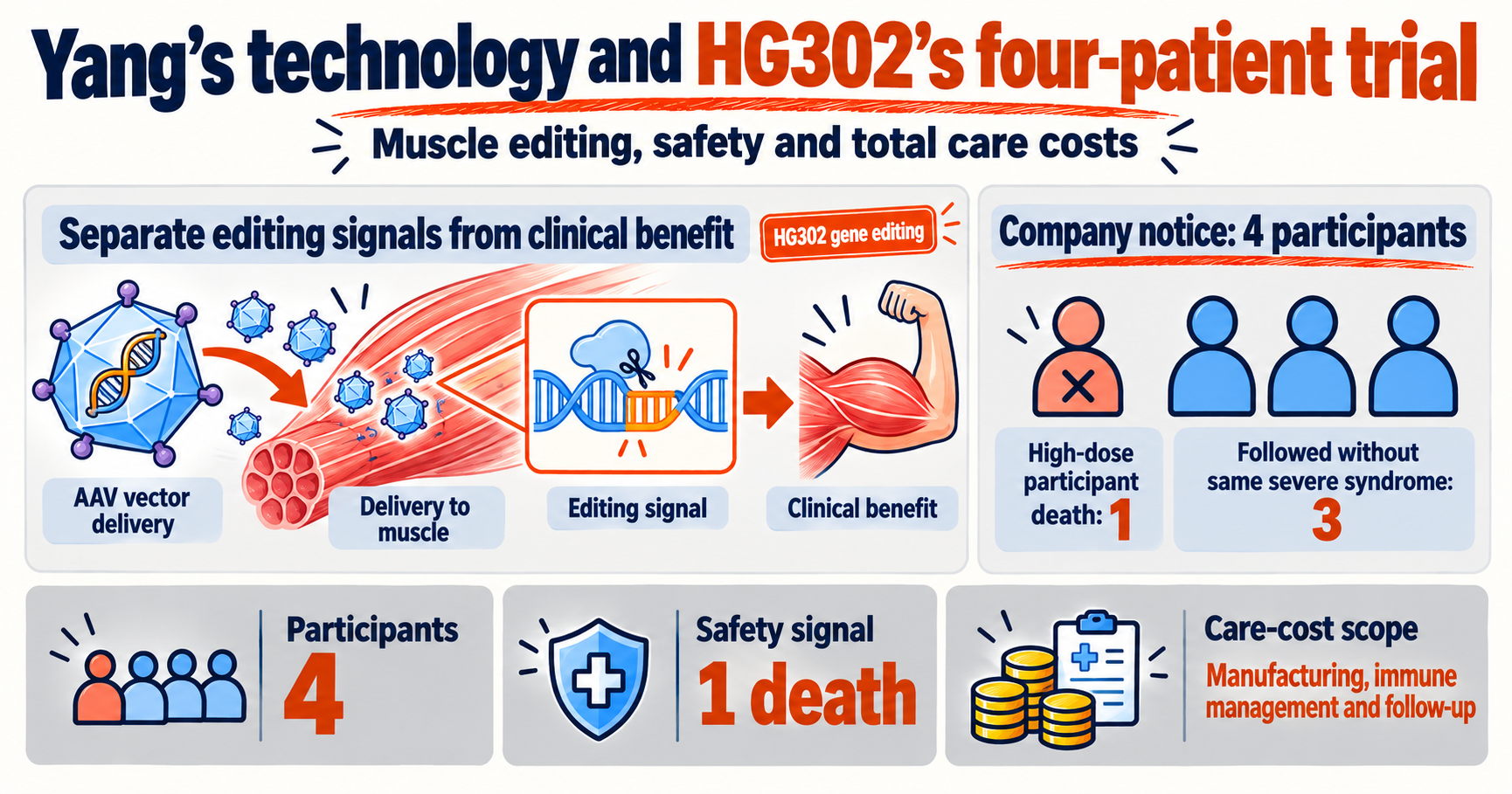
HG302 gene editing draws on technology developed by Hui Yang and Yingsi Zhou, whose foundational work listed HuiEdit and HuiGene affiliations. HuidaGene subsequently disclosed the death of one high-dose participant among four trial participants. The program raises a question that extends beyond editing DNA: what will it take to deliver a lasting benefit safely and affordably? Source: Protein & Cell — xCas12i 원천 연구 Source: HuidaGene — HG302 안전성 공지, 2026-08-05
Evidence note: this article uses public material checked on October 27, 2026. The nominated Cell paper, DOI 10.1016/j.cell.2026.09.059, could not be verified. Early clinical findings below are attributed to company disclosures, not presented as verified findings from that paper.
The people behind the technology and trial
Yang and Zhou were corresponding authors of the foundational Protein & Cell study engineering Cas12i. Hainan Zhang, Xiangfeng Kong and Mingxing Xue were credited with equal contributions. These are the technology paper’s authors; their roles in the unverified Cell clinical paper cannot be assumed. Source: Protein & Cell — xCas12i 원천 연구
Translation into patients requires a different set of skills. The company located MUSCLE at Shanghai Children’s Medical Center, affiliated with Shanghai Jiao Tong University School of Medicine. Alvin Luk presented early findings at ASGCT in 2025. Developing an enzyme and overseeing patient safety are distinct responsibilities; the clinical principal investigator could not be independently identified from the material obtained. Source: HuidaGene — MUSCLE 임상 개시, 2024-12-12 Source: HuidaGene — ASGCT 2025 초기 결과 발표
What HG302 gene editing aims to change
Duchenne muscular dystrophy involves a failure to produce functional dystrophin, a protein that helps protect muscle. HG302 is in vivo editing: an AAV viral carrier delivers an editing tool into the body. It is not ex vivo editing of cells removed from the patient. Targeting muscle also does not imply an injection limited to one muscle. Source: NIH SCGE — HG302 임상 등록정보
The company describes HG302 as targeting a DNA site involved in processing exon 51. Exons are segments used to assemble a protein’s instructions. For compatible mutations, skipping the relevant segment is intended to restore productive reading of those instructions. This neither replaces the entire normal gene nor addresses every DMD mutation. Source: HuidaGene — MUSCLE 임상 개시, 2024-12-12
The tool-engineering work connects to HuidaGene’s single-AAV design. Sarepta’s Elevidys instead delivers a gene for a shortened dystrophin. Editing existing DNA and adding protein-making instructions are different mechanisms. Neither description alone establishes superior safety or durability in patients. Source: HuidaGene — MUSCLE 임상 개시, 2024-12-12 Source: FDA — Elevidys 안전성·적응증 변경, 2025-11-14
HG302 design
Edit existing DMD DNA
Approach
Scope · Mutations amenable to exon 51 skipping
Elevidys
Deliver a micro-dystrophin gene
Approach
Distinction · Gene-transfer therapy
A muscle signal is not yet a proven patient benefit
The company’s account of Luk’s early presentation reported vector DNA in muscle, on-target editing and trace dystrophin. These observations occupy different steps in the evidence chain. Delivery does not establish sufficient editing, and some editing does not establish durable preservation of walking ability. Source: HuidaGene — ASGCT 2025 초기 결과 발표
The distinction matters especially in a small, uncontrolled study. Changes in performance may reflect age, repeated testing or background treatment. A measurement in one biopsy also cannot stand in for whole-body, cardiac or respiratory benefit. Unverified tissue editing rates and protein-restoration percentages are therefore not supplied here.
-
1
Delivery
Detect vector in muscle
-
2
Editing
Verify target DNA changes
-
3
Protein
Assess amount, location and function
-
4
Clinical benefit
Establish durable function and safety
What the high-dose fatality leaves unresolved
HuidaGene’s August 5, 2026 notice reported that a high-dose participant died in August 2025, developing acute respiratory distress syndrome alongside severe complement and cytokine activation. Complement is an immune-defense protein system; cytokines are immune signaling molecules. The company described a severe immune-associated respiratory event. Source: HuidaGene — HG302 안전성 공지, 2026-08-05
The company said the other three participants did not develop the same severe syndrome and remained under long-term follow-up. One event among four participants is not a reliable population fatality estimate: doses differed and the sample is very small. The other participants’ experience does not establish overall safety either. Source: HuidaGene — HG302 안전성 공지, 2026-08-05
HuidaGene, Aug 5, 2026. Small sample with differing doses; not an estimate of fatality risk or safety.
This separates the editing specificity studied by Yang and Zhou from administration safety. Reducing edits at unintended DNA sites does not automatically eliminate immune responses to the carrier or editing protein. Their respective contributions, and the effects of dose and immunosuppression, require the full clinical evidence and independent review.
One administration does not end the cost calculation
The following is economic analysis, not a measured trial result. If HG302 eventually delivers durable functional benefit, it could reduce some recurring treatment, visits and caregiving burdens. Families might also recover working time. Those savings cannot be quantified before the relevant outcomes and their duration are established.
AAV manufacturing and quality control sit at the front of the cost chain. Lower vector requirements at the same body weight could let a fixed output serve more patients, provided efficacy is preserved. But facility, batch-testing and rejected-material costs remain. Halving dose would not automatically halve either manufacturing cost or price.
Screening, immune management, hospitalization, severe-event care and follow-up add further costs. FDA guidance addresses monitoring for delayed risks; follow-up should be assessed for the product and risk involved. For the early signal presented by Luk to create economic value, durable patient benefit must justify these additional demands. Source: FDA — 유전자치료제 장기 추적 가이드라인
-
1
Manufacturing
Vector production and testing
-
2
Administration
Screening and immune management
-
3
Follow-up care
Adverse-event care and monitoring
What Sarepta and Precision teach Korean industry analysts
Sarepta provides a concrete example of safety affecting the eligible market. In November 2025, FDA added a boxed warning for serious liver injury and liver failure to Elevidys and limited its indication to ambulatory patients aged four and older. This should not be treated as the same mechanism as HG302’s respiratory event. It demonstrates how selection and safety management can alter commercial reach. Source: FDA — Elevidys 안전성·적응증 변경, 2025-11-14
Precision BioSciences describes PBGENE-DMD as using a different editor, ARCUS. Its page’s expectation of starting a trial in 2026 is a development plan, not proof of patient benefit or safety. Korean analysts should compare mutation eligibility, delivery, dose and verified development stage. HG302’s event alone establishes neither failure across competitors nor a commercial windfall for another company. Source: Precision BioSciences — PBGENE-DMD 개발 프로그램
Potential opportunities for Korean suppliers include lower-dose delivery, vector analytics, immune-response testing and follow-up infrastructure. These are inferred capability needs, not confirmed orders. Manufacturing contracts should be assessed against eligible patients, batch-testing costs and terms covering clinical interruption, rather than headline patient counts alone.
Our earlier discussion of ultrasound-assisted psCas12f editing focused on delivery research. HG302 raises the separate question of benefit and risk after systemic administration in people. Keeping engineering progress separate from human clinical validation makes both stories easier to assess. Related: Ultrasound-assisted psCas12f editing
HG302’s economics cannot be read from a single editing percentage. They depend on how many patients can be treated safely, how long function is preserved, and the total cost over that period. Turning the possibilities opened by Yang and Zhou’s technology into an industrial achievement requires clinical evidence across that gap. This article is not a recommendation to buy or sell any security, nor medical advice.
Assess HG302 through durable patient benefit, safety and total care costs.
Sources and further reading
For information only — this is not a recommendation to buy or sell any asset.
Comments 0