Attosecond X-rays measured at 100–400 as — Will Inoue's team cut drug and materials R&D costs?
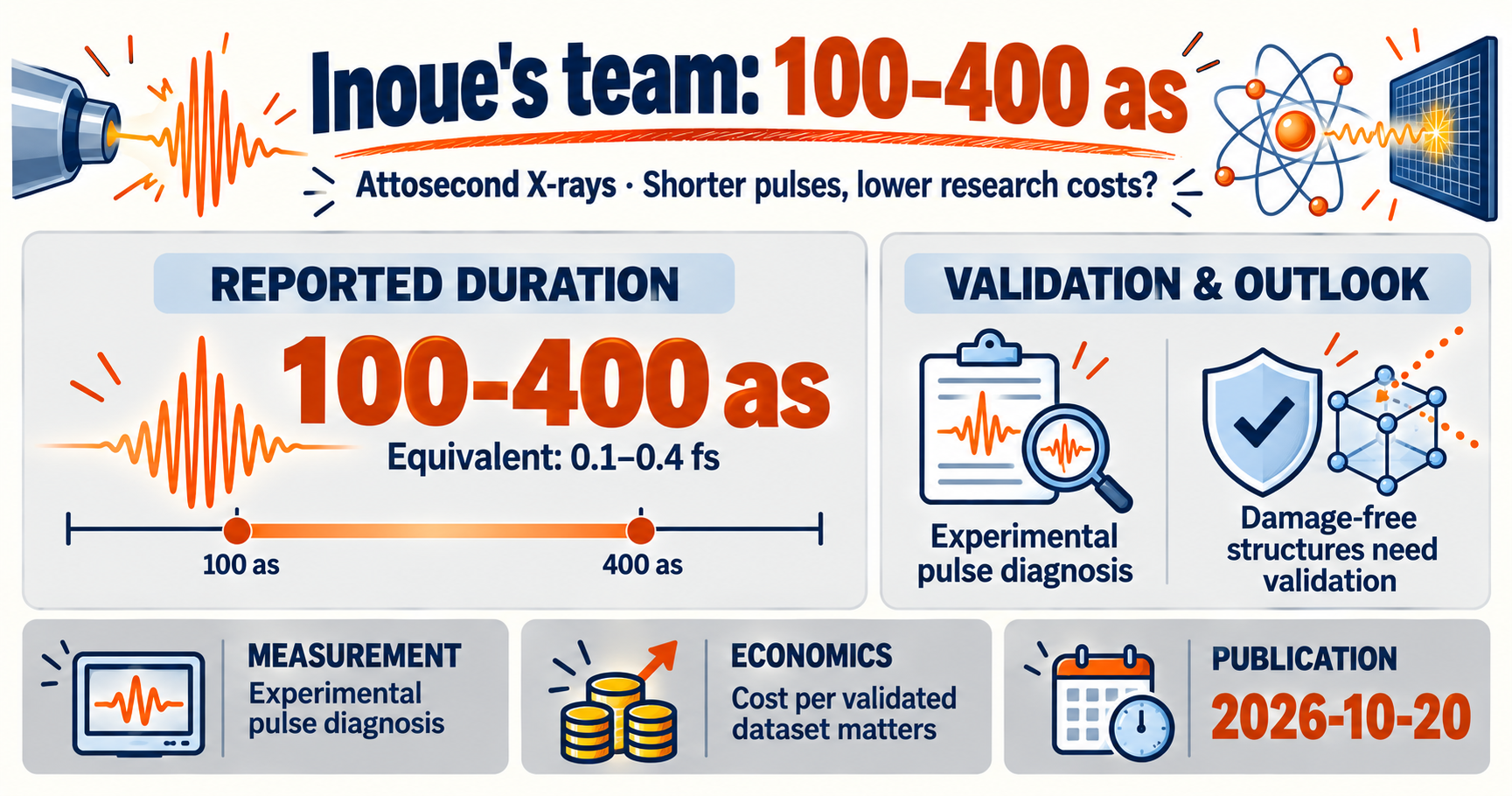
Ichiro Inoue of the University of Tokyo and RIKEN, Agostino Marinelli of SLAC and their collaborators have experimentally characterized attosecond X-ray pulses at LCLS. They report durations of 100–400 attoseconds. Turning that result into more productive drug and materials research will require reliable measurement tools. Source: Nature Photonics — Experimental demonstration of attosecond hard X-ray pulses Source: Authors’ preprint — experimental methods and limitations
The paper appeared in Nature Photonics on October 20, 2026, following a public manuscript in 2025. Its significance is the experimental evidence, rather than a claim that the entire field began this week. Source: Nature Photonics — Experimental demonstration of attosecond hard X-ray pulses Source: Authors’ preprint — experimental methods and limitations
Inoue, Marinelli and Sato: three skill sets in one experiment
Inoue led the diagnostic concept, experiment and analysis. Co-first authors River Robles and Aliaksei Halavanau worked with Marinelli and colleagues on beam simulations and pulse shaping. Takahiro Sato led the design of the copper-emission measurement setup. Source: Nature Photonics — Experimental demonstration of attosecond hard X-ray pulses
Their earlier work in 2025 addressed tightly focusing hard X-ray pulses. SLAC has also described its X-ray optics collaboration with Inoue. Accelerator control and precise delivery of the beam to a sample are complementary skills; this experiment needed both. Source: SLAC — Nanofocused attosecond hard XFEL (2025) Source: SLAC — Creating the perfect X-ray pulse
What attosecond X-rays can reveal
An attosecond is one quintillionth of a second. One femtosecond equals 1,000 attoseconds, making the reported range 0.1–0.4 femtoseconds. Think of a shorter exposure: it can reduce temporal blur, but an exposure alone does not produce a complete image.
100–400 as is the reported range, not a mean, error bar or guaranteed specification. Source: authors’ manuscript.
Chemical reactions involve changes in electronic states as well as nuclear positions. In separate work, SLAC has described probing early electron motion through X-ray absorption: which photon energies a material absorbs reveals information about its electronic state. The new diagnostic helps establish the tools needed for such fast measurements. Source: SLAC — First steps in a chemical reaction
Spatial and temporal resolution are different. Short hard-X-ray wavelengths help probe small structures, while short pulses help distinguish rapid changes. A pump–probe experiment also depends on synchronization between the pulse that starts a reaction and the one that measures it. Shortening the probe does not eliminate timing errors or beam-time queues.
How Sato’s copper experiment measured time
Copper acted as a diagnostic material in Sato's setup. The team measured amplified spontaneous emission and compared it with a physical model to infer pulse duration. This is an indirect diagnostic, not a direct movie of the pulse. Source: Authors’ preprint — experimental methods and limitations
Some pulses were consistent with being near the transform limit—the shortest duration supported by their bandwidth. This does not mean every shot was identical. The public manuscript describes pulse-to-pulse variation and weaker discrimination at low signal levels. Source: Authors’ preprint — experimental methods and limitations
Single-shot pulse diagnosis is not single-shot protein structure determination. A short pulse may reduce distortion while damage develops, but it does not guarantee sample survival or enough scattering signal for a complete structure.
Established here
Hard-X-ray pulse duration
Object
Method · Emission signal and model comparison
Still to establish
Structure and reaction studies
Application
Cost · Lower cost per validated dataset
Research costs are not set by beam time alone
The economic implications below are conditional analysis, not measured savings from Inoue's experiment. LCLS generally provides non-proprietary access without a facility charge, while users cover travel and some exceptional consumables. Proprietary work is subject to full-cost recovery and advance payment. Source: LCLS — Proposals Source: LCLS — Proprietary Research
For public research, savings could come mainly from sample preparation, staff time and fewer repeat experiments. For proprietary users, a genuine reduction in booked time could also affect facility charges. Neither case supports translating a shorter pulse into an equal percentage reduction in cost.
A useful metric is total preparation, sample, facility, staffing and analysis cost divided by validated datasets. Extra tuning or discarded shots can raise that cost even while the shortest-pulse record improves. More decision-quality data from the same resources would improve productivity.
-
1
Reliable operation
Control tuning and diagnostic overhead
-
2
Usable data
Validate sample signal and repeatability
-
3
Less rework
Only if repeat experiments and analysis decline
-
4
Check total cost
Compare per dataset including preparation
LCLS already describes standard configurations that reduce repeated setup and testing. Industrial users need that repeatability. Pulse shaping must become dependable operation and diagnosis before the capability can scale beyond experiments requiring extensive specialist intervention. Source: LCLS — Proposals
Opportunities in R&D and instrumentation
For catalysts, distinguishing reaction pathways could help avoid synthesizing and testing unproductive candidates. As our look at Source: plastic-recycling catalyst regeneration showed, catalyst economics often hinge on repeated testing and regeneration rather than lab performance alone. For proteins, less damage-related distortion could improve interpretation. Neither a shorter drug-development schedule nor cheaper catalyst production was demonstrated here; these applications need controlled comparisons on real samples.
Potential markets include focusing optics, pulse diagnostics, detectors, automated sample delivery and analysis services. These are inferred needs, not verified supplier orders. Research infrastructure has a limited customer base and lengthy qualification cycles, so new capability does not immediately translate into supplier revenue. Nothing here is a recommendation to buy or sell any stock.
Infrastructure investment is a separate question. DOE's FY2026 budget justification gives a $716 million total project cost baseline for LCLS-II-HE. That project expands high-repetition-rate hard-X-ray capability; the figure is neither the price of this experiment nor annual operating cost. Its repetition-rate goals must not be presented as demonstrated specifications of these attosecond pulses. Source: DOE — FY2026 Congressional Budget Justification, Vol. 5 Source: LCLS — LCLS-II-HE
What Korea’s PAL-XFEL would need to establish
Korea has PAL-XFEL, which has provided user service since 2017. This creates a basis for assessing changes to beam shaping, optics and diagnostics at an existing facility. It does not establish that the LCLS mode can simply be transferred. Source: PAL — PAL-XFEL 원리소개
An industry–academic trial should start with a question existing tools cannot answer well. Which electronic state in a battery material or catalyst matters, and does the measurement improve interpretation? Reproducibility, preparation and analysis time should then be tracked together. This research did not establish a confirmed Korean deployment schedule or upgrade budget.
Our discussion of Source: MassNet and protein-analysis costs raises a related question through a different technique: can a new tool improve development decisions and reduce rework?
Inoue and colleagues strengthen the experimental foundation for accessing shorter timescales. What matters next is the reliability and repeatability of the science produced with the tool. Its near-term value is more likely to be in difficult research problems than in wholesale replacement of established analytical services.
Assess shorter pulses through the total cost of validated experimental data.
Sources and further reading
- Nature Photonics — Experimental demonstration of attosecond hard X-ray pulses
- Authors’ preprint — experimental methods and limitations
- SLAC — Nanofocused attosecond hard XFEL (2025)
- LCLS — Proposals
- LCLS — Proprietary Research
- DOE — FY2026 Congressional Budget Justification, Vol. 5
- PAL — PAL-XFEL 원리소개
- SLAC — Creating the perfect X-ray pulse
- SLAC — First steps in a chemical reaction
- LCLS — LCLS-II-HE
For information only — this is not a recommendation to buy or sell any asset.
Comments 0