ECHO diabetes implant: six weeks in mice — could electrical glucose control cut treatment costs?
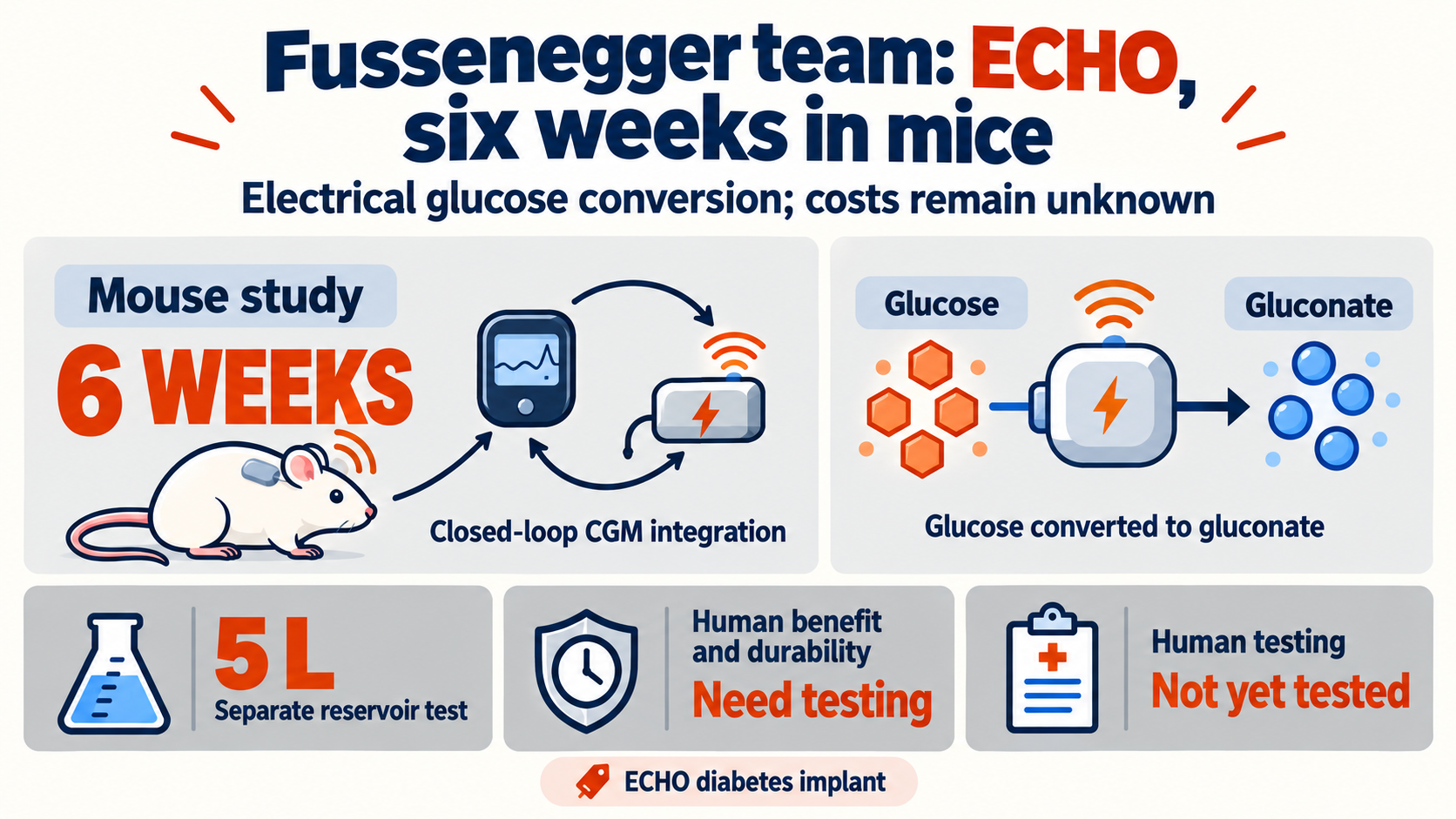
Martin Fussenegger’s team at ETH Zurich has reported ECHO, an experimental diabetes implant tested for six weeks in mice with type 2 diabetes and obesity. It controls glucose through electrocatalysis. The idea could change treatment economics, but human benefit remains unproven. Source: AAAS 연구 발표
A glucose-lowering device may sound like an insulin pump. The intriguing change here is the way the device intervenes in glucose metabolism. That distinction could eventually affect how treatment is manufactured and maintained.
The people behind the work
Fussenegger leads the work from ETH’s Department of Biosystems Science and Engineering in Basel. Debasis Maity is the first author; Preetam Guha Ray, Peter Buchmann and Ghislaine Charpin-El-Hamri are coauthors. Public institutional material does not say who handled the animal work or the circuit design. Source: ETH 연구진 소개
The lab’s 2023 DART study used direct current to regulate gene expression in engineered cells. ECHO takes that long-running interest in electronic control of biology in a different direction: an inorganic catalyst becomes the active component. Source: Nature Metabolism, DART 연구
What the ECHO diabetes implant does to glucose
Maity and colleagues use a platinum-decorated gold catalyst to convert glucose to gluconate for renal excretion. Gluconate is the ionized form of gluconic acid. Electrocatalysis uses electrical energy and an electrode’s catalytic surface to drive a chemical reaction. Source: AAAS — 작동 원리
A continuous glucose monitor, or CGM, repeatedly measures glucose in tissue fluid. ECHO links its readings to control through a smartphone. This feedback arrangement is a closed loop: the latest measurement determines the next action. Source: AAAS — 폐루프 제어
-
1
CGM
Measure glucose
-
2
Phone control
Use readings to control activation
-
3
Catalysis
Glucose → gluconate
-
4
Measure again
Feedback adjusts operation
The engineering control variable changes. A medicine’s action depends partly on absorption and clearance, whereas an electrode reaction can be regulated through current. But switching current off does not instantly stabilize whole-body metabolism. Sensor delays and reaction kinetics still need to be matched. This is an engineering interpretation, not a demonstrated clinical advantage.
Before calling it an alternative to insulin or GLP-1
Insulin helps the body use glucose. GLP-1 medicines affect several physiological processes, including insulin release and appetite. SGLT2 inhibitors increase urinary glucose loss by reducing renal reabsorption. Removing glucose-derived energy from the body is therefore not an entirely new therapeutic concept. Source: NIDDK — 당뇨 치료
Fussenegger’s distinguishing approach is direct chemical conversion. That does not establish equivalence to GLP-1 therapy. NICE’s 2026 guidance values cardiovascular and renal benefits alongside glucose control for relevant GLP-1 and SGLT2 treatments. Similar glucose readings need not mean equivalent long-term value. Source: NICE NG28, 2026
Drug-free describes the device’s glucose-lowering mechanism. It does not mean every patient could discontinue medication or that adverse effects disappear. Future trials would need to establish who, if anyone, could use it alone and who would still need combination treatment.
Between six weeks in mice and years of human treatment
ETH also reports conversion in five litres of glucose-containing nutrient solution. A volume comparable to human blood volume is not a human blood treatment or a clinical trial. The reservoir experiment and the animal study answer different questions. Source: ETH — 5 L 용액 시험
Reservoir
5 L nutrient solution
Scope
Meaning · Engineering conversion test
Mice
Six weeks
Duration
Meaning · Preclinical proof of concept
Humans
Not yet tested
Status
Needed · Long-term benefit, safety and cost
A human implant would need to work after prolonged exposure to proteins and tissue responses. Follow-up questions include catalyst retention, material release, product clearance and use in people with impaired kidneys. These are development questions, not claims that the study observed these failures.
Taking Maity and colleagues’ concept into a product would also link control reliability to cost. Developers would need to verify safe behavior when sensing or communication fails. Implantation, removal and software would require evaluation; removing biological components does not make authorization automatic.
The Science full text was inaccessible. This account therefore uses ETH and AAAS institutional announcements for the core findings. Sample sizes, detailed statistics and supplementary toxicology were not independently checked; no numerical weight-loss claim or claim of clinical superiority is made.
Lower drug spending would not remove the cost of care
The economic discussion from here is prospective analysis. Device cost must be combined with implantation, replacement, sensor supplies and follow-up care, then compared with existing treatment at equivalent health outcomes. Low electricity consumption alone would not establish affordability.
Service life is a key variable. Longer use spreads the initial procedure cost over more years; early catalyst degradation could make replacement erase drug savings. Precious-metal names alone do not establish manufacturing cost either. Material loading, yield, sterilization and testing expenses are needed.
The Korean comparison base is substantial. KDCA’s 2025 chronic-disease factbook reports diabetes medical spending of approximately KRW 1.68 trillion in 2014 and KRW 3.77 trillion in 2024, using health-insurance statistics. These are nominal medical expenditures, not total societal costs including caregiving and lost work. Source: 질병관리청 — 2024 건강보험통계 인용 표
KDCA 2025 factbook / health-insurance statistics; rounded. Not societal cost or ECHO market size.
That KRW 3.77 trillion is neither ECHO’s addressable revenue nor its potential savings. Eligibility, efficacy and reimbursement remain unknown. Productivity benefits would likewise depend on reduced management time and avoided complications, and would need clinical and economic measurement.
Could sensor companies gain a new role?
An established sensor business already exists. Abbott reported third-quarter 2026 CGM sales growth of 7.3% as reported and 7.7% on a comparable basis. Those figures describe its existing business, not demand for ECHO or a partnership with the researchers. Source: Abbott 2026년 3분기 실적
If Fussenegger’s approach proves clinically useful, it could expand demand for systems that turn measurements into therapeutic actions. Korean digital-health and wearable developers could examine sensor integration, low-power communications, control software and clinical management tools. Component expertise alone does not establish medical-device readiness. No Korean supply contract or financing deal is established here.
Displacement of drug spending remains an open question. A complementary role could combine sensors, procedures and medicines. Sustained benefit at lower total cost could instead shift some spending toward devices and services. Both scenarios depend on long-term human evidence that does not yet follow from the mouse results.
Maity and Fussenegger’s team has opened a new experimental direction for electronic intervention in metabolism. The next useful information will be human trial design, catalyst durability and replacement intervals. Those data will determine whether a drug-free mechanism can deliver better care at lower cost. This article explains research; it is not investment advice or a recommendation on any company, and treatment decisions belong with clinicians.
Assess ECHO through long-term human outcomes and the total cost of care.
Sources and further reading
- Maity 외, Science (2026), DOI: 10.1126/science.ady8560
- ETH Zurich — ECHO 연구 발표, 2026-10-22
- AAAS 보도자료 — Implant enables drug-free management of diabesity (BrightSurf 재게시)
- Nature Metabolism (2023) — An electrogenetic interface to program mammalian gene expression by direct current
- 질병관리청 — 2025 만성질환 현황과 이슈, 2024년 진료비 표
- Abbott — 2026년 3분기 실적, 2026-10-21
- NICE NG28 — Initial medicines, 2026-02-18 개정
- NIDDK — Insulin, Medicines, and Other Diabetes Treatments
For information only — this is not a recommendation to buy or sell any asset.
Comments 0