Single-crystal additive manufacturing reaches 1 metre: can Liu’s team change aerospace costs?
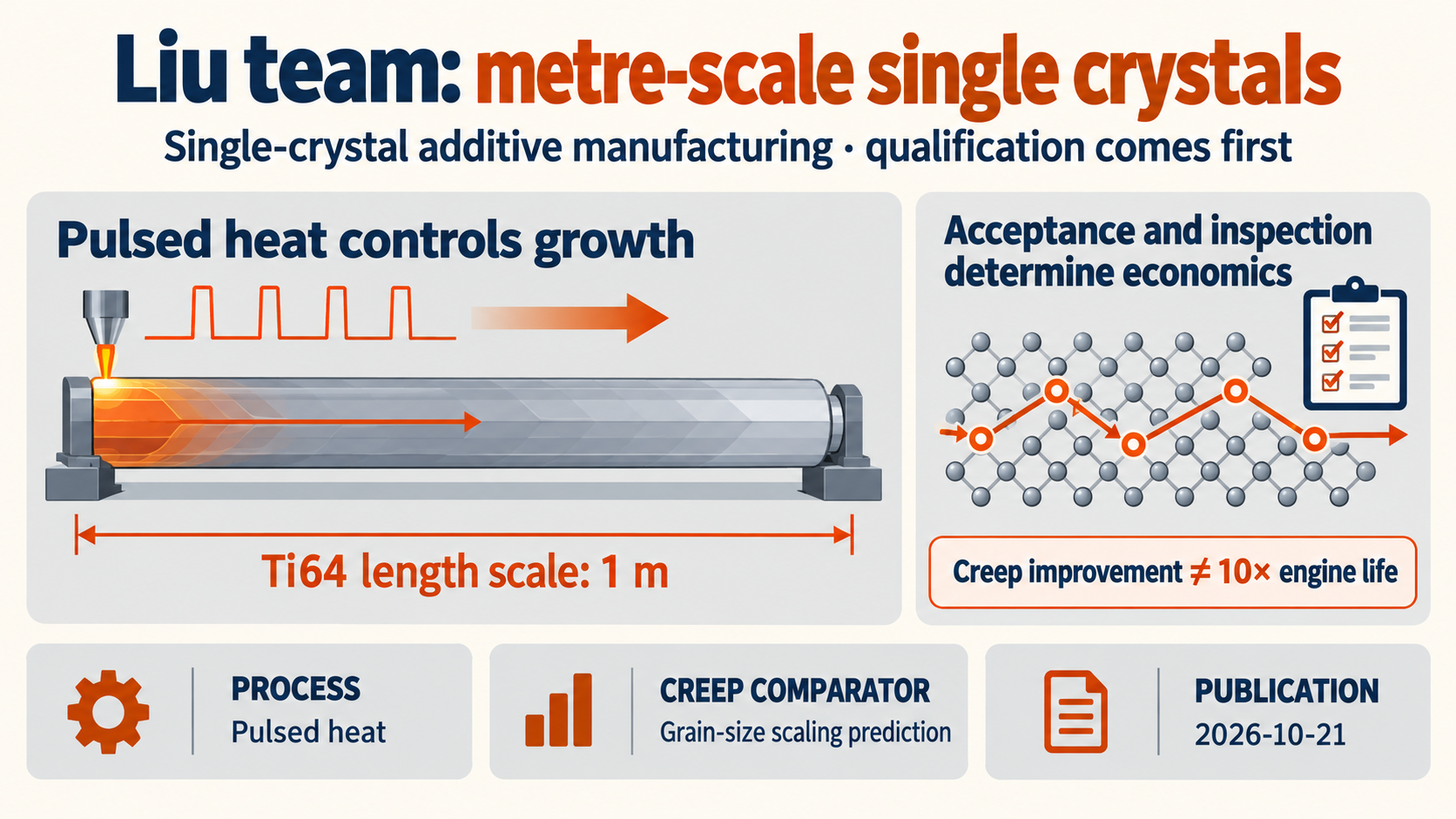
Changmeng Liu at Beijing Institute of Technology, Yinan Cui at Tsinghua University and Y. Morris Wang at UCLA are among the researchers behind a Nature study published on October 21. Their single-crystal additive manufacturing method reaches metre-scale structures and expands possibilities for materials that resist creep, or gradual deformation under sustained load at elevated temperatures. Whether aerospace parts become cheaper depends on inspection and qualification as well as printing. Source: Nature · 2026-10-21
Making a large metal shape is only part of the job. An aircraft component must be reproducible and supported by evidence of safe service. The price of a printer and the cost of an accepted part answer different questions.
The people behind the work
Liu conceived the idea and designed and performed experiments with Cui, Jiachen Wang and Xiao Han. Morris Wang helped supervise the research. These roles are identified in the paper’s contribution statement. Source: Nature · Author contributions
Liu’s earlier work helps explain the attention to geometry. Liu’s university profile lists leadership of a national project on support-free additive manufacturing of large lattice structures. A lattice connects slender members through space, allowing designers to place material where it carries load. Source: BIT · Changmeng Liu
Morris Wang’s group studies how additively manufactured and nanostructured metals deform. UCLA describes its use of microscopy and X-ray techniques to examine interactions between defects and interfaces. This collaboration brings large-scale fabrication together with the study of small-scale deformation. Source: UCLA · Yinmin Morris Wang
How single-crystal additive manufacturing limits grain boundaries
Most metals contain small crystals with different atomic orientations. Their interfaces are grain boundaries. Boundaries can strengthen a metal in some conditions, but can also provide pathways for deformation and damage during prolonged hot service. That is why single-crystal turbine materials have a long industrial history. Source: NIMS · Superalloy
Liu’s team applies carefully controlled pulses of heat to wire-arc additive manufacturing, or WAAM, which melts metal wire with an electric arc. The DSP-WAAM process controls crystal growth through this thermal cycle. Source: Nature · DSP-WAAM
Gregory Rohrer’s accompanying Nature commentary highlights readily available equipment, complex shapes and lengths up to one metre. The attraction is access to geometries difficult to make by established crystal-growth routes. Available equipment, however, does not imply a universally transferable machine setting. Source: Nature News & Views · Gregory S. Rohrer
-
1
Wire and heat
Arc and pulsed control
-
2
Crystal and shape
Growth and geometry
-
3
Repeat qualification
Inspection, life and cost
Our earlier titanium additive manufacturing article examined microstructural strengthening and tensile strength. Here the emphasis is crystal growth and deformation over time at elevated temperature. A single strength number cannot rank the approaches across different operating conditions. Related: 관련 글 · 티타늄 3D 프린팅과 인장강도
What the size and creep results establish
Liu’s team reports metre-scale Ti-6Al-4V, a titanium alloy containing aluminium and vanadium, and zigzag lattice structures. It also demonstrates the approach in tungsten, molybdenum, niobium and MoNb alloy. The metre-scale result should not be extended to every material. Source: Nature · Abstract
The reported creep-resistance gain is about an order of magnitude, roughly tenfold. The comparator is standard grain-size scaling predictions, not engine service life. Crystal structure matters too. Ti64 grows as the high-temperature beta phase and transforms into a mixed alpha/beta microstructure on cooling. The single-crystal assessment includes reconstruction of the prior beta orientation, so the finished part is not free of every internal interface. Source: Nature · Abstract / Extended Data
The public extended data also show higher polycrystal yield strength — the stress at which permanent deformation begins — at lower temperatures, and acknowledge microcracking challenges in pure tungsten. These results do not establish universal superiority across temperatures or materials. Source: Nature · Extended Data 6, 10
Reported
Metre-scale Ti64 and lattices
Fabrication
Performance · Creep gain vs scaling prediction
Still to establish
Repeat acceptance and total cost
Production
Components · Fatigue, oxidation and service life
Lower creep could extend service intervals when dimensional change is the limiting failure mode. This is a conditional inference. Components also face fatigue, oxidation, surface damage and joint failures. Improving creep alone will not eliminate replacements driven by other mechanisms.
Engine applications require another distinction. The high-temperature turbine blades described by NIMS use nickel-based superalloys. The Ti64 results are not evidence of a direct replacement. Applying Liu’s method to another alloy and a service component requires fresh validation. Source: NIMS · Nickel-based superalloys
Material savings do not guarantee cheaper accepted parts
The first economic question is material input. Building close to the final shape can reduce the amount removed from a larger blank. Finishing, heat treatment, inspection and failed builds still belong in the calculation. The study does not establish a production cost-saving percentage.
Consider an illustrative batch calculation. Set the incumbent process cost to 100 with a 100% acceptance rate. If a new process costs 80 but acceptance falls to 80%, the accepted-part cost index is 80 divided by 0.8, or 100. Rejected parts absorb the apparent saving.
If stronger inspection raises batch cost to 90 while acceptance improves to 90%, the index is still 100. These are invented accounting examples, not quotations or measured results. Total cost, including depreciation and inspection, must be divided by accepted output.
Baseline 100/100%; saving case 80/80%; added inspection 90/90%. Arbitrary units and equal candidate output.
Productivity also depends on time. Tight thermal control may occupy a machine long enough to offset material savings. Small batches may still benefit if printing avoids expensive tooling and long procurement delays. The useful delivery metric runs from order placement to completed inspection, not merely deposited mass per hour.
Norsk Titanium illustrates the gap between qualification and sales
Norsk Titanium offers a useful reference for how long commercialization can take. Its RPD (Rapid Plasma Deposition) technology, which melts titanium wire with plasma, is different from the DSP-WAAM single-crystal process. In its February 24, 2026 update, the company said RPD titanium material data had been accepted in December 2025 for publication in MMPDS, a handbook used in aerospace certification. Source: Norsk Titanium · 2026-02-24
The same update acknowledged commercialization delays. CEO Fabrizio Ponte described the need to align engineering, certification, procurement and other customer functions. The company withdrew its revenue and cash-flow guidance at that time. This is a dated example, not a statement of its October results or outlook. Source: Norsk Titanium · Commercial progress
The example helps explain the sequence before revenue arrives. Material data must be accepted, a customer must adopt a specific part, and purchasing must turn into repeat orders. Process licensing and integration into customer factories are possible business models alongside equipment sales. No such contracts or monetization plans are established here for the study’s researchers.
What Korean aerospace and defense suppliers would need
From here on, this is analysis from a Korean supplier’s perspective rather than an experimental finding. Aerospace and defense firms should start with a component’s operating temperature and failure mechanism, then decide whether a single crystal is useful. Adding costly inspection to an already adequate component may weaken its economics.
The FAA’s 2020 report describes the same level of approval rigor for additive and conventional manufacturing, with a risk-based approach. Successful printing therefore does not itself authorize supply of a flight component. The report neither approves DSP-WAAM nor specifies a qualification route for it. Source: FAA · Report to Congress, March 2020
Preparation means building a repeat-production record: connecting wire composition, thermal history, crystal orientation, internal defects and finishing conditions to component tests. If a coupon passes but a joint in a full-size structure fails, the process needs further investigation. Budgets must cover the people and inspection systems that create this evidence as well as the equipment.
Shipbuilding calls for selective applications. This study provides no economic case for replacing ordinary hull structures with costly single crystals. Candidates would need a service benefit, such as sustained hot operation or difficult replacement access, large enough to justify qualification. No adoption or orders by Korean shipbuilding or defense firms are established here.
New markets could extend beyond printing services to orientation inspection, anomaly monitoring, alloy-specific thermal control and service-life data management. Established casting suppliers might become qualification partners using their materials and quality expertise. These are conditional business possibilities, not demonstrated market outcomes.
Liu’s work makes the next question more concrete: once a desired single-crystal shape can be made, how many acceptable copies can be produced, and at what fully inspected cost? Evidence on those questions will determine whether improved creep performance changes both component life and price. This article explains the research and its industrial implications; it is not investment advice about any company.
Assess single-crystal production through the total cost of repeatedly accepted components.
Sources and further reading
- Liu et al., Nature (2026): Additive manufacturing of ultralong and architected single crystals
- Gregory S. Rohrer, Nature News & Views (2026-10-21)
- Beijing Institute of Technology: Changmeng Liu
- UCLA Samueli: Yinmin Morris Wang
- Norsk Titanium operational update, 2026-02-24
- FAA report to Congress on additive manufacturing, March 2020
- NIMS: Superalloy (2023)
For information only — this is not a recommendation to buy or sell any asset.
Comments 0