MYC cancer research: 67% of essential bases are noncoding—can RNA targets change drug development costs?
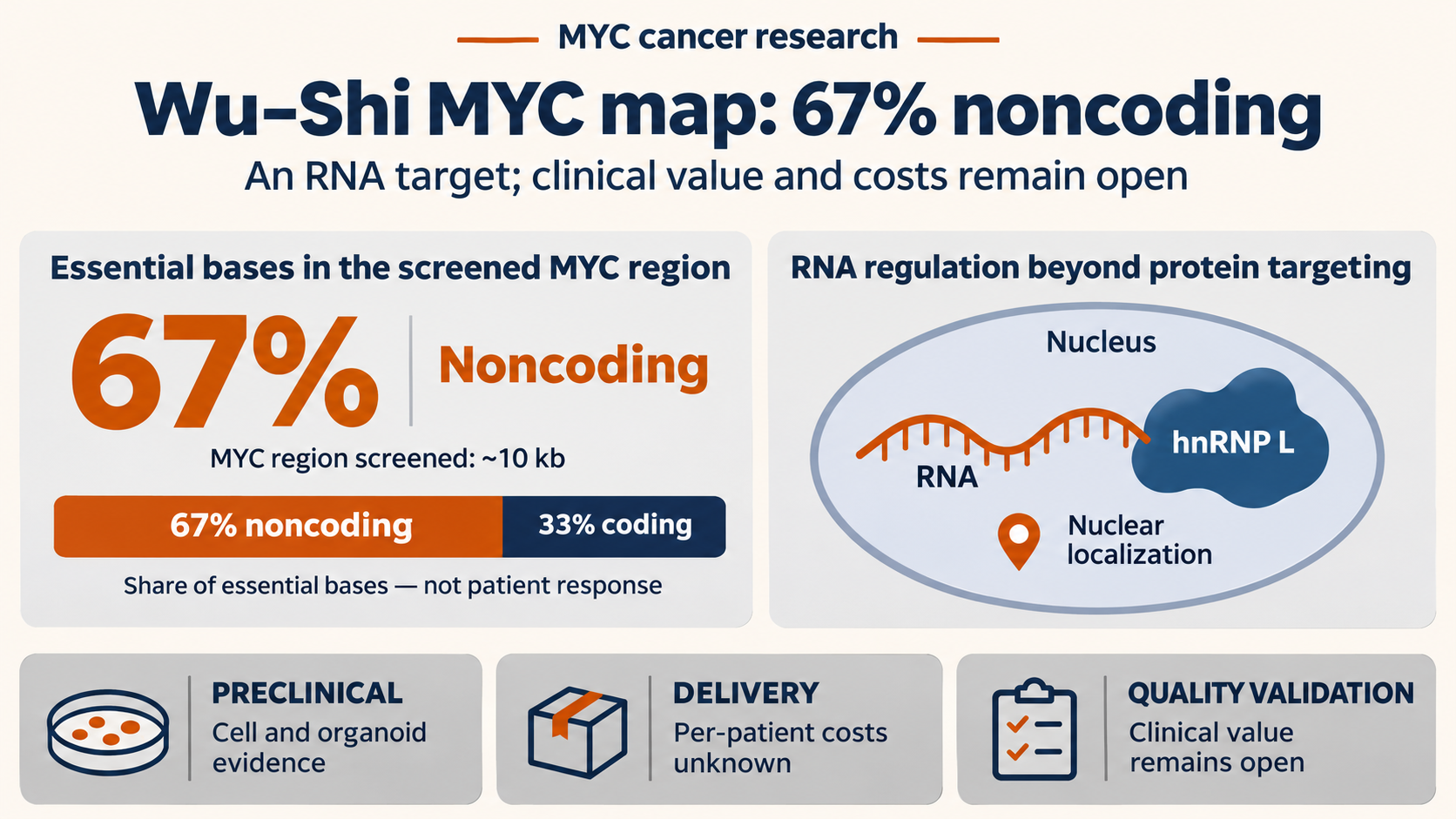
Xuebing Wu and Peiguo Shi at Columbia University have widened the search for MYC cancer targets. Their Cell paper, released on November 4, maps roughly 10 kb of the MYC locus and reports that 67% of functionally essential bases are noncoding. One RNA regulatory element inside that map is the paper's proposed drug target—and the source of a new set of development costs. Source: Cell 연구
The evidence is preclinical: cancer cells and patient-derived tumor organoids. It does not establish tumor shrinkage in treated patients or lower healthcare costs. The economic question is which uncertainties the discovery removes, and which expensive experiments still lie ahead.
Who did what on the team
Wu and Shi conceived the project. Shi and Tala Fnu performed most experiments, while Feiyue Yang led the computational analyses. Co-corresponding author Jianwen Que supervised Fnu’s work, including organoid models and imaging. That collaboration connected a genetic map to patient-derived experimental systems. Source: Cell 저자 기여
Wu’s lab has previously studied RNA structure at messenger-RNA ends and the suppression of noncoding translation. This project extends that interest: the amino-acid instructions alone may not explain where a message operates inside a cell. Source: Wu 연구실 논문 목록
MYC cancer research looks beyond the protein
MYC regulates the activity of other genes. Tumors that depend heavily on that activity may be vulnerable to its inhibition. Designing a molecule that reliably interferes with the protein has nevertheless been difficult. Source: OMO-103 임상 논문
Direct inhibition has not reached a dead end. Elena Garralda and colleagues published a 22-patient phase 1 study of the MYC-inhibiting miniprotein OMO-103 in 2024. It primarily assessed safety and tolerability. Some patients had stable disease, but no objective responses were recorded under RECIST criteria. Wu and Shi have added another route to investigate, rather than demonstrated superiority to that approach. Source: Nature Medicine, 2024
SpRY-Cas9, the DNA-cutting tool used by Shi, greatly relaxes the short neighboring sequence requirement known as PAM. That makes a dense tiling of cutting sites possible. The screen uses mutations produced after cutting and their effects on cell growth; it is not an independent test of every possible single-base substitution. Source: 선행 프리프린트·방법
The denominator behind Yang’s 67% is the set of bases classified as functionally essential in the screened MYC region. It is neither the fraction of the human genome that can treat cancer nor a patient response rate. The remaining 33% in the chart below is the complement of that figure, not a separately measured value. Source: Cell 결과의 범위
Essential bases in this MYC screen. 33%=100−67; not a genome-wide share or patient response rate.
Blocking RNA function without simply destroying the message
The team focused on the 3′ untranslated region, or 3′UTR, of MYC messenger RNA. This tail is part of the message but does not encode the protein. An ultraconserved element—a sequence retained across species—interacts with the RNA-binding protein hnRNP L. The paper links that interaction to the message’s position near the nucleus and the protein’s nuclear localization. Source: Cell 기전
An antisense oligonucleotide, or ASO, is a short nucleic acid designed to bind a selected RNA sequence. Here it acts as a physical blocker. The precursor study describes chemical modifications intended to avoid RNase H-mediated cleavage of the message. Reducing protein abundance and disrupting its localization require different measurements of success. Source: 프리프린트 ASO 설계
-
1
3′UTR element
Interacts with hnRNP L
-
2
Perinuclear RNA
Position of the message
-
3
Nuclear MYC
Location of protein activity
Patient-derived organoids in the work supervised by Que are three-dimensional cultures of tumor material. Growth inhibition in these models extends the evidence beyond target identification. But exposing a culture to a compound is different from delivering it through the circulation to tumors throughout a patient. Survival benefit and normal-tissue safety remain separate questions. Source: Cell 오가노이드 결과
Better discovery productivity can bring new downstream costs
The following is an economic interpretation, not a measured result of the paper. A defined RNA element gives developers another starting point for comparing candidate compounds. A clearer target could reduce unproductive discovery work. Selecting a sequence, however, is only one part of building a medicine.
But the practical question is a different one: how much material must be administered to achieve adequate tumor exposure. Poor delivery may require more drug. Frequent dosing can add clinic visits and monitoring as well as manufacturing demand. The relevant cost is a clinically effective course of treatment, not merely the price of synthesizing a molecule.
CMC covers chemistry, manufacturing and controls. Developers must establish consistent batches, impurity control and stability. They may also need assays of nuclear MYC activity and ways to identify likely responders. If the experimental selectivity does not translate to people, late-stage failure could outweigh savings in discovery.
Discovery and manufacturing
Start from a defined RNA target
Candidate search
Scale economies · Requires a shared product and sufficient demand
Translation costs
Dose and dosing frequency unknown
Delivery and dosing
Quality and validation · Impurities, safety and responder selection
A per-patient manufacturing and validation estimate would need dose, dosing frequency, process yield, quality-testing costs and the treated population. This study does not supply those commercial inputs. A shared sequence used across patients could support scale economies. Using patient-derived organoids does not itself make this a bespoke ASO manufactured separately for each patient.
What the opportunity could mean for Korean CDMOs
There is evidence of substantial capital committed to oligonucleotide production. In January 2023, Agilent announced approximately $725 million to expand therapeutic nucleic-acid manufacturing capacity. This is a historical investment announcement, not a current market-size estimate or funding for the Wu–Shi MYC candidate. Source: Agilent 공식 투자 발표
In Korea, ST Pharm describes CDMO services spanning monomer building blocks and oligonucleotide active ingredients. A CDMO develops and manufactures medicines for other companies. Its official page labels the 2026 expansion as ongoing; that should not be treated as proof of completed capacity or an order connected to this MYC research. Source: 에스티팜 공식 CDMO 소개
Potential business could include process development, impurity analysis and stability testing for new chemical modifications or delivery systems. Conversely, low doses or clinical discontinuation could limit manufacturing demand. Contracts and clinical evidence still separate Wu’s discovery from earnings for a Korean supplier. This article explains research; it is not investment advice or a recommendation on any stock.
A new market, or a replacement for existing cancer drugs?
Clinical progress could create demand for tests of MYC dependence, tumor-delivery technologies and noncoding-RNA target discovery services. These are conditional prospects. High MYC abundance and a tumor’s dependence on MYC are not interchangeable; patient selection could itself become an important development task.
Replacement of immunotherapies or antibody–drug conjugates cannot be inferred from these experiments. That would require comparative efficacy, safety and treatment-burden evidence in comparable patients. A combination treatment might expand the market while increasing total drug spending. Lower manufacturing costs would not automatically mean lower prices or payer expenditure.
The paper discloses a related provisional patent application naming Shi and Wu. Filing does not establish a granted patent or a completed licensing deal. The next useful evidence concerns clinically workable delivery, repeat-dose safety and responder selection. Those results will determine whether an interesting target can become an economically viable treatment. Source: Cell 이해관계 공개
Where costs accumulate between discovery and treatment showed up the same way in two earlier articles.
Related reading: “RNA fingerprinting and drug-candidate selection” covers the cost of narrowing candidates, and “In-body CAR-NK delivery and treatment costs” covers delivery economics. Related: RNA fingerprinting과 신약 후보 선택 Related: 체내 CAR-NK 전달과 치료비
An RNA target must ultimately deliver patient benefit at a viable cost per treatment course.
Sources and further reading
- Cell (2026): CRISPR mutagenesis of the MYC locus reveals a druggable ultraconserved RNA element
- Wu Lab: 연구진·논문 목록·RNA 연구 배경
- 선행 프리프린트: Decoding the MYC locus
- Nature Medicine (2024): OMO-103 phase 1 trial
- Agilent (2023-01-10): $725 million oligonucleotide capacity investment
- 에스티팜: 올리고뉴클레오타이드 CDMO 공식 소개
For information only — this is not a recommendation to buy or sell any asset.
Comments 0