Circadian Soft Robot 2026 — 142 Thermopneumatic Moves Without a Battery
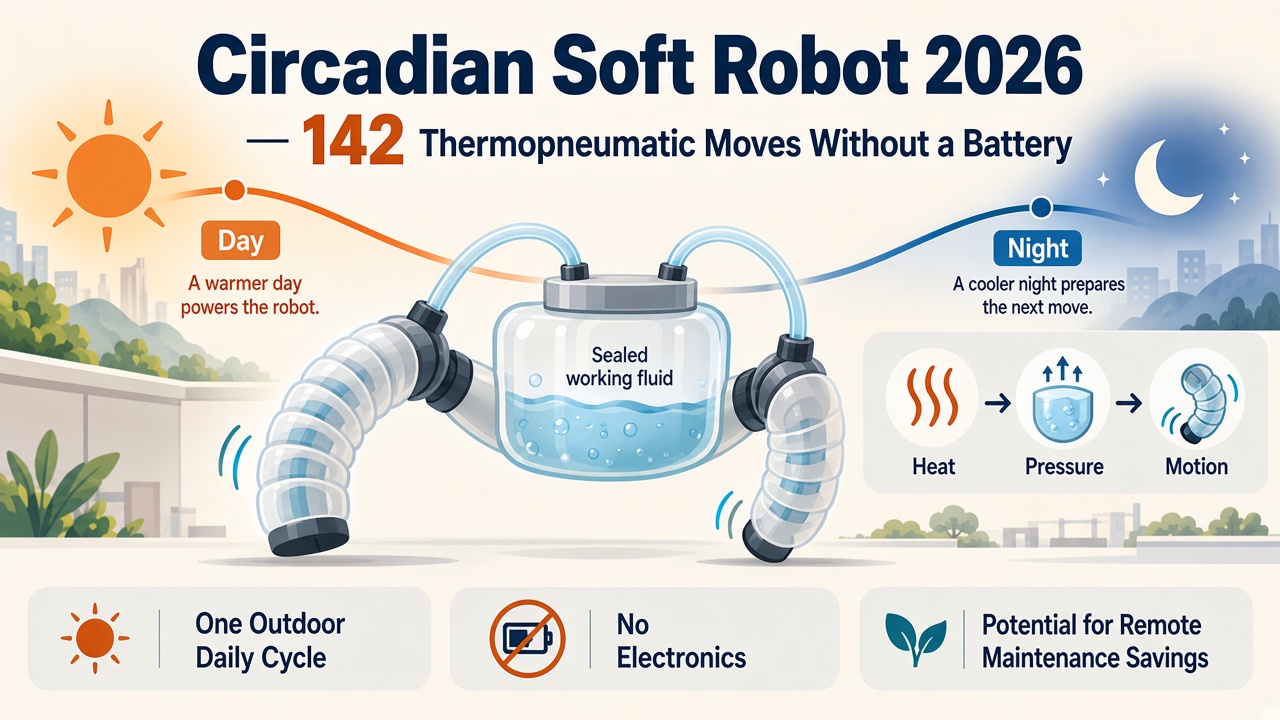
A circadian soft robot used one outdoor day-night thermal cycle to trigger a pneumatic actuator 142 times. The result appeared in Nature Communications on September 7, 2026. The striking part is not raw power: the system stored environmental heat as pressure and used it without a battery or electronic controller.
That does not make it a maintenance-free universal robot. This is still a research demonstration involving a small actuator and a two-limbed soft robot. But it may change the economics of places where sending a worker to replace a battery costs far more than the electricity itself.
The paper’s demonstrated results and the conditional industrial inferences are kept separate below.
How did a circadian soft robot move 142 times?
A pneumatic actuator bends or expands when pressurized. Flexible chambers replace rigid motors and gears, making the technology useful around delicate objects and inside irregular spaces. The inconvenient part is supplying compressed air.
In a laboratory, a pump and hose solve that problem. In the field, a robot may need a gas tank or pump, a battery, and control electronics. The body stays soft while its power system becomes heavy and complicated.
The AMOLF and Eindhoven University of Technology team changed the sequence. A low-boiling-point fluid absorbs light and ambient heat, vaporizes, and creates pressure. Cooling later condenses the fluid. The daily thermal swing becomes an extremely slow charger.
A pneumatic control circuit stores and releases the pressure. Just as an electronic circuit routes current, this circuit routes pressure and airflow. During one real-world thermal cycle, it drove 142 activations of a self-oscillating actuator and powered locomotion in a two-limbed soft robot.
-
1
Daylight & heat
Working fluid warms
-
2
Vapor & pressure
Heat stored pneumatically
-
3
Pneumatic circuit
Automatic release
-
4
Soft actuation
142 activations & motion
What changes when solar panels and batteries disappear?
A solar-electric system converts light into electricity, stores it in a battery, and uses a motor or pump to produce pressure and motion. It is versatile, dispatchable, and can also power sensing, computation, and communications.
The thermopneumatic design skips the electrical conversion. Heat creates fluid pressure, and pressure directly moves the soft body. In principle, that can remove panels, power electronics, motorized pumps, and a large battery from simple machines.
The trade-off is substantial. Weather and seasons set the charging rate. The robot cannot necessarily deliver high power on demand, and sophisticated sensing or radio links may still require electricity.
Solar + battery
Light→electricity→pressure
Conversion
Strength · Power on demand
Burden · Battery, electronics, pump
Circadian thermal
Heat→pressure→motion
Conversion
Strength · No battery/electronics
Burden · Slow and weather-bound
Its first competitor is therefore not every battery-powered robot. It is the worker who periodically travels to turn a valve, move an indicator, or trigger a small sampler. Waiting is acceptable in those jobs; eliminating the service visit matters more than speed.
The economic case begins with fewer site visits
A small remote device may consume little energy. Yet maintaining hundreds of devices across greenhouses, levees, waterways, or solar farms adds vehicle mileage, labor time, safety equipment, and downtime. Those costs can dwarf the electricity bill.
A thermopneumatic device could extend service intervals by handling one simple motion, such as daily ventilation, changing a mechanical indicator, or activating a sampler. These are candidate applications inferred from the design, not commercial uses validated by the authors.
Savings could come from three places: fewer battery and charging components, fewer maintenance trips, and less downtime caused by depleted power. Leakage, fluid replacement, or short component life would erase those gains.
Where thermopneumatics could enter a 100,000-unit service-robot segment
The International Federation of Robotics reports 102,900 professional transportation and logistics robots sold in 2024, up 14%. Cleaning, agriculture, and search, rescue, and security are other major service categories. These figures come from a supplier sample and are not projections for the entire industry.
102,900 transportation and logistics service robots sold in 2024, up 14 percent. Source: IFR World Robotics 2025. Supplier-sample data, not an industry-wide estimate or a forecast for this technology.
Those numbers are context, not a sales forecast for circadian robots. Most service robots sold today use electronics and batteries. The addressable slice here is work that tolerates low power and slow cycles but suffers from poor access to electricity and maintenance.
Components may commercialize before complete robots. The supply chain would need durable seals for the working fluid, flexible valves that survive repeated bending, pressure reservoirs, and climate-specific heat-absorbing coatings.
Korea offers plausible test sites in greenhouses, aquaculture, mountain solar installations, and long pipeline networks. Performance through winter and monsoon conditions must be measured first. The paper’s worldwide applicability claim comes from a model, not completed field validation in every climate.
What the paper proves—and what remains unknown
The demonstrated result is clear: the researchers converted daily thermal variation into stored pneumatic energy, triggered an actuator 142 times in one outdoor cycle, and moved a two-limbed robot without repeated manual intervention or electronics.
Long-term sealing, rain and dust tolerance, working-fluid safety, useful load, and lifetime cost remain open. The 142 activations should not be confused with 142 heavy industrial work cycles.
- Output: how much mass moves, and how far?
- Durability: do seals and soft materials survive multiple seasons?
- Climate: does the system charge through cloudy winters and monsoons?
- Economics: do service visits and lifetime costs actually fall?
The first market is work that can wait
Scientifically, the paper treats ordinary environmental temperature variation as a controllable source of motion. From an engineering perspective, it combines harvesting, storage, control, and actuation within a pneumatic architecture.
It is unlikely to replace fast warehouse or surgical robots soon. A better framing is a power and control component for remote machines that only need to move a few times per day.
The important next numbers are not peak speed. They are cycles after one year, maintenance visits avoided, and lifetime cost per device. When those figures arrive, we will know whether an elegant experiment can become a new industrial niche.
For related context, see our articles on waste-heat elastocaloric cooling and explainable autonomous-driving AI. They show two adjacent questions: how ambient energy becomes useful work, and why validation cost matters when autonomous systems leave the lab.
142 activations is the science number. Cycles after one year, service visits avoided, and lifetime cost per device are the business numbers.
Sources
- Nature Communications — Harvesting environmental circadian oscillations for energy autonomy of soft robots
- IFR — World Robotics 2025 Service Robots report
- IFR — World Robotics 2025, Service Robots Executive Summary
- Communications Materials — Bio-inspired autonomy in soft robots
- 내부 글 — 폐열로 냉각을 만드는 형상기억합금
- 내부 글 — 자율주행 AI의 안전 검증
For information only — this is not a recommendation to buy or sell any asset.
Comments 0