MassNet turns 1.5 billion spectra into AI data: where could drug research costs fall?
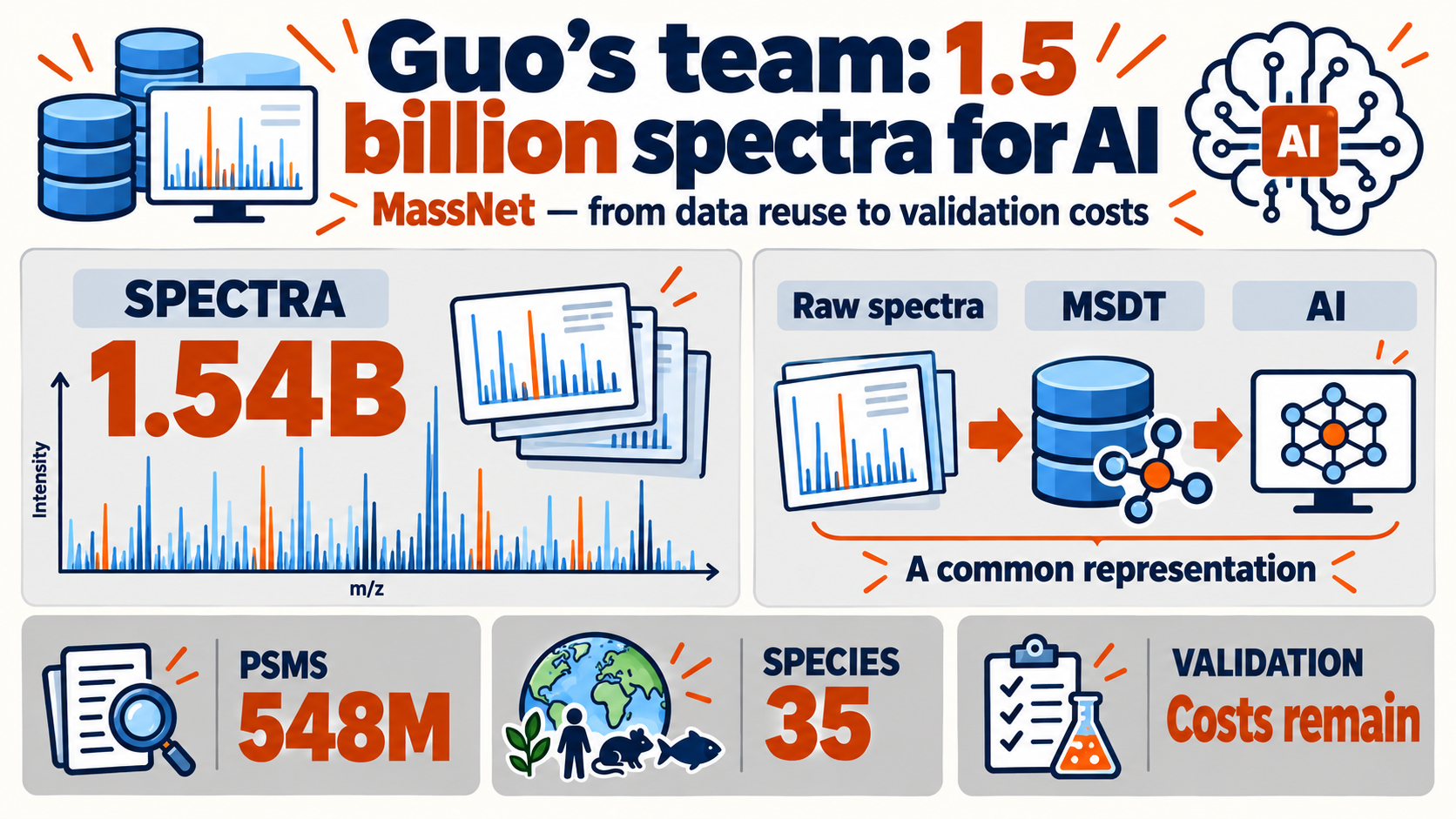
MassNet, developed by Tiannan Guo and collaborators at Westlake University, brings together 1.54 billion mass spectra as a resource for AI. The ambition is to learn more from protein measurements that already exist. Its economic value depends on two distinct costs: preparing data for analysis and validating what that analysis finds. Source: Guomics Lab — MassNet 공식 데이터 개요
An expensive instrument does not automatically tell researchers which proteins a sample contains. Signals still need interpretation, and proposed identities need checking. A shared starting point could reduce duplicated work across laboratories.
Tiannan Guo’s lab: from COVID-19 serum to AI training data
Guo’s laboratory has a history of connecting protein measurements with disease research. In 2020 it investigated proteins and metabolites in COVID-19 patient serum for signals associated with severity. MassNet addresses an earlier part of the workflow: assembling material that many different models can learn from. Source: Westlake University — Guomics의 혈청 연구
The public preprint names Siqi Sun and Zhiqiang Gao as corresponding authors alongside Guo. The authors’ deposited results also list Jun A, Xiang Zhang, Xiaofan Zhang and Jiaqi Wei. Those records establish participation; they do not justify assigning specific experiments to individual authors without checking the final contribution statement. Source: MassNet — 2025년 프리프린트 저자 정보 Source: 저자 공개 자료 — MassNet 연구진
What the 1.54 billion records actually represent
A common way to study proteins is to cut them into shorter pieces called peptides. Mass spectrometers measure the mass-to-charge ratios of charged molecules and their fragments. A spectrum records the positions and intensities of those signals. Researchers use that evidence to infer the peptide’s amino-acid sequence.
The official overview reports 1.54 billion spectra and 548 million peptide-spectrum matches, or PSMs. A PSM pairs a spectrum with an assigned peptide sequence. Repeated observations are possible: neither number is a count of distinct proteins, and their ratio is not a model accuracy score. Source: Guomics Lab — MassNet 공식 데이터 개요
Official overview: 1,540M spectra and 548M PSMs. Neither unique protein counts nor accuracy scores.
A larger collection can expose a model to more experimental variation. But uneven coverage of species or instruments can still limit performance elsewhere. An adopting laboratory should ask how closely the collection resembles its own samples, rather than judging it by size alone.
MSDT connects raw measurements to AI
MSDT provides a consistent representation of spectra and associated information. It is rather like bringing laboratory records into a common form. Its specification uses Parquet, a tabular storage format, to make the information easier to exchange and reuse. Source: Guomics Lab — MSDT 형식 명세
The resources deposited by Jun A, Xiang Zhang and colleagues include search workflows using FragPipe and Sage. Traceable processing helps laboratories compare results. The deposits also support predicting chromatographic retention time and reassessing the confidence of peptide-spectrum assignments. Source: 저자 공개 자료 — 데이터 검색·후속 과제
-
1
Raw measurements
Keep originals and provenance
-
2
Search and organize
Associate signals with sequences
-
3
MSDT
Use a consistent representation
-
4
Model evaluation
Benchmark on local samples
The specification explicitly says MSDT does not replace raw files or mzML as an archival standard, nor preserve every instrument-specific parameter. Deleting originals to save storage could undermine reanalysis and troubleshooting. A realistic budget includes both archives and model-ready data. Source: Guomics Lab — MSDT 형식 명세
What XuanjiNovo changes—and what still needs checking
Database search matches measured signals against candidate sequences already available in a reference collection. De novo sequencing instead infers the amino-acid sequence from the signal itself. That can broaden discovery beyond a candidate list, while making error control especially important.
According to the team’s code repository, XuanjiNovo is a non-autoregressive Transformer trained on 100 million PSMs. It predicts sequence positions jointly rather than generating every residue strictly in order. Available pretrained models give laboratories a practical starting point for evaluating adoption. Source: Guomics Lab — XuanjiNovo 공개 코드
Database search
Known candidate sequences
Starting point
Constraint · Coverage of the reference list
De novo sequencing
Measured fragment signals
Starting point
Constraint · Errors in inferred sequences
The test is not simply whether the model proposes more sequences. How many survive at a matched error threshold? Does performance hold on unfamiliar samples? Do follow-up experiments confirm them? Useful sequencing does not by itself establish reliable protein quantification or diagnostic performance.
Where research costs could fall
The following is an economic interpretation, not a measured result. If the resource extracts more useful information at the same error threshold, reanalysis of existing measurements could avoid some repeat acquisitions. Standardized inputs could also reduce staff time spent preparing and connecting datasets.
Net savings equal avoided measurement and preparation costs minus conversion, storage, GPU computation and additional validation costs. Pretrained models may reduce the need to train from scratch. Local benchmarking still costs money, so comparing GPU purchase prices alone misses the adoption economics.
Discovery can even increase downstream spending by generating more candidates. Apparent disease associations need separate samples and analyses before they become useful biomarkers. More validated candidates for the same budget would be a productivity gain even if total spending did not decline.
What Thermo Fisher’s $3.1 billion Olink deal says about demand
Industrial demand for protein information has already produced substantial transactions. Thermo Fisher completed its Olink acquisition in July 2024 at approximately $3.1 billion net of acquired cash. It described Olink as complementary to its mass-spectrometry capabilities. That valuation is not a revenue forecast or valuation for MassNet. Source: Thermo Fisher — Olink 인수 완료, 2024-07-10
UK Biobank announced a project in January 2025 targeting up to 5,400 proteins across 600,000 samples, followed by £20 million in government funding in June. Its specified platform is Olink Explore HT. Large-scale measurement of selected proteins and interpretation of mass spectra address different problems. Source: UK Biobank — 단백질 연구 착수, 2025-01-10 Source: UK Biobank — 정부 지원, 2025-06-23
If Guo’s public models gain adoption, basic sequencing software could face price pressure. Services that adapt analysis to customer samples, manage errors and document validation could gain opportunities. This is a possible competitive shift, not evidence that existing instruments or antibody-based assays have been displaced.
What Korean research and manufacturing providers should test first
CROs perform outsourced research, while CDMOs provide development and manufacturing services. Korean providers considering this resource could begin with a small comparison using existing DDA data. DDA selects molecules for fragmentation based on observed signals. Results should not be assumed to transfer unchanged to other acquisition methods.
A useful pilot would match error thresholds and record confirmed sequences, processing time per sample, manual review time and follow-up costs. Expansion should follow stable results. Manufacturing release testing additionally requires reproducibility and controlled method changes; research performance alone is insufficient.
For public resources such as the biobank run by the Korea Disease Control and Prevention Agency, possessing stored specimens is different from possessing reusable mass spectra. Sample history, permitted uses, clinical metadata and actual file formats need checking first. This is an adoption scenario, not a report that any Korean institution has adopted MassNet.
Our earlier RNA fingerprinting article concerned narrowing possible drug mechanisms; this story concerns the infrastructure for interpreting protein signals. Virtual-cell research raises a related economic question: can validation keep pace with the predictions? Related: RNA fingerprinting and drug validation Related: Virtual cells and experimental costs
MassNet could change the value extracted from accumulated measurements more directly than the price of an instrument. Its promise lies in reducing repeated preparation and freeing resources for stronger validation. The decisive economic metric comes after corpus size: the actual cost of obtaining a confirmed result.
Source note: this article uses the authors’ public data, code and specifications, alongside institutional announcements. The specified Nature Methods full text could not be accessed, so its performance-improvement figures and evaluation conditions are not cited, and no experimental cost-saving percentage is claimed. Nothing here is a recommendation to buy or sell any company’s shares. Source: MassNet — Nature Methods (원문 접근 제한)
Evaluate MassNet economics by total cost per validated result.
Sources and further reading
- MassNet — Nature Methods (원문 접근 제한)
- Guomics Lab — MassNet 공식 데이터 개요
- Guomics Lab — MSDT 형식 명세
- Guomics Lab — XuanjiNovo 공개 코드
- Guomics Lab — 데이터·모델 배포
- 저자 공개 자료 — 데이터 검색·후속 과제
- 저자 공개 자료 — MassNet 연구진
- MassNet — 2025년 프리프린트 저자 정보
- Westlake University — Guomics의 혈청 연구
- Westlake University — Tiannan Guo
- Thermo Fisher — Olink 인수 완료, 2024-07-10
- UK Biobank — 단백질 연구 착수, 2025-01-10
- UK Biobank — 정부 지원, 2025-06-23
For information only — this is not a recommendation to buy or sell any asset.
Comments 0