Neonatal NEC: could blocking a toxin protect the brain? Wu and colleagues’ 2026 Nature study
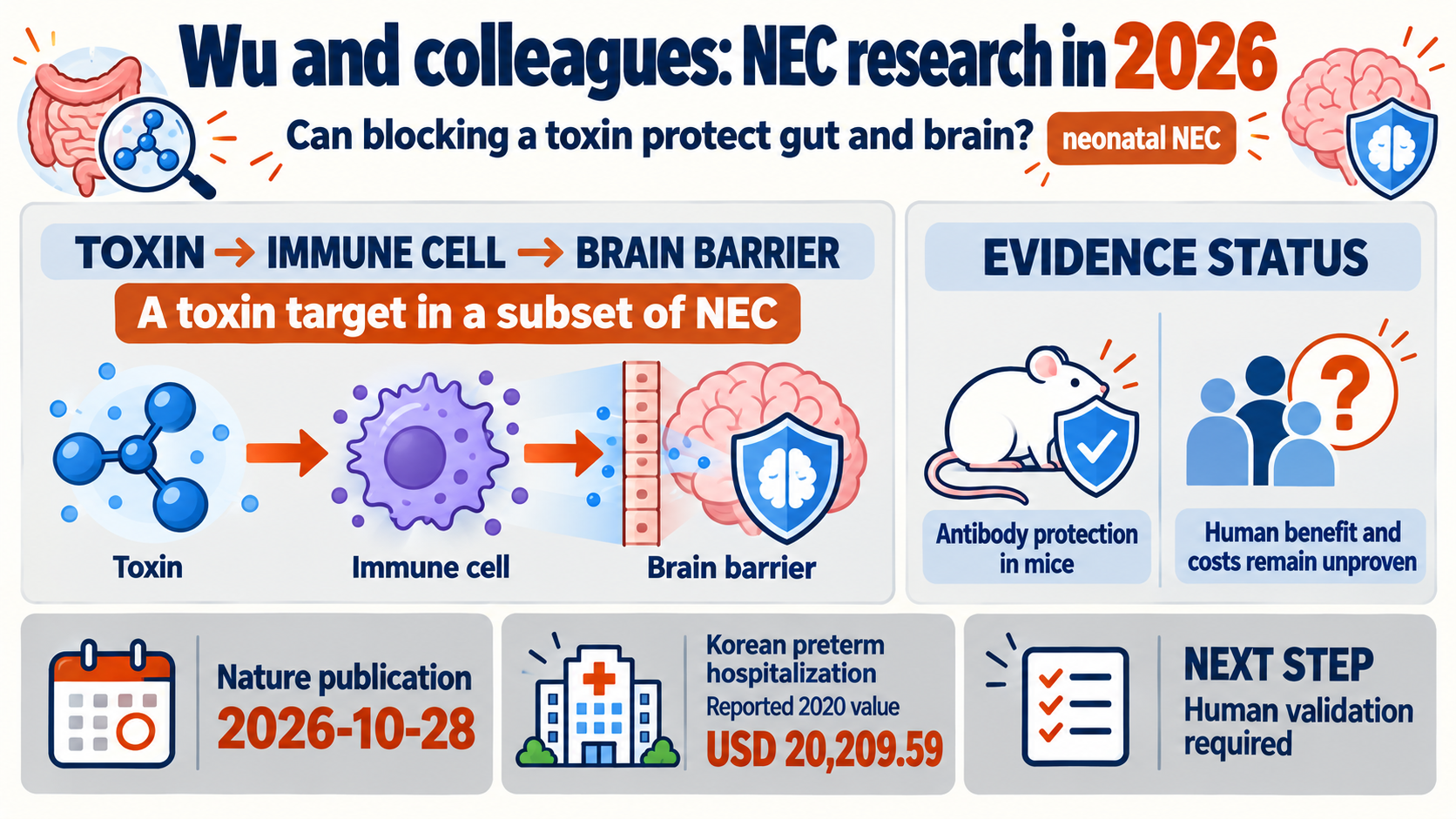
Kai Wu of Zhujiang Hospital, Southern Medical University, and colleagues have narrowed a potential target in neonatal NEC. Their October 28, 2026 Nature study connects a subset of severe disease to a bacterial toxin and reports antibody protection in mice. The evidence stops at mice for now. The economic question is whether this can eventually reduce intensive care and the burden of care after discharge. Source: Nature 원논문
NEC, or necrotizing enterocolitis, damages and kills intestinal tissue in newborns. So is blocking one toxin enough? Not yet. Identifying a disease pathway and safely treating a baby by blocking it require different kinds of evidence.
Kai Wu, Min Dong and Xiaozhe Xiong: the three who led the work
The corresponding authors are pediatric surgeon Kai Wu, Min Dong at Harvard Medical School and Boston Children’s Hospital, and Xiaozhe Xiong at Guangzhou National Laboratory. Zhujiang Hospital pediatric-center researchers Daiyue Yu and Xi Zhang also participated. The institutional announcement does not specify their individual experimental assignments. Source: 남방의과대학 연구진 발표
Dong’s laboratory has a history of identifying the cell proteins that bacterial toxins recognize. Its Harvard profile lists toxin-receptor discoveries, including a 2016 Nature study, and genome-wide CRISPR screening. That experience is well suited to tracing a clinical observation back to a cellular mechanism. Source: Harvard 연구실 소개
Delta toxin: the one toxin singled out in neonatal NEC
The collaborators focused on Delta toxin from Clostridium perfringens. Toxin-positive infection and purified toxin exposure reproduced intestinal and acute brain injury in mice. But the purified toxin was injected into the abdominal cavity, which differs from the way an infant acquires the infection in the gut. Source: Nature 실험과 방법
The institutional account describes macrophages, immune cells that clear foreign material, as a key link. Toxin-driven inflammation in these cells was associated with disruption of the blood–brain barrier and neuroinflammation. This offers a mechanism connecting intestinal injury with damage elsewhere. Source: 주강병원 기전 설명
-
1
Delta toxin
A bacterial toxin
-
2
Immune-cell response
Macrophage inflammation
-
3
Barrier disruption
Linked to neuroinflammation
The practical hypothesis is more specific than a microbiome profile: does this patient have the relevant toxin-mediated disease? If validated clinically, that distinction could separate treatment groups within the same NEC diagnosis. Whether such classification improves care remains a question for future trials.
CD9 and the antibody: what the evidence establishes
A CRISPR screen, which tests the effects of disabling genes, identified cell-surface CD9 as a toxin receptor. A neutralizing antibody protected mice. This does not establish improved human survival or long-term neurodevelopment. Source: Nature 표적·항체 결과
The authors note the use of both seven-day-old and four-week-old mice, the absence of an isogenic toxin-deletion strain, and the need for larger multicenter cohorts. The prevalence of the relevant subgroup is not settled. Source: Nature 연구 한계
Reported evidence
Cells and animals
Setting
Target · Delta toxin–CD9
Still to establish
Subgroup and safe treatment timing
Patients
Outcomes · Survival, development and costs
For development, timing may be decisive. Trials must establish whether treatment still helps after symptoms emerge, whether a diagnostic result arrives in time, and what dose is safe in premature infants. Blocking the host receptor and neutralizing the toxin are distinct strategies requiring separate safety assessments.
Korean NICU costs: start with the right denominator
To connect Wu’s work to Korean healthcare spending, first define the cost measure. A 2025 nationwide claims study reported preterm-infant hospitalization costs per patient of $7,390.90 in 2008 and $20,209.59 in 2020. These are the paper’s dollar-denominated figures, not NEC-specific costs or parental out-of-pocket bills. Source: 한국 미숙아 입원비 전국 연구
Historical insured costs, not NEC-specific costs, family bills, 2026 prices or antibody savings.
Coverage and clinical practice changes may contribute to the difference. It is not a sum that a single drug dose would necessarily save. Korea also has a 2007–2017 NEC claims study, but it does not identify the toxin-positive subgroup. Multiplying all NEC cases by an assumed drug price would be a weak market estimate. Source: 한국 NEC 발생 연구
The following is economic analysis, not a study finding. Effective treatment might reduce hospitalization, surgery and complications, while freeing neonatal intensive care unit capacity. But an available bed-day does not immediately eliminate salaries or building costs. Lower cash expenditure and increased capacity are different benefits.
For families, time after discharge may matter most. Fewer developmental impairments could mean fewer rehabilitation visits and less caregiving time. Yet improved survival can also increase long-term service use. A treatment can be valuable for survival and quality of life without reducing the total healthcare budget.
A budget analysis would subtract testing, drug, administration, adverse-event and operating costs from avoided acute and long-term costs. It must also set a time horizon and a discount rate — the factor that restates future spending in today’s money — and account for mortality and improved survival. The available evidence does not support a Korean per-patient rehabilitation saving or a percentage cost reduction.
Rapid testing and antibody: a market needs both
The commercial possibility in the collaborators’ work is a combined diagnostic and treatment pathway. Detecting the capacity to produce a toxin and measuring active toxin answer different questions. Development should establish which marker best predicts treatment response and whether it can be measured quickly enough.
Diagnostic developers would need fast, reproducible testing from small samples. Antibody developers would need neonatal safety data and reliable manufacturing. Better selection could reduce treatment of patients unlikely to benefit, but a small subgroup also makes recruitment and development-cost recovery harder. No specific company revenue forecast follows from this paper.
Regulation and quality have already shaped this field. In October 2023, the FDA warned about infection risks from probiotics used in hospitalized preterm infants and issued warnings concerning Abbott and Infinant Health products. This dated example illustrates the need for product-specific evidence; it does not show that an antitoxin antibody is safer or superior. Source: FDA 2023년 발표
The next questions return to clinical practice: which babies should be tested, how quickly can results arrive, and when could treatment protect both gut and brain? Human evidence on that sequence will determine diagnostic demand and resource allocation. For now, the work opens a targeted research opportunity. My own guess is that the test deciding whom to treat moves before the treatment does. This article is research and industry analysis, not individual treatment or investment advice.
The value of this toxin target depends on whether it can protect the developing gut and brain in patients.
Sources and further reading
- Nature (2026-10-28): Delta toxin–CD9 and NEC
- 남방의과대학 주강병원 연구 발표 (2026-10-30)
- Harvard Medical School: Min Dong 연구 소개
- Rising public costs of preterm infant hospitalization in South Korea (2025)
- Incidence of necrotizing enterocolitis in South Korea from 2007 to 2017 (2021)
- FDA: Probiotic products in hospitalized preterm infants (2023-10)
For information only — this is not a recommendation to buy or sell any asset.
Comments 0