NeoCOAST-2 ctDNA clearance reaches 72.5%: could it change lung cancer costs?
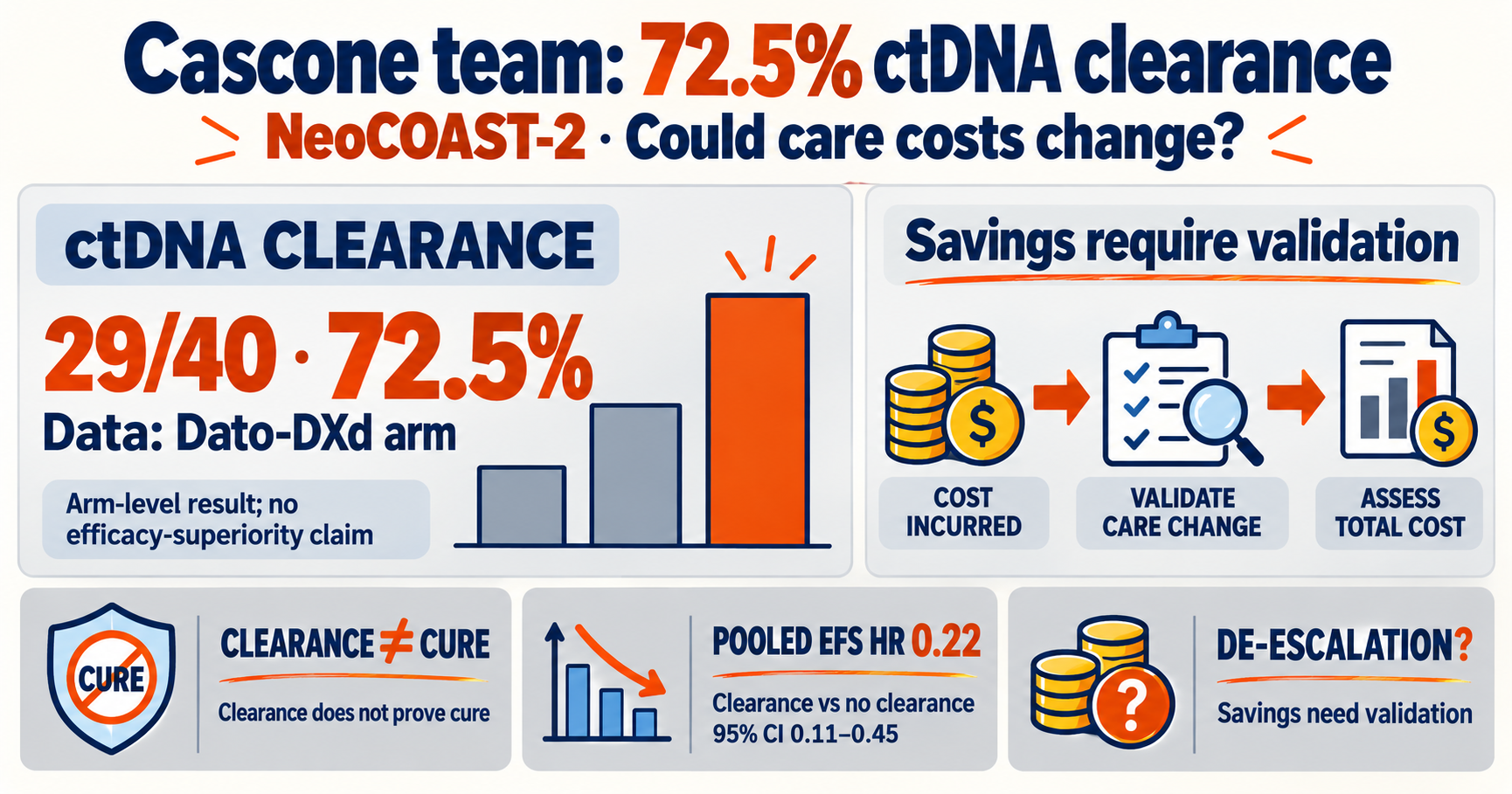
A NeoCOAST-2 follow-up report with MD Anderson’s Tina Cascone as corresponding author found 72.5% ctDNA clearance in the Dato-DXd combination arm. ctDNA consists of tumour-derived DNA fragments circulating in blood. The result raises a practical question: could better response assessment change both lung cancer treatment and its costs? Source: Nature 2026
A disappearing blood signal does not establish cure. The findings offer a way to refine risk assessment. Whether changing treatment on that basis is safe, and whether it saves money, requires separate evidence. This article is not medical advice or a recommendation to invest in any drug or diagnostics company.
Cascone, McGrath and two Korean coauthors
Cascone also led the 2025 Nature Medicine report on pathological response. Lara McGrath of AstraZeneca’s translational medicine team is first author of the new Nature paper. Translational research connects laboratory measurements with patient outcomes. This is a collaboration involving clinical investigators and company researchers. Source: Nature 저자 정보 Source: 2025 연구·기여도
Korean coauthors include Dong-Wan Kim of Seoul National University and Byoung Yong Shim of the Catholic University of Korea’s St. Vincent’s Hospital. The earlier paper credits both with treating and/or recruiting patients. Korean participation should not be mistaken for a separately demonstrated Korean subgroup benefit or a reimbursement decision. Source: 연구진·기여도
What did Cascone’s team change before surgery?
Drug treatment around surgery matters in resectable non-small-cell lung cancer because removing the visible tumour does not guarantee the same subsequent outcome for every patient. Cascone’s trial tested new combinations involving durvalumab, an immunotherapy that blocks PD-L1, and chemotherapy. Source: 시험 설계
Dato-DXd is an antibody–drug conjugate, or ADC: an antibody carries a cell-killing payload. After binding TROP2 and entering a cell, it releases a drug that damages DNA. Targeted delivery changes how the drug reaches cells; it does not eliminate toxicity. Source: ADC 기전
The regimens also differ in their chemotherapy backbone. The Dato-DXd arm used durvalumab, Dato-DXd and a single platinum agent. The other two arms used oleclumab or monalizumab with durvalumab and platinum-doublet chemotherapy. Their results cannot isolate the effect of simply adding an ADC to an otherwise identical regimen. Source: 치료군 구성
The denominator behind 72.5% is 40 patients
The 2026 analysis by McGrath, Cascone and colleagues reports clearance at cycle 3 day 1 of treatment before surgery. The supplementary information identifies 53, 55 and 40 evaluable patients across the arms; 29 patients in the Dato-DXd arm had clearance. Source: Nature 후속 분석 Source: 보충표 1·6
Clearance/evaluable: 27/53, 30/55, 29/40. Nature 2026, Supplementary Table 6. Not cure rates or proportions of all enrolled patients.
The official conference poster defines clearance as detectable ctDNA at baseline becoming undetectable after two doses. A person with no baseline signal is not automatically counted as having treatment-induced clearance. The monalizumab denominator also changed between the 2025 poster and the latest report, so the two versions should not be mixed. Source: ASCO 검사 정의 Source: 최신 분모
Tissue and blood answer different questions
Pathological complete response, or pCR, means no viable cancer cells are found in the assessed surgical specimen and sampled lymph nodes. A blood test instead reads circulating DNA signals. Combining direct examination of tissue with a blood measurement may provide additional information about risk. Source: 병리 평가 정의
The 2025 official poster describes GRAIL’s tumour-agnostic methylation assay. Methylation involves chemical marks on DNA; their patterns can help identify cancer-associated signals. This differs from first constructing a patient-specific tumour mutation list. The research assay should not be treated as interchangeable with Galleri screening. Source: 검사 방법
Pathology
Surgical tissue and nodes
Sample
Question · Are viable cancer cells found?
ctDNA testing
Blood
Sample
Question · Is tumour-associated DNA detected?
Undetectable means the test did not identify a signal, not that every residual cancer cell has been ruled out. The opportunity is to add useful information to pathology, rather than assume that blood testing can replace it.
HR 0.22 is not a cure rate or a drug comparison
Across the pooled treatment arms, the reported EFS hazard ratio for clearance versus non-clearance was 0.22, with a 95% confidence interval of 0.11–0.45. Event-free survival tracks time without protocol-defined events such as progression, recurrence or death. It is distinct from overall survival and postoperative disease-free survival. Source: Nature EFS 분석
A hazard ratio compares the relative rate of events during follow-up. It is not an individual recurrence probability or proof of Dato-DXd’s superiority. Clearance is observed after treatment and can reflect differences in tumour biology and response as well as treatment exposure.
The Dato-DXd arm had the highest numerical 24-month EFS estimate, but uncertainty remains substantial. The chart is descriptive: this phase 2 platform study was not a definitive superiority comparison between these regimens. Source: EFS 보충표 3 Source: 시험의 한계
95% CIs: 57.9–80.0 / 63.4–84.4 / 62.4–87.6. mITT n=74/70/54. Descriptive point estimates, not a superiority test. Nature Supplementary Table 3. · Axis starts at 67, not zero
A larger drug market need not mean lower care costs
From an industry perspective, Cascone’s findings support further investigation of ADCs before surgery. Daiichi Sankyo and AstraZeneca’s 2020 development and commercialization agreement specified a $1 billion upfront payment and up to $5 billion in contingent payments. The $6 billion maximum is neither realized sales nor funding for this particular study. Source: 다이이찌산쿄 제휴 공시
Commercial history must also be separated from this setting. The FDA’s June 2025 lung cancer accelerated approval concerned EGFR-mutated, locally advanced or metastatic disease after EGFR-directed treatment and platinum chemotherapy. That decision does not establish approval of the perioperative combination studied here. Source: FDA 승인 범위
The following is economic reasoning, not a cost-effectiveness result from the paper. Broader preoperative ADC use would add drug acquisition and administration costs up front. Preventing recurrence could reduce later treatment, hospitalization and caregiving burdens. Better health outcomes may still come with higher total spending.
Adverse-event management belongs in that calculation. US prescribing information warns about interstitial lung disease or pneumonitis, ocular reactions and stomatitis. These warnings do not imply identical rates in this trial, but they explain why acquisition price alone is an incomplete measure of treatment cost. Source: DATROWAY 처방정보
For Korea, the key is what the test changes
The participation of Kim and Shim makes the practical question tangible for Korean hospitals: what would an additional blood result change? If treatment and follow-up remain unchanged, testing adds spending to existing care. Revenue growth for a testing business is not equivalent to savings for an insurer.
There are conditional routes to savings. A future trial could show that selected low-risk patients maintain outcomes with less treatment, reducing drug use and visits. Intensifying care for higher-risk patients might instead increase immediate spending. Neither strategy is established by this association analysis.
-
1
Test and interpret
Collection and analysis add cost
-
2
Validate the decision
Compare outcomes and safety
-
3
Assess total costs
Include drugs, recurrence and caregiving
Laboratory productivity depends on the full workflow. Avoiding patient-specific tumour assay design could reduce preparation work. Blood collection, transport, quality control, analysis and interpretation must still finish in time to guide care. Repeated sampling and failed runs can raise cost per patient even if a sequencing run becomes cheaper. These are operational hypotheses, not measured savings from this trial.
A Korean assessment would need tests per patient, prices, actual changes in drug use and admissions, missed recurrences, unnecessary investigations, and patient travel and caregiving time. The available evidence cannot establish Korean reimbursement prices or net savings, much less a revenue forecast for a specific local company.
The next question is whether acting on the signal helps
The signal reported by Cascone and McGrath can help design the next trial. A strategy that uses blood and pathology results to guide treatment must demonstrate patient benefit. Long-term follow-up and cost data are needed to determine whether a new diagnostic market also creates value for patients.
For now, ctDNA clearance is promising information associated with better outcomes. It does not establish that surgery or postoperative treatment can be omitted. Economic value depends on selecting appropriate care more accurately, rather than simply selling an additional test.
A blood test creates value when it improves the selection of appropriate care.
Sources and further reading
For information only — this is not a recommendation to buy or sell any asset.
Comments 0