Pinal protein design: four tested tasks, but where could lab costs fall?
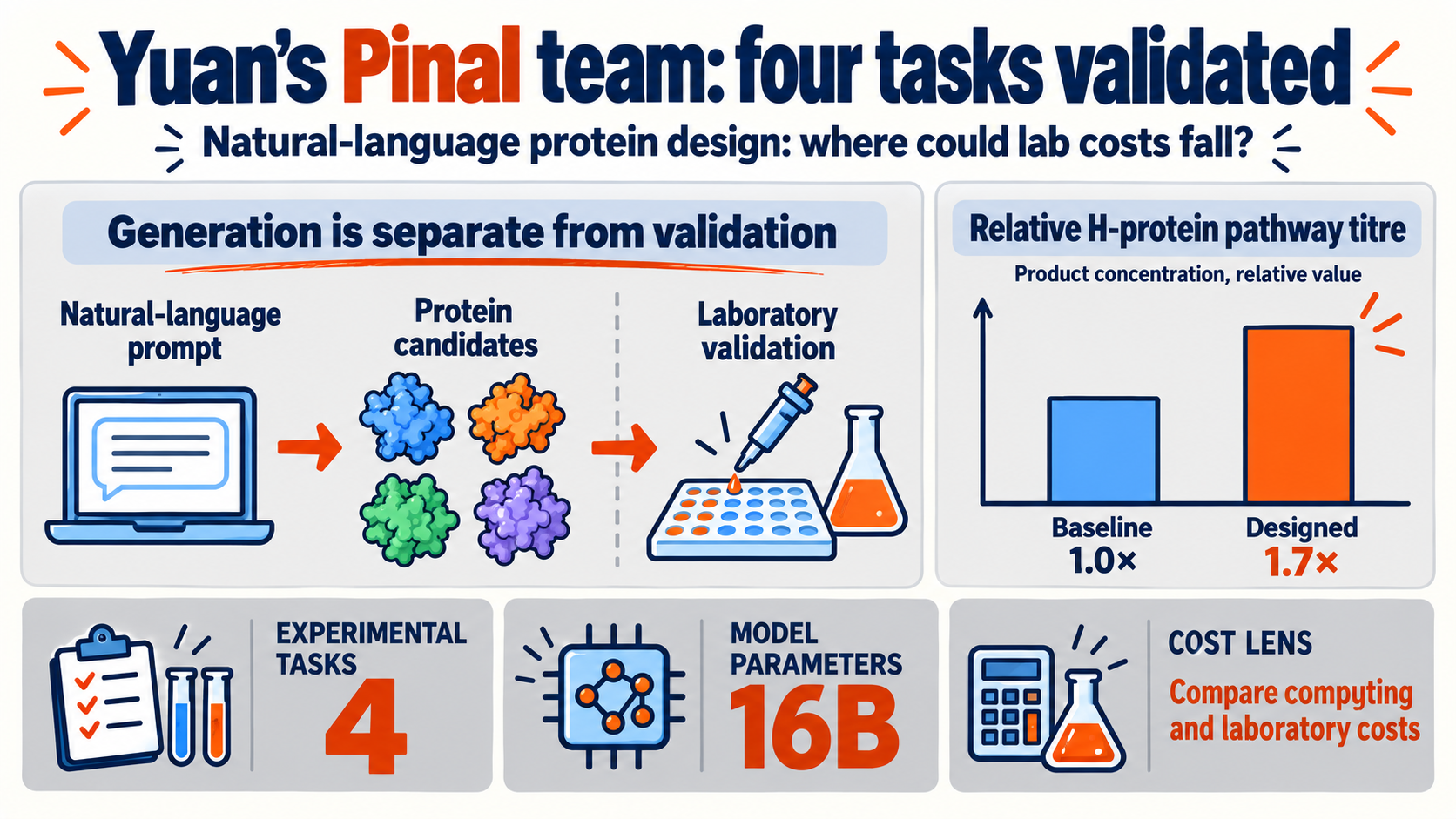
Fajie Yuan at Westlake University and his collaborators have introduced Pinal, an AI system that generates protein candidates from descriptions of desired functions. Their Nature study, published on 21 October 2026, reports experimental validation across four tasks. For Korean biotechnology and chemical manufacturers, the economic question is how much work remains between a generated candidate and a useful process. Source: Westlake University · Pinal
Asking for a protein that breaks down plastic sounds simple. A factory needs more: which waste stream, at what throughput, and with how much reusable enzyme? Pinal changes how researchers start searching for candidates. Whether that changes the cost of a finished product requires a separate test.
Fajie Yuan’s lab and the experimental team: who did what
Yuan leads Westlake’s Representation Learning Laboratory. Its earlier SaProt work combines protein sequence and structural information, while ProTrek connects natural language with protein data for functional searches. Pinal extends that research direction into candidate generation. Source: Westlake University · 연구자 소개
The project joins computational and experimental work. Co-first author Fengyuan Dai implemented and trained the model; co-first author Shiyang You contributed to the main research and enzyme validation. Hongyuan Lu of HKUST (Guangzhou), Jianming Liu of Westlake and Tong Si of the Shenzhen Institute of Advanced Technology, Chinese Academy of Sciences, co-supervised the biological experiments. Their collaboration connects generated designs to measurable biological function. Source: Nature · 저자 기여
What does Pinal change about design?
Proteins are chains of amino acids that fold into working shapes. Enzymes are proteins that accelerate chemical reactions. Designing a function means considering the sequence, its folded shape and the molecules it must act on. Translating a human request into molecular constraints is therefore a substantial part of the job.
Yuan’s approach first generates a symbolic representation of structure from a functional description, then uses it to produce sequence candidates. It seeks to reduce reliance on modifying natural starting proteins or manually specifying structural constraints. Natural-language design predates this study, and matching a description computationally does not establish that every requested property works experimentally. Source: Nature · 설계 구조
The official repository separates generation from computational evaluation. Researchers still need to assess predicted folding and alignment with the requested function. A company should compare the entire interval from specifying its requirements to obtaining a testable shortlist, rather than the time it takes to enter a prompt. Source: Pinal 공식 저장소
Pinal has about 16 billion parameters, the internal values adjusted during training. It was trained on 1.7 billion synthetically annotated protein–text pairs. Those pairs are not 1.7 billion distinct proteins tested experimentally. Training scale and the scope of functional validation need to be read separately. Source: Nature · 모델 및 학습 자료
-
1
Describe function
Specify the desired function
-
2
Generate candidates
Propose structural and sequence candidates
-
3
Computational evaluation
Assess folding and functional alignment
-
4
Experimental validation
Synthesize, express and measure
Four successful tasks do not mean every candidate works
The team tested a fluorescent protein, a PET-degrading hydrolase, an alcohol dehydrogenase and a metabolic H-protein. These cover distinct functional roles. Demonstrating those tasks is meaningful, but it does not establish unrestricted, on-demand protein engineering. Source: Nature · 네 과제
For PETase, the top 94 of 2,416 computationally filtered candidates entered an initial enzyme-activity screen before a standout advanced to PET hydrolysis validation. This was not a factory-use test of every generated candidate. The screening count cannot establish an industrial success rate: passing an assay and meeting a production specification are different milestones. Source: Nature · Extended Data 8
That distinction matters for budgets. Generating more candidates expands the search, but synthesizing and measuring more candidates also expands the bill. Useful generation must be paired with effective selection. An experimental system that records failures as well as successes is part of the economic proposition.
H-protein’s 1.7×: what did it actually measure?
In the H-protein work involving Jianming Liu and Yudian Zhu, replacing the native E. coli component increased product titre in a multi-enzyme CO₂-fixation pathway to 1.7 times the reference, without iterative experimental optimization. Titre means product concentration. The result shows that replacing a component can improve the output of a system of proteins. Source: Nature · H-protein 결과
Relative values reported in Nature; not carbon removal, factory productivity or cost savings.
The boundary matters. Higher titre alone does not establish a carbon-removal cost or factory throughput. Feedstock and energy inputs, operating time, protein lifetime and product purification all matter. This experiment does not provide a combined commercial cost for those operations.
Separate computing costs from laboratory costs
Yuan’s team has released its code. The repository gives a minimum of 40GB GPU memory for the large structural model and an example of roughly one minute to design ten proteins on an A40. That describes candidate generation, not time to experimentally confirmed function or total development cost. Source: Pinal · 실행 요구사항
A practical development budget separates computation and design from physical experiments. The first includes GPU use, candidate evaluation and researcher review. The second includes gene synthesis, protein production, purification, measurement and repeat testing. Scale-up and quality validation add further costs before the design becomes a manufacturing technology.
Design and computation
GPU use, evaluation, researcher review
Included costs
Adoption metric · Time and cost to obtain testable candidates
Experiments and process
Synthesis, purification, assays, repeats, scale-up
Included costs
Adoption metric · Total cost per validated candidate and quality
The following is an adoption proposal, not a measured finding of the paper. Compare Pinal with the existing workflow on total cost per validated candidate under the same performance specification. Track how many candidates require synthesis, elapsed time to success and the full cost of unsuccessful experiments.
The same distinction applies to other protein-design results. Our earlier protease-design article offers a related example of separating molecular performance from the conditions required for practical use. Related: 관련 글 · 프로테아제 설계
An enzyme is only part of a PET recycling plant
A separate process study provides context for the team’s PETase validation. NREL researchers’ 2025 work examined reaction conditions and separation technologies to reduce PET recycling costs and energy demand. Efficient breakdown does not guarantee a competitive product if recovering the resulting materials remains expensive. Source: NREL · 2025년 공정 연구
Capital is another separate requirement. Carbios’ own release on 24 September 2026 reported credit-committee approvals from several lenders, while export-credit and equity due diligence continued. The prospective 60% pre-sales figure depended on a beverage-company agreement being finalized. Those statements describe company expectations and progress, not completed financing or fully secured sales. Source: Carbios · 2026년 상반기 발표
Neither example establishes use of Pinal. Their relevance is narrower: a new enzyme must connect to reliable feedstock, stable operations, product recovery and customer commitments. Enzyme developers and process-engineering companies still need to validate that chain together.
The opportunity for Korean firms lies in validation
For Korean manufacturers, one possible starting point is a controlled comparison within an existing enzyme-based process. Keep feedstock, temperature and product-quality requirements constant, then record selection and retesting costs. This is a commercialization scenario, not evidence of Korean adoption or contracts.
An easier interface could let smaller laboratories test a wider range of enzyme ideas. That could support demand for custom design, standardized assays and automated laboratory services. Businesses differentiated mainly by generating candidates could face price pressure. Experimental data and knowledge of customer processes may become more valuable.
For an enzyme such as ADH, economics also includes the supply and regeneration of cofactors—the helper molecules involved in the reaction. Even a cheaper cofactor can disappoint if activity or lifetime deteriorates. This article makes no claim that Pinal demonstrated a particular saving from cofactor substitution; it is an additional industrial cost question.
Immediate replacement of established chemical processes would be a stronger claim than the evidence supports. Initial adoption may instead improve a particular enzyme or shorten candidate searches. Testing that scenario requires long-duration operating data, enzyme use per unit of product, and quality and reprocessing costs.
Good models and useful validation data need to develop together. Our MassNet article provides related context on protein-analysis data. To assess competition after Pinal, I would prioritize usable candidates obtained within a fixed budget over the sheer volume generated. This article explains research and is not a recommendation to buy or sell shares of any company mentioned. Related: 관련 글 · MassNet 단백질 분석
Pinal creates economic value when it improves the search for validated proteins within a fixed budget.
Sources and further reading
- Nature — Programmable design of functional proteins from natural language (2026-10-21)
- Westlake University — Fajie Yuan 연구실·대표 연구
- Westlake University — Pinal 연구 소개 (2026-10-23)
- Pinal 공식 GitHub — 모델·코드·실행 요구사항
- NREL 연구진 — Plastics Recycling With Enzymes Takes a Leap Forward (2025-06-30)
- Carbios — 2026년 상반기 실적 발표 (2026-09-24)
For information only — this is not a recommendation to buy or sell any asset.
Comments 0