Alzheimer GWAS finds 127 risk loci: can it cut drug-discovery costs?
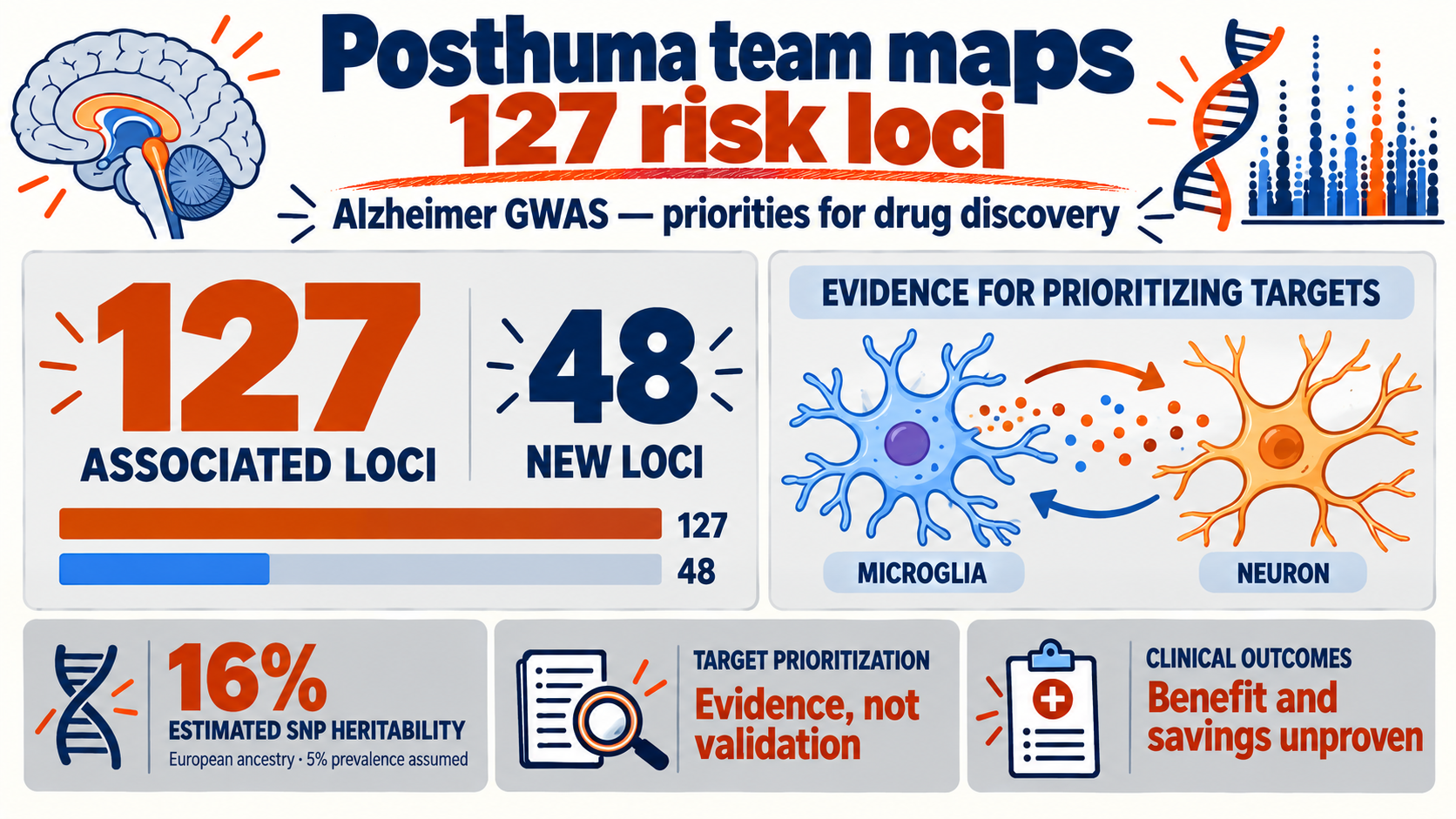
Alzheimer GWAS research has widened the starting point for drug discovery. PGC-ALZ, co-led by Danielle Posthuma at Vrije Universiteit Amsterdam and Ole Andreassen at Oslo University Hospital, reported 127 associated genomic regions in Nature on October 28, 2026, including 48 new ones. It matters because it changes which experiments get funded first and what risk-prediction services must prove. Source: Nature Source: Oslo University Hospital
These are leads for investigation, not a matching number of medicines. This was not a trial showing that a treatment helps patients. Its potential economic value lies in improving decisions about which experiments and development programmes deserve resources.
The Posthuma–Andreassen network behind the study
Emil Uffelmann is the first author and Douglas Wightman the second author of the study conducted within Posthuma and Andreassen’s international network. A 2021 Nature Genetics study by Wightman, Posthuma and colleagues was an earlier large Alzheimer GWAS. The new work builds on that continuing collaboration. Source: Broad Institute Source: CNCR summary statistics
Takafumi Ojima and Akira Narita were among the Tohoku Medical Megabank contributors. Their institution linked participants’ genomes to questionnaires about parental dementia. A participant reporting an affected parent could serve as a proxy case. That is different from being a diagnosed patient; it uses the genetic relationship between parents and children. Source: Tohoku Medical Megabank
Alzheimer GWAS: what 127 associated regions tell us
Uffelmann and colleagues used genome-wide association studies, or GWAS, to compare DNA variants between cases and controls. A variant is a difference in DNA sequence. A locus is a genomic region containing an association signal. Identifying the gene responsible within a region requires further evidence.
The abstract distinguishes 109,479 cases and 2,131,799 controls from additional family-history proxy cases and controls. The 127 loci combine 118 from the multi-ancestry analysis and nine additional ancestry-specific findings; 48 are new. Previously known regions can also be revisited to identify likely effector genes. Source: Broad Institute abstract
Source: Nature/Broad abstract. 79 calculated as 127−48. These are not gene or drug counts.
A locus count is not a drug count. A region may contain several genes, and association alone does not establish causation. For a developer, the value is stronger evidence for choosing experiments. Selecting a candidate and making an effective medicine remain separate tasks.
The team’s 16% estimate is not your probability of disease
SNP heritability estimates how much variation in underlying disease susceptibility is explained by common DNA variants. In European case–control data excluding proxies, with assumed prevalence of 5%, the team estimated about 6% using LDSC and 16% using SBayesRC. Source: Nature: heritability analysis
Nature: European case–control data, proxies excluded, assumed prevalence 5%. Point estimates; uncertainty bars omitted. Not personal risk or test accuracy.
The disease did not suddenly become more genetic. Different models capture genetic effects differently. This is neither a personal 16% chance of dementia nor a test-accuracy figure. The population and prevalence assumption matter.
Our interpretation is that research funders should reconsider the idea that little common-variant information remains to be discovered. But a heritability estimate cannot be inserted directly into a revenue forecast. A service must demonstrate added value beyond age, family history and existing clinical information.
Why immune cells and neurons both matter
Microglia help regulate immunity and the local environment in the brain. Genetic risk was enriched among genes more highly expressed in patient microglia, and among genes less expressed in some neurons. Expression describes how actively a gene is read in a cell. Source: Tohoku Medical Megabank
The neuronal findings included GABAergic Sncg and Sst types and glutamatergic L6 IT Car3 neurons. Adjustment for average expression differences weakened evidence for neuronal specificity. These findings do not establish that suppressing microglia treats Alzheimer’s disease. Source: Nature: cell-type analysis
Microglia
Risk enrichment in upregulated genes
Observed
Next experiment · Test which functions to modulate
Some neurons
Risk enrichment in downregulated genes
Observed
Limitation · Weaker subtype specificity after adjustment
The scientific opportunity is to connect inherited risk with changes in cellular activity. Commercially, this could improve experimental design: which cells should a medicine affect, and what should it change? Functional studies must come before claims about safety or benefit in people.
Where research productivity could improve
Tohoku’s account highlights QPCT, SYK and KEAP1 as potential drug targets. A target is a biological entity whose activity a medicine aims to change. Companies using the team’s results could combine these leads with functional experiments and existing pharmacology to rank projects. Better prioritization might reduce time spent on weak candidates. This is our economic interpretation; the study did not measure savings. Source: Tohoku: candidate targets
Another possible use is trial recruitment. A polygenic score combines the effects of many variants into a measure of inherited risk. If it adds useful information for a particular trial, it might make recruitment more efficient before costly confirmatory testing. Missing eligible patients or disproportionately excluding a population would instead damage trial quality and representativeness.
-
1
Target priorities
Use genetic evidence to rank experiments
-
2
Function and safety
Fund cellular and preclinical validation
-
3
Human validation
Evaluate benefit and recruitment criteria
-
4
Economic evaluation
Compare added costs with demonstrated benefits
Potential businesses include target-validation services, analysis linking hospital data, and trial-recruitment support. A risk score sold without a useful clinical pathway could simply generate additional testing. Improved research productivity and lower healthcare spending are separate outcomes.
Open data and blood tests serve different roles
The team’s summary statistics describe variant–disease associations. CNCR provides a download route but requires permission for commercial use. This is not unrestricted access to individual genomes. Competitive advantage may depend on permitted use, reproducible analysis and validated clinical utility rather than exclusivity over the association results. Source: CNCR terms of use
A different kind of diagnostic information is already commercial. In May 2025, the FDA cleared Fujirebio’s Lumipulse blood test to help assess amyloid pathology using a plasma protein ratio in symptomatic adults aged 55 or older. It is not intended for population screening or stand-alone diagnosis. Source: FDA
Inherited susceptibility and pathology at the time of testing answer different questions. Combining them might be useful, but PGC-ALZ3 did not validate such a commercial product. Any reduction in PET use from a blood-testing pathway should not be credited to a genetic score. Source: FDA: intended use
For Korea, look beyond testing revenue to care burden
Ojima and colleagues helped broaden East Asian participation, but that does not establish performance in Koreans. Tohoku’s account emphasizes the limitations of predominantly European data. A Korean service needs local calibration by age, evidence of incremental value and measurement of costs caused by misclassification. That validation work could itself support partnerships between hospitals and analytics companies. Source: Tohoku: sample limitations
The cost base extends beyond medical treatment. KDCA’s 2025 release puts estimated annual dementia management cost per patient at about KRW 26.39 million for 2023, including care-related expenditure. It is neither Alzheimer-only spending nor a family’s out-of-pocket bill. It cannot simply be treated as the addressable genetic-testing market or savings from a new treatment. Source: KDCA dementia statistics
An economic evaluation must balance added testing, counselling, treatment and monitoring against demonstrably avoided care costs and time lost by patients and families. More detection without effective action can raise spending. Preserving everyday function and reducing family caregiving could spread benefits far beyond testing-company revenue. Those outcomes were not measured here.
The route to Korean contract development and manufacturing organizations, or CDMOs, is longer. Biogen’s third-quarter 2026 filing discusses its LEQEMBI collaboration with Eisai and related manufacturing batches: an example of manufacturing business attached to antibody therapy. A new genetic target, however, might lead to an antibody, an oral drug or no viable treatment. This discovery alone does not establish demand for Korean antibody capacity. Source: Biogen Q3 2026 10-Q
What evidence should come next?
The next useful evidence is what happens to cell function when a prioritized target is altered. Then come meaningful human benefit, prediction in Koreans and improvements in care sufficient to justify added cost. Success at one stage should not be booked as success at the next.
The work could change which questions developers ask and where they spend first. If better priorities eliminate weak experiments earlier and help find useful treatments sooner, the economic effect could be substantial. What exists now is a stronger basis for testing that possibility, not proof of a company’s future profits or an investment recommendation.
The economic value of genetic discoveries must be demonstrated through better experiments and patient benefit.
Sources and further reading
For information only — this is not a recommendation to buy or sell any asset.
Comments 0