Medical AI care costs 3.2 times higher — Aran’s team prices AI-recommended tests and referrals
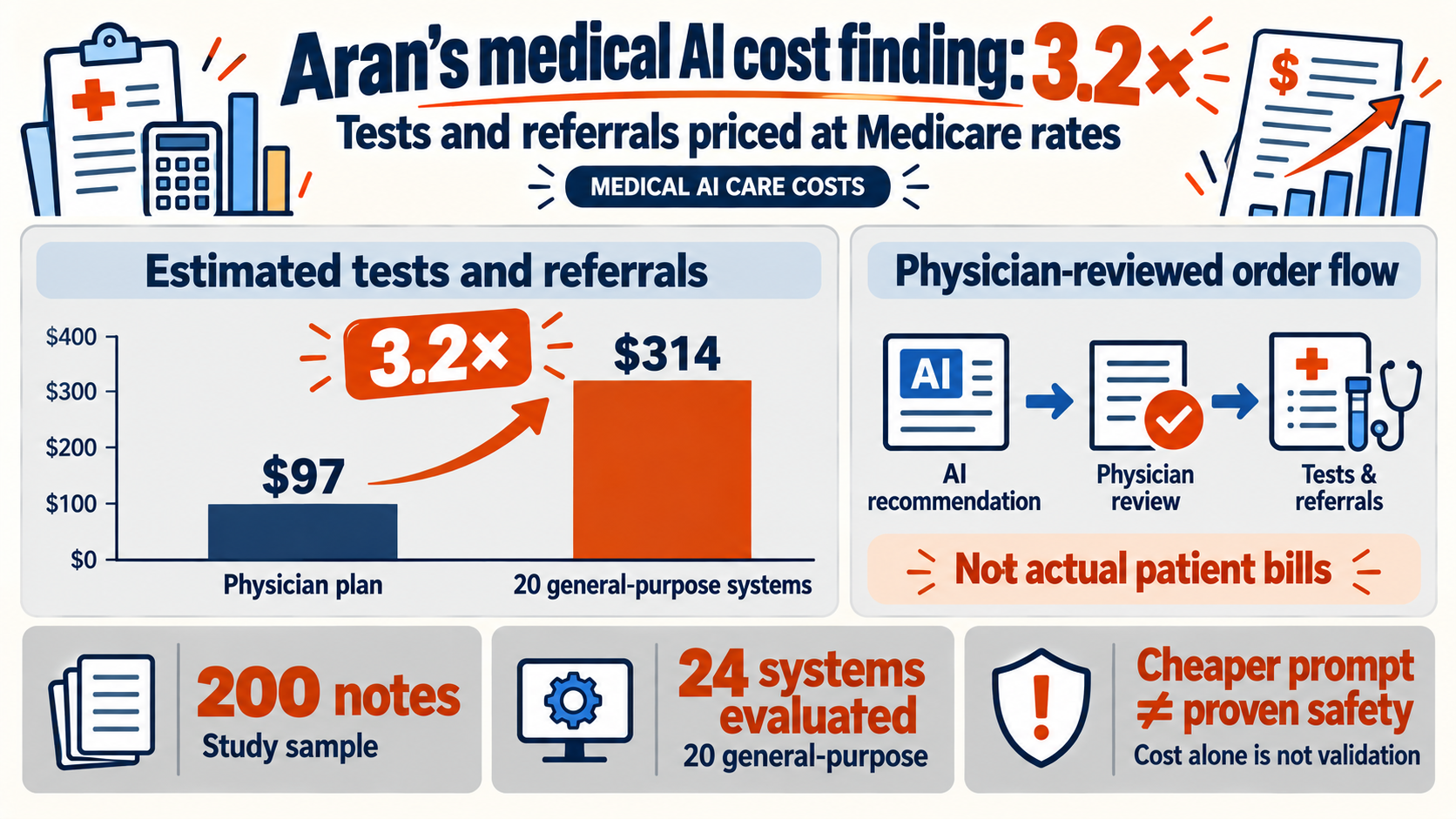
Will medical AI care costs fall simply because doctors spend less time on paperwork? Dvir Aran of the Technion and colleagues found that general-purpose AI recommendations for tests and specialist referrals averaged $314 per visit, versus $97 for physicians’ documented plans. That 3.2-fold gap changes what a hospital needs to measure before deployment. Source: 논문 초록 / Abstract
These are estimated prices of recommendations, not money patients actually paid. The researchers applied 2026 US Medicare rates to both sets of plans. The primary total covers tests and specialist referrals, excluding drug spending and longer-term care. It is a resource-use comparison, not a measured increase in national medical expenditure.
A Technion clinical AI lab meets a Stanford health economist
Aran leads a Technion laboratory working on biological data and clinical AI. Coauthor Jeremy Goldhaber-Fiebert, a Stanford professor of health policy, studies the costs and effects of health interventions. Their collaboration brings a useful second question to model evaluation: how many resources would it take to act on the answer? Source: Technion 연구자 소개 Source: Stanford 연구자 소개
The other coauthors are Ittai Many, Anthony Nguyen, Daniel Yang and Shahar Shelly. Aran and Shelly also participated in a prospective evaluation of LLM decision support in an emergency department. This study extends that clinical focus to the economics of the proposed plan. Public materials do not establish each author’s detailed division of work. Source: 저자 명단·자료 Source: 관련 연구
The paper appeared in NEJM AI on October 15, 2026, a date also listed by UCSF CODEX. The publisher’s full text was inaccessible during this review. This article therefore cross-checks the abstract hosted by Stanford with the authors’ public analysis materials, without claiming to have verified every supplementary-method detail. Source: 게재일 / Publication date Source: NEJM AI
How medical AI care costs were compared
Aran and colleagues used 200 deidentified outpatient and emergency-department notes from MTSamples. Each system received the presentation preceding the clinician’s assessment and generated its own plan. The comparator was the treating physician’s plan documented in the same record. Source: 자료와 방법
The panel contained 20 general-purpose and four medical-specific systems. Three independent LLMs extracted orders, which were priced consistently. The contribution is an evaluation design rather than a new diagnostic model: attaching resource costs to the actions existing models propose. That exposes a dimension that an examination score cannot capture. Source: 논문 초록
For the general-purpose panel, the reported mean difference was $216, with a 95% confidence interval of $177–$257. Subtracting the displayed rounded means gives $217; that arithmetic should not replace the study’s reported estimate.
Mean across 20 general-purpose systems; 2026 Medicare prices per visit. Not actual bills or total care costs; drugs excluded. Source: study abstract.
The excess comprised $105 in diagnostic tests and $111 in specialist referrals. A test’s price alone therefore misses much of the resource issue. A referral also uses another clinician’s time and appointment capacity, although the study did not directly measure changes in waiting times.
Components of the reported mean difference, distinct from subtracting the rounded displayed means. · Axis starts at 100, not zero
Can AI recognize when no test is needed?
The 66% figure deserves careful reading. It is the proportion of visits with no diagnostic testing documented by the physician, not the fraction of all visits at which AI added testing. Every system proposed additional testing within that subset, often in recurring panels.
A panel bundles several tests, such as blood tests, into a single order. Producing a comprehensive explanation of symptoms and selecting only the actions appropriate for this encounter are different tasks. The public analysis also shows variation across models in the proportion of these visits receiving added tests. “Every system” does not mean every system ordered tests at every individual visit. Source: 저자 공개 분석
One interpretation is defensive medicine: recommending a wider workup to reduce the chance of missing something. That is an interpretation, not an experimentally established model motive or training mechanism. Missing clinical information may also make some extra tests reasonable. Greater estimated spending alone does not establish that every added recommendation was unnecessary.
Can a cost-conscious prompt solve it?
Aran’s team also changed the prompt. A cost-aware instruction yielded costs 2.5 times the physician comparator; a parsimonious-but-safe instruction yielded 1.4 times. Instructions clearly influence resource use. But a lower estimated bill is not evidence that safety has been preserved. Source: 초록의 프롬프트 비교
Comparisons reported in the abstract, not a time series or evidence of equivalent safety.
This was not a clinical trial assigning patients to competing care pathways and following outcomes. Missed necessary tests, subsequent visits and hospitalizations would need to be measured before claiming savings. Writing “safe” into an instruction does not measure safety.
Extracting orders from prose introduces another source of uncertainty. Using three extractors helps examine that problem but cannot settle how an ambiguous recommendation would turn into an actual order. Nor is the physician’s written plan guaranteed to contain every judgment and action.
Faster documentation can coexist with higher downstream costs
Aran’s question already intersects with commercial workflow design. Microsoft documents how Dragon Copilot turns spoken clinician intent into suggested orders and connects those suggestions to an electronic health record, or EHR, for review and matching. AI-generated text is reaching the screen where clinical work happens. Source: Microsoft 제품 문서
That feature differs from an AI independently generating a care plan in the study. The findings do not establish that Dragon Copilot raises costs 3.2-fold. The distinction matters: transcribing a decision the clinician has already made and proposing a new test can have different economic consequences.
The following is a deployment scenario, not an observed paper result. Less documentation time could free clinicians for explanation or additional visits. Unreviewed test suggestions selected by default could instead increase utilization. Provider productivity and an insurer’s total spending need not move together.
-
1
Suggested services
AI proposes additional actions
-
2
Clinician review
Review need, duplication and coverage
-
3
Actual delivery
Accepted services consume resources
-
4
Outcome assessment
Measure costs, missed diagnoses and revisits
A useful economic assessment goes beyond subscription prices. It compares the value of time released with integration, review and additional services actually delivered. Follow-up utilization and patient outcomes can change the result again. Time saved is not automatically cash saved on staffing; staffing or activity must change for that accounting effect to appear.
In Korea, payment rules and the ordering screen both matter
From the cost-effectiveness perspective represented by Goldhaber-Fiebert’s work, a Korean assessment starts with local care pathways, not a currency conversion. HIRA explains that fee-for-service payment compensates services through prices and quantities, alongside other arrangements such as bundled payment. Local tariffs, coverage and referral pathways prevent the Medicare ratio from serving as a Korean spending forecast. Source: 심평원 지불제도 안내
For a Korean EMR or clinical chatbot deployment, an early question is whether newly suggested tests can advance toward ordering without explicit clinician approval. Coverage checks may help reduce unsupported claims. Yet predicting a payment denial and deciding whether a patient needs care are different judgments that require separate validation.
A local evaluation could begin in a mode that does not affect care, pricing suggestions against Korean records and tariffs. It could then measure clinician acceptance and follow testing, repeat visits and missed diagnoses around deployment. National effects depend on adoption, acceptance and case mix. This study alone cannot quantify them.
What will the medical AI market need to sell?
The study suggests possible demand for evaluation services. EMR vendors could show the rationale and expected price for each suggested order; evaluators could check whether model updates change testing and referral behavior. These are potential business opportunities, not revenue or profitability findings established by the paper.
The research-associated MEDBAR.ai site already offers benchmarking against an institution’s own case mix. That illustrates a research-to-business connection and a commercial interest readers should recognize. Its promotional claims are not treated here as independent evidence of clinical effectiveness. Source: MEDBAR.ai 서비스 설명
Replacement of existing work should also be assessed task by task. Parts of documentation and order search can be automated; this experiment does not establish a case for replacing physicians. A plausible source of product value is making justified recommendations easy to review and measuring what follows, rather than maximizing the number of suggestions.
Our earlier MedGemma article offers a related perspective: performance on medical tasks and the economics of hospital deployment need separate evaluation. Our byte-level LLM conversion article looked at the cost of building models; this study looks at the costs that appear on the hospital and payer side once a model is in use. Related: 관련 글: MedGemma
Aran’s study leaves a practical question: when suggested services are actually delivered, do patients do better while clinician workload and total costs fall? The 3.2-fold ratio does not answer it. It shows why the ordering pathway needs to be evaluated before suggestions are routinely turned into care.
Medical AI economics must be evaluated where suggestions become services and patient outcomes.
Sources and further reading
- Aran et al., NEJM AI — Comparative Cost of Care Recommended by Large Language Models versus Treating Physicians
- Stanford — Jeremy Goldhaber-Fiebert 프로필 및 해당 논문 초록
- Dvir Aran — 연구 데이터와 분석 코드
- 저자 공개 분석 수치 — paper_numbers.md
- MEDBAR.ai — Ask for the Bill
- MEDBAR.ai — 연구진의 관련 논문 목록
- American Technion Society — Dvir Aran
- UCSF CODEX — 논문 게재일 목록
- Microsoft — Dragon Copilot 주문 관리
- 건강보험심사평가원 — 우리나라 진료비 지불 제도
For information only — this is not a recommendation to buy or sell any asset.
Comments 0