IMF 헤지펀드 경고 — 미 국채 점유율 4%→9%, 마진콜은 한국 기업에 어떻게 번질까IMF Hedge Fund Warning: Treasury Share Up From 4% to 9% — How Margin Calls Could Reach Korean Firms
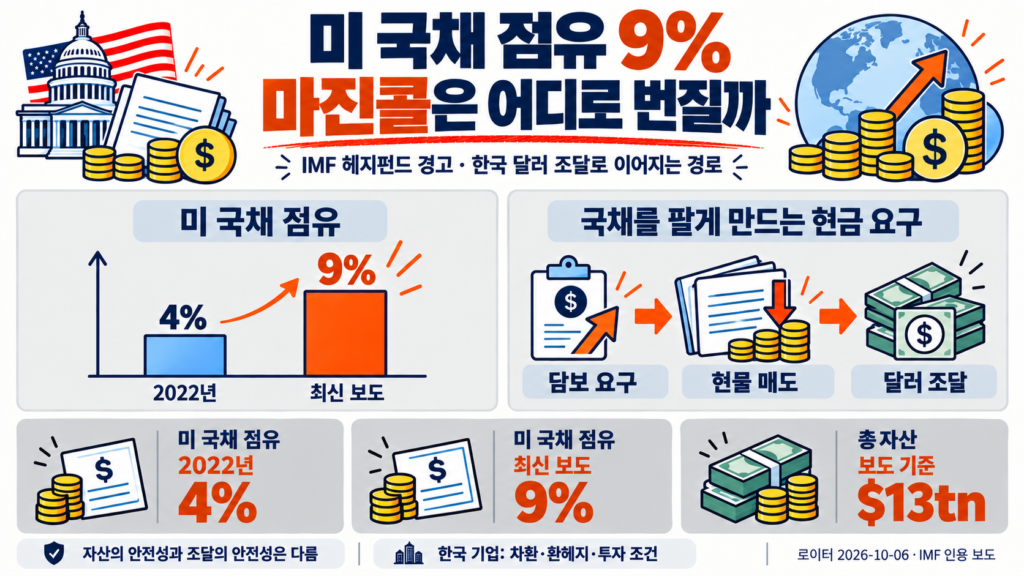
IMF 헤지펀드 경고의 핵심은 안전한 국채도 돈을 빌려 사면 급매물이 될 수 있다는 점입니다. 10월 6일 Reuters가 전한 IMF 분석에서 헤지펀드의 미 국채시장 점유율은 2022년 4%에서 최근 9%로 커졌습니다. 이 거래가 흔들릴 때 한국 기업의 달러 조달과 투자에 어떤 부담이 생기는지 살펴봅니다. 출처: Reuters · 2026-10-06
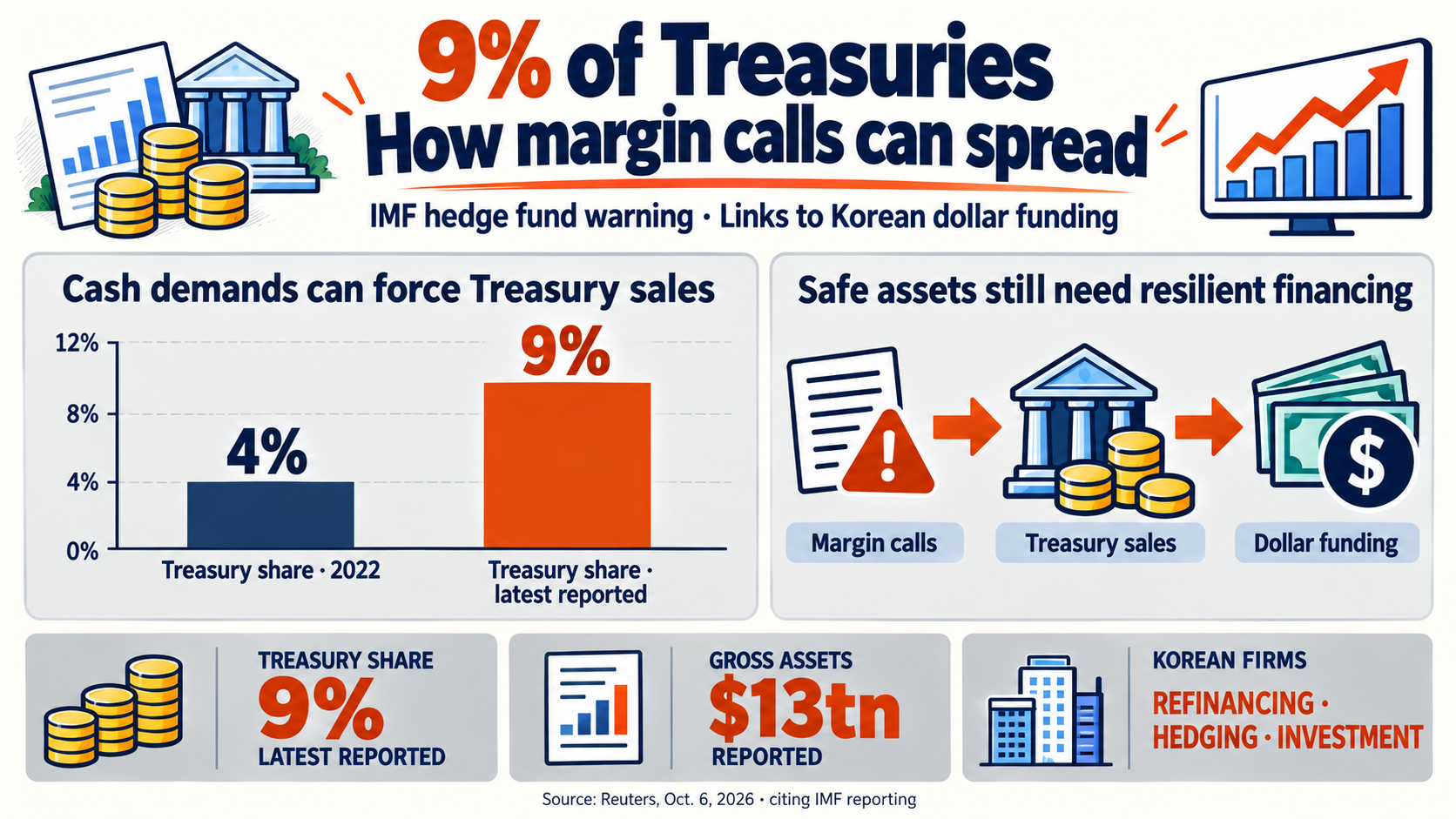
The IMF hedge fund warning concerns the financing behind apparently safe assets. Reuters reported on October 6 that hedge funds’ share of the Treasury market has risen from 4% in 2022 to 9%. Understanding the borrowing behind those holdings helps explain how market stress could reach Korean companies. Source: Reuters · 2026-10-06
회사 재무팀 입장에서 중요한 것은 미국 펀드가 얼마를 잃었느냐만이 아닙니다. 다음 달 갚을 달러를 다시 빌릴 수 있는지, 환율 변동을 막아 놓은 계약에 현금을 더 맡겨야 하는지도 중요합니다. 펀드의 거래와 공장 투자 사이에는 이렇게 자금의 연결이 있습니다.
자료 기준은 한국시간 10월 7일입니다. IMF 공식 페이지에서는 제2장 발표 일정을 확인했고, 최신 수치는 보고서를 인용한 보도를 사용했습니다. 10월 원문 도표는 직접 대조하지 못했으며, 거래 구조는 연준의 공식 연구로 교차검증했습니다. 아래 한국 기업 영향은 특정 기업의 손실 발표가 아니라 조건부 분석입니다. 출처: IMF · October 2026 GFSR 출처: Federal Reserve · 2026-06-22
IMF 헤지펀드 경고, 13조달러와 40조달러의 차이
헤지펀드는 전문 투자자의 돈을 모아 주식·채권·파생상품에 투자하는 펀드입니다. 헤지라는 이름이 손실 방지를 보장하지는 않습니다. 자산을 사는 동시에 다른 자산을 팔거나, 빌린 돈으로 거래를 키우는 등 전략이 다양합니다. 은행은 아니지만 은행의 대출과 파생상품 서비스를 이용합니다. 출처: New York Fed · 2025-10-16
보도에 나타난 규모는 두 가지입니다. 총자산은 약 13조달러이고, 파생상품을 포함한 명목노출은 40조달러를 넘는 수준으로 전해졌습니다. 후자는 계약의 기준금액을 넓게 합친 것으로, 그만큼 현금이 투자됐거나 손실이 발생했다는 뜻은 아닙니다. 출처: Reuters · 2026-10-06 출처: Cinco Días · 2026-10-06 출처: Ahram Online · 2026-10-06
총자산 약 13조달러
차입으로 산 자산도 포함
의미
주의 · 투자자 순자산과 다름
명목노출 40조달러 초과 보도
파생상품 계약 규모까지 포함
의미
주의 · 예상 손실액이 아님
예를 들어 같은 채권과 관련된 매수·매도 계약이 함께 있으면 명목금액은 커져도 가격 방향에 대한 위험은 상당 부분 상쇄될 수 있습니다. 그렇다고 위험이 사라지지는 않습니다. 서로 다른 계약에서 돈을 주고받는 시점이 다르면, 최종 손익이 작아도 오늘 필요한 현금은 클 수 있습니다.
따라서 40을 13으로 나눠 업계의 자기자본 대비 차입 배수라고 읽으면 안 됩니다. 레버리지를 판단하려면 투자자가 넣은 순자산, 실제 차입, 상쇄되는 포지션과 담보조건을 함께 봐야 합니다. 큰 숫자는 더 들여다볼 이유이지 파산 규모의 예고장이 아닙니다.
국채를 사고 선물을 파는 거래는 왜 커졌을까
대표적인 전략은 베이시스 거래입니다. 현물 국채를 사고, 나중에 국채를 넘기기로 하는 선물은 매도합니다. 두 가격 사이의 작은 차이가 줄어들 때 이익을 얻으려는 거래입니다. 국채금리가 무조건 오른다거나 내린다는 한 방향의 전망과는 구별됩니다. 출처: Federal Reserve · 2026-06-22
현물 매입 대금은 레포로 조달할 수 있습니다. 레포는 국채를 맡기고 단기로 현금을 빌린 뒤 되갚는 거래입니다. 담보가 좋아 적은 자기자금으로 큰 금액을 굴릴 수 있고, 작은 가격 차이도 자기자금 기준으로는 매력적인 수익이 됩니다. 이 구조가 헤지펀드의 국채시장 참여를 키운 배경입니다. 출처: Federal Reserve · 2023-09-08
참여가 늘면 평상시에는 현물과 선물 가격의 괴리가 줄고 거래 상대를 찾기 쉬워집니다. Reuters가 전한 4%에서 9%로의 점유율 확대는 이런 중개 역할이 커졌다는 뜻이기도 합니다. 다만 이 비율을 모든 펀드가 똑같은 전략을 쓴다는 증거로 읽을 수는 없습니다. 출처: Reuters · 2026-10-06
미 국채시장에서 커진 헤지펀드 비중. Reuters, 2026-10-06. 최신 9%의 세부 관측일·분모는 IMF 원문 추가 확인 필요. 거래량 점유율이나 순방향 베팅 비율로 해석하지 않습니다.
교차검증 자료도 있습니다. 연준이 2026년 6월 22일 발표한 연구는 2025년 9월 대형 헤지펀드가 민간 보유 미 국채의 시장가치 기준 약 8.5%를 보유한 것으로 추정했습니다. IMF 인용 보도의 9%와 확대 방향은 맞지만 표본·분모·시점이 완전히 같다고 확인되지는 않았습니다. 두 수치를 이어 붙여 최근 증가율을 계산하지 않는 이유입니다. 출처: Federal Reserve · 2026-06-22
수익은 가격 차이만으로 결정되지 않습니다. 레포 금리가 뛰면 빌린 돈에 내는 이자가 늘고, 거래를 유지할 매력이 줄어듭니다. IMF의 4월 금융안정보고서도 조달금리 상승과 위험한도가 청산 압력을 만들 수 있다고 설명했습니다. 수익이 얇은 거래일수록 자금 조건의 작은 변화가 크게 작용합니다. 출처: IMF · April 2026 GFSR Chapter 1
마진콜이 오면, 손실보다 현금이 먼저 문제가 됩니다
마진콜은 거래를 계속하려면 현금이나 담보를 추가로 내라는 요구입니다. 선물 가격 변동에 따른 손익 정산과, 앞으로의 위험에 대비해 요구하는 증거금 인상은 구분해야 합니다. 국채를 맡기고 빌릴 수 있는 금액이 줄거나 레포 만기 연장이 거절되는 경우도 자금 압박을 만듭니다. 출처: Federal Reserve · 2023-09-08
현물 국채 가격이 오르는 상황을 생각해 보겠습니다. 펀드는 보유 채권에서 이익이 나도, 매도한 선물 가격이 함께 오르면 그쪽에는 현금을 내야 할 수 있습니다. 채권의 평가이익이 선물 계좌로 자동 이체되는 것은 아닙니다. 반대로 현물 가격이 떨어질 때는 담보 가치가 줄 수 있지만 선물 매도에서는 이익이 날 수 있습니다.
현금을 마련하지 못한 펀드는 포지션을 줄입니다. 이때 현물은 팔고, 선물 매도는 되사서 정리합니다. 비슷한 거래를 한 펀드가 동시에 움직이면 받아 줄 금융회사의 여력이 부족해질 수 있습니다. 가격 괴리가 더 벌어지고 담보 요구가 다시 커지는 악순환이 가능한 이유입니다. 출처: Federal Reserve · 2026-06-22
-
1
조달·담보 조건 변화
레포 만기·증거금 요구
-
2
당장 쓸 현금 필요
평가이익과 현금은 다름
-
3
거래 축소
현물 매도·선물 되사기
-
4
가격 괴리 확대 가능
동시 청산이면 압력 증폭
프라임브로커는 헤지펀드에 대출·증권대차·파생상품 서비스를 제공하는 금융회사입니다. 각 은행이 자기 거래만 보고 대출하면, 같은 펀드가 다른 은행에서 얼마나 빌렸는지 놓칠 수 있습니다. 담보가 있다고 안심하는 것과, 여러 고객이 동시에 팔 때 담보를 얼마에 처분할 수 있는지는 다른 문제입니다. 출처: New York Fed · 2025-10-16
그렇다고 모든 충격이 국채금리 상승으로 끝나지는 않습니다. 강제 매도는 해당 채권 가격을 누르지만, 경기 불안에 따른 안전자산 매수는 금리를 낮출 수 있습니다. IMF의 경고를 읽을 때는 방향을 미리 정하기보다 가격 변동과 매매 비용이 커질 조건을 봐야 합니다.
한국 기업에는 달러 조달·환헤지·투자로 전해집니다
한국 기업의 달러 채권 발행 비용은 미국의 기준이 되는 시장금리에 기업 신용위험과 거래 여건을 반영한 가산금리를 더해 정해집니다. 미 국채금리가 안정되더라도 은행과 투자자가 위험을 덜 지려 하면 가산금리가 높아질 수 있습니다. 달러 부채 만기가 임박한 기업이 먼저 영향을 받는 경로입니다.
은행도 달러를 조달해 기업에 빌려줍니다. 해외 거래상대방이 대출 한도를 줄이거나 담보를 더 요구하면 은행은 신규 대출의 가격과 만기를 조정할 수 있습니다. 은행의 조달비용 증가가 기업의 이자비용으로 옮겨 가는 과정입니다. 이미 고정금리로 장기 조달한 회사와 단기 차입을 계속 갈아타는 회사의 부담은 다릅니다.
환헤지는 미래에 받을 달러나 갚을 달러의 교환 조건을 미리 정해 환율 위험을 줄이는 거래입니다. 하지만 계약이 있다고 모든 자금 문제가 해결되지는 않습니다. 스왑시장에서 달러 수급이 빡빡해지면 거래 비용이 달라지고, 담보 약정이 있는 계약은 중간에 현금이 필요할 수 있습니다. 헤지 비용은 한미 금리차·만기·매수와 매도 방향에 따라서도 달라집니다. 출처: IMF · April 2026 GFSR Chapter 2
부담이 커질 수 있는 경우
짧은 만기·반복 차환
차입
달러 흐름 · 수입·상환이 매출보다 먼저
담보 · 추가 현금 요구에 여유 부족
충격을 줄이는 조건
장기 만기·고정 조달
차입
달러 흐름 · 수입과 지출 시점 일치
담보 · 가용 현금과 분산된 거래처
이하 실적과 산업 영향은 이 경로를 적용한 분석입니다. 원화가 약해지면 달러 매출의 원화 환산액이 늘 수 있지만, 원재료 수입과 달러 이자도 비싸질 수 있습니다. 수출기업이라는 이름만으로 수혜를 판단하기 어려운 이유입니다. 달러로 버는 돈에서 달러로 쓸 돈을 뺀 규모와 지급 시점을 함께 봐야 합니다.
자금 비용이 높아진 상태가 이어지면 공장·데이터센터·발전설비 투자에서 통과해야 할 수익률 기준도 높아집니다. 기술이나 주문이 좋아도 자금 조달이 확정되지 않으면 착공이 늦어집니다. 앞서 다룬 세계은행 민간자본 유치에서도 보증과 실제 금융종결을 구분했듯, 투자 발표와 집행 사이에는 조달 조건이 있습니다.
그 결과 현금이 넉넉하고 차입 만기가 긴 기업은 투자를 이어 가는 반면, 차환에 의존하는 기업은 증설을 미룰 수 있습니다. 이런 차이가 오래 지속되면 시장점유율과 협력사 주문에도 영향을 줍니다. 가계에서는 대출금리 부담과 자산가격 하락이 소비를 누를 수 있지만, 단기 시장 소동이 곧바로 경기침체를 의미하지는 않습니다.
외환보유액도 같은 구분이 필요합니다. 보유 채권 가격이 내려 장부상 평가액이 줄어드는 것과, 당장 쓸 달러가 부족한 것은 같은 일이 아닙니다. 스트레스 때는 팔거나 담보로 쓸 수 있는 자산의 유동성이 중요합니다. 이 글은 한국의 외환보유액 부족이나 개입 필요성을 판정한 분석은 아닙니다. 출처: IMF · April 2026 GFSR Chapter 2
IMF·연준·정부 발언으로 본 금리 상승의 원인과 충격의 증폭
줄리 코잭 IMF 커뮤니케이션국장은 10월 1일 브리핑에서 에너지 가격과 통화정책 예상, 부채 우려와 기간프리미엄을 금리 상승 요인으로 설명했습니다. 기간프리미엄은 오랫동안 돈을 묶어 두는 불확실성에 투자자가 요구하는 추가 보상입니다. 당시 채권시장이 질서 있게 작동한다는 평가도 함께 제시했습니다. 취약성을 경고하는 것과 이미 시장 기능이 무너졌다고 진단하는 것은 구분해야 합니다. 출처: IMF · 2026-10-01
미셸 보먼 연준 금융감독 부의장은 5월 8일 연설에서 은행의 비은행 거래상대방 보고가 너무 넓게 묶여 위험을 세밀하게 보기 어렵다고 설명했습니다. 차주의 자산·이익·레버리지 정보를 더 확보하겠다는 방향도 밝혔습니다. 사모신용이 중심인 연설이며 이번 IMF 발표에 대한 반응은 아니지만, 은행 밖으로 간 위험도 은행과 연결해서 봐야 한다는 공통점이 있습니다. 출처: Federal Reserve · 2026-05-08
Reuters가 전한 이번 IMF 권고도 데이터 공백 해소와 위험 감시 강화에 초점을 맞췄습니다. 이를 실제 관리로 옮기려면 펀드의 총차입뿐 아니라 프라임브로커별 한도와 담보, 동시 청산 가능성을 봐야 합니다. 이는 당장 금리를 낮추라는 처방과는 다른 감독 과제입니다. 출처: Reuters · 2026-10-06
국내에서는 재정경제부가 10월 1일, 10월 국고채 발행물량을 당초 계획보다 5조원 줄이겠다고 발표했습니다. 시장이 받아야 할 신규 채권을 줄이는 조치입니다. 그러나 국내 공급을 줄여도 해외 은행의 달러 한도나 미국 레포시장까지 직접 정상화할 수는 없습니다. 이 조치를 헤지펀드 청산의 결과로 볼 증거도 확인되지 않았습니다. 출처: 재정경제부 / KDI · 2026-10-01
앞서 미국 10년물 국채금리와 한국 기업 비용에서 금리 수준이 이익과 주가에 전해지는 경로를 다뤘습니다. 이번 IMF 헤지펀드 경고는 그 과정에서 누가 급하게 팔아야 하는지를 더합니다. 금리가 오른 이유와 가격 움직임이 커지는 이유를 나눠 보면 정책의 역할도 더 선명해집니다.
주식시장 심리가 나아져도 자금조달 위험은 따로 봐야 합니다. 제공 스냅샷의 CNN 공포·탐욕지수는 10월 6일 48.0으로 중립입니다. 1주 전 28.9에서 19.2포인트, 1개월 전 45.2에서 2.8포인트 올랐습니다. 한국 GoldKimp KOSPI 지수는 10월 1일 60.5로 탐욕입니다. 한국이 더 낙관적인 등급이지만 관측일·산식이 달라 점수 차를 그대로 비교할 수 없고, 한국의 주간·월간 변화는 자료가 없어 확인하지 못했습니다. 출처: CNN Fear & Greed 출처: GoldKimp KOSPI F&G
SentimenTrader의 최신 Smart Money·Dumb Money 개별 점수와 기준일은 공개 화면에서 확인되지 않았습니다. 확인 가능한 9월 25일 요약에는 두 지수의 차이가 9월 16일 0 위로 올라섰다고 나옵니다. 이는 당시 관측이며 현재 점수가 아닙니다. 주식 심리가 회복됐다는 신호를 국채 담보와 단기 차입이 안전하다는 증거로 바꾸어 읽어서는 안 됩니다. 출처: SentimenTrader 출처: SentimenTrader · 2026-09-25
금리 한 숫자보다 레포·담보·달러 조달 조건을 보세요
지켜볼 것은 금리의 높이뿐 아니라 거래가 가능한 상태인지입니다. 레포 조달금리와 담보 요구가 안정되는지, 국채를 사고파는 가격 차이가 커지는지, 한국 은행의 달러 조달 가산금리와 환헤지 견적이 악화되는지를 함께 보면 도움이 됩니다. 이 지표들이 나빠져야 한다는 예측이 아니라, IMF가 지적한 위험이 실제로 전이되는지 확인하는 순서입니다.
담보와 차환이 안정되면 헤지펀드는 가격 차이를 줄이는 역할을 계속할 수 있습니다. 반대로 같은 시기에 차입을 줄여야 한다면 국채시장의 작은 괴리가 기업의 투자 일정까지 흔들 수 있습니다. 한국 기업과 투자자에게 남는 질문은 분명합니다. 가진 자산의 질과 함께, 그 자산을 유지할 현금의 시간표도 보고 있는지입니다.
출처와 참고자료
- IMF — October 2026 GFSR 발표 일정
- Reuters / MarketScreener — Hedge funds market footprint, 2026-10-06
- Cinco Días — IMF 헤지펀드 보고서 보도, 2026-10-06
- IMF — Julie Kozack 브리핑, 2026-10-01
- Federal Reserve — Michelle Bowman 연설, 2026-05-08
- Federal Reserve — Treasury Exposures, Repo, and Margining, 2023-09-08
- New York Fed — The Basics of Hedge Funds, 2025-10-16
- IMF — April 2026 GFSR Chapter 1
- IMF — April 2026 GFSR Chapter 2: Capital Flows
- 재정경제부 / KDI — 2026년 10월 국고채 발행계획, 2026-10-01
- CNN — Fear & Greed, 2026-10-06 스냅샷
- GoldKimp — KOSPI F&G, 2026-10-01 스냅샷
- SentimenTrader — 공개 대시보드
- SentimenTrader — 2026-09-25 공개 주간 요약
- SentimenTrader — 2026-10-02 공개 주간 요약
- Federal Reserve — Decomposing Hedge Funds’ U.S. Treasury Exposures, 2026-06-22
- Ahram Online — IMF 명목노출 40조달러 초과 보도, 2026-10-06
For a corporate treasurer, the immediate question is practical: can the company refinance its dollar debt next month, and might its currency contracts require more cash collateral? Those links connect a fund’s trading book to a manufacturer’s investment budget.
This article is dated October 7, Korea time. The IMF page confirms the Chapter 2 release schedule; current headline figures come from reporting on that chapter. Its underlying tables were not directly available for verification. Federal Reserve research supports the trading mechanics. The Korean business implications below are conditional analysis, not reported company losses. Source: IMF · October 2026 GFSR Source: Federal Reserve · 2026-06-22
The IMF hedge fund warning: assets versus exposure
Hedge funds pool capital from sophisticated investors and use varied strategies across securities and derivatives. The word “hedge” does not guarantee protection. Funds may offset one position with another or borrow to expand a trade. They sit outside banking but rely on banks for financing and derivatives services. Source: New York Fed · 2025-10-16
Reported gross assets are about $13 trillion; derivatives-inclusive notional exposure is reported above $40 trillion. Notional amounts describe contract scale, not cash invested or losses. Source: Reuters · 2026-10-06 Source: Cinco Días · 2026-10-06 Source: Ahram Online · 2026-10-06
Gross assets: about $13tn
Includes assets financed with borrowing
Meaning
Caution · Not investor equity
Notional exposure reported above $40tn
Includes derivatives contract amounts
Meaning
Caution · Not expected losses
Offsetting contracts can make gross exposure large while reducing sensitivity to price direction. Cash needs are a different matter. Gains and losses may settle with different counterparties at different times, leaving a fund short of immediately usable money even when the eventual net result is modest.
Dividing 40 by 13 does not produce an equity leverage ratio. That assessment requires net assets, borrowing, offsetting positions and collateral terms. These large totals justify scrutiny; they do not measure an impending default bill.
Why buy Treasuries and sell futures?
A common strategy is the cash-futures basis trade: buy a Treasury and sell a futures contract against it. The objective is to capture a price discrepancy as it converges, after financing and other costs. It is different from a simple bet on whether interest rates rise or fall. Source: Federal Reserve · 2026-06-22
Repo financing supplies cash against the Treasury collateral, usually for a short term. Modest collateral requirements let funds control large positions with relatively little capital. A small pricing gap can then offer an attractive return on that capital. This helps explain the expansion of arbitrage activity. Source: Federal Reserve · 2023-09-08
More participation can narrow pricing discrepancies and improve trading conditions. The reported rise in market share also reflects a larger intermediation role. It does not mean every fund follows the same strategy. Source: Reuters · 2026-10-06
A larger Treasury-market footprint. Reuters, October 6, 2026. Precise observation date and denominator require the IMF tables. Not a share of turnover or directional bets.
A June 22, 2026 Federal Reserve note estimates that large hedge funds held about 8.5% of privately held Treasuries by market value in September 2025. That supports the broad direction of expansion, but differences in sample, denominator and timing prevent treating it as an identical series to the IMF figure. Source: Federal Reserve · 2026-06-22
Financing costs can erase the appeal of the trade. The IMF’s April stability report describes how higher repo rates and binding risk limits can push funds to unwind positions. When the underlying profit margin is narrow, a relatively small funding change can matter. Source: IMF · April 2026 GFSR Chapter 1
When a margin call arrives, timing matters
A margin call requires additional cash or collateral. Daily settlement of a futures loss is different from an increase in the buffer required against future losses. Repo lenders can also reduce the amount they advance against collateral or decline to renew financing. Each creates a different liquidity demand. Source: Federal Reserve · 2023-09-08
Suppose Treasury prices rise. A fund can gain on the bond while owing cash on its short futures position. The bond’s unrealized gain does not automatically move into the futures account. If bond prices fall, collateral value may shrink while the short futures position gains. The distinction prevents confusing a liquidity shortfall with a net investment loss.
A fund unable to raise cash reduces positions, selling the bond and buying back the futures. If many funds do this together, dealers may lack capacity to absorb the trades. Larger pricing dislocations can then generate further collateral pressure. Source: Federal Reserve · 2026-06-22
-
1
Funding terms change
Repo renewal or margin requirements
-
2
Immediate cash need
Unrealized gains are not cash
-
3
Positions shrink
Sell cash bonds; buy back futures
-
4
Dislocations can widen
Crowded exits can reinforce stress
Prime brokers supply financing, securities lending and derivatives services. A bank focused only on its own relationship may miss a fund’s borrowing elsewhere. Having collateral is different from knowing the price at which it could be sold when many clients exit together. Source: New York Fed · 2025-10-16
Forced sales pressure the affected bonds, but safe-haven demand during a growth scare can pull yields lower. The final direction depends on the shock and policy response. The more robust concern is the potential for abrupt price moves and expensive execution.
How the pressure could reach Korean companies
A Korean issuer’s dollar borrowing cost combines a benchmark market rate with compensation for credit risk and market conditions. Even if Treasury yields stabilize, less willing lenders can demand a larger spread. Firms approaching a refinancing date would feel this channel first.
Banks obtain dollars and lend them to businesses. Tighter counterparty limits or collateral requirements can change the price and tenor of that lending. Companies with long-dated fixed-rate funding are differently exposed from those repeatedly rolling over short-term loans. This is a possible transmission mechanism, not evidence that such a tightening has already occurred.
Currency hedges lock in exchange terms for future dollar receipts or payments. They reduce exchange-rate uncertainty but do not eliminate funding needs. Tight dollar supply in swap markets can change pricing, and collateralized contracts may require cash before maturity. Interest differentials, tenor and the direction of the hedge also matter. Source: IMF · April 2026 GFSR Chapter 2
Potentially greater pressure
Frequent short-term refinancing
Debt
Dollar flows · Payments precede receipts
Collateral · Little cash for extra calls
Factors that can cushion stress
Long maturities and fixed funding
Debt
Dollar flows · Matched payment and receipt dates
Collateral · Available cash and diversified counterparties
The following business implications are analysis. A weaker won can lift translated export revenues, but imported inputs and dollar interest payments may cost more. Net dollar cash flows and payment dates matter more than the exporter label alone. The exchange-rate direction itself remains uncertain.
Persistently higher funding costs raise the return required to justify factories, data centers or power projects. Strong technology or orders may not be enough to secure financing. Our earlier discussion of World Bank private capital mobilization similarly distinguished support commitments from financial close.
Cash-rich businesses with secure financing may keep investing while refinancing-dependent competitors delay expansion. If persistent, that divergence can alter market shares and supplier orders. Households may face higher debt-service costs or weaker asset values, weighing on consumption. A brief market disruption, however, need not become a recession.
Reserve valuation losses are different from a shortage of usable dollars. In stress, the liquidity of assets available for sale or collateral matters. This article does not assess Korea’s reserve adequacy or conclude that intervention is necessary. Source: IMF · April 2026 GFSR Chapter 2
What the IMF, the Fed and Seoul are saying: the shock versus its amplification
At the IMF’s October 1 briefing, communications director Julie Kozack discussed energy prices, policy expectations, debt concerns and term premiums as drivers of higher yields. A term premium compensates investors for uncertainty over a longer holding period. She also described bond markets as orderly. Vulnerability is not the same as an ongoing market breakdown. Source: IMF · 2026-10-01
In a May 8 speech, Fed supervision vice chair Michelle Bowman argued that broad reporting categories obscure banks’ exposures to nonbanks, and described plans for more detailed borrower information. Her remarks focused on private credit and predate this IMF chapter. The relevant connection is the need to understand links across the banking boundary. Source: Federal Reserve · 2026-05-08
The IMF recommendations reported by Reuters emphasize closing data gaps and improving monitoring. In practical risk management, aggregate borrowing must be considered alongside prime-broker limits, collateral and correlated exits. That is a supervisory task distinct from setting policy interest rates. Source: Reuters · 2026-10-06
Korea’s finance ministry announced on October 1 that October Treasury issuance would be reduced by KRW 5 trillion from the original plan. Less new supply can ease local absorption needs. It does not directly repair offshore dollar limits or US repo markets, and the evidence reviewed does not establish hedge-fund liquidation as the cause of the Korean decision. Source: 재정경제부 / KDI · 2026-10-01
Our earlier article on Treasury yields and Korean corporate costs examined the transmission of higher rates. This IMF hedge fund warning adds a question about who might be forced to trade. Distinguishing the original shock from amplification helps clarify the policy response.
Equity sentiment has improved, but it does not measure funding resilience. The supplied CNN snapshot reads 48.0, neutral, on October 6: up 19.2 points from a week earlier and 2.8 from a month earlier. GoldKimp’s KOSPI reading is 60.5, greed, dated October 1. Korea’s classification is more optimistic, but differing methods and dates prevent direct numerical comparison. Korean weekly and monthly changes are unavailable. Source: CNN Fear & Greed Source: GoldKimp KOSPI F&G
Current Smart Money and Dumb Money values and dates were blank on SentimenTrader’s public dashboard. Its September 25 summary says their spread crossed above zero on September 16. That is a dated observation, not a current reading. Better equity sentiment is not proof that collateral and short-term funding will remain available. Source: SentimenTrader Source: SentimenTrader · 2026-09-25
Watch repo, collateral and dollar-funding terms, not just one yield
Watch whether markets remain usable: repo rates and collateral demands, Treasury bid-ask conditions, bank dollar-funding spreads and currency-hedging quotes. These are ways to test whether the vulnerability is spreading, not a forecast that each measure must deteriorate.
If collateral terms and refinancing remain stable, funds can continue to help align prices. If many must cut borrowing at once, a trading dislocation can travel into investment plans. For Korean businesses and investors, asset quality should be assessed alongside the timetable of cash needed to hold those assets.
Sources and references
- IMF — October 2026 GFSR 발표 일정
- Reuters / MarketScreener — Hedge funds market footprint, 2026-10-06
- Cinco Días — IMF 헤지펀드 보고서 보도, 2026-10-06
- IMF — Julie Kozack 브리핑, 2026-10-01
- Federal Reserve — Michelle Bowman 연설, 2026-05-08
- Federal Reserve — Treasury Exposures, Repo, and Margining, 2023-09-08
- New York Fed — The Basics of Hedge Funds, 2025-10-16
- IMF — April 2026 GFSR Chapter 1
- IMF — April 2026 GFSR Chapter 2: Capital Flows
- 재정경제부 / KDI — 2026년 10월 국고채 발행계획, 2026-10-01
- CNN — Fear & Greed, 2026-10-06 스냅샷
- GoldKimp — KOSPI F&G, 2026-10-01 스냅샷
- SentimenTrader — 공개 대시보드
- SentimenTrader — 2026-09-25 공개 주간 요약
- SentimenTrader — 2026-10-02 공개 주간 요약
- Federal Reserve — Decomposing Hedge Funds’ U.S. Treasury Exposures, 2026-06-22
- Ahram Online — IMF 명목노출 40조달러 초과 보도, 2026-10-06
이 글은 정보 제공 목적이며, 특정 자산의 매수·매도를 권유하지 않습니다.
For information only — this is not a recommendation to buy or sell any asset.
댓글Comments 0