법인세 파급효과 2026 — 최저한세 15%는 이익만 옮길까, 공장도 옮길까Corporate Tax Spillovers 2026: Will a 15% Minimum Move Profits or Factories?
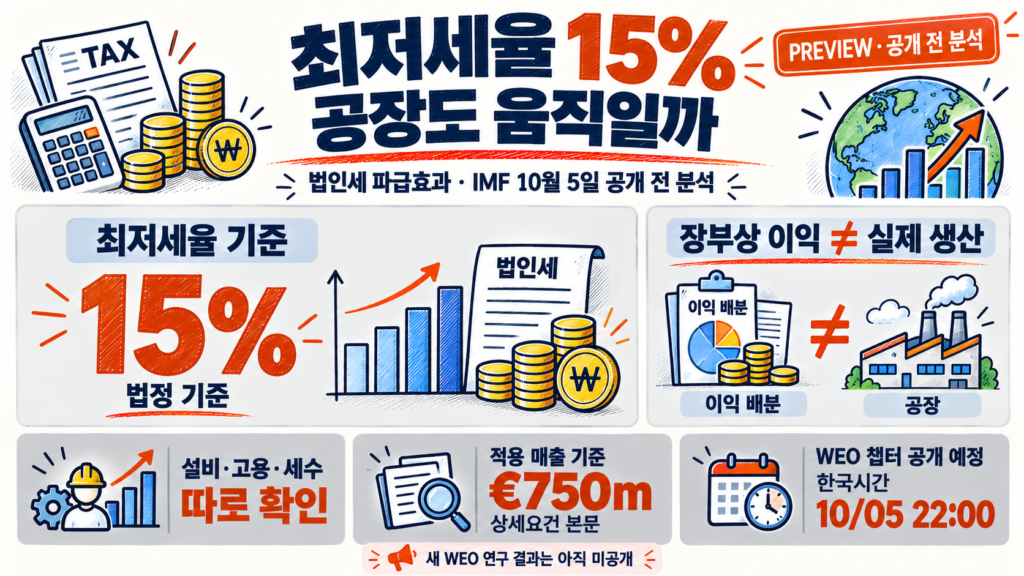
법인세 파급효과는 해외 정부의 세금 결정이 한국 기업의 이익과 투자 장소까지 바꾸는 현상입니다. IMF는 이 문제를 다룬 세계경제전망(WEO) 분석 챕터를 10월 5일 공개할 예정입니다. 반도체 공장을 어디에 짓고, 기술 사용료를 어느 나라 법인이 받는지가 같은 세제 변화에도 다르게 반응할 수 있습니다. 출처: IMF — October 2026 WEO, Chapter 3 공개 일정
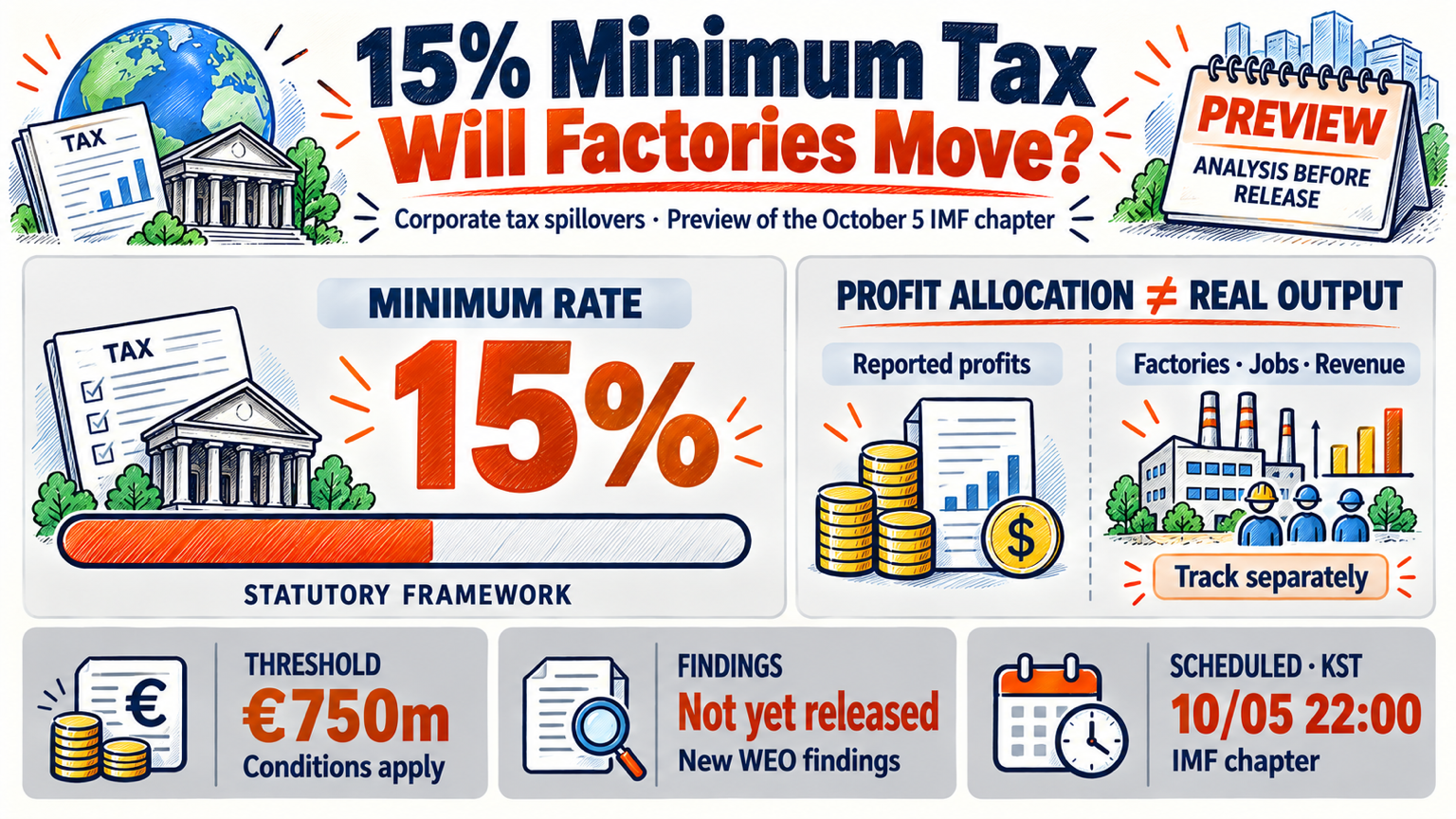
Corporate tax spillovers occur when one country’s tax decisions change profits and investment choices elsewhere. The IMF is scheduled to release a World Economic Outlook analytical chapter on this subject on October 5. For Korean businesses, the location of a chip factory and the location of technology licensing income can respond very differently to the same policy change. Source: IMF — October 2026 WEO, Chapter 3 공개 일정
IMF가 안내한 제3장 제목은 ‘Intangible Yet Real: Spillovers from Corporate Income Taxation’이며, 공개 예정은 미국 동부시간 10월 5일 오전 9시, 한국시간 같은 날 밤 10시입니다. 이 글의 자료 확인 시점인 10월 5일 오전 3시대에는 공식 페이지가 공개 대기 상태였습니다. 출처: IMF — October 2026 WEO, Chapter 3 공개 일정
따라서 아래 내용은 새 챕터의 결과 요약이 아니라, 발표를 읽기 위한 사전 분석입니다. 확인된 제도와 기존 연구를 바탕으로 설명하며, 한국 기업에 미칠 영향은 조건부 해석으로 구분합니다. 세금이 줄어 남는 돈, 실제 공장이 늘어 생기는 생산, 정부가 걷는 세수. 이 셋을 따로 봐야 헷갈리지 않습니다.
법인세 파급효과, 공장보다 이익이 먼저 움직이는 이유
한국에서 개발한 기술을 해외 공장이 사용하고, 현지 판매법인이 제품을 판다고 가정해 보겠습니다. 기술을 쓴 대가인 로열티를 어느 법인에 얼마나 지급하느냐에 따라 각 나라에 신고되는 이익이 달라집니다. 완성품 판매량이 그대로여도 세금을 매기는 이익의 위치는 바뀔 수 있습니다.
이때 특허·소프트웨어·브랜드처럼 형태가 없는 자산을 무형자산이라고 부릅니다. 무형자산은 여러 나라 사업에서 동시에 쓰일 수 있고 거래가격을 비교하기도 쉽지 않습니다. 다만 회사가 원하는 대로 이익을 옮길 수 있다는 뜻은 아닙니다. 계열사 간 거래에도 독립된 기업끼리 거래했을 때의 가격을 적용하는 정상가격 원칙과 관련 규정을 검토해야 합니다. 출처: 국세청 — 추가세액계산 흐름도
실제 생산의 이동은 훨씬 느립니다. 공장은 전력과 숙련 인력, 고객까지의 거리, 장비 설치와 인허가가 필요합니다. 세율이 낮은 곳으로 장부상 이익이 늘었다는 사실만으로 그 나라의 고용·생산성이 높아졌다고 판단하면 놓치는 것이 많습니다. IMF의 2014년 법인세 파급 보고서도 한 나라의 제도가 다른 나라에 미치는 영향을 별도 정책 문제로 다뤘습니다. 출처: IMF — Spillovers in International Corporate Taxation (2014)
이익 배분 변화
로열티·국가별 과세이익
움직이는 것
먼저 볼 항목 · 거래 근거·실효세율
실물 효과 · 생산·채용 증가는 별도 확인
실제 사업 확장
설비·개발인력·조달
움직이는 것
먼저 볼 항목 · 수요·전력·금융비용
실물 효과 · 추가 생산·임금으로 연결 가능
무형자산이 많으면 투자 반응을 측정하는 방법도 중요해집니다. 소피아 첸과 에스텔 도시는 2014년 IMF 워킹페이퍼에서 미국의 2000년대 초 한시적 투자 세제를 분석했습니다. 무형자산을 모형에 넣으면 세제 혜택에 대한 투자 반응이 대체로 더 크게 추정됐습니다. 다만 당시 미국 자료를 분석한 저자들의 연구이며, 2026년 한국 기업이나 새 WEO 챕터의 추정 결과는 아닙니다. 출처: Chen·Dauchy — 무형자산과 투자 세제, IMF WP/14/104 (2014-06-12)
최저세율 15%인데 세제 경쟁이 남는 까닭
글로벌최저한세는 일정 규모 이상의 다국적기업이 저세율 국가에서 얻은 소득에 추가 과세하는 제도입니다. 국세청은 직전 4개 사업연도 가운데 2개 이상에서 조정 연결매출액이 각각 7억5천만 유로 이상인 그룹을 적용대상으로 안내합니다. 작은 수출기업까지 모두 같은 계산을 하는 것은 아니며, 제외기업 등 세부 요건도 있습니다. 출처: 국세청 — 글로벌최저한세 신고대상
여기서 15%는 각 나라의 법정 법인세율을 모두 똑같이 바꾸라는 숫자가 아닙니다. 같은 나라에 있는 그룹 회사들의 조정된 소득과 세금을 합쳐 실효세율을 계산합니다. 실효세율은 소득에 비해 세금이 얼마나 되는지를 뜻합니다. 이 값이 기준보다 낮으면 추가 세액을 계산하는 구조입니다. 출처: OECD — Global Minimum Tax: 세율·공제·과세 순서
추가 세액을 매기는 이익에서도 일부 금액을 뺍니다. 직원 급여와 유형자산을 기준으로 계산하는 ‘실질기반제외소득’입니다. 공장·사람과 연결된 소득 일부를 추가 과세 대상에서 제외한다는 뜻입니다. 그래서 모든 기업이 회계상 이익의 정확히 15%를 세금으로 낸다고 해석하면 틀립니다. 출처: OECD — Global Minimum Tax: 세율·공제·과세 순서 출처: 국세청 — 추가세액계산 흐름도
가상 계산을 해보겠습니다. 조정소득이 100이고 조정세액이 10이면 실효세율은 10%입니다. 제외소득이 없을 때 추가 세액은 5입니다. 제외소득을 10으로 가정하면 5%에 90을 곱하므로 추가 세액은 4.5가 됩니다. 아래 비교는 다른 조정·면제와 국가 간 세액 배분을 생략한 설명용 숫자이며, IMF 전망이나 실제 기업의 납부액이 아닙니다. 출처: 국세청 — 추가세액계산 흐름도
가상 계산: 제외소득에 따른 추가 세액. 조정소득100·세액10·실효세율10%·최저세율15%. 5%×100=5, 5%×90=4.5. 다른 조정·면제·국가별 배분 생략. 실제 기업·IMF 전망 아님. 출처: 국세청 계산식을 활용한 자체 예시. · 축이 0이 아니라 4.2에서 시작합니다
그렇다고 공장을 지으면 언제나 세금보다 더 큰 이득이 남는 것은 아닙니다. 제외소득을 늘리려면 실제 자산이나 급여 지출이 뒤따르고, 그 지출은 기업의 비용입니다. 세금 절감액보다 전력비·금융비용·빈 공장의 유지비가 더 크면 투자를 서두를 이유가 약해집니다.
세금은 누가 걷고, 지원금은 얼마나 남을까
저세율 국가가 세금을 덜 걷는다고 기업이 그만큼 모두 절약하는 것도 아닙니다. 적격소재국추가세(QDMTT)는 사업이 있는 나라가 추가 세금을 먼저 걷는 장치입니다. 그다음 모회사 단계에서 걷는 소득산입규칙(IIR), 남은 부분을 다른 시행국에 배분하는 소득산입보완규칙(UTPR)이 이어집니다. 실제 적용은 각 나라의 시행 여부와 적격성, 면제 조건에 달려 있습니다. 출처: 국세청 — 추가세액계산 흐름도
-
1
소재국
QDMTT로 먼저 징수
-
2
모회사 단계
IIR로 적용 대상분 과세
-
3
나머지 시행국
잔여분에 UTPR 적용
이 순서 때문에 한국의 세수 효과도 단순하지 않습니다. 해외 자회사 소재국이 추가 세금을 먼저 걷으면 한국 모회사 쪽에 배분될 금액은 줄어들 수 있습니다. 그룹이 내는 총세금의 변화와 한국 정부 세입의 변화는 별개입니다. 국내로 들어오는 외국인직접투자(FDI) 역시 신고 금액과 실제 설비·채용 집행을 나눠 봐야 합니다.
2026년에는 제도 자체도 달라졌습니다. OECD의 1월 5일 Side-by-Side 패키지는 일정 요건을 충족한 본국의 최종모기업 그룹에 대한 적용면제 장치와, 실질 활동에 연결된 일부 세제지원에 대한 장치를 포함했습니다. 이처럼 정해진 조건을 충족할 때 계산이나 적용 부담을 덜어주는 규정을 세이프하버라고 부릅니다. 최저한세 도입으로 모든 투자 인센티브가 사라졌다고 보기는 어렵습니다. 출처: OECD — Side-by-Side 합의 발표 (2026-01-05)
9월 11일 OECD는 각국 입법의 일관성을 점검하는 절차와 정보신고서, 추가 행정지침을 발표했습니다. 갱신된 신고서 적용도 대상 회계연도가 정해져 있습니다. 기업이 받은 혜택의 이름이 ‘세액공제’라는 사실만으로 현금 효과를 판단할 수 없는 이유입니다. 혜택의 요건·회계 처리·추가 과세를 같이 계산해야 남는 금액이 보입니다. 출처: OECD — 최저한세 일관성·신고·행정지침 패키지 (2026-09-11)
한국 반도체·배터리·플랫폼에 닿는 세 갈래
반도체에서는 세후 투자수익과 공장 가동 시점이 함께 중요합니다. 다음은 조건부 시나리오입니다. 경쟁국의 지원이 실제 현금 혜택으로 남고 전력·인력이 확보돼 있다면 새 생산라인의 입지가 그쪽으로 기울 수 있습니다. 한국 장비·소재 기업은 현지 공장에 납품할 기회를 얻을 수 있지만, 현지 조달이 확대되면 한국에서 직접 수출하는 몫은 줄어들 수도 있습니다.
배터리는 고객의 주문과 가동률이 더해집니다. 세금 혜택이 커도 제품을 사줄 고객이 부족하면 공장의 고정비를 충분히 나눠 부담하지 못합니다. 반대로 장기 공급계약과 지원금 지급 조건이 맞아떨어지면 금융기관이 보는 사업의 현금흐름이 개선될 여지가 있습니다. 이는 업종별 판단 구조이며, 특정 회사의 증설이나 이익 증가가 확인됐다는 뜻은 아닙니다.
플랫폼·소프트웨어 기업은 기술 사용료를 받는 법인과 실제 개발 인력의 위치를 함께 봐야 합니다. 로열티의 배분이 달라지면 국가별 과세소득과 세후이익은 변할 수 있지만, 이용자가 갑자기 늘거나 서비스 생산성이 높아지는 것은 아닙니다. 연구개발 조직까지 이동하는 경우에야 인건비·협력업체·지역 소비를 통한 실물 영향이 더 커질 수 있습니다.
국내 소비로 이어지는 경로도 여기서 갈립니다. 장부상 이익만 옮겨지면 가계소득에 미치는 직접 효과는 작을 수 있습니다. 국내 설비 발주와 채용이 늘면 임금과 협력업체 매출을 통해 소비로 번질 가능성이 생깁니다. 정부가 세제 혜택을 늘리는 경우에는 줄어든 세수를 새 투자에서 얼마나 회복하는지도 확인해야 합니다.
조세협약은 이 계산의 다른 층입니다. 국가 간 이중과세를 줄이고 과세권을 배분하는 약속이므로, 로열티에 대한 원천징수—돈을 지급할 때 미리 떼는 세금—와 분쟁 해결도 함께 검토해야 합니다. 최저한세 기준을 확인했다고 기존 협약 검토가 끝나는 것은 아닙니다. 지급국·수취국의 실제 협약과 남용 방지 요건을 확인해야 하며, 여기서는 특정 국가쌍의 세율을 가정하지 않습니다. 출처: OECD — Tax treaties
감세보다 비싼 돈: IMF·OECD·미 재무부가 한 말
줄리 코잭 IMF 커뮤니케이션국장은 10월 1일 브리핑에서 에너지 가격과 통화정책 기대, 높은 부채와 기간 프리미엄을 채권수익률 상승의 배경으로 설명했습니다. 기간 프리미엄은 투자자가 돈을 오래 묶어두는 위험에 요구하는 추가 보상입니다. 기업 입장에서는 세금이 줄어도 돈을 빌리는 비용이 올라 투자 계획의 수익성이 개선되지 않을 수 있습니다. 금리 부담이 한국 기업 이자비용으로 번지는 경로는 미국 10년물 국채금리 5% 경고에서 따로 다뤘습니다. 출처: IMF — Julie Kozack 브리핑, 2026-10-01
마티아스 코르만 OECD 사무총장은 1월 5일 합의가 조세 확실성을 높이고 복잡성을 줄이며 세원을 보호한다고 평가했습니다. 같은 날 스콧 베선트 미국 재무장관은 미국 본사 기업에 대한 과세주권과 연구개발·투자 인센티브 보호를 강조했습니다. 두 발언을 함께 읽으면 공동 규칙의 안정성과 각국 산업정책 목표가 동시에 작동한다는 점이 보입니다. 출처: OECD — Side-by-Side 합의 발표 (2026-01-05) 출처: 미 재무부 — Scott Bessent 최저한세 합의 성명 (2026-01-05)
베선트의 발언을 한국 기업에 그대로 대입해서는 안 됩니다. 미국에 공장이 있다는 사실과 최종모기업이 미국에 있다는 사실은 다릅니다. 한국 본사 그룹의 미국 자회사가 같은 적용면제를 자동으로 받는다고 볼 수 없으며, 그룹 구조와 구체적 요건을 확인해야 합니다. 출처: 미 재무부 — Scott Bessent 최저한세 합의 성명 (2026-01-05) 출처: OECD — Side-by-Side 합의 발표 (2026-01-05)
투자자들의 위험 선호도 한 방향은 아닙니다. 제공된 CNN 스냅샷의 미국 공포·탐욕지수는 10월 2일 31.2로 ‘공포’입니다. 1주 전 36.9, 1개월 전 46.1보다 각각 5.8포인트, 14.9포인트 낮습니다. GoldKimp의 한국 KOSPI 지수는 10월 1일 60.5로 ‘탐욕’이지만, 산식과 기준일이 달라 두 점수의 차이를 그대로 해석할 수는 없습니다. 한국의 같은 지표에 대한 주간·월간 이력이 없어 추세는 판단하지 않았습니다. 출처: CNN — Fear & Greed (제공 스냅샷 2026-10-02) 출처: GoldKimp — KOSPI Fear & Greed (제공 스냅샷 2026-10-01)
SentimenTrader의 Smart Money·Dumb Money는 서로 다른 투자행태를 묶어 보여주는 신뢰도 지표입니다. 이번 확인에서는 홈페이지의 최신 점수와 기준일이 비어 있었습니다. 대신 9월 25일 공개 요약에서 두 지표의 차이가 9월 16일 0 위로 돌아왔다는 설명을 확인했습니다. 이는 과거 관측이며 현재 두 점수나 실제 기관 순매수액을 뜻하지 않습니다. 출처: SentimenTrader — Smart/Dumb Money 공개 대시보드 확인 출처: SentimenTrader — 2026-09-25 공개 주간 요약
이 심리 차이가 세제 뉴스 때문에 생겼다는 증거는 없습니다. 다만 미국의 위험 선호가 약해진 상황에서는 먼 미래의 절세 기대보다 당장 확보되는 현금과 조달 조건을 따져볼 이유가 커집니다. 앞서 다룬 세계은행 민간자본 유치에서도 보증 규모보다 실제 금융종결과 사업 조건이 중요했습니다. 세제지원 역시 계약·추가 과세를 거쳐 기업에 남는 돈으로 평가해야 합니다.
IMF 챕터가 나오면 확인할 것은 세 가지입니다
첫째, 이익 이전과 실물 투자를 어떻게 구분했는지 봐야 합니다. 해외직접투자 금액에는 기업 인수나 금융거래가 섞일 수 있습니다. 투자가 늘었다는 숫자가 새 공장·생산·고용의 증가를 얼마나 설명하는지 확인해야 한국의 수주 효과까지 연결할 수 있습니다.
둘째, 무형자산 비중이 큰 기업의 반응을 따로 추정했는지, 정책 시행 이후 실제 자료인지 모형 속 시나리오인지 확인해야 합니다. 셋째, 다른 나라의 대응과 2026년 최저한세 변경을 어떤 조건으로 넣었는지가 중요합니다. 상대국이 세금이나 지원 방식을 바꾸면 처음 계산한 세수·생산 효과도 달라질 수 있습니다.
한국 기업의 실적을 볼 때는 해외 법인세 부담, 실제 납부한 세금, 설비투자 집행과 가동률을 함께 읽는 편이 낫습니다. 일시적인 세금 효과로 순이익이 늘어도 영업에서 벌어들이는 돈이 같은 속도로 늘었다는 뜻은 아닙니다. 주가에 미칠 영향도 세후 현금흐름의 개선 폭과 이미 반영된 기대에 따라 달라집니다.
법인세 경쟁이 이익 배분에서 설비·고용의 경쟁으로 더 옮겨갈 가능성은 있습니다. 그러나 그 전환이 자동으로 일어나거나 한국이 일방적인 수혜자가 된다고 단정할 근거는 아직 없습니다. 세금 혜택이 실제 추가 투자로 이어지고, 그 투자가 고객 수요를 만나 생산과 임금을 늘리는지까지 확인해야 경기 효과를 말할 수 있습니다.
출처와 참고자료
- IMF — Julie Kozack 브리핑, 2026-10-01
- IMF — October 2026 WEO, Chapter 3 공개 일정
- IMF — Spillovers in International Corporate Taxation (2014)
- Chen·Dauchy — 무형자산과 투자 세제, IMF WP/14/104 (2014-06-12)
- OECD — Global Minimum Tax: 세율·공제·과세 순서
- OECD — Side-by-Side 합의 발표 (2026-01-05)
- OECD — 최저한세 일관성·신고·행정지침 패키지 (2026-09-11)
- 미 재무부 — Scott Bessent 최저한세 합의 성명 (2026-01-05)
- OECD — Tax treaties
- 국세청 — 글로벌최저한세 신고대상
- 국세청 — 추가세액계산 흐름도
- CNN — Fear & Greed (제공 스냅샷 2026-10-02)
- GoldKimp — KOSPI Fear & Greed (제공 스냅샷 2026-10-01)
- SentimenTrader — Smart/Dumb Money 공개 대시보드 확인
- SentimenTrader — 2026-09-25 공개 주간 요약
The timing matters. Chapter 3, “Intangible Yet Real: Spillovers from Corporate Income Taxation,” is scheduled for October 5 at 9 a.m. US Eastern time, or 10 p.m. in Korea. At the research cutoff, shortly after 3 a.m. Korean time on October 5, the official page still said “Coming Soon.” Source: IMF — October 2026 WEO, Chapter 3 공개 일정
This is a preview analysis, not a summary of findings from the unreleased chapter. It draws on verified rules and earlier research, with implications for Korean businesses identified as conditional analysis. The useful distinction is between cash saved on tax, output created by a new facility, and revenue collected by a government.
Corporate tax spillovers: profits can move before factories
Imagine technology developed in Korea, used by an overseas factory, with products sold through a local sales company. Royalties—the payments for using that technology—affect where profits are reported. The location of taxable income can change even when the number of finished products sold does not. This is an illustrative business structure, not a claim about a particular company.
Patents, software and brands are intangible assets: valuable resources without a physical form. They can be used across several countries, and comparable market prices may be difficult to find. That does not make profit allocation arbitrary. Related companies must consider arm’s-length pricing—the terms independent businesses would use—and the applicable tax rules. Source: 국세청 — 추가세액계산 흐름도
Real production usually moves more slowly. A factory needs power, skilled workers, access to customers, equipment installation and permits. More reported profit in a low-tax country does not by itself demonstrate higher employment or productivity there. The IMF’s 2014 spillovers report treated the effects of one country’s tax system on others as a distinct policy issue. Source: IMF — Spillovers in International Corporate Taxation (2014)
Profit allocation
Royalties and taxable profits
What changes
Check first · Pricing basis and effective tax
Real effect · Output and jobs need separate evidence
Real expansion
Equipment, developers and sourcing
What changes
Check first · Demand, power and financing
Real effect · Potential additional output and wages
Intangibles also affect how researchers measure investment responses. In a 2014 IMF working paper, Sophia Chen and Estelle Dauchy examined temporary US investment incentives in the early 2000s. Accounting for intangible assets generally produced larger estimated investment responses. This was the authors’ research on that historical sample, not an IMF policy position or a new estimate for Korean firms in 2026. Source: Chen·Dauchy — 무형자산과 투자 세제, IMF WP/14/104 (2014-06-12)
Why a 15% minimum still leaves room for tax competition
The global minimum tax imposes additional tax on low-taxed income of sufficiently large multinational groups. Korea’s National Tax Service describes a scope threshold of at least EUR 750 million in adjusted consolidated revenue in at least two of the four preceding fiscal years. Smaller exporters are not automatically covered, and excluded-entity rules also matter. Source: 국세청 — 글로벌최저한세 신고대상
The 15% figure does not require every country to adopt the same statutory corporate tax rate. The rules aggregate adjusted income and taxes for group entities in each jurisdiction to calculate an effective tax rate. If that rate falls below the minimum, a top-up tax calculation follows. Source: OECD — Global Minimum Tax: 세율·공제·과세 순서
The top-up tax base also excludes an amount linked to payroll and tangible assets. This substance-based income exclusion removes part of the income associated with real operations from the additional-tax base. It is therefore incorrect to assume that every business pays exactly 15% of its accounting profit. Source: OECD — Global Minimum Tax: 세율·공제·과세 순서 Source: 국세청 — 추가세액계산 흐름도
Consider an illustrative calculation in arbitrary monetary units. Adjusted income of 100 and adjusted taxes of 10 give a 10% effective rate. With no exclusion, the top-up is 5. If the exclusion is 10, the calculation is 5% multiplied by 90, giving 4.5. This example omits other adjustments, reliefs and allocation between governments. It is neither an IMF forecast nor an actual company’s tax bill. Source: 국세청 — 추가세액계산 흐름도
Illustration: top-up tax with and without an exclusion. Income100, taxes10, ETR10%, minimum15%. 5%×100=5; 5%×90=4.5. Other adjustments, relief and allocation omitted. Author illustration using NTS formula, not actual company data or an IMF forecast. · Axis starts at 4.2, not zero
This does not make building a factory automatically profitable. Increasing the exclusion requires qualifying assets or payroll, which cost money. If financing, electricity and idle-capacity costs exceed the tax benefit, the incentive to invest weakens. This is an economic interpretation of the mechanism, not a measured result from the forthcoming chapter.
Who collects the tax—and how much of an incentive survives?
A tax concession in a low-tax country does not necessarily become an equal saving for the business. A qualified domestic minimum top-up tax, or QDMTT, gives the host jurisdiction first collection rights. The income inclusion rule, IIR, operates at parent-company level; the undertaxed profits rule, UTPR, can allocate remaining top-up tax to other implementing jurisdictions. Actual outcomes depend on implementation, qualification and relief conditions. Source: 국세청 — 추가세액계산 흐름도
-
1
Host jurisdiction
First collection through QDMTT
-
2
Parent level
Relevant amount under IIR
-
3
Other implementers
UTPR for remaining amounts
That ordering complicates the implications for Korean tax revenue. If an overseas subsidiary’s host country collects first, less may remain to be allocated at the Korean parent level. Changes in the group’s total tax bill and changes in Korean public revenue are different questions. For inward foreign direct investment, announced amounts also need to be distinguished from equipment actually installed and workers actually hired.
The framework itself changed in 2026. The OECD’s January 5 Side-by-Side package included safe harbours for groups with ultimate parents in eligible jurisdictions and for certain substance-based tax incentives. A safe harbour grants specified relief when its conditions are met. These arrangements make it too simplistic to say that the minimum tax has eliminated every investment incentive. Source: OECD — Side-by-Side 합의 발표 (2026-01-05)
On September 11, the OECD released a legislative review framework, an updated information return and further administrative guidance. The return changes apply to specified fiscal years. Calling a benefit a “tax credit” is not enough to establish its cash value: eligibility, accounting treatment and additional taxation must be assessed together. Source: OECD — 최저한세 일관성·신고·행정지침 패키지 (2026-09-11)
Three channels for Korean chips, batteries and platforms
For semiconductors, after-tax returns and the date a factory can begin operating both matter. Consider a conditional scenario: if a competing country’s incentive survives as a cash benefit and power and labour are available, a new line may become more attractive there. Korean equipment and materials suppliers could gain orders, while stronger local sourcing could reduce the share exported directly from Korea.
Battery projects add another constraint: customer orders and capacity utilisation. A large tax benefit cannot spread fixed costs across units that are never sold. Conversely, a long-term supply agreement combined with reliable incentive payments could improve the cash flows lenders assess. This describes a decision framework, not verified expansion or earnings growth at any named company.
For platform and software businesses, the entity receiving royalties and the location of development staff need to be considered together. Reallocating royalty income can change taxable profits and after-tax earnings without creating more users or improving service productivity. If development teams also relocate, effects on wages, suppliers and local spending can become more substantial.
The path to household consumption differs accordingly. A change in reported profits alone may have little direct effect on household income. Domestic equipment orders and hiring can reach consumers through wages and supplier revenues. Governments granting incentives must also ask how much forgone revenue is recovered through genuinely additional activity.
Tax treaties are another layer. They allocate taxing rights and help reduce double taxation, so royalty withholding—the tax deducted when a payment is made—and dispute resolution also require attention. Checking the minimum-tax rules does not replace checking the relevant treaty and its anti-abuse provisions. No treaty rate for a particular country pair is assumed here. Source: OECD — Tax treaties
Cheaper tax, costlier money: what the IMF, OECD and US Treasury said
In her October 1 briefing, IMF Communications Director Julie Kozack discussed energy prices, monetary-policy expectations, high debt and term premia as drivers of rising bond yields. A term premium is the extra compensation investors demand for committing funds for longer. For businesses, a smaller tax bill can be offset by more expensive financing. We traced how higher yields feed into Korean companies’ interest costs in the US 10-year Treasury yield warning. Source: IMF — Julie Kozack 브리핑, 2026-10-01
On January 5, OECD Secretary-General Mathias Cormann said the agreement improved tax certainty, reduced complexity and protected tax bases. The same day, US Treasury Secretary Scott Bessent emphasised US taxing sovereignty over US-headquartered groups and protection for research and investment incentives. Together, the statements show shared-rule stability operating alongside national industrial-policy priorities. Source: OECD — Side-by-Side 합의 발표 (2026-01-05) Source: 미 재무부 — Scott Bessent 최저한세 합의 성명 (2026-01-05)
Bessent’s statement should not be applied mechanically to Korean businesses. Having a factory in the United States is different from having a US ultimate parent. A US subsidiary of a Korean-headed group does not automatically obtain the same relief; the group structure and specific conditions matter. Source: 미 재무부 — Scott Bessent 최저한세 합의 성명 (2026-01-05) Source: OECD — Side-by-Side 합의 발표 (2026-01-05)
Risk appetite is also uneven. In the supplied snapshot, CNN’s US Fear & Greed reading was 31.2, or Fear, on October 2, down 5.8 points from 36.9 a week earlier and 14.9 points from 46.1 a month earlier. GoldKimp’s KOSPI reading was 60.5, or Greed, on October 1. Different methods and dates prevent treating their numerical gap as directly comparable. Matching Korean weekly and monthly history was unavailable, so no Korean trend is inferred. Source: CNN — Fear & Greed (제공 스냅샷 2026-10-02) Source: GoldKimp — KOSPI Fear & Greed (제공 스냅샷 2026-10-01)
SentimenTrader’s Smart Money and Dumb Money confidence indicators summarise different types of investor behaviour. Its homepage did not display current values or a latest-update date during this check. The public September 25 summary said their spread returned above zero on September 16. That is a dated observation, not today’s individual readings or a measure of institutional net purchases. Source: SentimenTrader — Smart/Dumb Money 공개 대시보드 확인 Source: SentimenTrader — 2026-09-25 공개 주간 요약
There is no evidence here that tax news caused these sentiment readings. Weaker US risk appetite nevertheless makes current cash and financing terms relevant when assessing distant tax benefits. Our earlier discussion of World Bank private-capital mobilisation likewise distinguished headline guarantees from financial close and project conditions. Tax support needs the same attention to cash retained after contractual conditions and additional taxation.
Three questions to take to the IMF chapter
First, examine how the chapter distinguishes profit allocation from real investment. Foreign direct investment can include acquisitions and financial transactions. An increase in its headline amount needs to be connected to new facilities, production and employment before translating it into Korean supplier orders.
Second, check whether intangible-intensive firms are estimated separately and whether results come from observed post-reform data or modelled scenarios. Third, examine assumptions about other governments’ responses and the 2026 minimum-tax changes. If another country changes its own tax or support policy, the initially calculated revenue and output effects can change.
When reading Korean company results, combine overseas tax exposure with cash taxes paid, capital expenditure actually executed and capacity utilisation. A one-off tax effect can lift net profit without a matching improvement in operating cash generation. Equity-market implications depend on the size of the after-tax cash-flow improvement and how much investors have already priced in.
Tax competition may place more weight on facilities and employment alongside profit allocation. That transition is not automatic, and the available evidence does not establish Korea as an unambiguous winner. A macroeconomic benefit requires incentives to induce additional investment that meets customer demand and raises production and wages.
Sources and references
- IMF — Julie Kozack 브리핑, 2026-10-01
- IMF — October 2026 WEO, Chapter 3 공개 일정
- IMF — Spillovers in International Corporate Taxation (2014)
- Chen·Dauchy — 무형자산과 투자 세제, IMF WP/14/104 (2014-06-12)
- OECD — Global Minimum Tax: 세율·공제·과세 순서
- OECD — Side-by-Side 합의 발표 (2026-01-05)
- OECD — 최저한세 일관성·신고·행정지침 패키지 (2026-09-11)
- 미 재무부 — Scott Bessent 최저한세 합의 성명 (2026-01-05)
- OECD — Tax treaties
- 국세청 — 글로벌최저한세 신고대상
- 국세청 — 추가세액계산 흐름도
- CNN — Fear & Greed (제공 스냅샷 2026-10-02)
- GoldKimp — KOSPI Fear & Greed (제공 스냅샷 2026-10-01)
- SentimenTrader — Smart/Dumb Money 공개 대시보드 확인
- SentimenTrader — 2026-09-25 공개 주간 요약
이 글은 정보 제공 목적이며, 특정 자산의 매수·매도를 권유하지 않습니다.
For information only — this is not a recommendation to buy or sell any asset.
댓글Comments 0