칼륨비료 가격 — 벨라루스 구매 추진이 비료값을 가르는 3가지 조건Potash prices — 3 conditions behind the Belarus purchase proposal
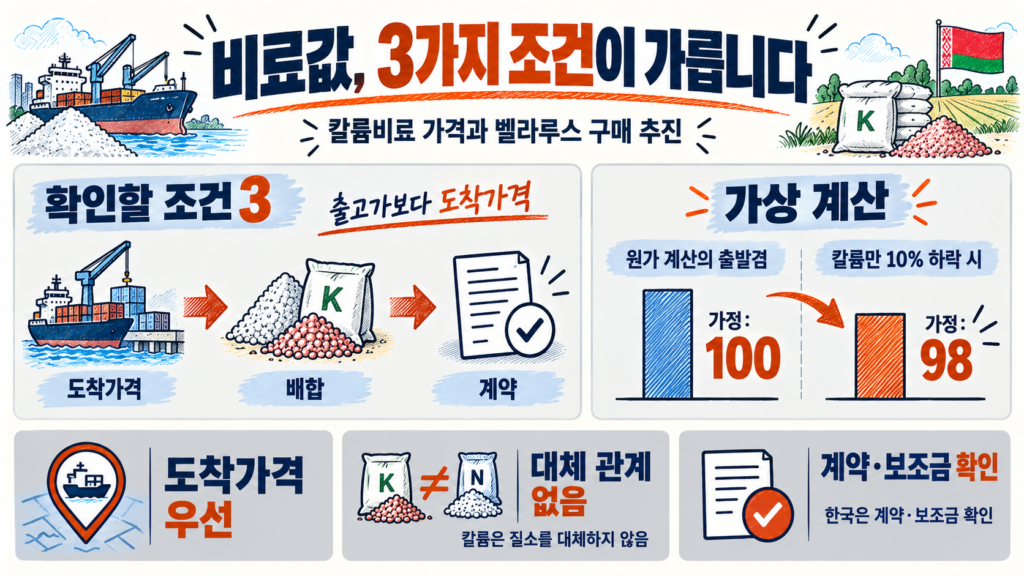
칼륨비료 가격을 낮추겠다는 미국의 새 구매 구상이 나왔습니다. 하지만 한국 농가의 비용까지 줄어들지는 도착가격, 비료 배합, 국내 계약이라는 3가지 조건에 달려 있습니다. 싸게 살 수 있다는 발표와 기업 이익·식품 가격 사이에는 확인할 것이 여러 개 있습니다.
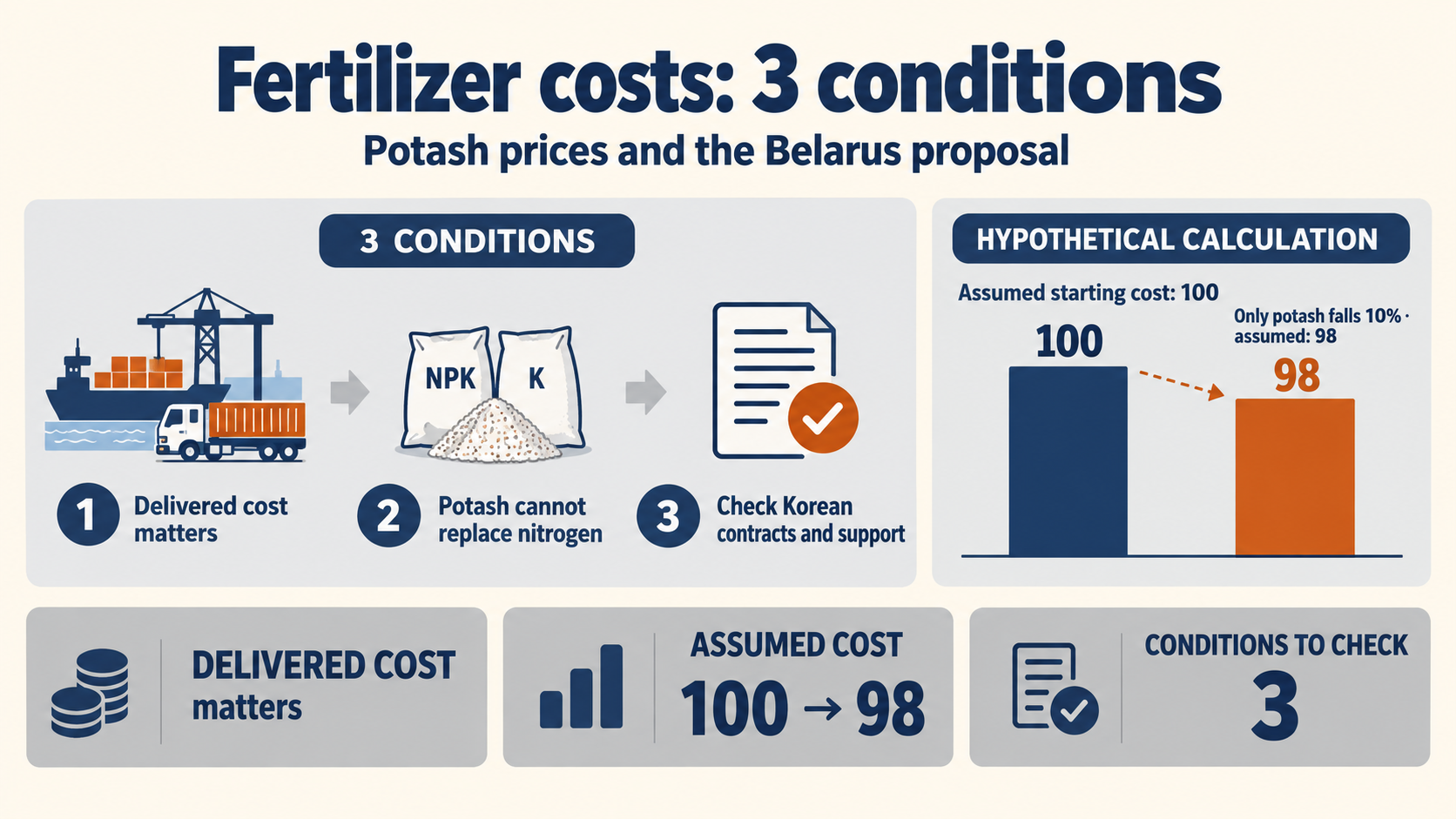
Potash prices are in focus after a new US proposal to buy cheaper fertilizer. Whether Korean farms benefit depends on three things: delivered cost, the nutrient mix and domestic contracts. Several conditions stand between a promise of cheaper purchases and changes in company profits or food prices.
9월 21일 Reuters에 따르면 트럼프 대통령은 캐나다산보다 저렴한 벨라루스산 칼륨 구매를 추진한다고 밝혔습니다. 다만 해당 보도에는 확정된 구매량·단가·첫 인도일이 없습니다. 지금 확인된 것은 구매 추진 발언입니다. 실제 비용 절감은 앞으로 확인할 부분입니다. Reuters 보도
자료 확인 기준일은 2026년 9월 23일입니다. 아래에서 기업 전망은 전망으로, 원가 계산은 가정으로 표시했습니다. 이 글은 개별 종목의 매수·매도 권유가 아닙니다.
칼륨비료 가격, 싸게 계약하면 끝일까요?
수입업체가 비교해야 할 가격은 광산에서 나올 때의 가격과 농가 창고에 도착할 때의 가격으로 나뉩니다. 출고가격이 낮아도 운송료, 보험료, 하역비, 국내 배송비를 더하면 순위가 바뀔 수 있습니다. 배송이 길어지면 물건을 받기 전에 묶이는 돈과 이자도 늘어납니다.
Reuters는 벨라루스 물량의 운송 제약과 가까운 캐나다의 이점을 지적했습니다. 따라서 벨라루스의 출고가격 할인만으로 미국 농가의 구매가격 하락을 계산하기는 어렵습니다. 운송 여건 보도
예를 들어 같은 품질의 비료를 톤당 30달러 싸게 사더라도 추가 배송비가 40달러라면 도착가격은 10달러 더 비쌉니다. 이는 현재 운임을 추정한 숫자가 아니라, 가격을 비교하는 방법을 보여주는 가상 예시입니다. 계약이 체결된다면 할인폭과 함께 인도 조건을 읽어야 하는 이유입니다.
세계 공급량도 따로 봐야 합니다. 벨라루스가 기존 고객에게 팔던 물량을 미국으로 돌린다면 세계에 비료가 더 생기는 것은 아닙니다. 반대로 막혀 있던 생산과 수출이 실제로 늘어난다면 세계 가격을 낮추는 힘이 더 커질 수 있습니다. 구매처 변경과 순공급 증가는 다른 사건입니다.
-
1
계약 조건
물량·단가·인도일 확인
-
2
도착 원가
운송·보험·금융비용 합산
-
3
완제품 가격
다른 영양분·재고·계약 반영
-
4
농가 부담
국내 유통·지원 조건 반영
비료는 한 종류가 아닙니다
그런데 비료라고 다 같은 비료는 아닙니다. 칼륨비료는 작물에 칼륨을 공급합니다. 질소·인산과 함께 필요한 주요 영양분 중 하나입니다. USGS는 이 영양분들이 서로 대체되지 않는다고 설명합니다. 질소가 부족한 밭에 값싼 칼륨을 더 준다고 같은 효과가 나지는 않는다는 뜻입니다. USGS 설명
공급업체의 진단도 나뉩니다. Nutrien은 8월 5일 발표에서 칼륨 공급을 다른 원자재에 비해 안정적으로 평가했습니다. 반면 질소에는 무역 차질과 에너지 비용, 인산에는 황 공급과 비용 압력이 있다고 설명했습니다. 이는 회사의 시장 평가이며 모든 지역의 수급을 확정하는 통계는 아닙니다. Nutrien 발표
여기서 복합비료 업체의 손익이 갈립니다. 복합비료는 여러 영양분을 섞어 판매하는 제품입니다. 칼륨을 싸게 조달해도 다른 원료가 오르면 완제품 원가는 내려가지 않을 수 있습니다. 어느 비료 가격이 움직였는지를 확인하지 않고 비료주 전체의 호재라고 묶기 어려운 이유입니다.
가상의 완제품 원가를 100으로 놓겠습니다. 칼륨 비용이 20이고 그 가격만 10% 내리면 총원가는 98이 됩니다. 절감률은 10%가 아니라 2%입니다. 여기에 다른 영양분 비용 50이 5% 오르면 2.5가 추가돼 총원가는 100.5가 됩니다. 실제 배합비·시세를 사용한 전망이 아닌 단순 원가 계산입니다.
칼륨만 하락
20 → 18
칼륨 비용
기타 영양분 · 50 유지
총원가 · 98 · 2% 감소
다른 영양분 5% 상승
20 → 18
칼륨 비용
기타 영양분 · 50 → 52.5
총원가 · 100.5 · 0.5% 증가
농가에서도 계산은 비슷합니다. 비료비가 줄어도 임차료·인건비·종자비까지 함께 줄지는 않습니다. 수확량과 농산물 판매가격이 그대로라면 비용 절감분이 농가 소득에 보탬이 될 수 있습니다. 그러나 농산물 가격이 더 크게 내려가면 소득은 오히려 줄 수 있습니다.
생산과 유통, 이익은 반대로 갈립니다
칼륨 생산업체에는 새 공급자가 낮은 가격을 제시하는 상황이 부담입니다. 기존 고객이 가격 재협상을 요구할 수 있기 때문입니다. 다만 할인 경쟁이 모든 지역에 번질지는 별개입니다. 고객까지 보내는 비용이 낮거나 장기 계약이 있는 업체는 가격 하락을 늦추거나 판매량을 유지할 여지가 있습니다.
Nutrien은 8월 기준 2026년 세계 칼륨 출하량을 7,400만~7,700만 톤으로 전망했습니다. 제품 중량 기준의 회사 전망이며 연간 실적이 아닙니다. 이 숫자에 벨라루스의 미국 판매량을 그대로 더해서도 안 됩니다. 기존 물량의 목적지만 바뀌는 부분이 있을 수 있기 때문입니다. 출하 전망 원문
혼합·유통업체는 원료를 싸게 사면서 판매가격을 유지하면 이익이 늘 수 있습니다. 하지만 이미 비싸게 사둔 재고가 있다면 당장은 반대입니다. 새 제품 가격이 먼저 내려가면서 기존 재고의 이익이 줄거나 손실이 날 수 있습니다. 다음 실적에서는 매출액보다 판매량, 단위당 이익, 재고 규모를 함께 볼 필요가 있습니다.
설비투자에도 두 힘이 작용합니다. 장기간 낮은 가격이 예상되면 새 광산에 투자할 유인이 줄어듭니다. 반면 기존 생산을 더 싸고 안정적으로 운송하는 설비의 가치는 높아질 수 있습니다. 한 나라의 구매 발표만으로 증산이나 투자 확대를 단정할 수 없는 이유입니다.
한국 농가가 먼저 보는 건 계약과 보조금입니다
한국의 전달 경로는 농식품부의 6월 8일 자료에서 확인할 수 있습니다. 당시 무기질비료 공급량의 약 97%가 농협을 거쳤고 가격은 농협과 제조사의 입찰·협상으로 결정됐습니다. 국제 원료가격이 변했다고 다음 날 농가 판매가격이 그대로 바뀌는 구조가 아닙니다. 농식품부 발표
같은 발표에서 20kg 한 포대의 판매가격은 평균 3,440원 올랐지만 추가 보조금 2,560원을 고려한 농가 부담 증가는 평균 880원이었습니다. 제품별로 차이가 있는 6월 조치의 수치입니다. 이를 9월 현재 모든 비료의 가격이나 지원액으로 읽으면 안 됩니다.
이 사례에서 중요한 것은 비용을 누가 부담하는지입니다. 국제가격이 내려가도 이전 계약과 비싼 재고가 남아 있으면 제조사의 원가 개선이 늦어집니다. 새 계약가격이 낮아져도 지원 방식이 달라지면 농가의 실제 절감액은 달라집니다. 따라서 국내 효과는 환율·재고 소진·다음 공급계약·지원 조건을 함께 봐야 합니다.
국내 비료업체의 원료 조달이 달러로 이뤄진다면 원화 약세가 해외 가격 하락을 상쇄할 수도 있습니다. 국제가격의 방향과 기업이 실제로 부담하는 원화 비용의 방향이 항상 같지는 않습니다. 이 환산 구조는 원달러 환율 해설과 함께 읽으면 이해하기 쉽습니다. 링크 글의 당시 시세를 현재 환율로 적용하지는 않았습니다.
식품 가격과 주가에는 서로 다른 시계가 있습니다
아래는 확인된 가격 변화가 아니라 경제적 전달 경로에 대한 분석입니다. 낮아진 비료비가 농가의 적정 사용량 유지에 도움을 주고, 날씨와 작황이 뒷받침되면 수확량을 지지할 수 있습니다. 곡물 조달비가 실제로 내려가면 식품·사료업체에도 유리합니다. 하지만 파종부터 수확까지 시간이 필요하고 날씨는 비료값보다 큰 변수가 될 수 있습니다.
소비자 가격에는 가공비·포장비·운송비·임금도 들어갑니다. 곡물값 하락분을 업체가 이익 회복에 쓰는지, 경쟁 때문에 제품 가격을 내리는지에 따라 가계가 체감하는 시점이 달라집니다. 소비 여력이 늘어나는 효과를 기대할 수는 있어도 이번 구매 추진만으로 물가나 기준금리의 경로가 바뀐다고 말하기는 어렵습니다.
주식시장은 실적보다 먼저 반응할 수 있습니다. 그렇다고 발표 당일 움직임을 장기 이익의 증거로 볼 수는 없습니다. 칼륨 생산기업은 실현 판매단가와 물량을, 복합비료 업체는 원료별 비용과 재고를, 식품업체는 곡물 구매계약을 확인해야 합니다. 이 글에서는 해당 발표가 특정 주가를 움직였다는 인과관계나 목표주가를 제시하지 않았습니다.
앞으로 확인할 것은 할인 약속 다음의 숫자입니다
세계은행 등이 8월 31일 낸 공동성명은 비료 생산뿐 아니라 혼합·저장·운송과 사용 효율에 대한 투자를 강조했습니다. 비료가 존재하는 것과 농가가 필요한 때에 살 수 있는 것은 다르기 때문입니다. 공동성명
이 관점에서 다음 뉴스는 세 갈래로 읽으면 됩니다. 계약량·도착단가·인도 일정이 공개되는지, 판매처 변경을 넘어 세계 공급이 실제로 늘어나는지, 한국의 다음 공급계약과 농가 부담액에 절감분이 반영되는지입니다. 아직 공개되지 않은 숫자를 미리 채워 넣을 필요는 없습니다.
칼륨비료 가격이 내려가는 경우에도 혜택은 차례로, 서로 다른 크기로 전달됩니다. 광산의 할인보다 농가의 최종 청구서를 봐야 하는 이유입니다. 한국 기업에는 어떤 원료를 언제 사서 어느 계약으로 파는지가, 소비자에게는 그 절감분이 식품 가격까지 도달하는지가 더 중요합니다.
농가에 남는 절감액은 출고가격이 아니라 최종 청구서에서 확인할 수 있습니다.
출처
On September 21, Reuters reported that President Trump was pursuing purchases of Belarusian potash at prices below Canadian supplies. The report gives no confirmed volume, unit price or first delivery date. A purchasing proposal is established; realized savings are not. Reuters report
This article uses information reviewed on September 23, 2026. Company forecasts and illustrative calculations are identified separately from reported facts. It does not recommend buying or selling securities.
Potash prices: a cheap contract is only the beginning
An importer compares both the price at the mine and the cost of getting the product to a farm. Freight, insurance, handling and inland delivery can reverse the apparent ranking. Longer transit can also tie up working capital before the fertilizer is available for sale.
Reuters describes transport constraints on Belarusian supplies and Canada’s geographic advantage. A discount at origin therefore cannot establish the size of any saving for US farmers. Reporting on transport constraints
Suppose an identical product costs $30 less per tonne at origin but incurs $40 of extra delivery costs. Its delivered price is $10 higher. These are hypothetical numbers, not current freight estimates. They illustrate why delivery terms matter alongside a negotiated discount.
Global availability is a separate question. Redirecting existing exports to the US does not create more fertilizer worldwide. Restoring production or exports that were previously constrained could have a larger effect on prices. A change of destination and an increase in total supply are different events.
-
1
Contract terms
Volume, price, delivery date
-
2
Delivered cost
Add freight, insurance, financing
-
3
Finished product
Other nutrients, stocks, contracts
-
4
Farmer payment
Distribution and support terms
Three nutrients, three different markets
Fertilizers are not all alike. Potash supplies potassium, one of the three main plant nutrients alongside nitrogen and phosphorus. USGS explains that these nutrients have no substitutes. Adding cheap potassium cannot perform the function of missing nitrogen. USGS explanation
Nutrien’s August 5 release described potash supply as relatively stable, while highlighting trade disruptions and energy costs for nitrogen, and sulfur constraints for phosphate. This is the producer’s assessment, not a definitive measure of conditions in every market. Nutrien release
This distinction matters for companies that blend several nutrients into a finished fertilizer. Cheaper potash can be offset by more expensive inputs elsewhere in the recipe. Investors need to identify the nutrient involved before treating a headline as good news for every fertilizer company.
Take a hypothetical finished-product cost of 100. If potash accounts for 20 and its price falls 10%, total cost drops to 98: a 2% saving. If other nutrients costing 50 also rise 5%, they add 2.5 and total cost becomes 100.5. This is arithmetic using assumed cost shares, not a market forecast or an actual product recipe.
Only potash falls
20 → 18
Potash cost
Other nutrients · Unchanged at 50
Total cost · 98 · down 2%
Other nutrients rise 5%
20 → 18
Potash cost
Other nutrients · 50 → 52.5
Total cost · 100.5 · up 0.5%
The same logic applies to a farm. Lower fertilizer costs do not automatically reduce rent, wages or seed expenses. With yields and crop prices unchanged, savings improve income. If crop selling prices fall by more, farm income can still decline.
Producers and distributors can move in opposite directions
A lower-priced competing supplier can put pressure on potash producers when customers seek better terms. But competition need not spread equally across regions. A producer with economical delivery routes or existing contracts may retain volume or delay some pricing pressure.
In August, Nutrien forecast 2026 global potash shipments of 74–77 million tonnes of product. That is a company forecast, not full-year output already recorded. Proposed Belarusian sales to the US cannot simply be added to it: some may replace shipments to other destinations. Shipment outlook
A blender or distributor may benefit if purchase costs fall while selling prices hold. Expensive inventory creates the opposite risk: market prices can fall before old stock is sold. Volume, margin per unit and inventory levels can therefore be more revealing than revenue alone in the next earnings report.
Investment faces two competing forces. Expectations of persistently lower prices weaken the case for new mines. Facilities that deliver existing output more cheaply or reliably may become more valuable. A single purchasing announcement is insufficient evidence of a coming production or investment boom.
Korean farms experience contracts and subsidies first
MAFRA’s June 8 release illustrates the Korean transmission mechanism. About 97% of inorganic fertilizer supply went through agricultural cooperatives, with prices established through tenders and negotiations with manufacturers. A change in world input prices therefore need not appear in a farmer’s purchase price the next day. MAFRA release
In that announcement, the average selling-price increase per 20kg bag was KRW 3,440. Additional support of KRW 2,560 left an average increase of KRW 880 for farmers. These describe the June measure, with differences across products; they are not current September prices or universal subsidy amounts.
The useful lesson is who bears the change in cost. Old contracts and costly inventories can delay a manufacturer’s savings. Even if the next supply contract is cheaper, the farmer’s net saving depends on support arrangements. Exchange rates, inventory turnover, contract renewal and subsidy terms belong in the same analysis.
For Korean companies paying for inputs in dollars, a weaker won can offset a decline in overseas prices. The world-price trend and the company’s won-denominated cost need not match. Our won–dollar exchange-rate explainer discusses that mechanism; its historical quotes are not used as current exchange rates here.
Food prices and share prices run on different clocks
The following is a conditional economic analysis, not an observed price effect. Cheaper fertilizer could help farms maintain suitable nutrient application and support yields if weather cooperates. Food and feed companies benefit if their actual crop procurement costs subsequently fall. Planting and harvesting take time, and weather can overwhelm the fertilizer effect.
Retail food prices also include processing, packaging, transport and wages. Consumers benefit sooner if competition passes savings through; producers may instead use them to rebuild margins. Household spending power could improve, but this proposal alone does not establish a change in inflation or the path of policy rates.
Equities can react before earnings do. An announcement-day price move is not proof of durable profit changes. Potash producers require scrutiny of realized prices and volume; blenders of input costs and inventory; food companies of crop-purchase contracts. No announcement-driven share-price effect or price target is asserted here.
The next evidence must go beyond the promised discount
An August 31 joint statement involving the World Bank emphasized investment in blending, storage, transport and efficient fertilizer use as well as production. Availability at a mine and timely access at a farm are different problems. Joint statement
Three sets of evidence will clarify the outcome: contracted volume, delivered price and schedule; an actual increase in global availability beyond rerouting; and savings reflected in Korea’s next supply contracts and farmers’ net payments. Undisclosed terms should remain undisclosed in the analysis.
Even if potash becomes cheaper, benefits arrive at different times and in different amounts. The farm’s final bill matters more than the discount at the mine. For Korean businesses, the decisive details are what they buy, when they buy it and the contracts under which they sell. For consumers, the question is whether savings reach food prices.
The saving that matters to a farmer appears on the final bill.
Sources
이 글은 정보 제공 목적이며, 특정 자산의 매수·매도를 권유하지 않습니다.
For information only — this is not a recommendation to buy or sell any asset.
댓글Comments 0