미국 연비 규제 완화 — 34.9mpg, 한국 자동차·배터리 손익은 왜 갈릴까US Fuel Economy Rollback — Why 34.9 MPG Splits Auto and Battery Profits
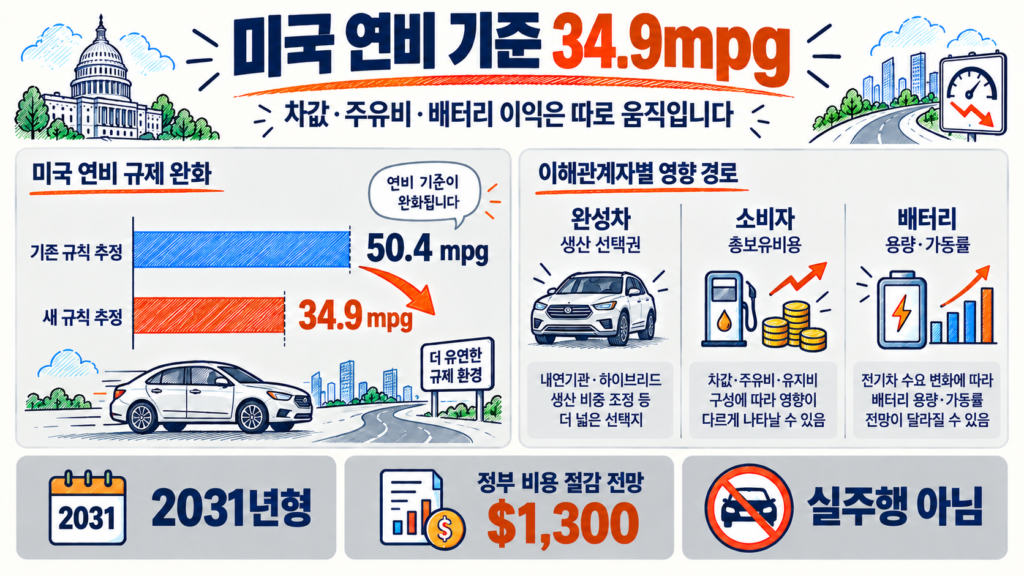
미국 연비 규제 완화가 확정됐습니다. 9월 28일 발표된 새 규칙의 2031년형 차량 평균 연비 추정치는 34.9mpg입니다. 규제 부담이 줄면 완성차 업체의 이익에는 도움이 될 수 있습니다. 그러나 한국 배터리 공장의 주문과 소비자의 주유비는 다른 방향으로 움직일 수 있습니다. 출처: Reuters · 2026-09-28
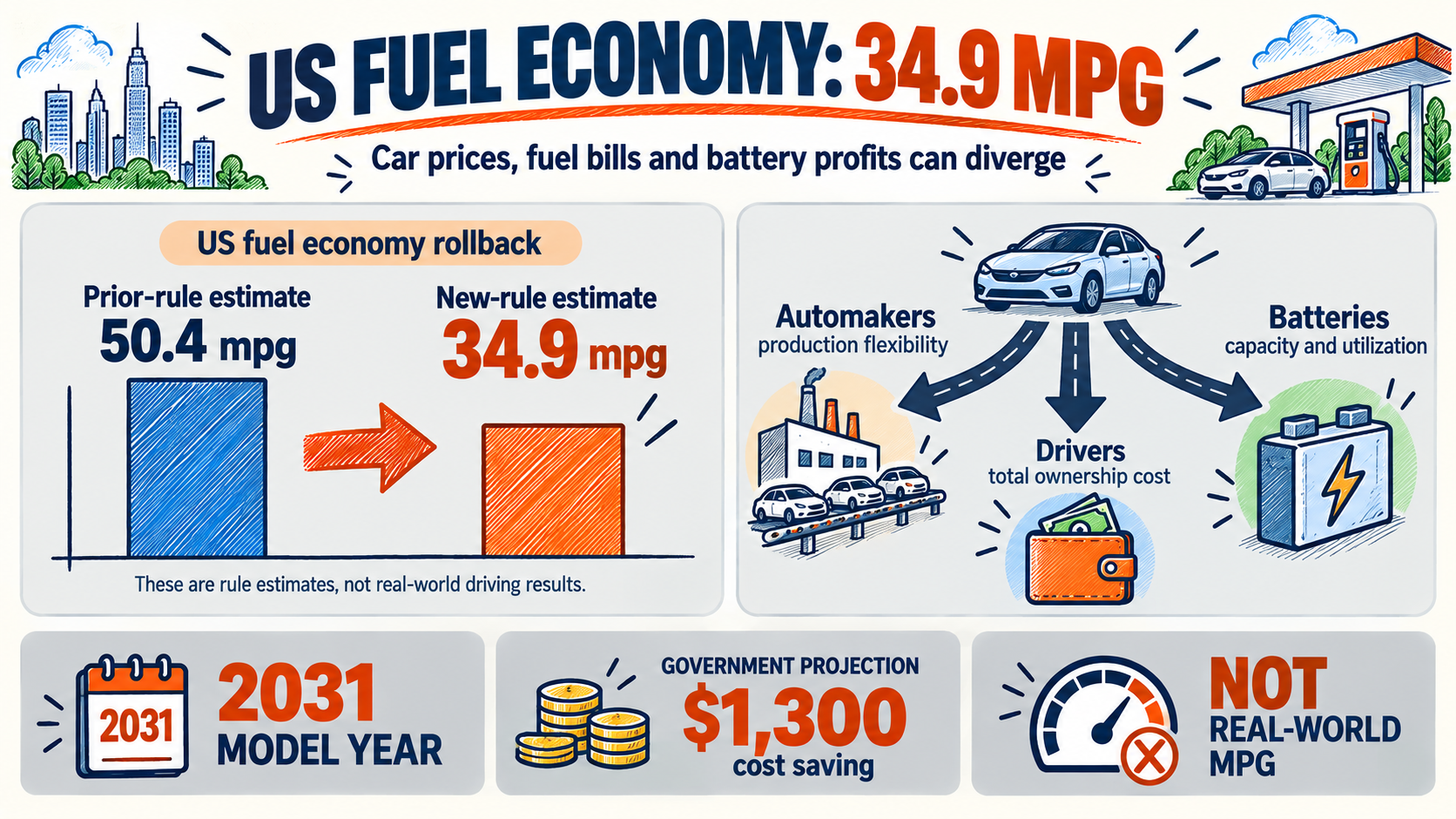
The US fuel economy rollback is final. Rules announced on September 28 project a fleet average of 34.9 mpg for model year 2031. Lower compliance costs could help automakers, while Korean battery factories and drivers face a different calculation. Source: Reuters · 2026-09-28
자동차 가격표만 보면 반가운 소식처럼 들립니다. 다만 차를 사는 날의 지출이 줄어드는 것과 몇 년 동안 차를 유지하는 비용이 줄어드는 것은 별개입니다. 이번 정책을 읽을 때는 완성차의 원가, 소비자가 내는 가격, 배터리 업체의 생산량을 따로 봐야 합니다.
미국 연비 규제 완화, 34.9mpg는 어떤 숫자인가
CAFE는 자동차 회사가 판매하는 차량군의 평균 연비를 관리하는 제도입니다. mpg는 휘발유 1갤런으로 가는 거리를 마일로 나타냅니다. 숫자가 높을수록 같은 거리를 갈 때 쓰는 연료가 적습니다. 모든 차종에 똑같은 연비를 요구한다는 뜻은 아닙니다. 출처: NHTSA · CAFE
기존 규칙을 발표한 2024년 NHTSA 자료의 2031년 평균 추정치는 약 50.4mpg였습니다. 이번 최종 발표는 34.9mpg를 제시했습니다. 두 발표 수치를 단순 비교하면 약 30.8% 낮습니다. 다만 규칙과 산정 전제가 바뀐 평균값의 비교입니다. 내 차의 실주행 연비가 그만큼 떨어진다는 뜻으로 읽으면 안 됩니다. 출처: NHTSA · 2024-06-07 출처: DOT · 2026-09-28
2031년 평균 연비: 두 규칙의 추정. 출처: NHTSA 2024-06-07, DOT 2026-09-28. 서로 다른 규칙·전제의 추정치이며 개별 차량의 실주행 연비가 아닙니다.
규제상 평균과 실제 주유비를 바로 연결하기도 어렵습니다. 차종 구성, 시험 방식, 실제 운전 조건이 다르기 때문입니다. 그래서 아래의 소비자 비용 계산에는 이 규제 수치를 그대로 대입하지 않고 별도의 가정을 사용했습니다.
왜 규제를 낮췄을까: 정부가 보는 가격과 업계가 보는 수요
숀 더피 미국 교통부 장관은 9월 28일 규제 완화가 차량 구매 부담을 낮추고 제조업을 지원한다는 취지로 설명했습니다. 정부는 신차 평균 비용이 1,300달러 줄어들 것으로 전망했습니다. 이는 정책 효과의 추정치입니다. 이미 자동차 판매가격이 그만큼 내려갔다는 통계가 아닙니다. 출처: DOT · Duffy 발언
자동차 업계의 논리도 수요에 맞춰 생산 속도를 조정하자는 데 있습니다. 주요 완성차 업체를 대표하는 Alliance for Automotive Innovation은 시장 여건과 법에 맞춘 결정이라고 지지했습니다. 반면 환경단체 Sierra Club은 소비자의 연료비 부담을 비판했습니다. 두 입장은 Reuters의 같은 날 보도에서 확인됩니다. 출처: Reuters · 업계와 환경단체 입장
경제적으로 보면 판매가 쉽지 않은 차를 규제 때문에 더 만들어야 할 때 문제가 생깁니다. 생산설비에는 돈이 들어가는데 재고가 쌓이면 할인도 늘어납니다. 규제를 완화하면 회사는 판매하기 쉬운 차종에 생산을 배분할 여지가 생깁니다. 이 문단은 제도의 유인을 풀어 쓴 분석이며, 모든 전기차가 수익성이 낮다는 판단은 아닙니다.
그렇다고 원가 절감액이 전부 구매자에게 돌아가지는 않습니다. 재고가 많고 경쟁이 치열하면 할인으로 나갈 수 있습니다. 인기 차종이 부족하면 회사가 이익으로 남길 여지도 있습니다. 비용을 줄였다는 발표만으로 판매량 증가와 이익률 상승을 동시에 확정할 수 없는 이유입니다.
-
1
규제 부담 완화
생산 구성의 선택 여지 확대
-
2
재고와 경쟁
판매 할인 필요성이 배분을 결정
-
3
가격 또는 마진
구매자 혜택과 회사 이익으로 나뉨
차값이 싸져도, 주유비까지 싸지는 것은 아닙니다
소비자가 비교할 것은 총보유비용입니다. 구입비에 할부 이자, 연료비, 보험료, 정비비를 더하고 나중에 중고차로 팔 때 받는 돈을 빼는 방식입니다. 차값을 조금 낮추는 대신 연료를 더 쓰는 차를 선택했다면, 오래 탈수록 처음의 할인 효과가 줄어들 수 있습니다.
계산을 위해서만 가정을 놓아 보겠습니다. 연간 1만2,000마일을 운전하고 휘발유가 갤런당 4달러라면, 실제 연비 30mpg 차량의 연료비는 1,600달러입니다. 40mpg 차량은 1,200달러입니다. 연간 400달러 차이입니다. 특정 차종이나 앞으로의 유가를 예측한 수치가 아닙니다.
가상 연료비: 같은 거리를 달린다면. 가정: 연간 12,000마일, 4달러/갤런. 계산은 거리÷연비×연료가격. 규칙 효과나 유가 전망이 아닙니다.
이 가정에서 구입비가 1,300달러 낮아졌다면 약 3.25년치 추가 연료비와 맞먹습니다. 실제로 모든 구매자가 정부 추정액만큼 싸게 산다는 뜻은 아닙니다. 금리와 중고차 가치까지 넣으면 결과도 달라집니다. 주행거리가 짧은 집과 장거리 출퇴근을 하는 집이 같은 차를 보고 다른 결론을 내릴 수 있습니다.
앞서 다룬 국제유가의 가계 비용 전달과도 연결됩니다. 연료비 부담이 커지면 외식이나 여가에 쓸 돈이 줄 수 있습니다. 정책이 신차 구매를 늘려도 다른 소비까지 같은 폭으로 늘어나는 것은 아닙니다. 관련: 국제유가와 한국 경제의 비용 전달
한국 완성차와 배터리 업체의 손익이 갈리는 이유
현대차는 이번 규칙 발표 전인 8월 26일 투자자 행사에서 북미 하이브리드 확대와 현지 생산 전략을 제시했습니다. 호세 무뇨스 CEO는 여러 구동계 선택지를 갖춘 신차 투자를 설명했습니다. 9월 규제 완화에 대한 새 대응으로 발표한 계획은 아닙니다. 다만 엔진차·하이브리드·전기차 사이에서 수요 변화에 대응하려는 전략이라는 점은 이번 정책과 맞닿습니다. 출처: 현대자동차 · 2026 CEO Investor Day
완성차 업체에는 생산 선택권이 중요합니다. 주문이 몰리는 차를 더 만들어 공장을 채우면 고정비를 더 많은 차량에 나눌 수 있습니다. 이미 확보한 설비를 잘 쓰는 것만으로도 수익성에 도움이 될 수 있습니다. 반대로 새 차종을 넣느라 설비를 크게 바꾸거나 할인 경쟁에 들어가면 그 이점이 줄어듭니다. 이는 조건부 분석입니다.
그런데 배터리 업체 입장에서는 이야기가 달라집니다. 자동차 몇 대가 팔렸는지보다 배터리 용량이 얼마나 출하됐는지가 중요합니다. 일반 하이브리드는 엔진과 작은 배터리를 함께 사용합니다. 배터리로 주행 에너지를 공급하는 순수 전기차와 필요한 용량이 같지 않습니다. 전동화 차량 판매가 늘어도 순수 전기차 비중이 줄면 배터리 수요가 기대에 못 미칠 수 있습니다.
완성차
차량당 이익
중요한 단위
기회 · 수요에 맞춰 생산 구성 조정
확인할 부담 · 할인·설비 전환 비용
배터리
출하 용량과 가동률
중요한 단위
기회 · 고객·제품 구성 다변화
확인할 부담 · 고정비·투자 회수 지연
공장을 이미 지었다면 그 차이가 실적에 더 크게 나타납니다. 감가상각은 설비값을 여러 해의 비용으로 나눠 반영하는 회계 처리입니다. 생산량이 줄어도 이 비용이 바로 없어지지 않습니다. 가동률이 낮아지면 배터리 한 단위가 부담하는 공장 비용이 커집니다. 완성차 업체의 투자 부담 완화가 공급업체의 이익 개선으로 자동 연결되지 않는 이유입니다.
소재·부품 업체도 공급 품목과 계약을 나눠 봐야 합니다. 엔진·변속기 부품과 배터리 소재는 같은 수요를 받지 않습니다. 최소 구매 약정이 있는지, 고객의 생산 계획이 얼마나 확정됐는지에 따라 매출과 현금 유입의 시점도 달라집니다. 이는 이전 컨테이너 운임 글에서 살핀 원가와 이익의 차이와 비슷한 문제입니다. 관련: 컨테이너 운임과 수출기업 이익
원가가 줄어도 주가가 오르지 않을 수 있는 이유
IMF의 페티야 코에바 브룩스 조사국 부국장은 7월 9일 전망 설명에서 올해 약화 뒤 내년 반등이라는 경기 경로를 제시했습니다. IMF는 동시에 물가 둔화가 정체됐다고 설명했습니다. 9월 자동차 규칙을 평가한 발언은 아닙니다. 이번 사안을 놓고 보면 차값 부담을 낮추려는 정책과 연료비·금융비용 부담이 함께 작동할 수 있다는 거시 배경입니다. 출처: IMF · July 2026 briefing
시장도 산업정책 한 가지로 움직이지 않습니다. 제공된 9월 28일 CNN 공포·탐욕 지수는 34.8로 공포입니다. 1주 전 34.2와는 비슷하지만 1개월 전 53.7보다 19.0포인트 낮습니다. 한국 GoldKimp KOSPI 지수는 9월 22일 55.0으로 중립입니다. 한국 쪽 관측일이 더 이르고 산식도 달라 같은 날의 우열 비교는 아닙니다. 출처: CNN · 제공 스냅샷 출처: GoldKimp · 2026-09-22
미국 심리의 한 달 변화. 사용자 제공 CNN 스냅샷, 2026-09-28 18:14:41 UTC. 한국 55.0은 9월 22일·별도 산식이므로 같은 막대에 놓지 않았습니다.
한국의 같은 지수에 대한 주간·월간 과거값은 확보하지 못했습니다. SentimentTrader의 Smart Money·Dumb Money Confidence도 9월 29일 홈페이지를 직접 조회했지만 두 수치와 갱신일이 표시되지 않았습니다. 따라서 큰손과 개인의 방향이 갈렸다고 판단할 근거로 쓰지 않았습니다. 미국의 위험선호가 한 달 전보다 약해졌다는 정도가 확인 가능한 해석입니다. 출처: SentimentTrader · 수치 미노출
이런 환경에서는 자동차 규제 완화가 발표돼도 미래 이익이 실제로 늘어나는지 확인하려는 요구가 커질 수 있습니다. 주가는 이익 전망뿐 아니라 그 전망에 얼마를 지불할 것인지에도 달려 있습니다. 자금조달 비용이 높거나 정책 지속성에 대한 의문이 남으면, 원가 절감만으로 주가 상승을 설명하기 어렵습니다. 특정 종목의 매수·매도 신호로 쓴 분석은 아닙니다.
다음 실적에서 볼 것은 판매대수보다 이익의 배분입니다
정책 일정도 구분해야 합니다. 교통부는 CAFE 크레딧 거래를 2028년형부터 종료한다고 밝혔습니다. 크레딧은 기준을 초과 달성한 실적을 다른 회사가 규제 준수에 활용하도록 거래하는 장치입니다. 다른 환경 규제의 크레딧까지 모두 없어진다는 뜻은 아닙니다. 시행 시점과 기업별 노출이 달라 당장 모든 관련 수익이 사라진다고 볼 수도 없습니다. 출처: DOT · 적용 일정
앞으로 완성차 실적에서는 판매가격과 할인 규모를 함께 보는 편이 좋습니다. 절감한 비용을 회사가 남겼는지, 판매량을 늘리기 위해 고객에게 돌려줬는지가 드러나기 때문입니다. 배터리 실적에서는 차량 판매 뉴스보다 고객의 차종 구성, 출하 용량, 공장 가동률과 투자 집행의 변화를 확인해야 합니다.
미국 연비 규제 완화의 경제적 의미는 자동차 산업 전체가 같은 혜택을 받는다는 데 있지 않습니다. 지금의 생산비를 낮추는 선택이 미래의 연료비와 설비 부담을 어디로 옮기는지에 있습니다. 한국 기업에도 판매 선택권 확대와 배터리 투자 회수 지연이 동시에 나타날 수 있습니다. 그 차이를 확인할 곳은 규제 발표문 다음에 나올 주문과 현금흐름입니다.
자료 기준: 2026년 9월 29일 한국시간. 정책 발표·기업 계획은 확인된 사실로, 비용 절감액은 기관의 전망으로, 기업 손익과 소비 파급은 조건부 분석으로 구분했습니다.
차값과 주유비, 배터리 공장 가동률을 따로 보면 정책의 손익이 보입니다.
출처
- 미국 교통부, CAFE 최종 규칙 발표 (2026-09-28)
- NHTSA, 기존 MY2027–2031 규칙 (2024-06-07)
- Reuters, US finalizes new lower fuel economy standards (2026-09-28)
- NHTSA, CAFE 제도 안내
- 현대자동차, 2026 CEO Investor Day (2026-08-26)
- IMF, July 2026 WEO briefing (2026-07-09)
- CNN Fear & Greed, 제공 스냅샷 2026-09-28
- GoldKimp KOSPI, 제공 관측값 2026-09-22
- SentimentTrader, 2026-09-29 조회 시 숫자 미노출
A lower sticker price sounds welcome. But buying a car more cheaply does not necessarily make it cheaper to own. The useful distinction is between manufacturing cost, the price paid by the buyer and the production volume available to battery suppliers.
US fuel economy rollback: what 34.9 mpg means
CAFE regulates the average fuel economy of a manufacturer’s vehicle fleet. Miles per gallon measures distance travelled on a gallon of fuel; a higher number means less fuel per mile. It is not a single identical requirement for every model. Source: NHTSA · CAFE
NHTSA’s 2024 announcement projected roughly 50.4 mpg for 2031. The new announcement gives 34.9 mpg, about 30.8% lower by simple arithmetic. These are averages under different regulatory assumptions, not a prediction that every car’s real-world efficiency will fall by that amount. Source: NHTSA · 2024-06-07 Source: DOT · 2026-09-28
2031 fleet economy: two rule estimates. Sources: NHTSA, June 7, 2024; DOT, September 28, 2026. Different regulatory assumptions; not individual on-road efficiency.
Nor should these regulatory averages be inserted directly into a household fuel bill. Model mix, testing conventions and driving conditions differ. The household example below therefore uses separate, explicitly hypothetical real-world fuel-economy figures.
Why loosen the rules? Prices, demand and investment
Transportation Secretary Sean Duffy presented the change on September 28 as support for affordability and manufacturing. The department projects a $1,300 reduction in average new-vehicle cost. That is an estimated policy effect, not an observed drop in transaction prices. Source: DOT · Duffy 발언
The Alliance for Automotive Innovation backed the change as better aligned with market conditions and the law. The Sierra Club objected to the burden on drivers at the pump. Reuters reported both positions on the day of the announcement. Source: Reuters · 업계와 환경단체 입장
The economic mechanism is straightforward. If compliance pushes a company to build models it struggles to sell, it can face both investment spending and inventory discounts. Relaxing that constraint may let it shift production toward products with stronger demand. This is an interpretation of incentives, not a claim that all electric vehicles are unprofitable.
Cost savings need not flow entirely to buyers. Heavy inventories and aggressive competition can turn them into discounts. Scarce, popular models may let manufacturers keep more of the benefit. A reduction in cost alone therefore does not establish both higher sales and a higher profit margin.
-
1
Compliance relief
More flexibility in production mix
-
2
Inventory and competition
Discount pressure shapes the split
-
3
Prices or margins
Benefits divided between buyers and earnings
A cheaper purchase can still mean a larger fuel bill
A buyer needs the total cost of ownership: purchase price, financing, fuel, insurance and maintenance, less eventual resale proceeds. If a cheaper vehicle uses more fuel, keeping it longer can erode the initial saving. The balance depends on the buyer’s actual mileage and the specific vehicles being compared.
Consider an illustration, not a forecast: 12,000 miles a year and gasoline at $4 a gallon. A car returning 30 mpg would use $1,600 of fuel annually, versus $1,200 at 40 mpg. The difference is $400 a year. Neither the mileage, fuel price nor efficiency figures are predictions for a specific model.
Illustrative annual fuel spending. Assumptions: 12,000 miles/year and $4/gallon. Miles ÷ mpg × fuel price. Not a policy or fuel-price forecast.
In that illustration, an initial saving of $1,300 would equal about 3.25 years of additional fuel spending. That does not mean every buyer receives the government’s estimated saving. Financing costs and resale values also change the result. A low-mileage household and a long-distance commuter can reasonably make different choices.
This connects with our earlier discussion of how oil prices reach household budgets. Higher fuel spending can leave less for dining out or leisure. A policy that lifts new-car purchases need not lift other consumption by the same amount. Related: How oil prices transmit through Korea’s economy
Why Korean automakers and battery suppliers may diverge
At its August 26 investor day, before this rule was announced, Hyundai outlined North American hybrid expansion and local production. CEO José Muñoz described investment across multiple powertrain options. This was not a new response to the September decision, but it is relevant to the ability to adapt to changing demand. Source: 현대자동차 · 2026 CEO Investor Day
Production flexibility matters to the assembler. Filling a plant with vehicles customers want spreads fixed costs over more units. Better use of existing equipment can help profitability. But expensive retooling or a price war can absorb that benefit. These are conditional effects, not an earnings forecast for Hyundai.
For battery suppliers, the picture changes. Battery suppliers must look at capacity shipped, not just vehicle units. A conventional hybrid combines an engine with a smaller battery; it does not need the same battery capacity as a fully electric car. Electrified-vehicle sales can rise while battery demand falls short of expectations if the mix shifts away from full EVs.
Automakers
Profit per vehicle
Key unit
Opportunity · Align production with demand
Risk to check · Discounts and retooling
Battery suppliers
Capacity shipments and utilization
Key unit
Opportunity · Diversify customers and products
Risk to check · Fixed costs and delayed payback
The distinction becomes sharper when a factory has already been built. Depreciation spreads the equipment’s cost over its useful life; it does not disappear when orders decline. Lower utilization leaves each unit of output carrying more factory cost. Less investment pressure on an automaker does not automatically improve its suppliers’ earnings.
Materials and components suppliers also differ by product and contract. Engine parts, transmissions and battery materials do not share the same demand. Minimum-purchase commitments and firm production schedules can change when revenue becomes cash. It is another version of the cost-versus-profit distinction explored in our freight article. Related: Container freight and exporters’ margins
Why lower costs may not lift share prices
In the IMF’s July 9 outlook briefing, Research Department Deputy Director Petya Koeva Brooks described weaker growth this year followed by a rebound next year. The IMF also warned that disinflation had stalled. This was not a comment on the September auto rule; it provides context for a policy that may lower purchase costs while fuel and financing remain constraints. Source: IMF · July 2026 briefing
The supplied September 28 CNN Fear & Greed reading is 34.8, or fear. It is little changed from 34.2 a week earlier but 19.0 points below 53.7 a month earlier. GoldKimp’s KOSPI reading is 55.0, neutral, dated September 22. Different observation dates and methods prevent a like-for-like ranking. Source: CNN · 제공 스냅샷 Source: GoldKimp · 2026-09-22
US sentiment over the past month. Supplied CNN snapshot, September 28, 2026, 18:14:41 UTC. Korea’s 55.0 is dated September 22 and uses another method, so it is not plotted here.
Comparable weekly and monthly KOSPI history was unavailable. The September 29 check of SentimentTrader’s Smart Money and Dumb Money Confidence page also showed blank values and no update date. It cannot support a claim that sophisticated and retail positioning diverged. The supported observation is that US risk appetite is weaker than a month earlier. Source: SentimentTrader · 수치 미노출
In that setting, investors may demand evidence that policy relief translates into cash earnings. Equity values depend on both expected profits and the price investors pay for them. High financing costs or uncertainty about policy durability can offset cost savings. This is not a buy or sell signal for any stock.
Next earnings: watch profit distribution, not unit sales
The department says CAFE credit trading will end from model year 2028. Credits allow overcompliance to be traded for another manufacturer’s compliance needs. This does not mean every other environmental credit program disappears, or that every related revenue stream vanishes immediately. Source: DOT · 적용 일정
For automakers, read transaction prices alongside incentives: did the company retain the saving, or pass it to buyers to gain volume? For batteries, examine customer model mix, capacity shipments, utilization and actual capital spending. Vehicle-sales headlines alone cannot answer those questions.
The US fuel economy rollback changes how costs are distributed across time and businesses. Greater product flexibility can coexist with slower recovery of battery investment. For Korean companies, the next evidence will come from orders and cash flow, rather than the policy headline alone.
Information cutoff: September 29, 2026, Korea time. Announcements and company plans are documented facts; projected savings are estimates; effects on earnings and consumption are conditional analysis.
Follow vehicle prices, fuel bills and battery utilization separately.
Sources
- 미국 교통부, CAFE 최종 규칙 발표 (2026-09-28)
- NHTSA, 기존 MY2027–2031 규칙 (2024-06-07)
- Reuters, US finalizes new lower fuel economy standards (2026-09-28)
- NHTSA, CAFE 제도 안내
- 현대자동차, 2026 CEO Investor Day (2026-08-26)
- IMF, July 2026 WEO briefing (2026-07-09)
- CNN Fear & Greed, 제공 스냅샷 2026-09-28
- GoldKimp KOSPI, 제공 관측값 2026-09-22
- SentimentTrader, 2026-09-29 조회 시 숫자 미노출
이 글은 정보 제공 목적이며, 특정 자산의 매수·매도를 권유하지 않습니다.
For information only — this is not a recommendation to buy or sell any asset.
댓글Comments 0