mRNA 백신 냉장 유통 — 37°C에서 2개월, 비용은 어디서 줄까mRNA Vaccine Cold Chain: Two Months at 37°C—Where Could Costs Fall?
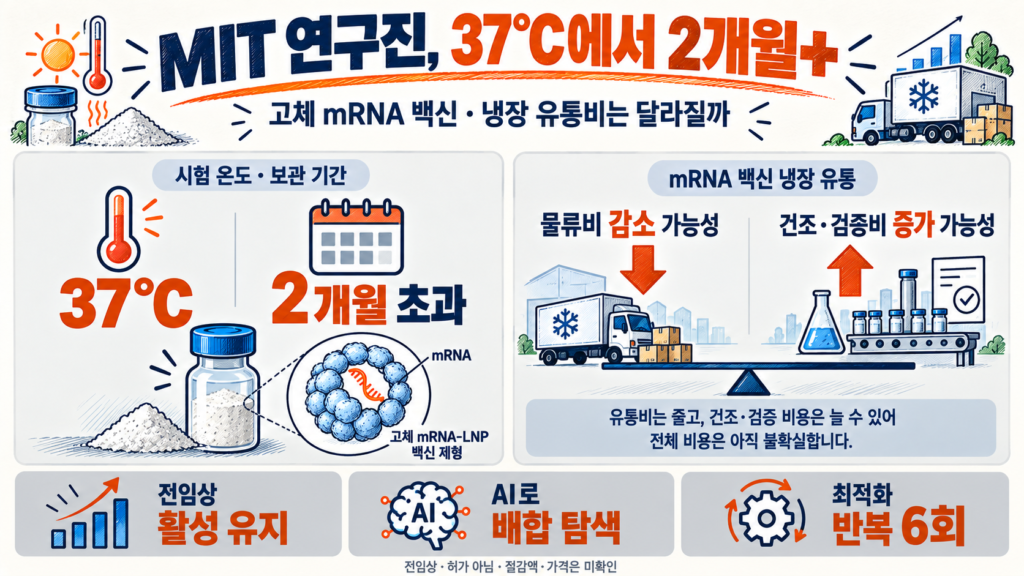
MIT 코흐연구소의 아나 야클레네츠(Ana Jaklenec)와 로버트 랭거(Robert Langer) 연구진이 mRNA 백신 냉장 유통의 부담을 줄일 고체 제형을 발표했습니다. 핵심은 37°C에서 2개월 넘게 보관한 뒤에도 생물학적 활성을 유지했다는 결과입니다. 그렇다면 이 성과가 실제 제품이 될 때 물류비와 제조비는 어디서 줄고, 어디서 늘어날까요? 출처: Nature Biotechnology
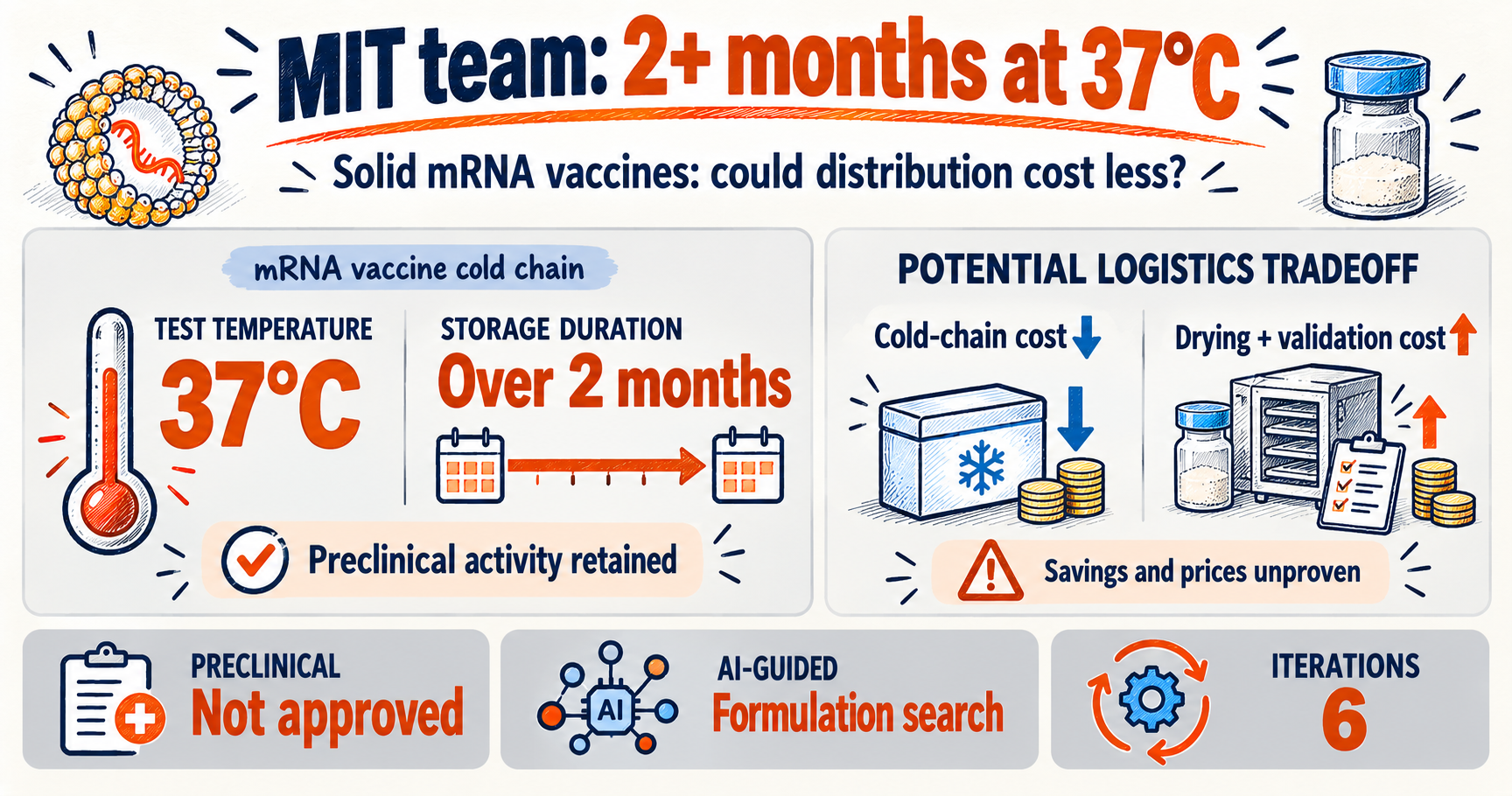
Ana Jaklenec and Robert Langer at MIT’s Koch Institute have reported a solid formulation that could ease mRNA vaccine cold-chain requirements. It retained biological activity after more than two months at 37°C. The commercial question is how this could change distribution and manufacturing costs. Source: Nature Biotechnology
9월 28일 Nature Biotechnology에 실린 AGENT 연구입니다. 다만 37°C는 통상적인 실내 상온보다 높은 시험 온도입니다. 그리고 이번 결과는 전임상 연구입니다. 창고에 놓아 둔 백신을 바로 사람에게 접종해도 된다는 허가는 아닙니다.
야클레네츠·랭거 팀, 예전 해법이 통하지 않은 이유
야클레네츠와 랭거가 연구를 총괄했고, 공동 1저자 진비 티안(Jinbi Tian)과 칸 트란(Khanh T. M. Tran)이 실험 설계·수행과 분석을 맡았습니다. MIT의 미나 코나코비치 루코비치(Mina Konaković Luković)는 알고리즘 개발과 해석을 지도했습니다. 약물을 다루는 연구자와 다음 실험을 고르는 알고리즘 연구자가 만난 셈입니다. 출처: 저자 기여 / Author contributions
MIT 발표에 따르면 야클레네츠·랭거 연구진은 앞서 고분자로 LNP를 안정화하는 연구를 했습니다. 그러나 그때의 입자는 상용 백신에 쓰인 조성과 달랐습니다. 티안과 트란에게는 예전에 잘됐던 보호 성분을 가져오는 것만으로 풀리지 않는 문제가 남아 있었습니다. 출처: MIT News
mRNA 백신 냉장 유통은 왜 어려울까
mRNA는 세포에 단백질을 만들라고 전달하는 유전정보입니다. LNP는 이 RNA를 보호하고 세포 안으로 들어가도록 돕는 작은 지질 입자입니다. 티안 연구진이 보존하려 한 기능은 RNA가 남아 있는 것만이 아닙니다. 입자가 RNA를 전달하고 세포가 그 정보를 읽을 수 있어야 합니다. 출처: MIT News
그래서 기존 제품과의 비교도 정확해야 합니다. 미국 SPIKEVAX의 2026–2027 처방정보는 해동 후 2~8°C에서 최대 60일의 냉장 보관을 허용합니다. 표시 유효기간이 먼저 오면 그때까지입니다. 같은 문서는 8~25°C 보관을 최대 12시간으로 제한합니다. 모든 mRNA 백신이 접종 직전까지 초저온 상태여야 한다는 설명은 맞지 않습니다. 출처: SPIKEVAX 처방정보 §16
야클레네츠 연구진의 고체 제형이 제품으로 발전한다면 중요한 차이는 냉장고 밖에서 쓸 수 있는 시간의 여유입니다. 다만 허가된 제품의 보관 조건과 실험실 결과는 근거 수준이 다르므로, 두 수치를 나누어 몇 배 더 낫다고 계산할 수는 없습니다.
상용 SPIKEVAX
2~8°C · 최대 60일*
해동 후 냉장
더 높은 온도 · 8~25°C · 최대 12시간
근거 · *표시 유효기간 우선
AGENT 고체 제형
37°C · 2개월 초과
연구 조건
평가 · 생물학적 활성 유지
근거 · 전임상 · 사람 허가 아님
티안과 트란이 AI에 맡긴 일
AI가 한 일은 백신의 유전정보를 새로 쓰는 것이 아니라 보호 성분의 배합을 고르는 일이었습니다. 연구진은 약 50개 부형제를 선별한 뒤 유망한 5개 성분의 비율을 탐색했습니다. 부형제는 약의 주성분을 보존하거나 제형을 만드는 데 쓰는 보조 성분입니다. 출처: MIT News
AGENT는 베이지안 최적화를 사용합니다. 이미 얻은 실험 결과로 유망한 배합과 아직 잘 모르는 배합을 추정하고, 다음에 시험할 후보를 고르는 방식입니다. 루코비치의 알고리즘이 제안하면 티안·트란 연구진이 실험하고 결과를 다시 넣습니다. 초록은 1개월 안에 6차례 반복으로 최적화했다고 보고합니다. 출처: Nature Biotechnology
-
1
배합 후보
보호 성분을 섞습니다
-
2
실험·측정
보관 뒤 기능을 평가합니다
-
3
모델 갱신
결과와 불확실성을 반영합니다
-
4
다음 후보
정보가 될 실험을 선택합니다
이 방식의 공학적 의미는 실험을 없앤 데 있지 않습니다. 다음 실험 한 번에서 얻을 정보를 늘렸다는 데 있습니다. 비율을 조금씩 바꿀 때마다 시료를 만들고 건조하고 측정해야 한다면, 불필요한 후보를 줄이는 것만으로도 개발 인력과 장비 시간을 아낄 여지가 생깁니다. 이는 비용 절감의 가능한 경로이지, 논문이 제시한 원가 절감률은 아닙니다.
37°C·2개월 결과는 어디까지 확인됐나
티안·트란 연구진은 Moderna와 Pfizer-BioNTech의 지질 조성을 각각 대표하는 두 LNP 시스템을 고체화했습니다. 공개 초록은 37°C에서 2개월 넘게 보관한 뒤 생물학적 활성 100% 유지를 보고합니다. 여기서 100%는 연구의 활성 평가 결과이며, 사람의 감염을 100% 막는다는 뜻이 아닙니다. 출처: Nature Biotechnology
MIT는 진공건조로 물을 제거했고, 장기 보관 시료를 투여한 쥐의 면역반응이 비교 제형과 비슷했다고 설명합니다. 별도로 실온 1년 보관 결과도 소개합니다. Nature의 연구 브리핑은 설치류와 비인간 영장류에서 신선한 백신에 뒤지지 않는 면역반응과 미세바늘 패치 전달 가능성을 요약합니다. 출처: MIT News 출처: Nature Research Briefing
미세바늘 패치는 작은 바늘이 피부에서 녹으며 성분을 전달하는 장치입니다. 트란 연구진의 결과는 보관 방식뿐 아니라 투여 형태를 넓힐 가능성도 보여줍니다. 하지만 쥐와 영장류의 모든 시험이 같은 보관 기간·용량·투여 경로를 썼다고 읽어서는 안 됩니다. 출처: Nature Research Briefing
이 글에서 확인한 범위는 공개 초록·저자 정보·그림 제목과 공식 연구 소개입니다. 유료 본문과 원자료 전체를 검토하지 못했으므로 영장류 표본수나 항체 역가, 통계적 비열등성 기준을 임의로 제시하지 않습니다. 사람의 안전성·예방효과·보호 지속기간 역시 이번 공개 자료만으로 판단할 수 없습니다.
백신값보다 먼저 달라질 것은 접종 한 번의 비용
야클레네츠 연구진의 성과를 산업으로 옮겨 생각하면, 비용을 세는 단위부터 바뀝니다. 공장에서 백신 한 병을 만드는 가격만 볼 일이 아닙니다. 냉장고를 가동하고, 포장해 운송하고, 온도 이탈로 버린 물량까지 감안해 실제 접종 한 번에 얼마가 들었는지 봐야 합니다. 아래는 논문의 실측 원가가 아니라 사업성을 판단하기 위한 분석입니다.
보관 온도가 완화되면 전력·냉매·보냉 포장 지출을 줄일 수 있습니다. 배송 지연 때문에 급송하거나 재배송하는 일도 줄어들 가능성이 있습니다. WHO 역시 냉장 설비와 얼음팩 생산 능력이 부족한 지역에서 유통 비용과 운영 제약이 백신 접근성을 가로막는다고 설명합니다. 출처: WHO
그런데 제조업체 입장에서는 이야기가 다릅니다. 건조 공정이 하나 더 붙습니다. 한 번에 얼마나 많이, 얼마나 빨리 말릴 수 있는지에 따라 생산량이 달라집니다. 방습 포장과 잔류 수분 검사도 비용 후보입니다. 주사제로 쓰기 위해 다시 녹여야 하는 제품이라면 현장의 준비 시간과 오염 방지 절차까지 따져야 합니다. 냉장 트럭에서 아낀 돈보다 공장에서 더 쓴 돈이 크면 가격은 내려가지 않을 수 있습니다.
줄어들 수 있는 비용
냉장·냉동 운용
보관
운송 · 보냉 포장·급송
손실 · 온도 이탈 폐기·재배송
추가될 수 있는 비용
건조 설비·사이클
생산
포장 · 방습·재용해 관리
품질 · 공정 검증·안정성 시험
계산은 다음처럼 잡을 수 있습니다. 접종 완료당 비용 = 제조·포장·보관·운송·접종 운영의 총비용 ÷ 실제 접종 완료 건수입니다. 폐기율이 낮아져 같은 예산으로 더 많은 사람에게 접종한다면, 출고 가격이 그대로여도 공급 효율은 좋아집니다. 반대로 접종 인력과 구매 예산이 부족하면 보관 안정성만으로 수요가 생기지는 않습니다.
저소득국에서는 이 차이가 새 공급 지역을 열 수 있습니다. 기존 냉장망으로는 수지가 맞지 않았던 작은 보건소를 정기 배송에 포함하는 시나리오입니다. 다만 더 낮은 총비용이 실제 조달 가격에 반영될지는 경쟁, 특허·기술료, 공급 계약에 달렸습니다. 이번 연구에서 특정 국가의 절감액이나 백신 판매가격은 확인되지 않았습니다.
한국 바이오·물류 기업은 무엇을 팔게 될까
랭거·야클레네츠의 결과가 한국 기업에 주는 질문은 어떤 회사 주가가 오르느냐보다 어떤 공정 역량이 새로 필요하냐에 가깝습니다. 삼성바이오로직스는 현재 mRNA·LNP 공정 개발, 분석, 무균 충전 서비스를 안내합니다. 2022년에는 송도 mRNA 설비 확장과 GreenLight와의 상업 규모 엔지니어링 생산을 발표했습니다. 이는 생산 기반의 사례이며 AGENT 도입 계약이 아닙니다. 이 글은 특정 기업의 매수·매도 추천이 아닙니다. 출처: Samsung Biologics 서비스 출처: 2022년 생산 사례
위탁개발생산 기업, 즉 다른 제약사의 공정 개발과 생산을 맡는 CDMO에는 고체 제형 최적화와 대량생산 검증이 새 서비스가 될 수 있습니다. 고객의 RNA나 지질 조성이 바뀌었을 때도 활성이 유지되는지 확인하고, 배치마다 같은 품질을 보장하는 능력입니다. 장비를 먼저 들이는 것보다 고객이 요구할 사양과 검증 비용을 함께 설계하는 일이 중요해질 수 있습니다.
한국 백신 개발사에는 수출 제품을 설계할 선택지가 늘어날 수 있습니다. 냉장 장비가 부족한 지역을 목표로 한다면 초기부터 보관·투여 방식을 함께 개발하는 전략입니다. 패치가 상용화되면 패치 제조와 포장 시장도 생길 수 있지만, 주사제를 단순히 패치에 넣는 것으로 끝나지는 않습니다. 피부를 통해 실제 전달되는 양과 사용자별 편차를 제품 수준에서 검증해야 합니다.
물류업체에는 수익의 이동이 생길 수 있습니다. 해당 제품의 고가 냉동 운송 수요가 줄어드는 대신 온도 기록, 재고 추적, 품질 보증을 포함한 배송 서비스가 중요해지는 방향입니다. 다른 생물의약품까지 같은 조건으로 보관할 수 있게 되는 것은 아니므로, 냉장 물류 산업 전체가 대체된다고 보기는 어렵습니다. 연구진의 성공이 어떤 업체에는 비용 절감이고 다른 업체에는 서비스 전환 비용일 수 있습니다.
상용화 전에 확인할 것: 대량생산·습도·WHO 기준
티안·트란 연구진의 결과가 실제 유통 조건이 되려면 공장과 배송 현장에서 재현되어야 합니다. 포장을 뜯기 전후, 습도가 높은 날, 온도가 오르내리는 운송 구간에서도 정해진 품질을 유지하는지 봐야 합니다. 같은 제형을 크게 생산했을 때 건조 시간이 길어지거나 불량률이 높아지면 연구실의 장점이 줄어들 수 있습니다.
WHO의 관리형 온도 유통인 CTC도 아무 온도에서나 보관한다는 뜻이 아닙니다. 투여 직전 최소 40°C에서 최소 3일의 단회 노출을 견디는 안정성과 승인 사양 준수를 요구합니다. AGENT의 37°C 장기 보관 결과를 이 기준의 자동 충족으로 바꾸어 읽을 수는 없습니다. 출처: WHO ECTC
야클레네츠와 동료들이 제시한 가능성은 분명합니다. 제형을 찾는 실험을 더 효율적으로 만들고, 백신이 이동할 수 있는 조건을 넓힐 수 있습니다. 경제적 성패는 여기에 대량생산 수율, 사람 대상 검증, 제품별 보관 허가, 실제 조달 계약이 붙을 때 드러납니다. 그때의 핵심 숫자는 창고 온도만이 아니라 같은 예산으로 몇 번의 접종을 더 완료했는가일 것입니다.
보관 안정성의 경제적 가치는 같은 예산으로 접종을 얼마나 더 완료하는지에 달렸습니다.
출처와 참고 링크
- Tian et al., Nature Biotechnology (2026): AGENT
- Nature Biotechnology Research Briefing: AI-guided optimization
- MIT News: New formulation helps RNA vaccines withstand high temperatures
- WHO: Extended Controlled Temperature Conditions
- SPIKEVAX 2026–2027 미국 처방정보, §16 (2026년 8월 개정)
- Samsung Biologics: mRNA Manufacturing and Development Services
- Samsung Biologics·GreenLight: commercial-scale engineering run (2022)
The AGENT study appeared in Nature Biotechnology on September 28, 2026. Its 37°C test is warmer than ordinary room temperature. These are preclinical findings, not permission to store a licensed vaccine outside its approved conditions.
The Jaklenec–Langer team and why an old fix fell short
Jaklenec and Langer supervised the work. Joint first authors Jinbi Tian and Khanh T. M. Tran designed and performed experiments and analyzed the results. MIT’s Mina Konaković Luković guided algorithm development and interpretation. Formulation research met experimental design. Source: 저자 기여 / Author contributions
MIT describes earlier work by Jaklenec and Langer on polymer-stabilized LNPs, whose composition differed from those in commercial vaccines. Ingredients that had previously worked did not straightforwardly solve Tian and Tran’s new problem. Source: MIT News
Why mRNA vaccine cold chains are difficult
mRNA carries instructions for making a protein. Lipid nanoparticles, or LNPs, protect it and help it enter cells. Preserving RNA alone is insufficient: the particle must still deliver it and the cell must be able to use it. Source: MIT News
The comparison with existing products needs care. The US 2026–2027 SPIKEVAX label permits refrigerated storage at 2–8°C for up to 60 days after thawing, or until the printed expiry date if sooner. At 8–25°C, the limit is 12 hours. It is inaccurate to say every mRNA vaccine requires ultracold storage until injection. Source: SPIKEVAX 처방정보 §16
If Jaklenec’s solid formulation becomes a product, the practical gain could be a longer operating window outside refrigeration. An approved product label and a laboratory result are different kinds of evidence; dividing their storage durations would not establish a performance advantage.
Licensed SPIKEVAX
2–8°C · up to 60 days*
After thawing
Warmer storage · 8–25°C · up to 12 hours
Evidence · *Printed expiry if sooner
AGENT solid formulation
37°C · over 2 months
Study condition
Readout · Retained bioactivity
Evidence · Preclinical, not human approval
What Tian and Tran asked AI to do
AI selected protective ingredient ratios rather than rewriting the vaccine’s genetic instructions. The team screened nearly 50 excipients and explored combinations of five promising ingredients. Excipients support a medicine’s stability or physical formulation. Source: MIT News
AGENT uses Bayesian optimization: previous experiments inform estimates of promising recipes and uncertain ones, helping select the next candidates. Predictions guide experiments, whose results update the model. The abstract reports six optimization iterations within one month. Source: Nature Biotechnology
-
1
Candidate ratios
Combine protective ingredients
-
2
Test and measure
Assess function after storage
-
3
Update model
Update estimates and uncertainty
-
4
Next candidates
Choose informative experiments
The engineering value is more information from each experiment. Every candidate still requires preparation, drying and measurement. Avoiding unproductive candidates could save staff and equipment time. This is a possible route to lower development cost, not a measured cost-reduction percentage.
What the 37°C result establishes
The team solidified two LNP systems representative of Moderna and Pfizer-BioNTech lipid compositions. The abstract reports 100% retained bioactivity after more than two months at 37°C. That is an activity-assay result, not 100% protection against infection in humans. Source: Nature Biotechnology
MIT describes vacuum drying and mouse immune responses comparable to a reference formulation after storage, including a separate room-temperature study lasting one year. Nature’s research briefing reports immune responses not inferior to fresh vaccine and microneedle-patch delivery in rodents and nonhuman primates. Source: MIT News Source: Nature Research Briefing
Microneedle patches deliver material through tiny dissolving needles. The work therefore points toward additional delivery formats. It does not mean every mouse and primate experiment used identical storage periods, doses or administration routes. Source: Nature Research Briefing
This article verified the public abstract, author information, figure titles and official research accounts. The subscription text and full underlying data were not reviewed. It therefore does not supply unverified primate sample sizes, antibody titers or statistical non-inferiority margins, or infer human safety and protection.
The relevant cost is a completed vaccination
For commercialization, the relevant unit is a completed vaccination. Factory price alone omits refrigeration, transport and doses lost to temperature excursions. The analysis below is a business framework, not a cost study reported in the paper.
Less demanding storage could reduce power, refrigerant and insulated-packaging expenditure, and potentially urgent replacement shipments. WHO identifies limited cold-chain and ice-pack capacity as obstacles to vaccine access. Source: WHO
Manufacturing gains an additional drying step. Batch size and drying-cycle duration affect throughput. Moisture-resistant packaging and residual-moisture testing can add expense. A product requiring reconstitution also needs preparation time and contamination controls. Factory costs could exceed transport savings.
Potential savings
Refrigeration/freezing
Storage
Shipping · Insulation and urgent delivery
Losses · Temperature losses/replacement
Potential added costs
Drying equipment and cycles
Production
Packaging · Moisture/reconstitution controls
Quality · Validation and stability tests
A useful framework is cost per completed vaccination = total manufacturing, packaging, storage, transport and administration cost ÷ completed vaccinations. Lower waste can improve value without lowering the factory price. But better stability alone cannot create purchasing budgets or vaccination staff.
A possible new market is regular supply to small clinics that are uneconomic to serve under existing cold-chain requirements. Whether lower total cost reaches procurement prices depends on competition, licensing and contracts. No country-specific saving or selling price was established here.
What Korean companies could sell
For Korean companies, the question is what capabilities would be needed. Samsung Biologics advertises mRNA/LNP process development, analysis and aseptic filling. In 2022 it announced expanded Songdo mRNA capacity and a commercial-scale engineering run with GreenLight. These show an industrial base, not an AGENT adoption agreement. Nothing here is a recommendation to buy or sell any company’s shares. Source: Samsung Biologics 서비스 Source: 2022년 생산 사례
Contract development and manufacturing organizations, or CDMOs, could offer solid-formulation optimization and scale-up validation. Customers would need consistent quality across batches and evidence for their own RNA and lipid compositions. Investment would need to follow customer specifications and validation requirements.
Korean vaccine developers could design export products around storage and administration needs from the outset. Commercial patches might create demand for patch manufacturing and packaging, but would require product-level validation of delivered dose and variability between users.
Logistics revenue could shift from premium frozen transport toward tracking, inventory visibility and quality-assured delivery for the affected products. Other biologics would retain their own requirements. The result would not imply wholesale replacement of cold-chain logistics; savings for one participant may require transition spending by another.
Before commercialization: scale-up, humidity and WHO criteria
Translation requires reproducibility in factories and distribution. Packaging, humidity, fluctuating temperatures and conditions after opening matter. Longer drying cycles or higher rejection rates at scale could erode the laboratory advantage.
WHO’s controlled temperature chain, or CTC, is not unrestricted ambient storage. It requires an appropriate stability profile for a single exposure of at least three days at a minimum of 40°C immediately before administration, within approved specifications. AGENT’s 37°C result does not automatically meet that requirement. Source: WHO ECTC
Jaklenec and colleagues offer a route to more efficient formulation discovery and broader distribution conditions. Commercial value will depend on manufacturing yield, human evidence, product-specific storage authorization and procurement. The decisive number will be how many additional vaccinations the same budget can deliver.
The economic value of stability depends on how many more vaccinations the same budget delivers.
Sources and further reading
- Tian et al., Nature Biotechnology (2026): AGENT
- Nature Biotechnology Research Briefing: AI-guided optimization
- MIT News: New formulation helps RNA vaccines withstand high temperatures
- WHO: Extended Controlled Temperature Conditions
- SPIKEVAX 2026–2027 미국 처방정보, §16 (2026년 8월 개정)
- Samsung Biologics: mRNA Manufacturing and Development Services
- Samsung Biologics·GreenLight: commercial-scale engineering run (2022)
이 글은 정보 제공 목적이며, 특정 자산의 매수·매도를 권유하지 않습니다.
For information only — this is not a recommendation to buy or sell any asset.
댓글Comments 0