티타늄 3D 프린팅 — 1.7GPa 강도, 항공부품 값도 낮출까Titanium 3D printing: Can 1.7 GPa strength make aircraft parts cheaper?
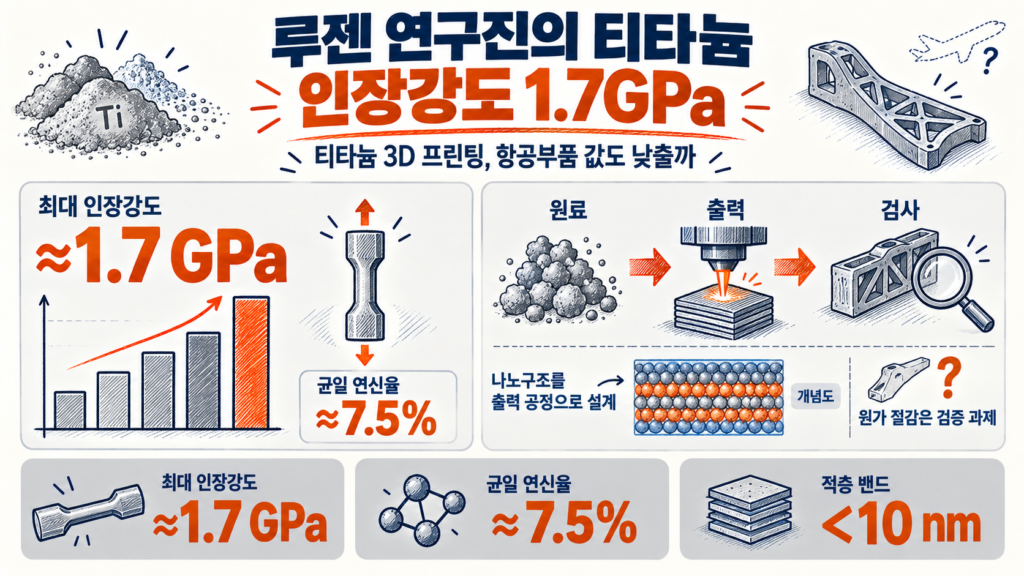
홍콩시립대 루젠(Jian Lu) 교수와 톈진대 허춘녠(Chunnian He) 교수 연구진이 티타늄 3D 프린팅으로 최대 인장강도 1.7GPa를 넘긴 합금을 발표했습니다. 9월 25일 Nature Materials에 실린 연구입니다. 높은 강도를 복잡한 부품에 구현할 수 있다면 항공 제조업에 매력적인 선택지가 됩니다. 다만 부품값이 내려갈지는 소재를 아낀 금액과 검사·인증에 드는 돈을 함께 계산해야 알 수 있습니다. 논문 원문
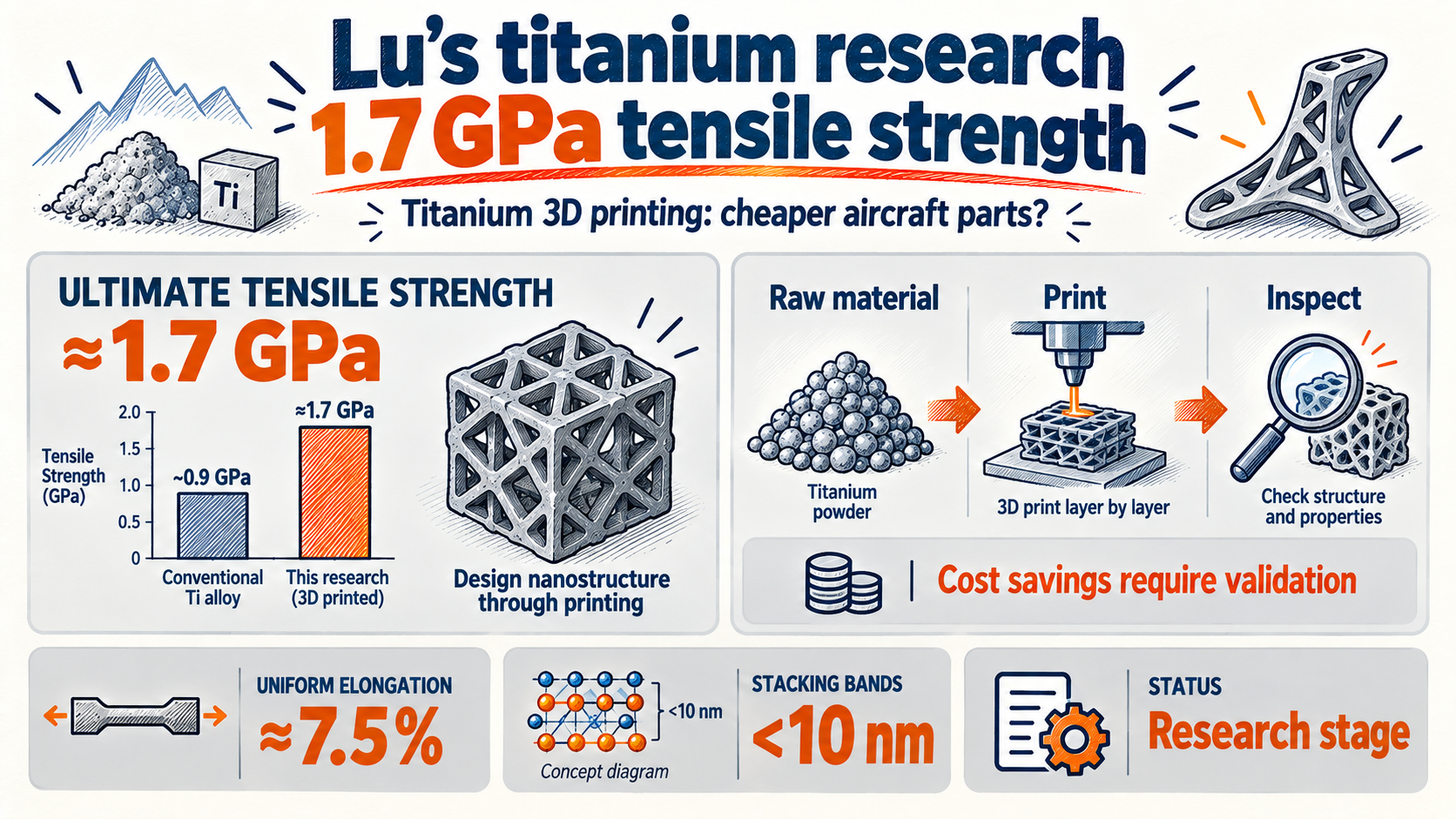
Jian Lu at City University of Hong Kong and Chunnian He at Tianjin University have reported a titanium 3D printing alloy with tensile strength above 1.7 GPa in Nature Materials on September 25. The industrial attraction is clear: strong material in complex shapes. Whether parts become cheaper depends on savings after inspection and qualification costs. Research paper
항공부품은 금속을 사서 원하는 모양으로 깎기만 하면 끝나는 제품이 아닙니다. 설계한 하중을 견디는지, 같은 품질로 다시 만들 수 있는지, 실제 사용 조건에서도 안전한지 확인해야 합니다. 이번 연구는 그 긴 과정의 출발점인 재료 성능을 바꿨습니다. 공장 전체의 원가를 증명한 단계는 아닙니다.
연구를 이끈 사람들
루젠과 허춘녠이 공동으로 연구를 감독했고, 제1저자 바이샹런(Xiangren Bai)이 재료 출력과 기계시험을 맡았습니다. 화둥펑(Dongpeng Hua)은 원자 움직임을 계산하는 모사를, 루안헝웨이(Hengwei Luan)와 리쓰쉬안(Sixuan Li)은 기계학습 분석을 수행했습니다. 합금 조성과 출력 조건을 찾고, 실제로 당겨 보고, 내부에서 무슨 일이 일어나는지 설명하는 역할이 맞물렸습니다. 저자별 기여
루젠에게 강도와 변형 능력을 함께 높이는 질문은 처음이 아닙니다. 앞선 2026년 Nature Communications 연구에서도 출력한 티타늄의 강화와 준안정성을 결합하는 방법을 다뤘습니다. 여기서 준안정성이란 평소에는 유지되지만 힘을 받으면 다른 구조로 바뀔 여지가 있는 상태를 뜻합니다. 한 번의 기록 경쟁보다 금속이 힘에 반응하는 방식을 설계해 온 연구 흐름으로 읽을 만합니다. 루젠 연구진의 이전 연구
티타늄 3D 프린팅, 원자 배열까지 바꿨습니다
금속을 강하게 만들면 잘 늘어나지 않는 문제가 생길 수 있습니다. 강도는 변형을 버티는 능력이고, 연성은 부러지기 전에 변형될 수 있는 성질입니다. 단단하지만 작은 흠집에서 갑자기 깨지는 부품이라면 설계자가 쓰기 어렵습니다. 바이샹런의 시험 결과를 읽을 때 강도 옆의 변형 지표도 봐야 하는 이유입니다.
이번 방식은 금속 분말을 얇게 깔고 레이저로 녹여 쌓는 LPBF입니다. 루젠 연구진은 티타늄·알루미늄·크로뮴의 조성과 출력 조건을 함께 조정해 내부에 10nm 미만의 적층 밴드를 만들었습니다. 출력 층의 두께가 10nm라는 뜻은 아닙니다. 굳어진 금속 안에서 원자가 쌓이는 순서가 달라지는 아주 좁은 영역을 가리킵니다. 미세구조와 공정 설명
화둥펑의 계산이 설명하려 한 것은 이 작은 구조와 변형의 관계입니다. 금속은 원자 배열의 어긋남인 전위가 움직이며 변형됩니다. 밴드 경계가 그 움직임을 방해하면서도 변형이 한곳에 몰리지 않도록 도울 수 있다는 설명입니다. 과학적으로 흥미로운 대목은 프린터를 모양 제작 도구에서 재료 내부 설계 도구로 확장했다는 점입니다.
분말 LPBF
금속 분말
원료
이번 연구 · 조성·공정으로 나노구조 설계
와이어 w-DED
금속 와이어
원료
Airbus 사례 · 최종 형상에 가깝게 적층
1.7GPa와 7.5%, 무엇을 측정했을까
바이샹런이 시험한 대표 합금의 항복강도는 약 1.5GPa, 최대 인장강도는 약 1.7GPa였습니다. 항복강도는 힘을 빼도 원래 모양으로 돌아오지 않는 변형이 시작되는 수준입니다. 최대 인장강도는 당기는 시험에서 기록한 가장 높은 공학적 응력입니다. 둘은 같은 재료의 서로 다른 측정값이므로, 막대의 차이를 기존 소재 대비 개선율로 읽으면 안 됩니다. 기계 성능, Figure 3
원문 1,501MPa·1,726MPa를 반올림. 기존 소재 대비 개선율이 아닙니다. 균일 연신율 ≈7.5%는 별도 지표입니다. · 축이 0이 아니라 1.4에서 시작합니다
균일 연신율은 약 7.5%였습니다. 시험편이 특정 부분에서 급격히 가늘어지기 전까지 비교적 고르게 늘어난 비율입니다. 이 수치를 비행 중 허용 변형률이나 부품 수명으로 바꿔 읽을 수는 없습니다. 또한 시험편은 가공·연마를 거쳤습니다. 논문에서 출력 상태의 미세구조를 강조했다고 해서 공장에서도 후가공을 생략할 수 있다는 뜻은 아닙니다.
루젠 연구진의 성과를 제품 설계에 쓰려면 다음 질문이 남습니다. 작은 흠집이 있을 때 균열은 얼마나 빨리 자랄까요. 반복되는 하중 아래에서는 어떨까요. 크고 두꺼운 부품을 여러 대의 장비에서 만들 때도 성능이 유지될까요. 이번에 확인한 인장 성능만으로 이런 질문의 답을 대신할 수 없습니다.
항공부품 값은 어디서 내려갈 수 있을까
허춘녠과 루젠의 합금이 겨냥할 산업적 가치를 이해하려면 이미 진행 중인 제조 변화와 나란히 놓아 보는 편이 좋습니다. Airbus는 2026년 1월 티타늄 와이어를 녹여 쌓는 w-DED 사례를 소개했습니다. 회사 설명에 따르면 기존 경로에서는 구입한 티타늄의 80~95%가 깎여 나와 재활용 대상으로 돌아갈 수 있습니다. 이 비율은 비용 손실률이 아니며, 금속이 전부 폐기된다는 뜻도 아닙니다. Airbus의 별도 w-DED 제조 사례
Airbus가 쓰는 와이어 방식과 이번 분말 방식은 다릅니다. 원료 형태와 장비, 부품 크기와 생산 속도가 달라 한쪽의 절감률을 다른 쪽에 옮길 수 없습니다. 다만 최종 형태에 가깝게 만들어 깎는 양을 줄이려는 경제적 목적은 비교할 수 있습니다. 새 합금이 Airbus에 채택됐다는 근거로 이 사례를 제시하는 것은 아닙니다.
이하의 비용 분석은 논문의 실측 원가가 아니라 상용화 조건에 대한 해석입니다. 먼저 재료비는 남은 금속의 재판매·재활용 가치를 빼고 계산해야 합니다. 원료를 적게 써도 고품질 분말이 비싸거나 출력 중 불량이 늘면 절감액이 줄어듭니다. 프린터의 레이저 출력만으로 단가를 예측하기 어려운 이유입니다.
그다음은 가공과 조립입니다. 복잡한 형상을 한 번에 만들 수 있고 필요한 정밀도까지 안정적으로 확보한다면, 여러 조각을 깎고 체결하는 시간을 줄일 여지가 있습니다. 반대로 표면을 다듬고 지지대를 제거하는 작업이 오래 걸리면 이점이 작아집니다. 루젠 연구진의 높은 강도는 설계 선택지를 넓히는 재료이지만, 생산 시간을 자동으로 단축하는 보증서는 아닙니다.
-
1
설계 검증
같은 기능·수명 충족
-
2
제조비 계산
원료·출력·후가공·불량
-
3
검사·인증 배분
반복 납품량에 나눠 부담
-
4
합격품 단가 비교
기존 공정과 같은 기준
마지막으로 검사와 인증 비용을 몇 개의 부품에 나눠 부담할지가 중요합니다. 첫 고객을 위한 시험이 비싸더라도 같은 사양으로 반복 납품하면 개당 부담은 낮아질 수 있습니다. 고객마다 설계와 출력 조건을 바꿔야 한다면 반대입니다. 그래서 경제성을 볼 때는 “출력 한 번에 얼마인가”보다 “합격해서 납품한 부품 하나에 얼마인가”가 더 유용합니다.
장비보다 먼저 열릴 수 있는 사업
바이샹런의 시험 결과가 산업계의 추가 검증으로 이어진다는 조건에서, 초기 수요는 새 프린터에만 생기지 않을 수 있습니다. 분말의 품질을 일정하게 맞추는 서비스, 장비별 출력 조건을 검증하는 작업, 부품 내부 결함을 찾아내는 검사 수요가 함께 늘어날 수 있습니다. Airbus의 META 프로젝트도 적층제조와 비파괴검사를 함께 다룹니다. 비파괴검사는 부품을 부수지 않고 내부 이상을 확인하는 기술입니다. Airbus META 산업화 프로젝트
한국 제조업에도 따져 볼 지점이 있습니다. 항공부품 가공업체가 보유한 정밀가공과 품질관리 역량은 출력 이후의 작업에서 가치를 가질 수 있습니다. 다만 새 합금용 공정을 개발하고 고객 승인을 받는 비용을 누가 부담할지 계약으로 정해야 합니다. 기술이 좋아도 그 비용을 공급사가 모두 떠안으면 매출보다 현금 지출이 먼저 늘어날 수 있습니다.
기존 단조·절삭 산업을 곧바로 대체한다는 전망도 이릅니다. 단순한 형상을 대량으로 만드는 경우와 복잡한 형상을 적은 수량으로 만드는 경우의 손익계산은 다릅니다. 허춘녠과 루젠의 결과가 먼저 기회를 얻을 곳을 찾는다면, 가벼운 무게와 복잡한 형상에 돈을 지불할 고객이 있는지부터 살펴보는 편이 합리적입니다. 이는 시장 전망이며, 이번 논문에서 확인된 주문이나 시장 규모는 아닙니다.
시장 심리·추세
제공된 9월 25일 기준 CNN 공포·탐욕지수는 37로 공포입니다. 1주 전 30.4보다는 6.6포인트 높지만, 1개월 전 59.6보다는 22.6포인트 낮습니다. 단기 공포는 누그러졌어도 한 달 전의 위험 선호를 회복했다고 보기는 어렵습니다. 한국은 GoldKimp의 9월 22일 KOSPI 공포·탐욕지수 55로 중립입니다. 기준일과 산식이 달라 두 나라를 같은 온도계로 재었다고 볼 수는 없습니다. CNN 지표 GoldKimp 지표
CNN·GoldKimp 제공 스냅샷, 0~100. 날짜·산식이 다르며 한국의 주·월 추세는 확인되지 않았습니다.
한국 지표의 같은 기준에 따른 전주·전월 수치는 확보하지 못해 추세를 판단하지 않았습니다. SentimentTrader 홈페이지도 이번 확인에서 값과 갱신일이 표시되지 않았습니다. 대신 공개 계정 게시물의 미러에서 확인한 최신 헤드라인은 9월 24일 Smart Money 0.41(41%, 중립), Dumb Money 0.35(35%, 비관)였습니다. 홈페이지 실시간 값을 확인한 결과와는 구분해서 읽어야 합니다. SentimentTrader 홈페이지 9월 24일 공개 헤드라인 확인 경로
Smart Money와 Dumb Money는 투자자 행동을 종합한 모형입니다. 기관과 개인의 실제 순매수 금액으로 읽으면 안 됩니다. 루젠·허춘녠의 연구처럼 매출까지 검증 시간이 필요한 기술은 이런 시장에서 수주와 현금 소진 속도를 더 꼼꼼히 따져 보게 됩니다. 이는 자금조달 환경에 대한 해석이지, 이 합금에 투자금이 유입되거나 빠져나갔다는 관측은 아닙니다. 지표의 정의
다음 뉴스에서는 강도보다 납품 조건을 보겠습니다
루젠 연구진이 보여 준 과학적 가치는 출력 공정과 합금 내부 구조를 함께 설계했다는 데 있습니다. 이제 경제적 판단을 바꿀 증거는 같은 품질을 반복 생산한 결과, 고객이 요구하는 수명 시험, 그리고 검사까지 포함한 부품 단가입니다. 이 자료가 쌓이면 높은 강도가 실제로 더 얇고 가벼운 설계와 낮은 비용으로 이어지는지 판단할 수 있습니다.
독자로서는 “티타늄이 더 강해졌다”는 제목 다음에 “누가 어떤 부품을 사기로 했는가”를 확인하면 됩니다. 1.7GPa는 출발점입니다. 연구실의 성능표가 공장의 납품 명세서로 옮겨 가는 과정에서 비용 절감의 크기와 이익을 가져갈 기업이 결정됩니다. 이 글은 기술과 산업 구조에 대한 분석이며 특정 종목의 투자 권유는 아닙니다.
강도 다음에 확인할 숫자는 검사와 인증을 포함한 합격품 한 개의 비용입니다.
출처와 참고 링크
- Nature Materials (2026-09-25): Sub-10-nm stacking bands enable ultrastrong additively manufactured titanium
- CityUHK Scholars: Jian Lu
- Nature Communications (2026): Harnessing strengthening-metastability synergy
- Airbus (2026-01): Aircraft manufacturing with titanium 3D printing
- Airbus META: industrialisation and non-destructive testing
- CNN Fear & Greed — supplied snapshot 2026-09-25
- GoldKimp KOSPI Fear & Greed — supplied snapshot 2026-09-22
- SentimenTrader — homepage attempted; values unavailable
- SentimenTrader public post mirror — headline dated 2026-09-24
- SentimenTrader — Smart/Dumb Money model definitions
An aircraft part needs more than the right shape. Its producer must show that it carries the required load, can be reproduced consistently and survives service conditions. This study changes the material proposition at the start of that process. It does not establish the cost of a qualified production part.
The people behind the work
Lu and He supervised the project. First author Xiangren Bai printed and mechanically tested the material. Dongpeng Hua performed molecular dynamics simulations; Hengwei Luan and Sixuan Li carried out machine learning analysis. Their roles linked material selection, physical testing and an explanation of internal behaviour. Author contributions
Lu’s earlier 2026 Nature Communications work combined strengthening with metastability in printed titanium. A metastable structure can persist until a force prompts it to change. That earlier work gives this result a research context: designing how a metal responds to load, rather than treating strength as an isolated number. Earlier research involving Lu
Titanium 3D printing changes the internal structure
Strength and ductility answer different questions: how much stress a material resists, and how much deformation it accommodates before failure. A part that is strong but fails abruptly at a flaw can still be difficult to design around. Bai’s results therefore need to be read as a combination of properties.
The process is laser powder bed fusion, or LPBF: a laser melts successive thin layers of powder. The team tuned titanium–aluminium–chromium composition and processing to create stacking bands below 10 nm inside the metal. That figure describes an internal atomic arrangement, not the thickness of the printed layers. Microstructure and process
Hua’s simulations examined how those internal bands interact with deformation. Metals deform as defects called dislocations move. Band boundaries can obstruct their motion while helping distribute deformation. The scientific interest is in using the printing process to design internal material behaviour as well as external geometry.
Powder LPBF
Metal powder
Feedstock
This study · Composition and process shape nanostructure
Wire w-DED
Metal wire
Feedstock
Airbus example · Deposit close to final shape
What do 1.7 GPa and 7.5% measure?
The representative alloy reached roughly 1.5 GPa yield strength and 1.7 GPa ultimate tensile strength. Yield marks the onset of permanent deformation; ultimate tensile strength is the peak engineering stress in the tensile test. They are different measurements on the same material, not a before-and-after improvement. Mechanical properties, Figure 3
Rounded from 1,501 and 1,726 MPa. Not an improvement over a baseline. Uniform elongation ≈7.5% is a separate measure. · Axis starts at 1.4, not zero
Uniform elongation was about 7.5%, describing stretching before deformation concentrates into a neck. It is not an allowable aircraft deformation or a service-life measure. The tensile specimens were machined and polished, so the reported as-built microstructure should not be confused with a finished part requiring no post-processing.
To use the result in product design, an engineer would still ask how cracks grow from small flaws, how the material behaves under repeated loading and whether larger parts made on different machines remain consistent. The reported tensile properties cannot answer those qualification questions by themselves.
Where could aircraft part costs fall?
A separate Airbus manufacturing example helps frame the opportunity. In January 2026, Airbus described wire directed energy deposition, or w-DED, and said traditional routes can send 80–95% of purchased titanium back for recycling. That is a material-removal figure, not a cost-loss rate, and the metal is not necessarily discarded. Airbus’s separate w-DED manufacturing case
Wire deposition and the paper’s powder process have different feedstocks, equipment and production constraints. Savings from one cannot be assigned to the other. Their comparable economic aim is to start closer to final geometry and reduce machining. The Airbus example is not evidence that it has adopted this alloy.
The following cost analysis is conditional, not a measured economic result from the paper. Material savings must account for the value recovered from scrap. Using less material may still save little if powder costs more or printing rejects rise. Laser specifications alone do not determine unit cost.
Machining and assembly come next. Complex geometry produced reliably could remove some machining and fastening work. But surface finishing and support removal can absorb the gain. Lu’s material result creates a design option; it does not guarantee a shorter production cycle.
-
1
Validate design
Meet function and life requirements
-
2
Count manufacturing costs
Feedstock, printing, finishing, rejects
-
3
Allocate qualification
Spread cost over repeat deliveries
-
4
Compare delivered unit cost
Use the same basis as incumbent processes
Finally, qualification and inspection costs must be spread across delivered parts. An expensive first qualification may become affordable over repeat orders. Constantly changing the design or process works in the opposite direction. The useful denominator is a conforming part delivered to the customer, not a print completed.
Businesses that could develop around the material
If Bai’s results lead to industrial validation, early demand need not centre only on new printers. Powder quality control, machine-specific process validation and internal-defect inspection may also benefit. Airbus’s separate META project combines additive manufacturing with non-destructive testing: checking parts without destroying them. Airbus META industrialisation project
For Korean suppliers, existing precision-machining and quality-control capabilities could retain value after printing. But contracts would need to allocate the cost of process development and customer approval. A technically promising material can increase a supplier’s cash outflow before it increases revenue.
Wholesale replacement of forging and machining is premature. Simple parts in high volumes have different economics from complex parts in small batches. A plausible early opportunity is a customer willing to pay for weight or geometry advantages. That is an industrial hypothesis, not an order book or a market-size estimate established by He and Lu.
Market sentiment and trend
The supplied CNN snapshot for September 25 reads 37, or fear: up 6.6 points from 30.4 a week earlier, but down 22.6 from 59.6 a month earlier. Short-term fear has eased without restoring the prior month’s risk appetite. GoldKimp’s September 22 KOSPI measure is neutral at 55. Different dates and methods limit a direct country comparison. CNN indicator GoldKimp indicator
Supplied CNN/GoldKimp snapshots, 0–100. Methods and dates differ; the Korean weekly/monthly trend is unavailable.
Comparable prior-week and prior-month Korean readings were unavailable. SentimenTrader’s homepage also returned blank values and dates. The latest visible headline found in a mirror of its public account was dated September 24: Smart Money 0.41 (41%, neutral), Dumb Money 0.35 (35%, pessimistic). These are fallback headline readings, not a verified live dashboard. SentimenTrader homepage September 24 public-headline mirror
Smart and Dumb Money are behavioural models, not institutional and retail net-buying totals. For a technology such as Lu and He’s, with a validation period before revenue, this backdrop makes orders and cash runway useful questions. That is an interpretation of financing conditions, not evidence of investment flows into this alloy. Model definitions
The next milestone is a production case
The scientific value is the joint design of printing and internal structure. The evidence that would change the economic assessment is repeatable production, service-life testing relevant to a customer, and a part cost including inspection. Those results would show whether higher strength translates into lighter designs at lower total cost.
After the strength headline, look for a customer and a specific part. The commercial outcome will be decided as laboratory properties turn into delivery specifications, with costs and responsibilities attached. This article analyses technology and industry structure; it does not recommend an investment.
After strength, measure the cost of a conforming part, including inspection and qualification.
Sources and further reading
- Nature Materials (2026-09-25): Sub-10-nm stacking bands enable ultrastrong additively manufactured titanium
- CityUHK Scholars: Jian Lu
- Nature Communications (2026): Harnessing strengthening-metastability synergy
- Airbus (2026-01): Aircraft manufacturing with titanium 3D printing
- Airbus META: industrialisation and non-destructive testing
- CNN Fear & Greed — supplied snapshot 2026-09-25
- GoldKimp KOSPI Fear & Greed — supplied snapshot 2026-09-22
- SentimenTrader — homepage attempted; values unavailable
- SentimenTrader public post mirror — headline dated 2026-09-24
- SentimenTrader — Smart/Dumb Money model definitions
이 글은 정보 제공 목적이며, 특정 자산의 매수·매도를 권유하지 않습니다.
For information only — this is not a recommendation to buy or sell any asset.
댓글Comments 0