psCas12f 초음파 유전자편집 — 단일 AAV, 치료비를 바꿀 3가지 조건psCas12f Ultrasound Gene Editing: Three Conditions for Lower Treatment Costs
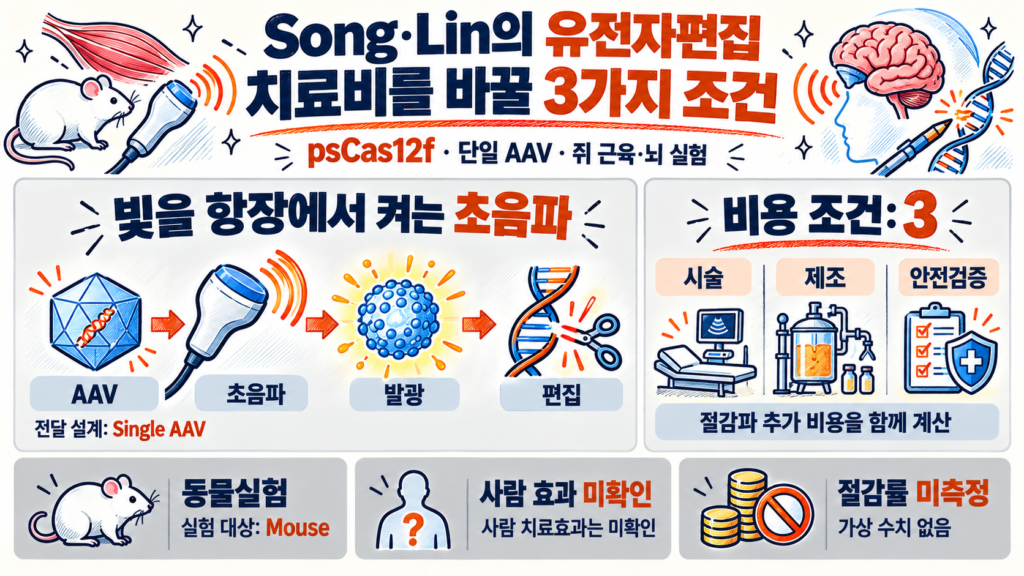
스탠퍼드대 마이클 Z. 린(Michael Z. Lin) 교수와 제1저자 Daesun Song 박사 연구진이 빛과 초음파로 작동 위치를 제어하는 psCas12f 유전자편집 기술을 발표했습니다. 편집 장치와 표적을 안내하는 RNA를 단일 AAV 전달체 하나에 담고, 쥐의 근육과 뇌 일부에서 편집을 유도한 연구입니다. 남는 질문은 돈입니다. 시술과 제조, 안전검증 가운데 어디가 실제로 싸지는지에 따라 이 기술의 값이 갈립니다. 출처: Stanford Bio-X — 연구진과 쥐 실험 출처: Song·Wu의 연구 설명 — 연구자 직접 공개
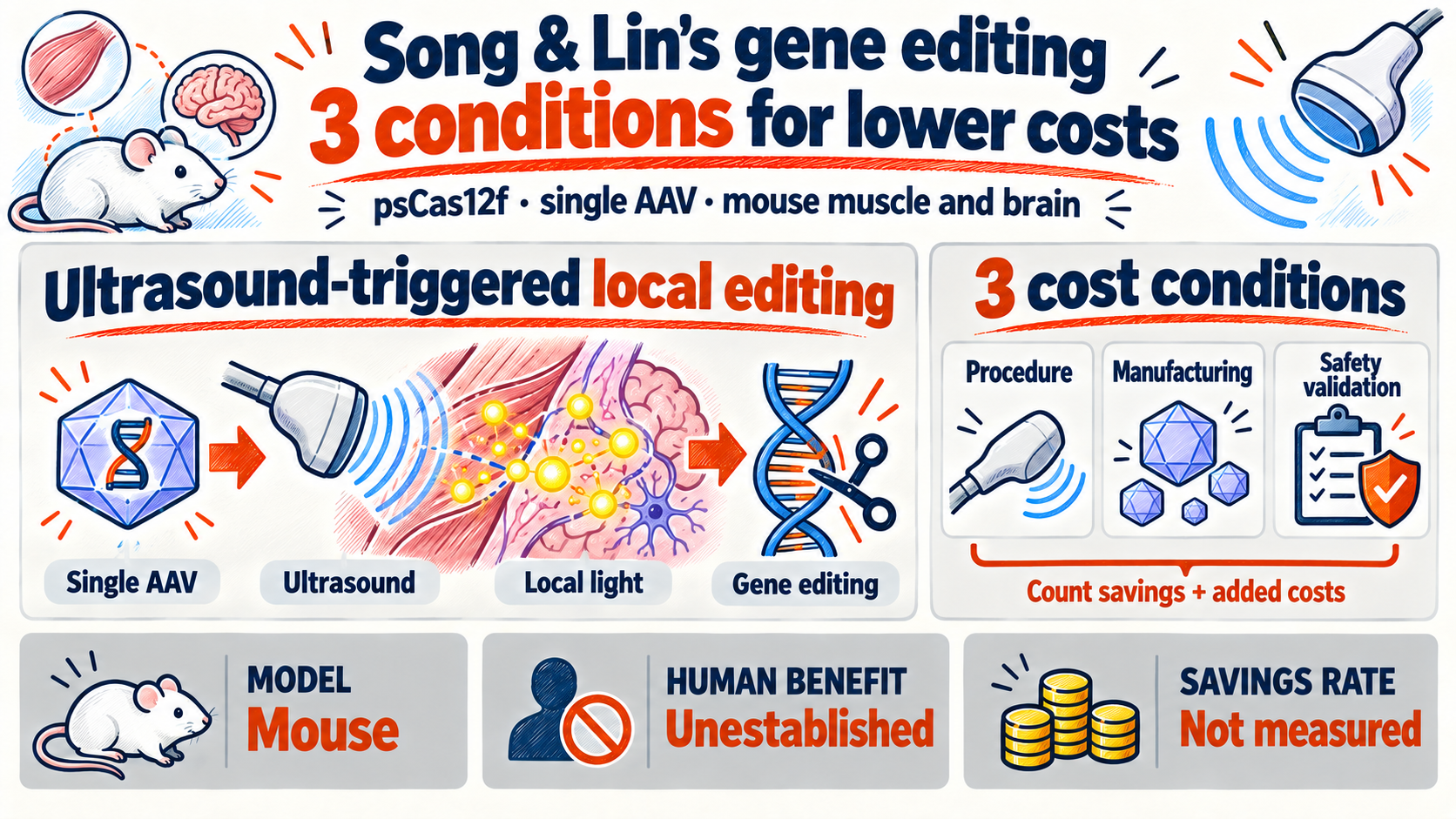
Stanford professor Michael Z. Lin and first author Daesun Song have reported psCas12f, a gene-editing system controlled with light and ultrasound. The editor and its guide RNA fit within a single AAV vector design, and the team demonstrated localized editing in mouse muscle and brain. The open question is cost. What this technology is worth depends on which of three things actually gets cheaper: the procedure, the manufacturing, or the safety testing. Source: Stanford Bio-X — 연구진과 쥐 실험 Source: Song·Wu의 연구 설명 — 연구자 직접 공개
논문은 2026년 9월 28일 Cell에 온라인으로 게재됐고, Nature는 10월 2일 연구 하이라이트로 소개했습니다. 반가운 진전이지만 지금 확인된 것은 동물에서 편집 위치를 제어할 수 있다는 사실입니다. 사람의 병을 고쳤다거나 의료비가 줄었다는 결과는 아직 없습니다. 출처: Nature Research Highlight — 2026-10-02 출처: Addgene — 논문 및 공개 플라스미드
린 연구실과 KAIST에서 온 제1저자
린 연구실은 빛으로 단백질의 작동을 켜고 끄는 방법을 오래 연구해 왔습니다. 연구실 기록에는 2017년 광스위치 Cas9 연구가 남아 있습니다. 이번 psCas12f는 같은 질문을 더 작은 편집 장치와 몸속 깊은 부위로 밀고 간 작업으로 읽힙니다. 출처: Lin Lab — 이전 연구와 Song 이력
Song 박사는 2021년 KAIST에서 린 연구실로 방문 박사후연구원으로 합류했습니다. 본인이 이번 연구를 소개한 글에서는 린 교수의 지도와 궈쑹 훙(Guosong Hong) 교수와의 협업을 함께 꼽았습니다. 훙 교수와의 협업이 집속 초음파와 기계발광을 편집 플랫폼에 붙이는 대목으로 이어집니다. 출처: Song·Wu의 연구 설명 — 연구자 직접 공개 출처: Lin Lab — 이전 연구와 Song 이력
공동저자 Xiang Wu 역시 초음파로 빛을 일으켜 편집기를 켜는 협업을 소개했습니다. Stanford Bio-X는 Marigold Malinao, Sa Cai, Michael Westberg, Hanlee Ji의 참여도 확인했습니다. 단백질 설계에 재료공학과 초음파 기술이 붙은 연구라는 뜻입니다. 다만 공개된 소개 글만으로는 각자의 실험 분담까지 알 수 없습니다. 출처: Stanford Bio-X — 연구진과 쥐 실험 출처: Song·Wu의 연구 설명 — 연구자 직접 공개
빛은 깊이 닿지 않는데, 초음파는 어떻게 편집기를 켤까
유전자편집은 DNA의 특정 위치를 찾아 바꾸는 기술입니다. 여기서 Cas12f는 DNA를 자르는 작은 단백질이고, 가이드 RNA는 어느 위치를 자를지 안내하는 역할입니다. 린 교수와 Song 박사가 만든 psCas12f는 여기에 빛으로 활성을 제어하는 기능을 더했습니다. 편집기를 몸에 넣은 뒤에도 언제, 어디서 작동할지 조절하려는 설계입니다. 출처: Song·Wu의 연구 설명 — 연구자 직접 공개 출처: Addgene — 논문 및 공개 플라스미드
문제는 빛입니다. 빛은 조직에 부딪히면 금방 흩어져 몸속 깊은 곳까지 닿지 않습니다. 훙 교수와의 협업에서는 초음파를 한곳에 모으는 집속 초음파와, 기계적 자극을 받으면 빛을 내는 입자를 결합했습니다. 몸 밖에서 초음파를 쏘면 표적 부위에서 빛이 만들어지고, 그 빛이 광감응 편집기를 켜는 구조입니다. 초음파가 직접 DNA를 고치는 것은 아닙니다. 출처: Song·Wu의 연구 설명 — 연구자 직접 공개
-
1
AAV 전달
편집기·가이드 RNA 유전정보
-
2
집속 초음파
원하는 영역에 자극
-
3
기계발광
입자가 빛을 방출
-
4
psCas12f 활성화
표적 부위 편집 유도
이 구조의 의미는 전달한 위치와 작동시킬 위치를 따로 정할 여지가 생겼다는 데 있습니다. 전달체가 닿은 세포 가운데 원하는 부위에서만 편집을 켤 수 있다면, 조직을 가려 치료하는 선택지가 늘어납니다. 근데 초음파를 모은 영역 안에도 여러 종류의 세포가 섞여 있습니다. 공간을 고르는 일과 병든 세포만 고르는 일은 같은 말이 아닙니다.
단일 AAV가 푼 문제와 쥐 실험이 남긴 질문
AAV는 유전정보를 세포로 운반하는 데 쓰는 바이러스 기반 전달체입니다. 담을 수 있는 정보량이 정해져 있어서 편집 장치가 크면 설계가 꼬입니다. Song 박사가 설명한 핵심은 작은 광감응 편집기와 가이드 RNA를 AAV 하나의 설계에 함께 담았다는 점입니다. 이 논문의 관련 유전자 구성체는 Addgene에도 공개돼 있습니다. 출처: Song·Wu의 연구 설명 — 연구자 직접 공개 출처: Addgene — 논문 및 공개 플라스미드
여기서 ‘단일’은 환자에게 바이러스 입자를 하나만 넣는다는 뜻도, 주사 한 번으로 치료가 끝난다는 뜻도 아닙니다. 구성요소를 여러 전달체에 나눠 담는 설계와 비교해, 같은 세포에 여러 전달체가 함께 도착해야 하는 부담을 줄일 수 있다는 의미입니다. 투여량이나 생산 원가는 이 표현만으로 계산되지 않습니다.
린 교수와 Song 박사의 결과는 쥐의 표적 골격근과 뇌 영역에서 편집이 일어났다는 확인입니다. 사람에게 필요한 치료 수준의 효과와는 다른 층위의 이야기입니다. 이 글은 Cell 전문과 보충자료에 접근할 수 없어 기관 발표, 저자의 직접 설명, 연구 도구 등록 정보를 교차 확인했습니다. 편집률과 동물 수, 비표적 편집률 같은 구체적 수치는 확인하지 못해 싣지 않았습니다. 출처: Stanford Bio-X — 연구진과 쥐 실험 출처: Addgene — 논문 및 공개 플라스미드
확인한 결과
단일 AAV 설계
전달
활성화 · 빛·초음파 제어
대상 · 쥐 골격근·뇌 영역
확인되지 않은 임상 가치
사람의 질병 개선
효과
안전 · 장기·전신 안전성
경제성 · 총치료비 절감
구분할 것이 하나 더 있습니다. 편집기의 활성을 끄는 스위치는 이미 바뀐 DNA를 되돌리는 스위치가 아닙니다. 원하는 영역에서 잘 켜지는 성능만큼, 켜지 않아야 할 때 새는 편집과 장기 영향을 확인하는 일이 중요합니다.
치료비를 바꿀 3가지 조건
비용으로 읽으려면 비교 대상을 먼저 정해야 합니다. FDA가 2023년 12월 승인한 Casgevy는 환자의 조혈모세포를 몸 밖에서 편집해 다시 넣는 치료이고, 그 전에 고용량 화학요법을 거칩니다. 절차가 복잡한 치료이지만 이번 근육·뇌 편집 실험과는 대상 질환도, 치료 목적도 다릅니다. psCas12f가 Casgevy를 대체한다고 읽으면 비교의 축이 어긋납니다. 출처: FDA — Casgevy 승인 당시 치료 절차
첫 번째 조건은 사람에게서 침습 시술을 덜 하면서도 필요한 치료효과가 나오는 것입니다. 빛을 넣기 위해 장치를 심는 과정을 피할 수 있다면 수술실 사용과 회복, 합병증 관리 부담이 줄어듭니다. 반대로 영상으로 위치를 잡고 초음파를 쬐는 시간이 길거나 반복 방문이 필요하면 절감액은 그만큼 깎입니다. 이번 논문이 측정한 항목이 아니라 앞으로 비교해야 할 항목입니다.
두 번째 조건은 제조가 단순해진 이득이 새로 붙는 구성품의 비용보다 커야 한다는 점입니다. 단일 AAV 설계는 분리된 벡터를 각각 생산하고 섞고 품질관리하는 공정을 줄일 여지가 있습니다. 대신 이 방식에는 빛을 내는 입자와 초음파 장비가 추가로 필요합니다. 벡터 개수를 세서 원가가 절반이 됐다고 말할 수 없는 이유입니다.
세 번째 조건은 안전성 개선이 검사와 추적 부담까지 줄일 만큼 입증되는 것입니다. FDA의 유전체편집 제품 가이던스는 설계, 제조와 시험, 비임상 안전성, 임상시험 설계를 모두 다룹니다. 국소 제어가 된다 해도 입자의 잔류와 배출, 원하지 않은 편집, 초음파가 조직에 주는 영향을 함께 검증해야 한다는 것이 이 글의 해석입니다. 초기 개발 단계에서는 검증할 항목이 오히려 늘어날 수도 있습니다. 출처: FDA — 유전체편집 제품 가이던스 (2024)
줄어들 가능성
삽입 시술·회복 부담
시술
제조 · 분리 벡터 관리 복잡성
안전 · 비의도적 편집 관련 부담
함께 계산할 항목
영상·초음파·반복 방문
시술
제조 · 발광 입자·제어 성능 시험
안전 · 입자·초음파·장기 추적 검증
결국 비교할 숫자는 약값 하나가 아닙니다. 같은 치료효과를 얻기까지 드는 벡터·입자 제조비, 시술비, 안전성 검사와 추적비, 추가 치료비를 모두 합쳐야 합니다. 환자와 보호자의 이동과 회복 시간까지 줄어든다면 청구서에 잡히지 않는 편익도 생깁니다. 절감률을 제시할 근거는 아직 없습니다.
초음파를 다시 쬐는 것과 AAV를 다시 넣는 것은 다릅니다
Song 박사의 설계에서 자연스럽게 따라오는 질문은, 몸속에 이미 들어간 편집기를 나중에 다시 켤 수 있느냐는 것입니다. 초음파를 다시 쬐는 일과 AAV를 다시 투여하는 일은 전혀 다른 문제입니다. 편집 장치가 얼마나 남아 있는지, 발광 입자를 더 넣어야 하는지, 추가 편집이 임상적으로 필요한지를 각각 확인해야 합니다.
FDA는 AAV에 대한 면역반응과 중화항체가 유전자 전달을 방해할 수 있다고 설명합니다. 비침습 제어가 가능해졌다고 해서 이 전달 장벽이 사라지는 것은 아니고, 재시술 비용 절감도 자동으로 따라오지 않습니다. 출처: FDA — AAV 면역원성 연구
한국 기업의 기회는 생산량보다 검증 능력에 있습니다
이 연구와 이어서 볼 만한 산업 쪽 변화는 유전자치료제 위탁개발·생산, 즉 CDMO의 제조·분석 서비스입니다. SK pharmteco는 2026년 6월 23일 AAV를 포함한 SKyvec 플랫폼 출시를 발표했습니다. 회사가 밝힌 제공 거점은 미국과 유럽입니다. 국내 생산설비 확충이나 이번 연구의 수주 실적으로 바꿔 읽을 근거는 없습니다. 출처: SK pharmteco — SKyvec 출시 (2026-06-23)
이런 기업이 psCas12f 같은 접근에서 기회를 얻으려면, 생산한 벡터가 일정하게 작동한다는 자료를 내놓아야 합니다. ‘자극이 없을 때는 얼마나 조용한가’, ‘자극을 주면 충분히 편집되는가’를 재는 시험이 그래서 중요해집니다. 발광 입자 제조사와 초음파 장비 업체도 생물학적 효과를 함께 검증하는 협업으로 들어올 수 있습니다. 상용화가 진전될 경우의 전망입니다.
가까운 활용처는 치료제 매출보다 연구 도구 쪽입니다. Song 박사와 린 교수 연구진의 구성체는 Addgene에 등록돼 다른 연구실의 후속 검증을 받을 수 있습니다. 특정 부위의 유전자만 바꿔 기능을 살피는 실험이 쉬워지면 준비와 반복 검증의 생산성이 올라갑니다. 연구 재료 공개가 임상용 품질이나 상업적 사용권까지 뜻하지는 않습니다. 출처: Addgene — 논문 및 공개 플라스미드
기존 산업을 얼마나 대체할지는 아직 판단하기 어렵습니다. 특정 질환에서 기존 치료와 비교해 효과가 나오는지, 사람 크기의 조직에서도 원하는 부위만 제어되는지, 치료 과정 전체가 더 간단해지는지를 차례로 봐야 합니다. 린 교수와 Song 박사가 내놓은 것은 그 비교를 시작할 새 도구입니다. 치료비의 답은 그 도구가 환자에게서 어떤 과정을 덜어 주는지에서 나올 겁니다.
이 글은 공개된 연구 자료와 산업 맥락을 정리한 것으로, 특정 종목의 매수·매도 추천이 아닙니다.
편집 위치를 고르는 기술의 가치는 환자의 치료 과정을 얼마나 줄여 주는지로 확인해야 합니다.
출처와 참고 링크
The paper appeared online in Cell on September 28, 2026, followed by a Nature research highlight on October 2. The advance is evidence for controlling where editing occurs in animals. It is not evidence of a human cure or of measured healthcare savings. Source: Nature Research Highlight — 2026-10-02 Source: Addgene — 논문 및 공개 플라스미드
The Lin lab and a first author from KAIST
Lin’s lab has a long history of engineering proteins that switch on and off with light. Its research record includes a photoswitchable Cas9 project in 2017. The new work pushes the same question toward a smaller editor and deeper tissue. Source: Lin Lab — 이전 연구와 Song 이력
Song joined the Lin lab as a visiting postdoctoral scholar from KAIST in 2021. In his own account of the paper, he credits both Lin’s mentorship and the collaboration with Guosong Hong. That collaboration is what connects focused ultrasound and mechanoluminescence to the editing platform. Source: Song·Wu의 연구 설명 — 연구자 직접 공개 Source: Lin Lab — 이전 연구와 Song 이력
Coauthor Xiang Wu has also described the collaboration on ultrasound-triggered light activation. Stanford Bio-X names Marigold Malinao, Sa Cai, Michael Westberg and Hanlee Ji among the participants. That mix tells you the project joined protein engineering to materials and ultrasound work. The public accounts do not establish each author’s experimental assignments. Source: Stanford Bio-X — 연구진과 쥐 실험 Source: Song·Wu의 연구 설명 — 연구자 직접 공개
Why psCas12f needs ultrasound to switch on deep inside the body
Gene editing changes DNA at a selected location. Cas12f is a compact DNA-cutting protein, while a guide RNA directs it to its target. Lin and Song added light-dependent control to create psCas12f. The point is to decide when and where the editor works after it has already been delivered. Source: Song·Wu의 연구 설명 — 연구자 직접 공개 Source: Addgene — 논문 및 공개 플라스미드
Light is the obstacle. It scatters as soon as it meets tissue and does not travel far below the surface. The collaboration with Hong pairs focused ultrasound with particles that emit light under mechanical stimulation. Ultrasound sent from outside the body generates light at the target, and that local light switches on the photoswitchable editor. Ultrasound itself does not rewrite DNA. Source: Song·Wu의 연구 설명 — 연구자 직접 공개
-
1
AAV delivery
Genetic instructions for editor and guide RNA
-
2
Focused ultrasound
Stimulation at a selected region
-
3
Mechanoluminescence
Particles emit light
-
4
psCas12f activation
Editing induced in the target region
The value here is room to separate where a vector goes from where it acts. If editing can be switched on only in a chosen region among the cells a vector reaches, there are more ways to treat one tissue and spare another. But an ultrasound focus still contains a mix of cell types. Selecting a region is not the same thing as selecting only diseased cells.
What single-AAV delivery solves — and what the mouse result leaves open
AAV is a virus-based vehicle used to carry genetic instructions into cells. Its cargo space is fixed, so a bulky editing system complicates the design. What Song describes is fitting the compact photoswitchable editor and its guide RNA into one AAV architecture. Related constructs from the paper are available through Addgene. Source: Song·Wu의 연구 설명 — 연구자 직접 공개 Source: Addgene — 논문 및 공개 플라스미드
“Single” here does not mean one viral particle per patient, nor a guaranteed one-shot treatment. Against designs that split components across vectors, it may ease the requirement that several vectors arrive at the same cell. Dose and production cost do not follow from the word alone.
Lin and Song’s result confirms editing in targeted mouse skeletal muscle and brain regions. A therapeutic effect in humans sits at a different level entirely. Full-text and supplementary access was unavailable for this article, so the reporting was cross-checked against the institution, the authors’ own accounts and the deposited research tools. Editing percentages, animal counts and off-target rates could not be verified and are therefore omitted. Source: Stanford Bio-X — 연구진과 쥐 실험 Source: Addgene — 논문 및 공개 플라스미드
Reported evidence
Single-AAV design
Delivery
Activation · Light and ultrasound control
Model · Mouse muscle and brain regions
Unestablished clinical value
Human disease benefit
Benefit
Safety · Long-term and systemic safety
Economics · Lower total treatment cost
One more distinction matters. A switch that turns the editor off is not an undo button for DNA that has already been changed. Leakage when the switch is off, and effects that persist, deserve as much attention as clean activation in the intended region.
Three conditions for lower treatment costs
An economic comparison needs a defined alternative. Casgevy, approved by the FDA in December 2023, edits a patient’s blood stem cells outside the body and returns them after high-dose chemotherapy. It is a complex pathway, but its target diseases and treatment goals differ from this muscle-and-brain experiment. Reading psCas12f as a Casgevy replacement lines up the wrong comparison. Source: FDA — Casgevy 승인 당시 치료 절차
The first condition is reaching the needed clinical effect in humans with less invasive intervention. Avoiding an implanted light-delivery device would cut operating-room use, recovery and complication management. Long imaging and ultrasound sessions, or repeat visits, shave the savings back down. These are items for future comparison, not costs the paper measured.
The second condition is that simpler manufacturing outweighs the components it adds. One AAV architecture can trim the separate production, mixing and quality control that split-vector systems require. In exchange, this approach needs light-emitting particles and ultrasound equipment. That is why counting vectors cannot establish that costs have halved.
The third condition is a safety advantage proven well enough to lighten the testing and follow-up burden. FDA genome-editing guidance covers design, manufacturing and testing, nonclinical safety and trial design. Even with local control, our reading is that particle persistence and clearance, unwanted editing, and ultrasound effects on tissue all have to be assessed together. In early development that list of checks may get longer, not shorter. Source: FDA — 유전체편집 제품 가이던스 (2024)
Potential reductions
Implantation and recovery burden
Procedure
Manufacturing · Split-vector complexity
Safety · Burden from unintended editing
Costs to include
Imaging, ultrasound and repeat visits
Procedure
Manufacturing · Particles and control-function assays
Safety · Particle, ultrasound and follow-up testing
The number that matters is not the drug price alone. It is the full cost of reaching a comparable outcome: vector and particle production, the procedure, safety testing and follow-up, and any further treatment. If travel and recovery time fall for patients and caregivers, there are benefits no invoice captures. There is still no basis for quoting a savings percentage.
Repeat activation is not repeat dosing
Song’s design raises an obvious follow-up: can an editor already delivered to the body be switched on again later? Reapplying ultrasound and administering another AAV dose are entirely separate problems. How much editor remains, whether more particles are needed, and whether further editing is clinically warranted each have to be established.
The FDA explains that immune responses and neutralizing antibodies against AAV can interfere with gene delivery. External activation does not remove that delivery barrier, and lower costs for repeat treatment do not follow automatically. Source: FDA — AAV 면역원성 연구
For Korean companies, the opening is in validation, not capacity
The adjacent industrial story is contract development and manufacturing for gene therapies — CDMO production and analytical services. SK pharmteco announced its SKyvec platform, including AAV services, on June 23, 2026. The company identifies US and European locations for it. Nothing there supports reading it as new domestic Korean capacity or as a contract tied to this paper. Source: SK pharmteco — SKyvec 출시 (2026-06-23)
To serve an approach like psCas12f, a manufacturer would have to show that the vectors it produces behave consistently. Assays for two things become valuable: how quiet the system stays without stimulation, and how much it edits once stimulated. Particle makers and ultrasound-device suppliers could be drawn into the same biological validation work. All of this assumes commercialization actually advances.
The nearer-term use is research tools rather than therapeutic revenue. Constructs deposited by the team are available for other laboratories to test. If perturbing a gene in one region gets easier, preparation and replication both get more productive. Open research materials still do not confer clinical-grade quality or commercial rights. Source: Addgene — 논문 및 공개 플라스미드
How much of the existing industry this displaces is not yet knowable. The order of questions is clear: benefit against standard care in a specific disease, regional control in human-scale tissue, and a genuinely simpler treatment pathway. What Lin and Song have supplied is a new tool for asking them. The answer on treatment cost will come from which burdens that tool actually removes for patients.
This article summarizes published research and its industrial context. It is not a recommendation to buy or sell any security.
The value of spatial control must be tested against the treatment burden it removes for patients.
Sources and further reading
이 글은 정보 제공 목적이며, 특정 자산의 매수·매도를 권유하지 않습니다.
For information only — this is not a recommendation to buy or sell any asset.
댓글Comments 0