플라스마 암모니아 합성 — 85시간 작동, 비료값은 내려갈까Plasma ammonia synthesis — 85 hours running, but cheaper fertilizer?
플라스마 암모니아 합성 촉매가 대기압에서 85시간 연속 작동했습니다. 비료 원료를 작은 장치로 만드는 데 도움이 될 연구지만, 비료값이 곧 내려간다는 뜻은 아닙니다. 새 촉매가 해결한 문제와 아직 남은 전력비를 함께 보면, 이 기술이 어느 시장부터 노릴 수 있을지 보입니다. Nature Communications 연구
Plasma ammonia synthesis has a new catalyst that operated continuously for 85 hours at atmospheric pressure. That is encouraging for smaller production systems. It does not establish cheaper fertilizer. The useful question is how a materials advance could change production costs—and which costs it leaves unresolved. Nature Communications paper
암모니아는 질소와 수소가 결합한 물질입니다. 질소비료의 출발 원료이므로 제조비가 달라지면 농업까지 영향을 받을 수 있습니다. 국제에너지기구(IEA)의 2021년 로드맵은 암모니아의 약 70%가 비료에 쓰인다고 설명합니다. 이 비중은 산업 구조를 보여 주는 과거 자료이며, 2026년 시장을 새로 집계한 수치는 아닙니다. IEA 암모니아 로드맵
이번에 읽을 논문은 9월 10일 공개된 Niu 연구진의 Nature Communications 연구입니다. 동료심사를 마친 조기 공개본으로, 최종 편집은 남아 있습니다. 실험 결과와 기업 발표, 이를 바탕으로 한 비용 계산은 근거가 다르므로 본문에서 표시해 두었습니다. 논문 및 공개 상태
플라스마 암모니아 합성은 무엇을 바꾸려 하나요?
공기 중 질소는 두 원자가 강하게 붙어 있어 다른 물질로 바꾸기 어렵습니다. 기존 하버·보슈 공정은 촉매와 높은 온도·압력을 이용해 질소와 수소를 반응시킵니다. 촉매는 반응을 더 쉽게 일어나게 하는 물질입니다. 이미 대량생산 경험이 쌓인 공정이므로, 신기술은 압력 하나만 낮추는 것으로 경쟁하기 어렵습니다. 기존 산업과 전환 경로: IEA
플라스마는 전기를 가해 전자 등이 활발히 움직이는 상태입니다. 비열 플라스마에서는 전자가 높은 에너지를 갖더라도 기체 전체가 같은 고온이 될 필요는 없습니다. 이 전자가 반응을 돕도록 하고, 촉매 표면에서 암모니아가 만들어지도록 유도하는 접근입니다. 따라서 낮은 온도나 대기압이라는 표현을 전기가 적게 든다는 뜻으로 읽으면 곤란합니다.
이번 실험도 질소와 수소 가스를 따로 공급했습니다. 공기와 물을 넣으면 완제품 비료가 나오는 장치는 아닙니다. 수소를 만드는 앞 공정과 암모니아를 모으는 뒤 공정은 사업성을 평가할 때 별도로 붙여야 합니다. 원문: 실험 가스와 반응기 조건
기존 하버·보슈
높은 온도·압력과 촉매
반응을 돕는 방법
사업 기반 · 축적된 대량생산 경험
비용 평가 · 원료·반응·회수·설비
이번 플라스마 연구
전기 방전과 새 백금 촉매
반응을 돕는 방법
시험 조건 · 대기압, 질소·수소 별도 공급
남은 평가 · 공정 전체의 제품 원가
백금의 양보다, 원자가 놓인 자리를 바꿨습니다
새로움은 촉매를 만드는 방법에 있습니다. 연구진은 서로 섞이지 않는 두 액체의 경계에서 플라스마를 이용했습니다. 질소가 들어간 탄소 구조에 흩어진 백금 원자와 작은 백금 집합체를 함께 붙잡아 두었습니다. 열처리 중 질소가 빠져나가거나 금속이 뭉치는 문제를 줄이려는 설계입니다. 논문: 촉매 제조의 새로움
연구진이 제안한 설명은 역할 분담입니다. 고립된 백금 원자는 질소의 반응을 돕고, 작은 집합체는 수소를 공급하는 데 기여합니다. 이는 분광 측정과 동위원소 실험, 계산을 종합한 반응 경로 해석입니다. 표면에서 벌어지는 모든 과정을 직접 촬영해 확정했다는 뜻은 아닙니다. 논문: 제안된 협동 반응 경로
공학적으로 중요한 이유는 촉매를 평가하는 질문이 달라지기 때문입니다. 금속을 얼마나 넣었는지만 볼 것이 아니라, 반응을 맡는 자리가 어떻게 배치되고 운전 중 얼마나 유지되는지도 봐야 합니다. 이런 배치를 반복해서 만들 수 있다면 촉매 제조업체의 품질 관리에도 새로운 기준이 생길 수 있습니다. 여기부터는 실험 결과를 산업에 연결한 해석입니다.
농도는 높아졌습니다. 85시간은 어디까지 보여 줬을까요?
인가 전압 9kV에서 새 촉매의 출구 암모니아 농도는 2.13%, 비교에 쓴 상용 백금·탄소 촉매는 0.48%였습니다. 같은 전압과 가스 유량에서 제품 농도가 높아진 결과입니다. 다만 방전전력과 백금 함량까지 동일한 비교는 아니므로, 이를 그대로 에너지 효율이나 생산원가의 개선 배수로 바꿀 수는 없습니다. 원문 그림 4a와 실험 설명
출처: 논문 그림 4a. 같은 인가 전압·유량. 방전전력·백금 함량은 다름. 순도 규격이나 원가 절감률 비교가 아닙니다.
제품 농도가 높아지는 것은 반가운 변화입니다. 같은 양의 암모니아를 얻기 위해 뒤 공정이 다뤄야 할 기체량을 줄일 여지가 있기 때문입니다. 그래도 실험에서 나온 혼합기체는 판매용 암모니아와 다릅니다. 회수율과 순도, 남은 가스의 재사용에 필요한 에너지를 측정해야 실제 절감액이 나옵니다.
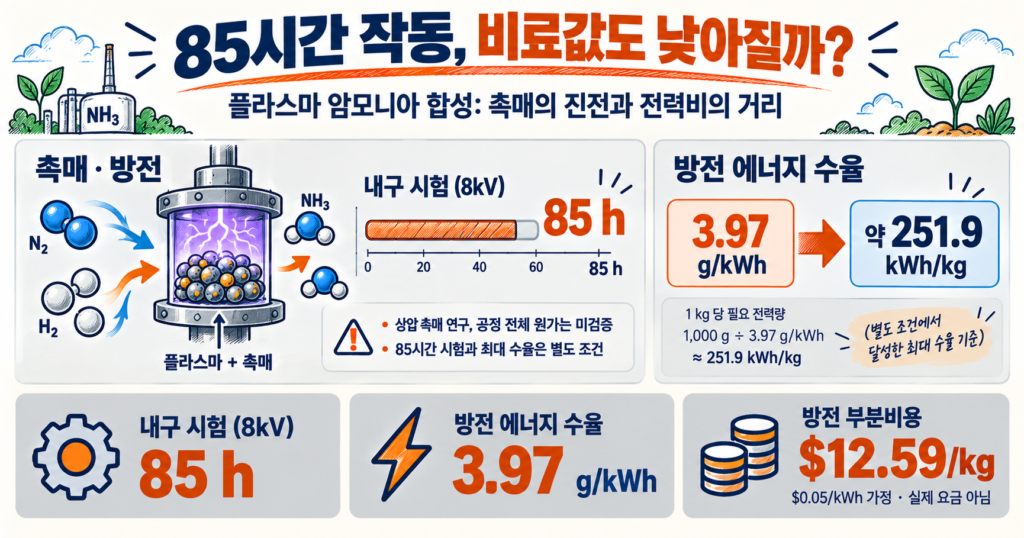
85시간 연속 운전은 별도로 8kV에서 확인했습니다. 최대 에너지 수율을 낸 조건으로 85시간을 보장했다는 뜻은 아닙니다. 구매자 입장에서 다음 질문은 분명합니다. 반복적으로 켰다 끄거나 원료에 불순물이 섞였을 때도 성능이 유지되는지, 교체와 세척 때문에 멈추는 시간은 얼마나 되는지입니다. 원문 그림 4h: 내구성 시험 조건
3.97g/kWh를 전력비로 바꾸면 보이는 것
논문이 보고한 에너지 수율은 방전 에너지 1kWh당 암모니아 3.97g입니다. 에너지 수율은 일정 에너지로 제품을 얼마나 만드는지를 나타냅니다. 보충자료의 계산식에서 분모는 방전전력입니다. 공장 전기계량기에 찍히는 전체 소비량과는 다릅니다. 보충자료 Note 2, 식 S6
이 수치를 1kg 기준으로 뒤집으면 1,000÷3.97, 약 251.9kWh가 됩니다. 전력단가를 kWh당 0.05달러로 가정하면 방전에 해당하는 부분비용만 약 12.59달러/kg입니다. 논문의 생산원가 추정치가 아니라, 독자가 에너지 수율의 크기를 이해하도록 계산한 예시입니다.
가정 단가를 0.03달러, 0.05달러, 0.10달러로 바꾸면 각각 약 7.56달러, 12.59달러, 25.19달러/kg입니다. 현재 어느 지역의 전기요금이나 암모니아 시세를 인용한 값이 아닙니다. 실험 수율을 유지한다는 조건에서 전력단가의 영향을 보여 줍니다.
계산: (1,000÷3.97)×가정 단가. 총원가 아님. 수소·질소 제조, 전원 손실, 회수, 촉매·설비비 제외. 실제 요금·시세 아님.
이 계산에는 전원장치의 손실, 수소·질소 제조, 암모니아 회수, 백금 촉매와 설비 비용이 빠져 있습니다. 그러므로 총원가로 부르면 안 됩니다. 대기압 반응기의 장점이 있어도 제품 한 단위당 전력 사용량을 크게 개선해야 한다는 과제가 드러납니다.
기존 공정과 비교할 때도 주의가 필요합니다. IEA가 제시한 공장 에너지 지표에는 원료와 연료가 들어가며 순에너지 기준도 사용합니다. 이를 실험의 방전 에너지와 한 그래프에 놓고 효율이 몇 배라고 단정하면 계산 경계가 어긋납니다. 제대로 된 경쟁력 평가는 같은 순도의 제품을 같은 위치까지 공급하는 비용으로 해야 합니다. IEA: 공정 에너지와 기존 설비
비료 공장을 대체하기 전에 만날 경쟁자
기존 비료기업도 가만히 있지 않습니다. Yara의 2025년 연차보고서는 노르웨이 Herøya의 24MW 재생수소 실증시설이 가동 중이라고 설명합니다. 최대 가동 시 재생 암모니아 생산 능력은 연간 약 2만t입니다. 이미 그만큼을 생산했다는 실적과는 구분해야 합니다. Yara 2025 연차보고서
더 최근에는 9월 7일 네덜란드 Sluiskil 탄소포집 시설의 개소를 발표했습니다. 회사가 밝힌 능력은 암모니아 생산에서 나온 이산화탄소를 연간 최대 80만t 포집·액화하는 것입니다. 이 역시 실제 연간 처리 실적이 아닌 시설 능력입니다. 포집한 탄소는 Northern Lights가 운송·저장하는 구조입니다. Yara 9월 7일 시설 개소 발표
두 사례는 신생 플라스마 기술과 같은 기술이 아닙니다. 하나는 수소 공급을 바꾸고, 다른 하나는 배출 탄소를 처리합니다. 하지만 같은 고객과 투자예산을 두고 경쟁할 수 있습니다. 기존 설비를 활용하는 개선안이 있다면, 완전히 새로운 합성 장치는 더 큰 절감이나 다른 입지의 이점을 보여 줘야 합니다.
따라서 이 논문만으로 기존 암모니아 공장의 대체 시점이나 특정 기업의 매출 증가율을 예상하기는 어렵습니다. 투자 판단에 필요한 정보는 실험 최고값보다 판매 가능한 제품의 지속 생산량, 장비 가격, 전력 계약과 고객의 구매 의사에 가깝습니다. 여기서는 특정 종목의 매수·매도를 권하지 않습니다.
큰 공장 대신, 작은 장치가 먼저 들어갈 곳
가능성을 찾는다면 소규모 현장 생산부터 생각해 볼 수 있습니다. 큰 공장에서 멀리 떨어진 사용처는 제품 가격에 운송·저장 비용까지 지불합니다. 작은 장치가 그 일부를 줄일 수 있다면, 공장 출하가격만으로는 보이지 않는 경쟁 여지가 생깁니다. 이는 논문이 검증한 사업 모델이 아니라 조건부 전망입니다.
다만 전기가 쌀 때만 돌린다고 모든 문제가 풀리지는 않습니다. 운전 시간이 줄면 설비값을 나눠 부담할 제품량도 줄어듭니다. 여기에 수소 공급과 제품 저장까지 맞아야 합니다. 저렴한 전력, 충분한 가동시간, 가까운 수요처가 함께 있는 입지가 필요한 이유입니다.
-
1
입지 조건
저렴한 전기·수소와 가까운 수요
-
2
공정 성능
충분한 가동시간·회수율·촉매 수명
-
3
고객 경제성
운송비 절감까지 합친 공급비 비교
그 조건이 충족된다면 촉매와 전원장치뿐 아니라 가스 회수 모듈, 품질 측정, 정비 서비스에 수요가 생길 수 있습니다. 생산성이 높아지는지도 같은 기준으로 봐야 합니다. 순간적인 반응 속도가 빨라져도 세척과 교체 때문에 자주 멈춘다면 연간 출하량은 늘지 않습니다. 고객에게 의미 있는 지표는 장치 한 대가 일 년 동안 공급한 규격 제품의 양입니다.
한국 독자에게도 이 관점이 유용합니다. 비료의 원료 공급원을 늘리는 전략과 원료를 만드는 기술을 바꾸는 전략은 서로 다릅니다. 칼륨비료의 조달 문제는 별도 글에서 다뤘습니다. 칼륨은 이번 질소비료와 다른 영양소이므로 암모니아 제조기술로 대신할 수는 없습니다. 관련 글: 칼륨비료 조달과 가격의 조건
다음 발표에서는 촉매보다 공정 전체를 보겠습니다
후속 연구에서 확인하고 싶은 것은 분명합니다. 원료부터 제품 회수까지 합친 전력 소비, 더 큰 장치에서의 반복 운전, 촉매 교체비를 포함한 제품 단가입니다. 특히 장치 크기를 키운 뒤에도 지금의 촉매 구조와 반응 성능을 함께 유지할 수 있어야 합니다.
이번 연구는 낮은 압력에서 촉매의 역할을 정교하게 나눌 수 있다는 가능성을 보여 줬습니다. 제 판단으로는 당장의 비료값보다, 이 성과를 전력 효율과 제품 회수 개선으로 이어 갈 수 있는지가 더 중요한 관전 지점입니다. 85시간의 실험이 공장으로 이어지려면, 고객이 사 갈 암모니아 1kg의 전체 청구서가 작아져야 합니다.
새 촉매가 비료 시장에 닿으려면, 고객에게 공급할 암모니아 1kg의 전체 비용이 낮아져야 합니다.
출처와 참고 링크
- Niu et al., Nature Communications (2026), DOI: 10.1038/s41467-026-77160-5
- Nature Communications accepted manuscript, pp. 9–11 / Fig. 4
- Supplementary Information, Note 2 / Tables S4–S5
- IEA, Ammonia Technology Roadmap (2021)
- IEA, Executive Summary (2021)
- Yara Annual Report 2025
- Yara, Sluiskil carbon capture inauguration (2026-09-07)
Ammonia combines nitrogen and hydrogen and is a starting material for nitrogen fertilizers. Changes in its production costs can therefore reach agriculture. The International Energy Agency’s 2021 roadmap put fertilizer use at around 70% of ammonia demand. This is a dated industry reference, not a fresh measurement of the 2026 market. IEA ammonia roadmap
Niu and colleagues published the study in Nature Communications on September 10, 2026. It is a peer-reviewed article in press, awaiting final editing. Experimental findings, company announcements and the economic reasoning below have different evidential status; the cost scenarios are our calculations. Paper and publication status
What does plasma ammonia synthesis change?
Nitrogen molecules are difficult to convert because their two atoms are tightly bonded. Conventional Haber–Bosch production combines nitrogen and hydrogen over a catalyst at elevated temperature and pressure. A catalyst makes a reaction easier to accomplish. Decades of large-scale operating experience give this incumbent process an advantage that a lower-pressure reactor alone cannot erase. Incumbent production and transition pathways: IEA
In a nonthermal plasma, energetic electrons can help initiate chemistry without heating all the gas to the same high temperature. The aim is to combine that electrical activation with useful reactions at a catalyst surface. A mild bulk temperature describes the operating conditions; it does not tell us how much electricity is consumed per kilogram of product.
The experiment uses supplied nitrogen and hydrogen gases. An integrated plant would still need feedstock preparation and product recovery. Those operations must enter the business case even when the synthesis reactor operates at atmospheric pressure. Manuscript: feed gases and reactor conditions
Conventional Haber–Bosch
Elevated temperature, pressure and catalyst
Activation
Operating base · Established large-scale operation
Cost boundary · Feedstocks, synthesis, recovery, capital
This plasma study
Electrical discharge and a new Pt catalyst
Activation
Test conditions · Atmospheric pressure; supplied N₂ and H₂
Still to establish · Complete cost of saleable product
The advance is in how the platinum is arranged
The materials advance is a plasma-based preparation method at the boundary between two immiscible liquids. It stabilizes isolated platinum atoms together with small platinum clusters on nitrogen-containing carbon, addressing nitrogen loss and metal migration during conventional thermal preparation. Paper: catalyst preparation
The proposed mechanism assigns different roles to the isolated atoms and clusters in nitrogen activation and hydrogen supply. Spectroscopy, isotope experiments and calculations support this interpretation. It is a mechanistic proposal, rather than a direct observation of every surface reaction. Paper: proposed cooperative mechanism
The engineering implication is that catalyst qualification should examine the arrangement and persistence of active sites, not just the amount of metal purchased. If a manufacturer can reproduce a useful arrangement across batches, structural consistency becomes a potential source of value. That is an industrial inference, and achieving it at manufacturing scale remains a separate task.
Higher concentration, with a limited endurance demonstration
At 9 kV, outlet ammonia concentration was 2.13% with the new catalyst, versus 0.48% with the commercial platinum-on-carbon comparator. Applied voltage and gas flow matched; discharge power and platinum loading did not. This comparison does not establish a corresponding improvement in energy efficiency or production cost. Manuscript Figure 4a and experimental discussion
Source: Figure 4a. Same applied voltage and gas flow; discharge power and Pt loading differ. Not a cost or product-purity comparison.
A more concentrated outlet can potentially reduce the gas-handling burden for a given amount of ammonia. But an experimental product stream is not a saleable product. Recovery yield, purity and energy for handling unreacted gas must be measured before assigning a saving. Better reactor chemistry creates an opportunity for process design; it does not finish that design.
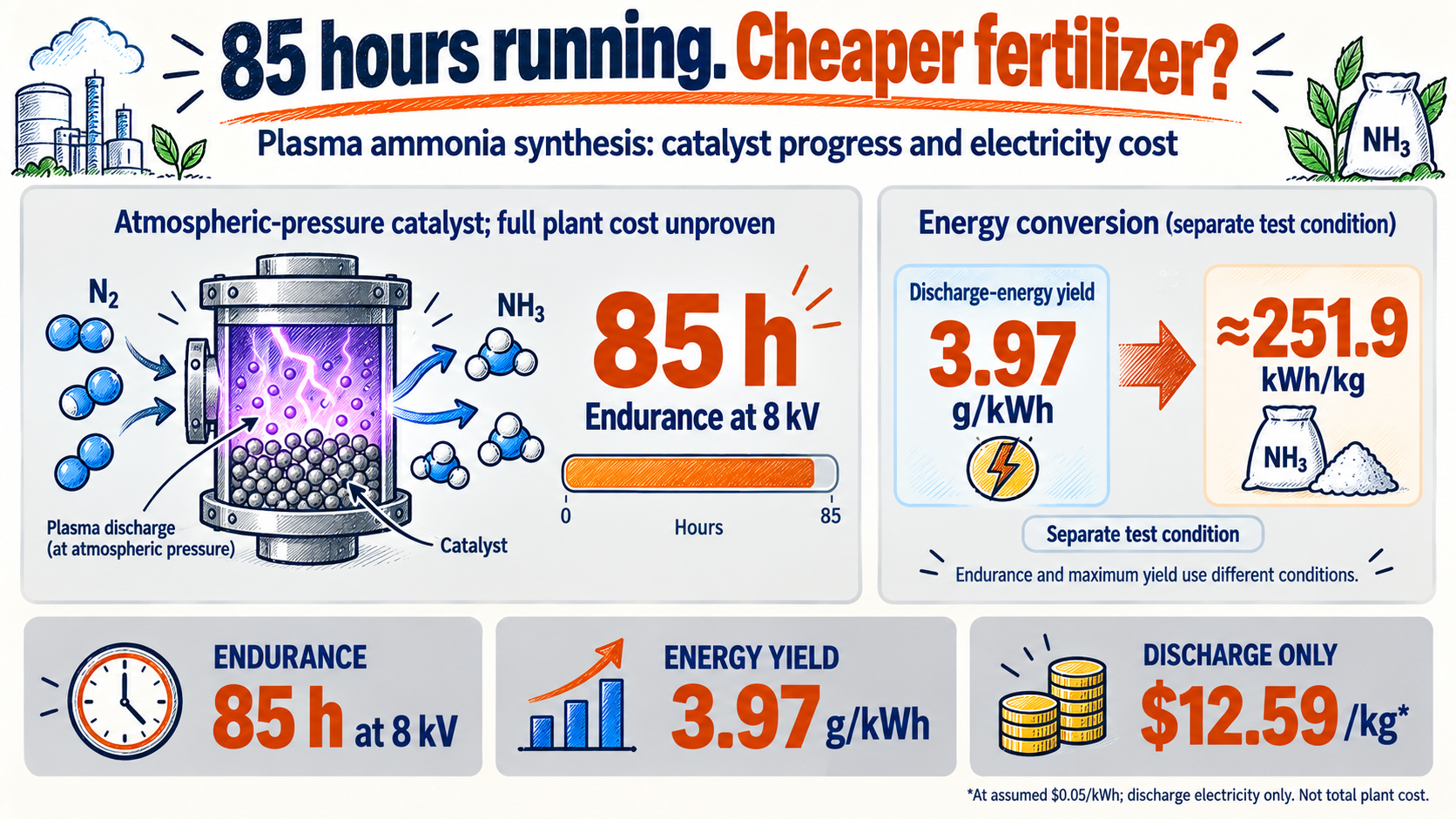
The 85-hour endurance test was conducted separately at 8 kV. It does not certify that duration at the maximum-energy-yield condition. A prospective buyer would next ask about repeated starts, feed impurities, cleaning and replacement downtime. Continuous laboratory operation answers only part of an equipment procurement question. Manuscript Figure 4h: endurance conditions
What 3.97 grams per kWh means for the electricity bill
The reported energy yield is 3.97 grams of ammonia per kWh of discharge energy. Supplementary Equation S6 explicitly uses discharge power in its denominator. This is a reactor metric, not a complete plant electricity-meter reading. Supplementary Note 2, Equation S6
Inverting the yield gives 1,000 ÷ 3.97, or approximately 251.9 kWh per kilogram. At an assumed electricity price of $0.05/kWh, the discharge-energy component would be about $12.59/kg. This is our illustrative calculation, not a techno-economic assessment reported by the authors.
Using assumed tariffs of $0.03, $0.05 and $0.10/kWh produces discharge-energy costs of approximately $7.56, $12.59 and $25.19/kg. These are scenarios, not quoted electricity tariffs or ammonia market prices. They hold the experimental yield constant to isolate the effect of electricity price.
Calculation: (1,000/3.97) × assumed tariff. Excludes feedstocks, power losses, recovery, catalyst and capital. Not total cost or market quotations.
The figures exclude power-supply losses, hydrogen and nitrogen production, ammonia recovery, catalyst replacement and capital costs. Adding these items would change the delivered cost. The calculation therefore exposes an engineering priority: improve output per unit of electrical energy while retaining the useful catalyst structure.
Comparisons with conventional plants need consistent boundaries. IEA plant energy figures incorporate feedstock and fuel and may use net-energy accounting. Dividing them directly into a laboratory discharge-energy figure would not provide a clean efficiency comparison. The commercial comparison should deliver the same product purity to the same location and account for all required equipment. IEA: plant energy and incumbent assets
The competitors are already changing their plants
Yara’s 2025 annual report describes its 24 MW renewable-hydrogen demonstration facility at Herøya as operational. It states that full capacity can support roughly 20,000 tonnes of renewable ammonia annually. Capacity is not evidence that this volume was actually produced. Yara Annual Report 2025
On September 7, 2026, Yara announced the inauguration of its Sluiskil carbon-capture facility. The company reports capacity to capture and liquefy up to 800,000 tonnes of CO₂ annually from ammonia production, with Northern Lights providing transport and storage. This is a capacity announcement, not a full year of verified capture. Yara September 7 inauguration announcement
Neither project uses the new plasma catalyst. One changes hydrogen supply; the other manages carbon emissions. Yet they can compete for the same customer budgets. When a producer can improve an existing asset, a new synthesis platform needs a compelling advantage in total cost, location or operating flexibility.
The paper cannot establish when existing ammonia plants might be displaced or how much a particular supplier’s revenue could grow. Commercial diligence needs sustained saleable output, equipment cost, power contracts and customer commitments. This analysis does not recommend buying or selling a security.
A first market could depend on location rather than scale
One conditional opportunity is smaller production close to users who face substantial transport and storage costs. A local unit could compete against delivered cost rather than a large plant’s gate price. This is a possible business model inferred from the technology, not one validated by the experiment.
Operating only during cheap-power hours introduces another trade-off: fewer running hours spread fixed equipment costs across less product. Hydrogen availability and product storage must also fit the operating schedule. A promising location would combine inexpensive electricity, sufficient utilization and reliable nearby demand.
-
1
Location
Affordable power and hydrogen; nearby users
-
2
Process performance
Adequate utilization, recovery and catalyst life
-
3
Customer economics
Compare delivered cost including avoided transport
If these conditions are met, demand could extend beyond catalysts and power supplies to recovery modules, product measurement and maintenance services. Productivity must also be measured over a useful operating period. Faster chemistry does not necessarily increase annual shipments when cleaning or replacement interrupts production. Customers ultimately pay for dependable quantities of specification-compliant product.
For Korean readers, changing fertilizer sourcing and changing fertilizer production technology are distinct strategies. Our separate discussion of potash examines sourcing. Potassium is a different plant nutrient from nitrogen; an ammonia synthesis advance cannot substitute for potash. Related: potash sourcing and pricing
What would make the next result commercially stronger?
The next commercially useful evidence would include full-process energy consumption, repeat operation at larger scale and product costs that include catalyst replacement. Scaling should preserve both the material structure and useful reactor performance. A larger vessel alone would not demonstrate that.
My assessment is that the immediate significance lies in catalyst design, while the commercial opportunity depends on better electrical yield and product recovery. The route from an 85-hour experiment to an operating business will be judged by the complete bill for a kilogram that a customer can actually use.
Commercial progress must reduce the complete cost of a kilogram of ammonia delivered to a customer.
Sources and further reading
- Niu et al., Nature Communications (2026), DOI: 10.1038/s41467-026-77160-5
- Nature Communications accepted manuscript, pp. 9–11 / Fig. 4
- Supplementary Information, Note 2 / Tables S4–S5
- IEA, Ammonia Technology Roadmap (2021)
- IEA, Executive Summary (2021)
- Yara Annual Report 2025
- Yara, Sluiskil carbon capture inauguration (2026-09-07)
이 글은 정보 제공 목적이며, 특정 자산의 매수·매도를 권유하지 않습니다.
For information only — this is not a recommendation to buy or sell any asset.
댓글Comments 0