초가공식품 대사 연구 — 32명 실험, 같은 열량에 인슐린은 왜 달랐을까Ultraprocessed Food Metabolism: Why Insulin Differed After Matched Meals in a 32-Person Trial
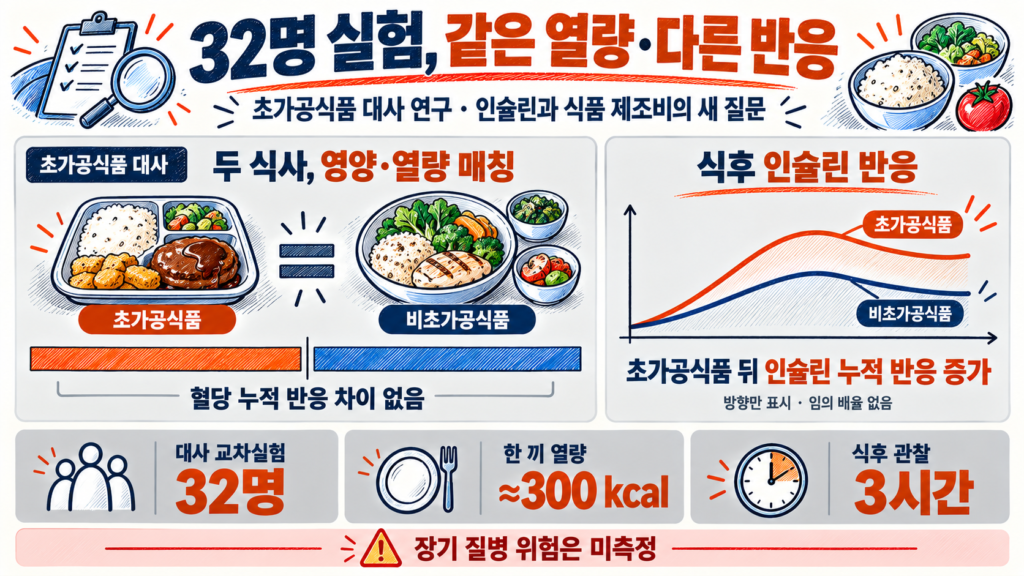
미국 버지니아공대 프랄린 생명의학연구소의 알렉산드라 G. 디펠리체안토니오와 제1저자 잭 허텔린이 10월 5일 Nature Metabolism에 발표한 초가공식품 대사 연구는 영양표만으로 설명되지 않는 차이를 보여줍니다. 32명이 참여한 대사 교차실험에서 영양 성분을 가깝게 맞춘 두 끼니의 인슐린 반응이 달랐습니다. 이 차이가 식품업체의 제품 개발과 제조비에 어떤 질문을 던지는지 살펴봅니다. 출처: Nature Metabolism (2026)
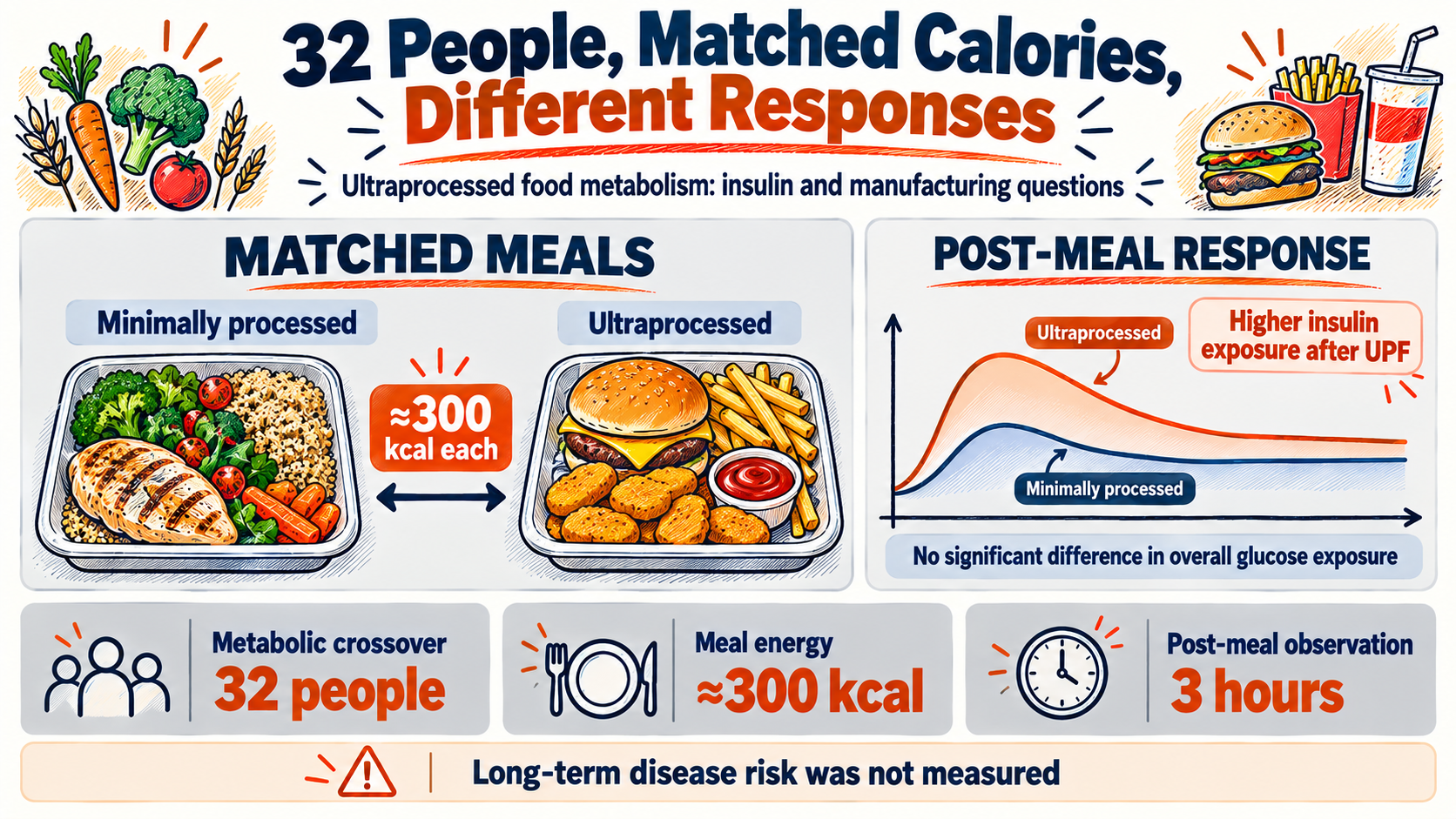
A new ultraprocessed food metabolism study from Alexandra G. DiFeliceantonio and first author Zach Hutelin at Virginia Tech’s Fralin Biomedical Research Institute appeared in Nature Metabolism on October 5. In a 32-person metabolic crossover experiment, closely nutrient-matched meals produced different insulin responses. The finding raises practical questions about how food companies develop, test and manufacture products. Source: Nature Metabolism (2026)
영양표가 비슷한 간편식을 고르면 몸도 비슷하게 반응할까요? 이번 결과는 그 질문에 다시 실험이 필요하다고 말합니다. 다만 한 끼의 반응 차이를 평생의 질병 위험으로 바꿔 읽을 수는 없습니다. 뒤에 나오는 산업 분석은 조건부 전망이며, 특정 기업이나 종목의 매수·매도 추천이 아닙니다.
연구를 이끈 사람들 — 허텔린은 음식 사진부터 맞췄습니다
교신저자 디펠리체안토니오는 연구의 개념과 방법, 연구비 확보를 맡았습니다. 허텔린은 실험 수행과 분석, 시각화, 초고 작성을 이끌었습니다. 메리 엘리자베스 보는 방법론과 검증에, 모니카 아렌스와 알렉산드라 L. 핸런은 데이터·통계 분석에 기여했습니다. 사람의 식사와 혈액, 뇌 영상을 함께 다루는 만큼 실험과 통계가 맞물린 작업입니다. 출처: Nature Metabolism (2026)
준비 작업도 있었습니다. 허텔린과 디펠리체안토니오 등이 참여한 2024년 Appetite 연구는 가공 수준이 다른 음식 사진을 비교용 도구로 검증했습니다. 사진 속 음식의 색이나 크기가 다르면 뇌 반응이 가공 수준 때문인지, 눈에 더 띄어서인지 알기 어렵기 때문입니다. 이번 연구는 그런 차이를 줄인 도구 위에 대사 측정을 더했습니다. 출처: Virginia Tech 연구 배경 / Research background
초가공식품 대사 실험 설계 — 57명 등록, 두 끼를 다 먹은 사람은 32명
논문 전체 등록자는 57명입니다. 그중 두 대사 실험에 참여한 사람은 32명이고, 뇌 영상 분석에는 52명이 포함됐습니다. 대사와 뇌 반응을 함께 연결한 분석은 29명입니다. 표본은 서로 겹치므로 더하면 안 됩니다. 인슐린 분석은 채혈 자료 문제 등으로 31명이었습니다. 출처: Nature Metabolism (2026)
서로 겹치는 표본이며 합산하지 않습니다. 출처: Nature Metabolism, Results·Methods·Fig. 1–2.
허텔린은 같은 사람이 서로 다른 날 두 식사를 먹게 하고 순서를 무작위로 정했습니다. 이런 교차설계는 사람마다 다른 기본 대사 특성의 영향을 줄여 줍니다. 약 300킬로칼로리의 식사를 모두 먹게 했고, 열량·주요 영양소·식이섬유·나트륨·물·혈당지수 등은 두 식사 간 차이를 1.6% 이하로 맞췄습니다. 출처: Nature Metabolism (2026)
여기서 초가공식품은 NOVA 분류의 4군입니다. 가정에서 흔히 쓰지 않는 성분과 산업적 조합·가공 방식 등을 고려하는 분류입니다. 비교 대상인 비UPF에는 NOVA 1~3군이 들어갑니다. 따라서 이 실험을 공장 음식과 자연 그대로의 음식의 대결로 이해하면 범위가 어긋납니다. 출처: Nature Metabolism (2026)
기존 연구와 질문도 다릅니다. 케빈 홀의 NIH 연구진은 2019년 20명을 입원시켜 원하는 만큼 먹도록 하는 시험을 했습니다. 무엇을 얼마나 더 먹는지가 중요했습니다. 디펠리체안토니오와 허텔린은 먹는 양을 고정해 놓고, 비슷한 영양이 들어온 뒤 몸이 어떻게 처리하는지로 질문을 좁혔습니다. 출처: Hall et al., Cell Metabolism (2019)
혈당은 비슷해도 인슐린은 달랐습니다
허텔린 팀의 식후 3시간 관찰에서 혈당의 누적 반응은 두 조건 사이에 통계적으로 유의한 차이가 없었습니다. 반면 UPF 식사 뒤 인슐린의 누적 반응은 더 컸습니다. 누적 반응은 여러 시점의 측정값을 합쳐 비교하는 방식입니다. 한순간의 최고치만 보는 것과 다릅니다. 출처: Nature Metabolism (2026)
인슐린은 혈액 속 포도당의 이용과 저장을 조절하는 호르몬입니다. 혈당 수치가 비슷하다는 사실만으로 그 과정까지 같다고 볼 수 없다는 뜻입니다. 그렇다고 이번 한 끼 실험으로 참가자에게 인슐린 저항성이나 당뇨병이 생겼다고 진단할 수는 없습니다.
디펠리체안토니오와 허텔린은 UPF 뒤 에너지 소비 반응이 더 크고, 지방에서 탄수화물로 연료 사용을 옮기는 반응이 약해지는 양상도 보고했습니다. 산화는 여기서 영양소를 에너지로 쓰는 과정을 뜻합니다. 쉽게 말해 UPF 뒤에는 지방을 연료로 쓰는 비중이 상대적으로 높게 남았습니다. 그렇다고 이 결과를 체지방이 더 빠진다는 광고로 바꾸면 곤란합니다. 몸무게는 이후 먹는 양과 장기간의 에너지 균형까지 함께 봐야 합니다. 출처: Virginia Tech 대사 연구 설명 / Metabolic research background
이번 실험의 관찰
누적 반응의 유의한 차이 없음
혈당
인슐린 · UPF 뒤 누적 반응 더 큼
연료 사용 · UPF 뒤 탄수화물 산화 전환 약화
별도 증거가 필요한 주장
당뇨·비만 발생 위험 미측정
장기 건강
원인 공정 · 원료·첨가물·구조 효과 미분리
산업 성과 · 판매량·원가·의료비 절감 미측정
선조체 반응을 곧바로 중독이라고 부를 수 없는 이유
허텔린은 별도 날짜에 음식 사진을 보여 주며 기능적 자기공명영상, 즉 fMRI를 측정했습니다. fMRI는 혈액 산소 상태와 관련된 신호로 뇌 활동을 간접 관찰합니다. 선조체는 보상 학습과 행동 선택에 관여하는 뇌 영역입니다. 이번에는 탄수화물 산화의 식사 간 차이와 음식 사진을 볼 때의 선조체 반응 차이가 연관됐습니다. 출처: Nature Metabolism (2026)
이 설계는 UPF를 먹기 전후 뇌가 어떻게 바뀌었는지를 직접 보여 주지 않습니다. 인슐린 차이가 뇌 반응을 일으켰다는 연결도 입증하지 않았습니다. 음식 사진 반응에서 중독이나 통제력 상실까지 가려면 행동과 장기 추적 증거가 더 필요합니다.
사업 관점에서 더 중요한 결과는 오히려 조용한 쪽에 있습니다. 참가자가 음식에 지불하려는 금액은 가공 수준별로 유의하게 다르지 않았습니다. 허텔린 팀의 뇌 영상 차이가 곧바로 비UPF의 가격 프리미엄이나 UPF의 더 강한 구매욕을 뜻하지 않는 이유입니다. 출처: Nature Metabolism (2026)
공장에서는 무엇을 바꿔야 할까요?
디펠리체안토니오 팀의 결과를 제품 개발로 옮길 때 가장 먼저 부딪히는 문제는 원인을 더 좁히는 일입니다. 두 식사는 단백질 총량이 비슷해도 단백질 원료는 달랐습니다. 첨가물과 음식 내부 구조도 따로 떼어 시험하지 않았습니다. 따라서 특정 유화제를 빼거나 특정 가열 공정을 없애면 해결된다는 처방은 아직 없습니다. 출처: Nature Metabolism (2026)
여기부터는 산업적 추론입니다. 후속 연구가 특정 구조나 공정의 개선 효과를 재현한다면, 제조사는 그 조건을 대량 생산에서도 유지해야 합니다. 원료를 덜 부수는 공정이 유효하다고 가정해 보겠습니다. 식감과 혼합 상태가 달라질 수 있고, 기존 충전기와 포장 공정에 맞는지도 다시 확인해야 합니다. 이 논문이 그런 공정을 검증했다는 뜻은 아닙니다.
설비를 바꾸면 시간당 생산량과 판매 가능한 제품의 비율이 달라질 수 있습니다. 원료비가 같아도 생산량이 줄면 제품 하나가 부담하는 인건비와 설비비가 올라갑니다. 보관 중 품질이나 유통기한까지 달라지면 냉장 운송과 폐기 비용도 다시 계산해야 합니다. 반대로 기존 설비를 크게 건드리지 않고 효과를 낼 수 있다면 전환 부담은 작아집니다.
-
1
원인 좁히기
원료·구조·공정별 재현 시험
-
2
공장 검증
처리량·수율·보관 안정성 확인
-
3
판매 검증
맛·가격·반복구매 확인
-
4
투자 회수
추가 이익이 개발·설비비를 충당
경제성을 판단할 식은 어렵지 않습니다. 판매 가능한 제품 한 개의 추가 이익이 원료·제조·물류의 추가 비용보다 커야 하고, 그 차이로 개발비와 설비 투자비까지 회수해야 합니다. 맛과 편의성을 유지해 반복구매가 일어나는지도 중요합니다. 가공을 줄였다는 문구만으로 이 계산이 해결되지는 않습니다.
저당·고단백 다음 경쟁은 무엇일까요?
기업은 이미 건강 목적에 맞춘 편의식 시장을 만들고 있습니다. 네슬레는 2024년 9월 GLP-1 계열 약물 이용자와 체중관리 소비자를 겨냥한 고단백 냉동식 Vital Pursuit의 미국 전국 출시를 발표했습니다. GLP-1 계열은 식욕·혈당 조절에 관여하는 신호를 활용하는 약물군입니다. 이 사례는 시장의 움직임을 보여 줄 뿐, 이번 논문이 해당 제품의 효과나 문제를 시험했다는 뜻은 아닙니다. 출처: Nestlé USA, 2024-09-18
디펠리체안토니오 팀의 연구가 저당·고단백 제품의 가치를 없애는 것은 아닙니다. 다만 영양소 함량으로 설명하는 장점과 식후 몸의 반응을 따로 검증할 여지를 넓힙니다. 후속 증거가 쌓이고 소비자가 이를 구별한다면, 제조사는 포장 문구를 바꾸는 비용에 더해 실제 제품 평가 비용도 부담할 수 있습니다.
단기 수요가 생길 후보는 인체 식사시험, 소화 특성 평가, 원료·공정 검증을 제공하는 기관입니다. 그래도 수혜가 확정된 것은 아닙니다. 업체가 반복 발주할 표준 시험법과 비용 대비 효용이 있어야 매출로 이어집니다. 식품업체 중에서는 연구개발비를 여러 제품에 나눠 부담하는 기업이 유리할 수 있지만, 기존 생산라인을 바꾸는 부담도 큽니다.
한국에서도 판매 접점은 작지 않습니다. 공식 온라인쇼핑동향에 따르면 2026년 1월 음식서비스 거래액은 3조8,191억원이었습니다. 다만 이는 온라인 음식서비스의 거래 규모이지 초가공식품 시장규모가 아닙니다. 배달 음식과 편의식 전체를 UPF로 묶을 수도 없습니다. 출처: 온라인쇼핑동향, 2026년 1월 / January 2026 online shopping
국내 업체에 대입하면 편의성을 지키면서 검증된 식후 반응을 제공할 수 있는지가 관건입니다. 가격이 크게 오르거나 조리 시간이 길어지면 소비자가 바꿔 살 이유가 줄어듭니다. 완제품 시장이 통째로 사라진다고 보기보다, 배합과 가공 방식이 다른 상품이 일부 수요를 가져가는 시나리오가 더 구체적입니다. 이 역시 전망이며 현재 확인된 시장점유율 변화는 아닙니다.
규제와 의료비 절감, 이 논문이 말하지 않는 것
정책도 움직이고 있습니다. 미국 HHS와 USDA는 2026년 8월 10일 연방 초가공식품 정의안을 최종 검토에 제출했다고 발표했습니다. 이는 정의안 추진이라는 사실입니다. 이 발표만으로 경고 표시나 판매금지가 시행됐다고 말할 수 없으며, 한국의 규제가 바뀌었다는 의미도 아닙니다. 출처: HHS, 2026-08-10
디펠리체안토니오 연구실의 다음 과제가 중요한 이유도 여기에 있습니다. 어떤 공정과 원료를 바꾸면 반응이 달라지는지, 그 변화가 오래 지속되는지 확인돼야 기업은 투자 대상을 고를 수 있습니다. 이름이 같은 UPF라도 제품별 반응이 다르다면, 분류 표시와 실제 성능 검증은 서로 다른 일을 하게 됩니다.
제약·헬스케어 산업의 파급효과는 한 단계 더 멀리 있습니다. 식품 개선이 장기적으로 질병 발생을 줄인다면 진료비와 돌봄 부담을 낮추고 결근을 줄일 가능성이 있습니다. 하지만 이번 시험은 그런 결과를 측정하지 않았습니다. 의료비 절감액, 비만치료제 매출 감소, 노동생산성 개선률을 이 논문에서 계산할 수는 없습니다.
허텔린의 실험 다음, 후속 연구가 풀어야 할 질문
이번 연구는 정상 체중 성인의 소규모 급성 실험입니다. 더 큰 식사, 다양한 연령과 건강 상태에서도 결과가 재현되는지 확인해야 합니다. 자료 수집과 분석이 맹검으로 진행되지 않았다는 점도 읽어 둘 한계입니다. 무엇보다 원료와 구조, 첨가물의 영향을 분리한 실험이 있어야 제조 공정으로 옮길 수 있습니다. 출처: Nature Metabolism (2026)
허텔린과 디펠리체안토니오가 식품 산업에 남긴 질문은 분명합니다. 영양표가 비슷한 제품을 만들었다면, 사람의 몸에서도 비슷하게 작동하는지 확인했느냐는 질문입니다. 그 답을 맛과 가격, 안정적인 생산까지 함께 갖춰 내놓는 기업이라면 새로운 경쟁력을 만들 수 있습니다. 지금은 특정 기업의 승리를 고를 때보다, 어떤 제품이 어떤 시험을 통과하는지 볼 때입니다.
영양표 뒤의 생리 반응을 검증하고, 그 개선을 맛과 가격까지 갖춘 제품으로 만드는 일이 남았습니다.
출처와 참고 링크
- Hutelin et al., Nature Metabolism (2026)
- Virginia Tech — Zach Hutelin dissertation and research background
- NIH — controlled feeding trial led by Kevin Hall
- Hall et al., Cell Metabolism (2019)
- Nestlé USA — Vital Pursuit nationwide launch
- HHS — proposed federal UPF definition submitted for final review
- 2026년 1월 온라인쇼핑동향
If two convenient meals have similar nutrition labels, will the body respond similarly? This study gives a reason to test that assumption more carefully. A response to one meal, however, cannot be converted into a lifetime disease risk. The industry analysis below is conditional, and nothing here is a recommendation to buy or sell any company’s stock.
Who led the work: Hutelin started with the food pictures
Corresponding author DiFeliceantonio helped develop the concept and methods and secured funding. Hutelin led experimental work, analysis, visualization and the initial manuscript. Mary Elizabeth Baugh contributed to methods and validation; Monica Ahrens and Alexandra L. Hanlon contributed to data and statistical analysis. Connecting meals, blood measurements and brain imaging required both experimental and statistical expertise. Source: Nature Metabolism (2026)
There was groundwork behind the experiment. A 2024 Appetite study involving Hutelin and DiFeliceantonio validated food pictures for comparisons across processing levels. Differences in color or image size could otherwise complicate the interpretation of brain activity. The new work connects a carefully prepared visual task with metabolic measurements. Source: Virginia Tech 연구 배경 / Research background
Ultraprocessed food metabolism trial design: 57 enrolled, 32 ate both meals
The study enrolled 57 people. Of these, 32 participated in the two metabolic sessions, 52 were included in the imaging analysis and 29 in the combined metabolism–brain analysis. These groups overlap and must not be added together. The insulin analysis included 31 participants. Source: Nature Metabolism (2026)
Groups overlap; do not add them. Source: Nature Metabolism, Results, Methods and Figs. 1–2.
Hutelin used a randomized crossover design: each person ate both meals on different days, in randomly assigned order. This reduces the influence of stable differences between individuals. Participants finished meals of roughly 300 kilocalories, matched within 1.6% on energy and multiple nutritional characteristics, including macronutrients, fiber, sodium, water and glycemic index. Source: Nature Metabolism (2026)
Ultraprocessed foods were NOVA group 4, a category that considers industrial formulations and ingredients not commonly used in home cooking. The non-UPF comparison included NOVA groups 1–3. It was therefore not simply a contest between factory-made food and food that had never been processed. Source: Nature Metabolism (2026)
The question differs from earlier work. Kevin Hall’s NIH team ran a 20-person inpatient trial in 2019 in which participants could eat freely. That design examined intake and weight changes. DiFeliceantonio and Hutelin fixed the amount consumed to examine what happens after similar nutrients enter the body. Source: Hall et al., Cell Metabolism (2019)
Similar overall glucose response, different insulin response
Over the three-hour post-meal period, overall glucose exposure did not differ significantly between conditions, whereas insulin exposure was greater after the UPF meal. Exposure here refers to the response accumulated across measurements, rather than a single peak. Source: Nature Metabolism (2026)
Insulin helps regulate glucose use and storage. Similar glucose measurements therefore do not establish that the underlying response was identical. The experiment does not diagnose insulin resistance or diabetes caused by the meal.
DiFeliceantonio and Hutelin also reported a larger energetic response and a weaker shift from fat toward carbohydrate oxidation after UPF. Oxidation means using nutrients as fuel. Greater fat oxidation over this short window is not evidence of greater long-term body-fat loss; later intake and sustained energy balance also matter. Source: Virginia Tech 대사 연구 설명 / Metabolic research background
Observed in this study
No significant difference in overall exposure
Glucose
Insulin · Greater exposure after UPF
Fuel use · Weaker shift toward carbohydrate oxidation after UPF
Claims requiring separate evidence
Diabetes and obesity incidence not measured
Long-term health
Responsible process · Ingredient, additive and structure effects not isolated
Commercial outcome · Sales, costs and care savings not measured
Why the striatal findings are not an addiction diagnosis
On a separate day, Hutelin measured functional MRI responses while participants viewed food pictures. fMRI indirectly tracks activity through blood-oxygen-related signals. The striatum participates in reward learning and action selection. Differences in carbohydrate oxidation between meals were associated with differences in striatal responses to the pictures. Source: Nature Metabolism (2026)
This was not a before-and-after scan demonstrating that eating UPF changed the brain. Nor did it establish that the insulin difference caused the neural response. Claims about addiction or loss of control require behavioral and longer-term evidence.
For a business reader, a quieter result matters too: willingness to pay did not differ significantly between processing categories. Neural differences in Hutelin’s study therefore do not establish a price premium for non-UPF or stronger purchasing demand for UPF. Source: Nature Metabolism (2026)
What would a factory actually need to change?
The first challenge in translating DiFeliceantonio’s findings into product development is identifying the responsible factors. Protein sources differed despite similar total protein. Additives and food structure were not tested separately. The study does not establish that removing a particular emulsifier or heating step would solve the problem. Source: Nature Metabolism (2026)
The following is industrial inference. If follow-up studies reproduce a benefit from a particular structure or process, manufacturers would need to preserve it at scale. Suppose a less disruptive milling process proved useful. Texture, mixing and compatibility with filling equipment might all require revalidation. That is an example of a development problem, not a process validated by this paper.
Changing equipment can affect hourly output and the share of production that is saleable. Even with unchanged ingredient costs, lower throughput increases labor and equipment cost per unit. Any change in storage stability or shelf life also affects logistics and waste. A benefit achievable on existing lines would be much cheaper to adopt.
-
1
Identify the factor
Replicate effects of ingredients, structure or process
-
2
Validate production
Check throughput, yield and storage stability
-
3
Test the market
Check taste, pricing and repeat purchases
-
4
Recover investment
Added contribution must repay development and equipment
The business test is straightforward. Added revenue per saleable unit must cover added ingredient, manufacturing and distribution costs, while leaving enough to repay development and equipment investment. Taste, convenience and repeat purchases matter. A reduced-processing label alone does not make the calculation work.
What comes after low-sugar and high-protein positioning?
Companies already sell convenient foods for specific health goals. In September 2024, Nestlé announced the nationwide US launch of Vital Pursuit, high-protein frozen meals aimed at GLP-1 users and people managing their weight. GLP-1 medicines act on signaling involved in appetite and glucose regulation. This is a commercial example; the new study did not test that brand. Source: Nestlé USA, 2024-09-18
DiFeliceantonio’s findings do not erase the value of controlling sugar or providing protein. They create room to distinguish nutrient claims from demonstrated physiological responses. If follow-up evidence accumulates and consumers respond to it, manufacturers may face product-testing costs as well as the cost of changing packaging and positioning.
Potential early demand could go to organizations offering human meal tests, digestion assessment and ingredient or process validation. That is not a guaranteed windfall: repeat business requires useful, reproducible tests at an acceptable price. Large manufacturers may spread research costs across products, while also facing substantial costs to adapt established production lines.
Korea provides a substantial distribution setting. Official online-shopping statistics put food-service transactions at KRW 3.8191 trillion in January 2026. This is a measure of online food-service spending, not the size of an ultraprocessed food market. Delivery meals and convenience foods cannot all be classified as UPF. Source: 온라인쇼핑동향, 2026년 1월 / January 2026 online shopping
For Korean manufacturers, the question is whether a validated response can be delivered without sacrificing convenience. A steep price increase or longer preparation time could discourage switching. A scenario in which differently formulated products win some demand is more concrete than assuming the entire packaged-food market disappears. Neither scenario is an observed market-share result.
Regulation and healthcare savings: what this paper does not show
Policy is moving as well. On August 10, 2026, HHS and USDA announced that a proposed federal UPF definition had been submitted for final review. That announcement documents a proposal moving forward. It does not establish that warning labels or sales bans have taken effect, and it says nothing about a change in Korean law. Source: HHS, 2026-08-10
That makes the next questions for DiFeliceantonio’s lab commercially important: which ingredients or processes change the response, and does the effect persist? Companies need those answers to choose investments. If products within a processing category behave differently, category labeling and product-level validation will serve different purposes.
Implications for pharmaceutical companies and healthcare are further away. If better food products eventually reduce disease incidence, they could lower care costs and absence from work. This trial measured none of those outcomes. It cannot supply a healthcare savings estimate, a forecast of obesity-drug sales or a productivity growth rate.
What follow-up studies need to answer after Hutelin’s experiment
This was a small, acute study in healthy-weight adults. Replication should examine larger meals and people of different ages and health status. Data collection and analysis were not blinded. Separating the effects of ingredients, structure and additives is particularly important before changing manufacturing processes. Source: Nature Metabolism (2026)
Hutelin and DiFeliceantonio leave the industry with a useful question: after matching a nutrition label, have you checked how the product actually behaves in people? A company that can answer that while preserving taste, price and reliable production could build an advantage. For now, the evidence to watch is which products pass which tests.
The next task is to validate the response behind the label and deliver any improvement at a workable taste and price.
Sources and further reading
- Hutelin et al., Nature Metabolism (2026)
- Virginia Tech — Zach Hutelin dissertation and research background
- NIH — controlled feeding trial led by Kevin Hall
- Hall et al., Cell Metabolism (2019)
- Nestlé USA — Vital Pursuit nationwide launch
- HHS — proposed federal UPF definition submitted for final review
- 2026년 1월 온라인쇼핑동향
이 글은 정보 제공 목적이며, 특정 자산의 매수·매도를 권유하지 않습니다.
For information only — this is not a recommendation to buy or sell any asset.
댓글Comments 0