Apple earnings: iPhone grows 17%, but margin guide falls to 45–46%
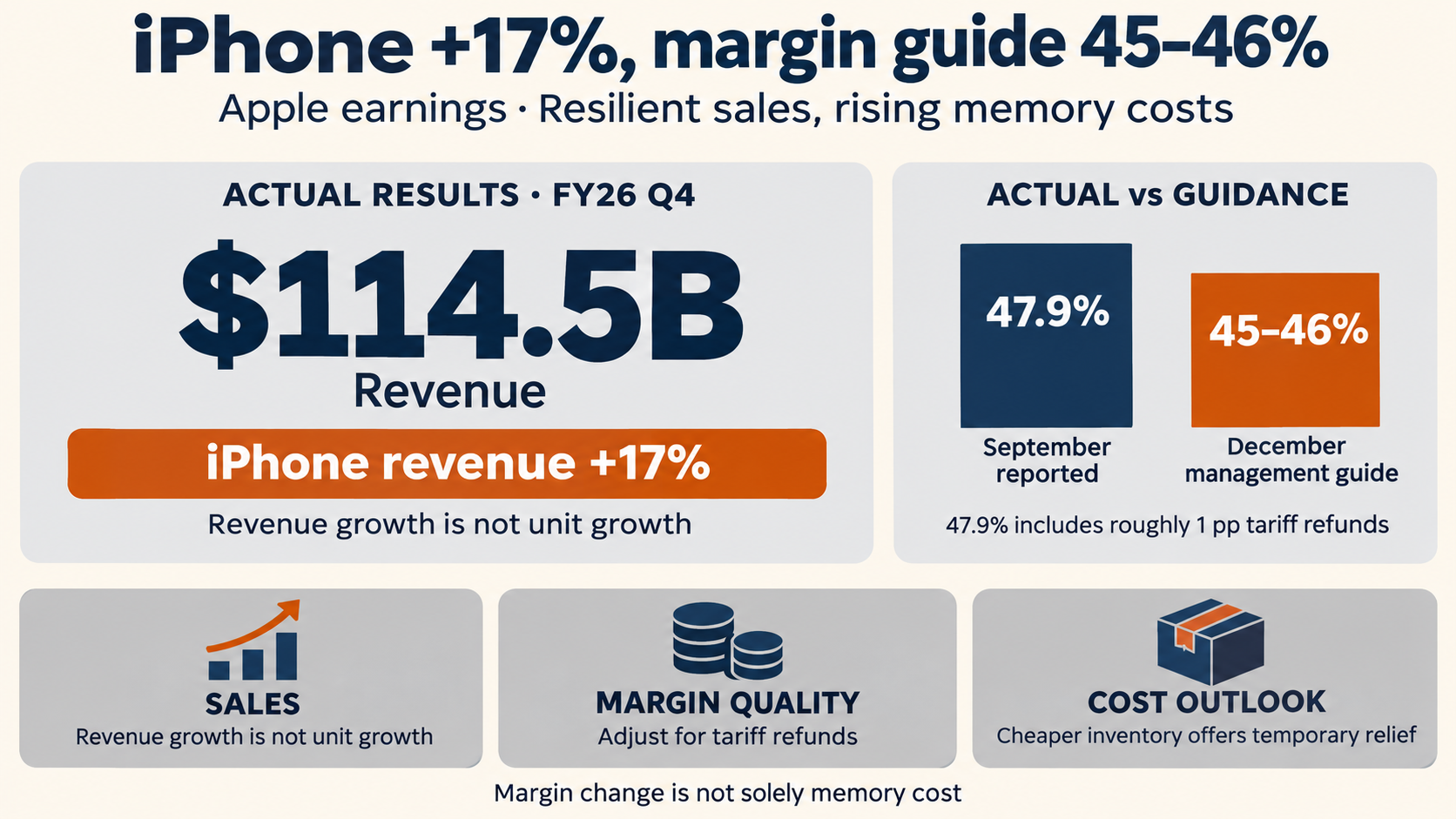
Apple earnings reveal strong sales alongside a weaker margin outlook. Revenue reached about $114.5 billion in fiscal Q4, reported November 2, while management guided December-quarter gross margin to 45–46%. For Korean investors, the question is how much of Apple’s higher component bill reaches memory suppliers, and when. Source: Apple FY26 Q4 공식 실적 발표 · 2026-11-02 Source: Reuters · 메모리 원가와 애플 마진 · 2026-11-03
The reported quarter ended September 26. The 45–46% range is guidance for the following quarter, not an achieved result. Keeping reported figures, management expectations and conditional analysis separate makes this apparent contradiction easier to understand. This article is not a recommendation to buy or sell any security. Source: Apple FY26 Q4 연결재무제표 · 2026-09-26 결산
Apple earnings: 17% growth is not unit growth
iPhone revenue was $57.583 billion, up 17.5%; Mac revenue was $10.792 billion, up 23.7%; Greater China revenue was $17.539 billion, up 21.0%. Growth is calculated from the financial statements. Greater China is a geographic segment and overlaps the product categories. Source: Apple FY26 Q4 연결재무제표 · 2026-09-26 결산
Product and regional revenue growth. FY26 Q4, calculated from Apple statements. Greater China overlaps product categories. These are revenue, not unit, growth rates.
Revenue equals units sold multiplied by average selling price. Higher prices or a larger share of premium models can lift revenue without equivalent unit growth. Reuters attributes the result partly to premium iPhone demand and price increases. A 17% revenue increase therefore does not establish a 17% rise in memory orders. Source: Reuters · 메모리 원가와 애플 마진 · 2026-11-03
Greater China’s recovery also needs context. Apple’s customers and product mix do not represent all Chinese consumption. Korean component suppliers need to track device production, memory capacity per device and their own supply share. None can be determined from revenue growth alone.
Before comparing margins, remove the tariff-refund benefit
Gross margin measures revenue remaining after the direct cost of products and services. It is different from operating margin, which also deducts expenses such as research and administration. Apple reported 47.9%, including roughly one percentage point from tariff refunds. Source: Apple FY26 Q4 공식 실적 발표 · 2026-11-02
The guidance midpoint is 45.5%. That is 2.4 percentage points below the reported margin, but about 1.4 points below a simple refund-adjusted 46.9%. The adjustment is our comparison, not a separately reported accounting measure. Attributing the entire headline decline to memory would overstate the effect.
Refund adjustment narrows the gap to about 1.4 points. 47.9% reported; 46.9% is a simple adjustment for roughly 1 point of refunds. 45.5% is the midpoint of management’s 45–46% December guidance, not an actual result. · Axis starts at 44, not zero
On the November 2 call, CFO Kevan Parekh attributed most of the expected pressure to memory, while also noting Siri AI costs. This is management guidance. It does not disclose the future memory-price increase or the separate contributions of DRAM and NAND. Source: Apple 2026-11-02 실적 콜 · Singju Post 전사본
A lower margin can still produce more gross profit if revenue grows enough. Conversely, price increases can preserve device revenue while lower unit sales hurt suppliers. Apple shareholders and Korean memory shareholders can reasonably focus on different parts of the same release.
Cheaper inventory delays the cost hit
A higher purchase price does not necessarily become an expense immediately. Components enter inventory and are expensed through the process of making and selling products. While cheaper inventory remains available, the income statement can show less pressure than current procurement prices suggest.
-
1
Buy components
New prices and cash commitments
-
2
Hold inventory
Cheaper stock provides an offset
-
3
Sell devices
Inventory cost becomes expense
-
4
Place new orders
Adjust to sales and remaining stock
CEO John Ternus said existing inventory partly offsets higher costs, with diminishing benefits over time. Total inventory reached $14.541 billion versus $5.718 billion at the previous fiscal year-end. That total cannot be treated as memory inventory or unsold iPhones alone. Source: Apple 2026-11-02 실적 콜 · Singju Post 전사본 Source: Apple FY26 Q4 연결재무제표 · 2026-09-26 결산
Buying ahead can reduce production disruption but ties up cash. If demand later disappoints, a device maker may cut new orders while using stock already on hand. Strong supplier revenue today and sustained growth in end-user purchases are different phenomena. Inventory and fresh orders need to be monitored together.
For Korean chipmakers, contracts and volumes matter more than price
DRAM holds data while a device is working; NAND stores files even when power is off. AI servers use high-bandwidth memory, or HBM, a form of DRAM that is not interchangeable with finished mobile DRAM products. The markets connect through manufacturers’ capacity and investment choices.
SK hynix’s October 28 release described expanding server products and the time needed to build capacity. It also reported long-term agreements covering more than half of 2027–28 capacity. That is the supplier’s position, not a disclosure of allocations to Apple. NAND also spans different server and mobile products, so price changes need not travel at the same speed. Source: SK hynix 3Q26 공식 실적 발표 · 2026-10-28
The clearest earnings benefit comes when contract prices rise and shipments hold up. A high spot-market price need not immediately reset a long-term contract. Product costs, repricing terms and the won-dollar exchange rate also affect Korean earnings. Apple’s extra cost cannot be assigned dollar for dollar to a particular Korean supplier.
Persistently higher costs may encourage device makers to raise prices, change base storage configurations or reduce discounts. These are possible responses, not newly announced Apple plans. If consumers delay upgrades, camera, display and assembly suppliers may also lose orders. A memory upswing need not benefit the entire IT supply chain.
This connects with our earlier discussion of Intel’s PC and server results. Apple illustrates how premium-device revenue can remain resilient while input costs squeeze margins. Pricing power and customer mix determine how the same supply shock affects different businesses.
AI spending lifts memory prices. Can consumers absorb them?
In Apple’s November 2 release, Ternus emphasized record September-quarter revenue and the product lineup. Read alongside Parekh’s cost warning, this describes demand resilience with pressure on profitability. If financing costs or living expenses constrain consumers, passing further costs through in device prices becomes harder. Source: Apple FY26 Q4 공식 실적 발표 · 2026-11-02
The IMF’s October 13 outlook projected 3.1% global growth and 4.7% inflation for 2026, while identifying a reassessment of AI expectations as a downside risk. Apple alone does not validate that forecast. Its experience does illustrate how AI investment can support some suppliers while raising costs elsewhere. Source: IMF 세계경제전망 · 2026-10-13
Market sentiment is split. CNN’s US Fear & Greed index stood at 20.3, extreme fear, on November 5: down 10.4 points from a week earlier and 22.8 from a month earlier. GoldKimp’s November 2 KOSPI measure was 77.8, extreme greed. Dates and methods differ, and comparable Korean history is unavailable; this does not establish an increase in Korean optimism. Source: CNN Fear & Greed · 2026-11-05 스냅샷 Source: GoldKimp KOSPI F&G · 2026-11-02
The contrast leaves room for different market assessments of Apple’s margin pressure and suppliers’ pricing prospects, but does not prove that explanation. SentimenTrader’s public page showed neither Smart Money nor Dumb Money values or their date when checked on November 6, so those measures could not corroborate the interpretation. Source: SentimenTrader Smart/Dumb Money · 조회 시 수치 미표시
Our earlier article on Microsoft and Alphabet’s investment and cash flow examined the spending side of AI. Apple shows a route from that spending to consumer-device costs. New capacity takes time. Whether end customers accept higher prices until supply expands will shape subsequent orders and activity.
Three things to watch next quarter: margin, contract prices, new orders
First, compare Apple’s actual margin with the 45–46% range and isolate one-off effects. Second, check whether Korean suppliers maintain shipments alongside higher contract prices. Third, watch whether device makers build inventories while reducing fresh orders. Looking only at supplier inventory or Apple revenue misses the connection.
Apple earnings offer a conditional signal for Korean memory. If device sales and memory content remain resilient, higher prices can sustain earnings. If upgrades slow and customers draw down previously accumulated stock, fresh component orders can fall before a large decline in final consumption. The test is how long today’s prices are supported by tomorrow’s orders.
Sources and references
- Apple FY26 Q4 공식 실적 발표 · 2026-11-02
- Apple FY26 Q4 연결재무제표 · 2026-09-26 결산
- Apple 2026-11-02 실적 콜 · Singju Post 전사본
- Reuters · 메모리 원가와 애플 마진 · 2026-11-03
- SK hynix 3Q26 공식 실적 발표 · 2026-10-28
- IMF 세계경제전망 · 2026-10-13
- CNN Fear & Greed · 2026-11-05 스냅샷
- GoldKimp KOSPI F&G · 2026-11-02
- SentimenTrader Smart/Dumb Money · 조회 시 수치 미표시
For information only — this is not a recommendation to buy or sell any asset.
Comments 0