Intel earnings: data center revenue up 78%, but PCs hit a memory squeeze
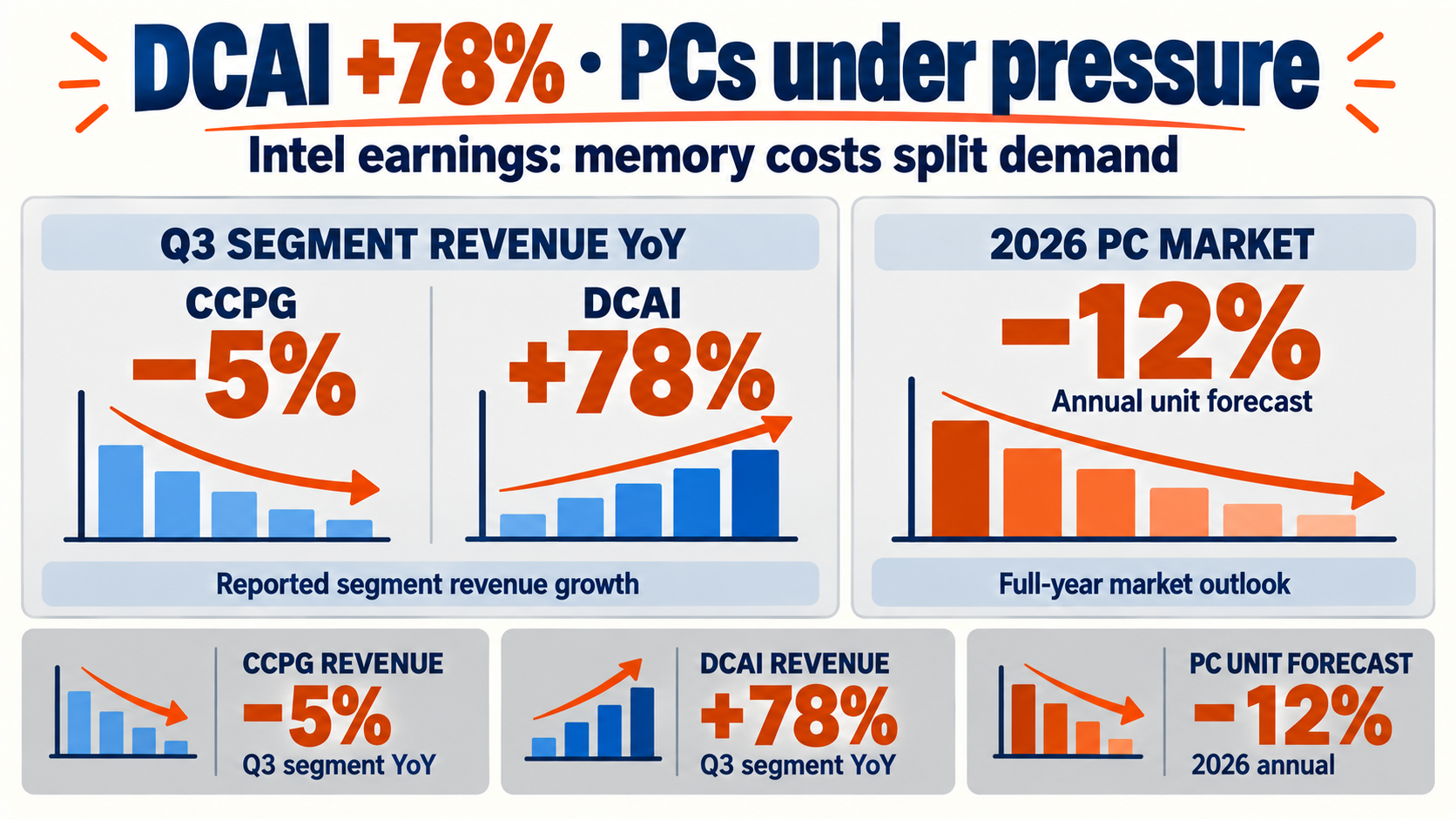
Intel earnings reveal a split chip cycle. Its October 29 release showed Q3 revenue falling 5% year over year in PC-focused CCPG, while Data Center and AI revenue rose 78%. For Korean memory suppliers, higher prices can improve earnings while also weakening their PC customers’ purchasing power. Source: Intel Q3 2026
The buyers have different budgets. A company building AI infrastructure and a household replacing a laptop do not respond to higher component prices in the same way. Server production disruptions add another complication: demand and the ability to fulfill it are separate questions.
Intel earnings: what actually grew 78%?
CCPG combines client computing and physical AI; DCAI covers data center and AI businesses. Their Q3 revenue was approximately $8.1 billion and $7.3 billion respectively. The 78% figure measures segment revenue, not growth in the number of AI server CPUs sold. Source: Intel segment results
Intel Q3 segment revenue. Source: Intel, Oct 29. Bars show revenue levels; growth is year over year. · Axis starts at 6.9, not zero
This distinction matters for Korean suppliers too. Revenue reflects prices, quantities and the mix of products sold. A shift toward expensive products can raise revenue without a matching increase in units. Intel’s segment growth therefore cannot be copied into a forecast for Korean memory shipments.
Why expensive memory can reduce CPU orders
A CPU performs the computer’s core processing, but it cannot make a complete PC by itself. The machine also needs DRAM for working data and NAND-based storage that retains information without power. A price increase in those components raises the cost of the finished computer.
Passing the cost on can prompt buyers to delay replacement or choose cheaper specifications. Absorbing it compresses the manufacturer’s margin. Corporate customers may also purchase fewer laptops within fixed IT budgets. A memory shortage can therefore become a CPU-order problem.
-
1
Memory costs rise
Higher PC production costs
-
2
Price or specification changes
Buyers may delay or cut purchases
-
3
Inventory reduction
Vendors reduce new orders
-
4
Lower CPU orders
Orders may fall faster than retail sales
On the October 29 earnings call, Intel CFO David Zinsner linked weaker PC consumption to memory shortages and limited IT budgets. Intel forecast that the total PC market (TAM, measured in units) would shrink by about 12% in 2026. That is management’s forecast, not a completed shipment count. Source: Intel earnings call via Benzinga
Intel also expected client revenue to decline more than 20% sequentially in Q4 as customers reduced inventories; Reuters described a mid-20% decline. Annual market units and quarterly company revenue have different periods and denominators. They should not be added or treated as interchangeable. Source: Reuters, October 29–30
Inventory adjustment can amplify the fall in orders. If a retailer sells existing stock first, new factory orders can fall sharply even when final consumer sales decline only modestly. Component suppliers may see a larger and earlier downturn than retail demand alone suggests.
Servers face a different problem: fulfilling demand
In the same day’s official release, Intel CEO Lip-Bu Tan identified additional Xeon supply as a priority. Xeon is Intel’s server CPU family. The company is trying to expand server availability while facing budget pressure in client computing. Source: Intel CEO statement, October 29
According to Reuters, Zinsner said the Kiryat Gat factory incident was expected to reduce Q4 revenue by about $300 million and gross margin by about two percentage points, with a similar revenue effect in the following quarter. These are preliminary management estimates, not final losses. Source: Reuters CFO interview
The relevant relationship for memory suppliers is complementarity: these components create value together. A missing server CPU can delay delivery of a complete machine even when memory is available. Memory demand might be postponed, or material might remain in an assembler’s inventory, rather than disappear.
There is no verified evidence here that the incident has caused Korean memory-order cancellations. Switching CPU platforms can also require qualification and software checks. The actual customer and product schedules matter before drawing conclusions about the entire memory market.
Where Korean memory suppliers and PC makers diverge
Samsung said on October 29 that server demand amid capacity constraints had lifted memory prices. SK hynix reported growth in server DDR5, HBM4 and data-center SSD sales on October 28. These statements support the broader picture of AI demand affecting several memory categories. Source: Samsung Q3 results
HBM stacks DRAM chips to deliver high bandwidth. It serves a different role from conventional server DRAM, while NAND provides storage. Expanding HBM production does not mechanically remove an equal amount of NAND capacity. Investment budgets may compete, but production processes and supply balances differ.
Memory suppliers
Higher prices can support revenue and margins
·
· · Lower PC units or content can offset gains
· · Server delays can affect shipment timing
PC manufacturers and vendors
Higher costs force pricing or margin choices
·
· · Delayed replacements can raise inventory risk
· · Order cuts transmit pressure upstream
Higher prices can benefit memory suppliers, but fewer PCs or lower memory capacity per machine can offset some of the volume. A company such as Samsung, which sells both components and finished devices, can experience opposing effects across divisions. Product and customer mix matter more than a broad company label.
For PC vendors such as LG Electronics, the questions are pricing power and inventory. Can they raise prices without losing buyers, or must they discount existing stock? This is a framework for examining their results, not a claim that LG’s inventory has risen or its profit has fallen.
A simple hypothetical illustrates the issue: a 10% price increase combined with a 10% volume decline produces a 1% revenue decrease, because 1.1 multiplied by 0.9 equals 0.99. This is not a company forecast. Profit also depends on production costs and depreciation on new factories.
AI investment is not the same as a consumer recovery
SK hynix CEO Kwak Noh-Jung said on October 28 that customer trust was translating into long-term contracts and better demand visibility. The company said agreements covered more than half of 2027–2028 capacity. This supports planning, but does not fix every future selling price or guarantee earnings. Source: SK hynix Q3 results, October 28
The macro issue is where spending goes. AI infrastructure investment can rise much faster than household purchasing power or corporate laptop budgets. Strong chip export values need not imply a broad consumer recovery. Capacity built to capture today’s server profits will eventually face the demand conditions prevailing when it comes online.
This connects with our coverage of Microsoft and Alphabet’s AI investment and cash flow: Intel shows the component-supply side of that spending. Our discussion of semiconductors versus other industries in US production raises a related point. AI investment strength and broad economic strength are different claims.
Expectations also shape share prices. The supplied October 30, 18:01 UTC snapshot puts CNN Fear & Greed at 23.9, or extreme fear: up 7.2 points from 16.7 a week earlier but down 6.4 from 30.3 a month earlier. GoldKimp’s October 29 KOSPI reading is 76.7, or extreme greed. Source: CNN snapshot
The indices use different methods and dates, so their numerical gap is not directly comparable. Matching historical Korean observations are unavailable here. Still, the contrast is a useful reason to examine weaker PC orders alongside enthusiasm about memory pricing. Source: GoldKimp KOSPI snapshot
The public SentimentTrader page checked on October 31 displayed neither Smart Money nor Dumb Money Confidence values or an update date. It cannot support a claim about institutions buying or individuals selling. Even available sentiment readings do not substitute for company orders and profitability. Source: SentimentTrader public page
What to check in the next results
Intel guided Q4 total revenue to $15–16 billion. Beyond whether results fall within that range, watch whether PC customers finish reducing inventory. Component orders can stabilize after destocking ends even without a strong recovery in final consumer demand. Source: Intel Q4 guidance
For Korean suppliers, examine server and PC memory shipments, realized contract prices and inventory turnover together. Normal server CPU deliveries could release deferred memory demand. Persistent PC weakness combined with delayed server assembly would make high memory prices alone an insufficient earnings argument.
The useful question is which customers can afford the price, which factories can deliver, and which companies hold the inventory. Those differences determine how much of the memory upcycle becomes Korean suppliers’ revenue and cash. This article does not recommend buying or selling any security.
Sources and references
- Intel — 2026-10-29 Q3 financial results
- Reuters — 2026-10-29, updated 10-30: Intel supply constraints
- Intel earnings call, 2026-10-29 — transcript hosted by Benzinga
- Samsung Electronics — 2026-10-29 Q3 results
- SK hynix — 2026-10-28 Q3 results
- CNN Fear & Greed — 2026-10-30 pipeline snapshot
- GoldKimp KOSPI — 2026-10-29 pipeline snapshot
- SentimentTrader — public page checked 2026-10-31 KST
For information only — this is not a recommendation to buy or sell any asset.
Comments 0