US October payrolls: 165,000 more jobs, but households still face strain
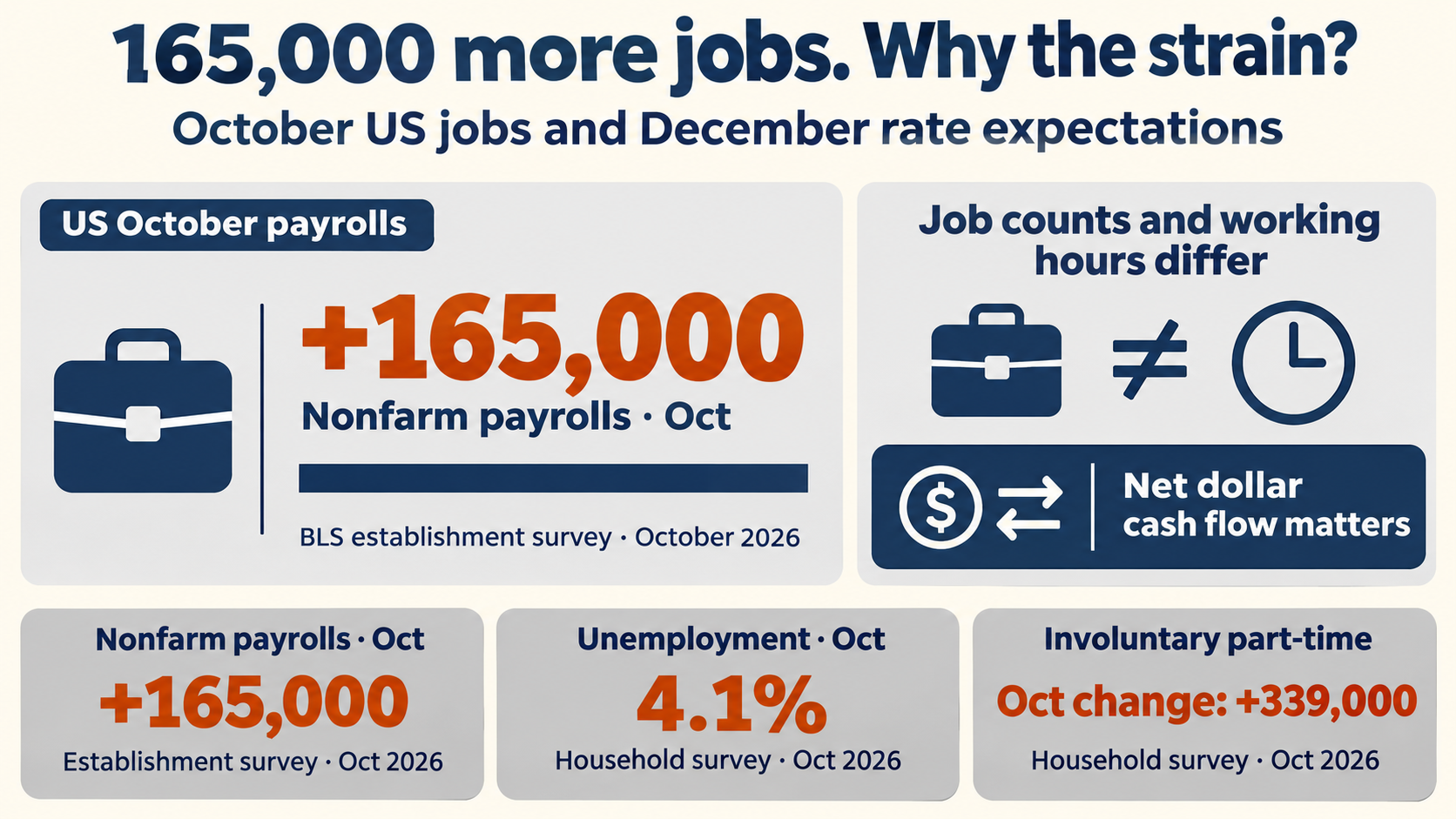
US October payrolls rose by 165,000, with unemployment at 4.1%, the BLS reported on November 6. Yet involuntary part-time work also increased. The distinction matters for household spending, December rate expectations and Korean corporate earnings. Source: BLS 10월 고용
Having a job is only the starting point. Hours worked and purchasing power determine how much income reaches shops. Reported statistics below are facts; the implications for companies and asset prices are conditional analysis.
US October payrolls: count hours as well as jobs
Involuntary part-time employment rose by 339,000 to 4.8 million. These workers wanted full-time work but faced reduced hours or could not find it. They remain employed, so the unemployment rate misses this strain. BLS described the unemployment rate as little changed. Source: BLS 가구조사
Payrolls count jobs reported by employers; part-time figures count people in a household survey. Subtracting one change from the other would be misleading. They describe different dimensions of labor-market health.
Employer survey
Nonfarm jobs
Measure
October change · +165,000
Household survey
Involuntary part-time workers
Measure
October change · +339,000
An employer facing softer orders may shorten shifts before cutting headcount. Hiring can also grow in sectors that do not match workers’ location, skills or schedules. This release cannot establish how much each mechanism contributed. Persistence in later reports matters more than a single observation.
Why a higher hourly wage may buy less
October nominal hourly earnings rose 3.1% from a year earlier. The latest official real-earnings release covers September, when real hourly pay fell 0.7% year on year. October real earnings are scheduled for November 10; these are different reference months. Source: BLS 실질임금·발표 일정
Real earnings adjust pay for prices. A household’s spending capacity also depends on hours worked. Higher hourly pay can coexist with postponed restaurant visits, appliance purchases or car replacements when shifts shrink or essentials become dearer. This is a risk channel, not evidence that every household is cutting spending.
For earnings, separate units sold from prices. Trading down can leave revenue stable while margins weaken. Retailers may reduce inventory or discount more often; durable-goods producers may reassess plant utilization before expanding capacity. These are possible responses if purchasing-power pressure persists.
Why the Fed is watching inflation again: two dissents and Musalem
On October 28, the FOMC held its target range at 3.75–4.00%, citing resilient spending, robust investment and elevated inflation. Governor Lisa Cook and Cleveland Fed President Beth Hammack preferred a quarter-point increase. Tightening was already under debate before this jobs release. Source: FOMC 성명·표결
St. Louis Fed President Alberto Musalem said on November 6 that Middle East supply shocks and AI infrastructure demand were contributing to inflation. Bloomberg reported that he was optimistic about AI productivity but unwilling to wait for those benefits. Construction can lift demand for power and metals before efficiency gains arrive. Source: Bloomberg 무살렘 보도
Stronger employment reduces pressure for the Fed to respond immediately to recession risk. Raymond James, cited by Reuters, expected a quarter-point December increase because policymakers could focus on inflation. That is an analyst forecast, not a Fed commitment. Source: Reuters 기관 전망
Reuters reported roughly 67% pricing for a December hike on Thursday, 85% just after the release and 78% at the article’s observation time. The initial move partly reversed. These are market-implied expectations, not an objective probability or a policy decision. Source: Reuters 11월 6일 관측
The new evidence following our October FOMC preview is the jobs release itself. More jobs do not resolve inflation, and more involuntary part-time work does not establish a recession. Both sides of the mandate still matter.
Dollar revenue and Korean profits can move differently
Expectations of higher US rates can make dollar assets more attractive. If that strengthens the dollar against the won, exporters translate dollar receipts into more won. The exchange rate also depends on other countries’ rates and capital flows, so this is a scenario rather than a directional forecast.
Start with dollar receipts minus dollar materials, equipment and interest costs. Companies with US factories also pay local wages. Net dollar earners differ from firms with heavy import bills. Weaker US orders can offset translation gains through lower sales volumes.
-
1
Tightening expectations
Dollar return expectations shift
-
2
FX and funding
A weaker won raises dollar receipts and costs
-
3
Net cash
Hedges, dollar costs and order volumes matter
Currency hedging fixes or limits an exchange rate for future receipts or payments. An exporter that already sold future dollar receipts forward may not capture all the benefit of a weaker won. A company needing to buy dollars may instead find that its hedge protects costs.
Higher US rates do not make every hedge uniformly more expensive. Forward prices reflect interest-rate differentials, while the effect depends on whether dollars are bought or sold. Maturity and dollar funding conditions matter too. Net dollar exposure, hedge coverage and contract dates are more useful than an exchange-rate forecast alone.
Banks and equities: higher rates are not a universal benefit
Net interest margin, or NIM, measures net interest income relative to interest-earning assets. Faster loan repricing can help; deposit competition or rising wholesale funding costs can squeeze it. US tightening expectations do not automatically improve Korean banks’ margins.
Higher borrower stress may also require larger credit-loss provisions. Net income can fall even when interest income rises, a distinction discussed in our JPMorgan earnings analysis. For companies, higher borrowing costs can delay projects whose expected returns no longer clear the financing hurdle.
Equity valuations also depend on the discount rate used to value future earnings. Higher rates can reduce today’s value of distant profits. Earnings prospects and discount rates may pull in opposite directions, so good employment news is not automatically good stock-market news.
Sentiment is split. CNN's Fear & Greed Index stood at 22.1, extreme fear, on November 6, down from 26.3 a week earlier and 47.0 a month earlier. GoldKimp’s KOSPI measure was 78.7, extreme greed, on November 5. Different methods and dates preclude a precise score-gap comparison, but the readings indicate contrasting risk appetite. Source: CNN 스냅샷
Comparable weekly and monthly KOSPI history was unavailable, so no Korean trend is asserted. SentimenTrader’s public page displayed neither Smart Money nor Dumb Money Confidence readings or dates; neither was used. If payroll strength keeps tightening in focus, elevated Korean expectations remain exposed to funding costs. Source: SentimenTrader 확인 불가 Source: GoldKimp KOSPI
What to watch next: purchasing power and working hours
The next checkpoint is October real earnings, scheduled for November 10, followed by the November jobs report in early December. The former tests purchasing power; the latter helps establish whether involuntary part-time growth persists. These are BLS schedules and may change. Source: BLS 실질임금 일정 Source: BLS next employment release
The release combines economic resilience with household-income vulnerabilities. For Korean companies, cash left after dollar costs matters more than translated revenue alone. For banks, funding costs and credit losses matter alongside loan rates. This article explains economic mechanisms and is not a recommendation to buy or sell an asset.
Sources and references
- BLS — October 2026 Employment Situation, Nov 6
- BLS — September 2026 Real Earnings, Oct 14
- Reuters — December hike pricing, Nov 6
- Federal Reserve — FOMC statement, Oct 28
- Bloomberg — Musalem on supply shocks and AI, Nov 6
- CNN Fear & Greed — pipeline snapshot Nov 6
- GoldKimp KOSPI — Nov 5 observation
- SentimenTrader — public page checked; values unavailable
For information only — this is not a recommendation to buy or sell any asset.
Comments 0