Bank of England Rate Hike Outlook: What Matters Beyond 4%
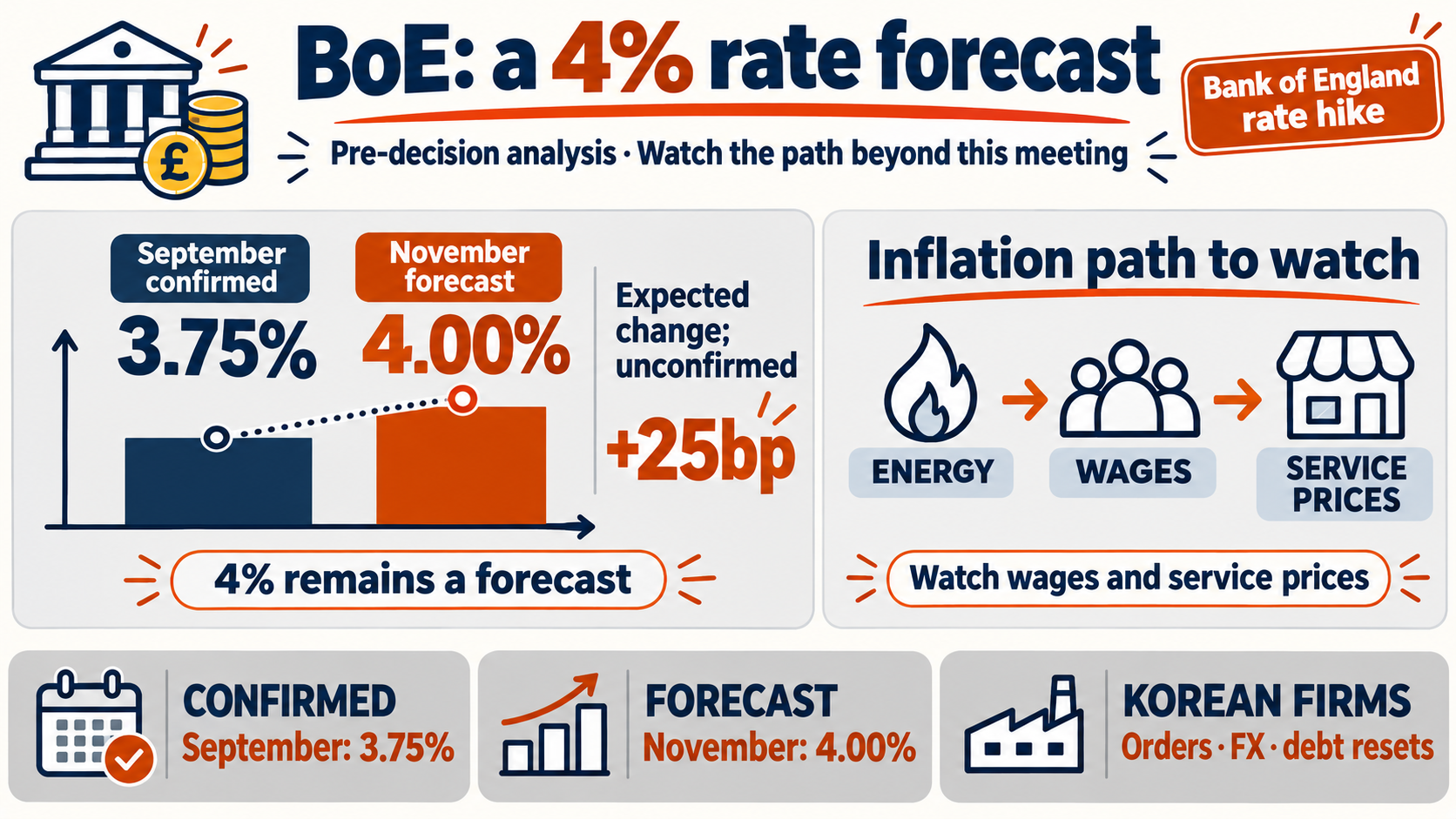
The Bank of England rate hike outlook centres on a quarter-point move in Bank Rate from 3.75% to 4.00%. This is a forecast ahead of the November 5 decision; the official page still carries a publication notice. This preview explains why the subsequent rate path matters for Korean companies. Source: BoE — November 2026 MPC publication notice
A 4% Bank Rate is still a forecast
Reuters reported on November 2 that economists expected a rise to 4.00%, which would be the first increase since August 2023. Markets were pricing a further rise to 4.75–5.00% next year. That pricing is not a central-bank commitment. Source: Reuters, 2026-11-02 — BoE poised to raise rates; Euronext syndication
The verified starting point is September’s 3.75% hold, approved by six votes to three. That is not November’s vote. A quarter-point move, or 25 basis points, remains unconfirmed. Source: BoE — September 2026 MPC minutes
Confirmed rate versus forecast (%). 3.75%: September decision. 4.00%: Reuters November 2 forecast; November result unconfirmed. · Axis starts at 3.6, not zero
Separate the current rate, the forecast decision and next year’s market pricing. Treating them as a confirmed schedule would create false confidence about future interest income or borrowing costs. The actual decision and new Monetary Policy Report projections still need checking.
Why raise borrowing costs after an energy shock?
Higher interest rates cannot produce more oil or gas. In an energy-importing economy, dearer fuel already reduces household purchasing power and increases business costs. Raising borrowing costs on top of that can further weaken demand. That is the central bank’s dilemma.
The concern is persistence. Workers may seek compensation for higher living costs, and firms may pass the resulting labour costs into service prices. Inflation can then remain elevated after energy prices stabilise. This further propagation is called a second-round effect.
-
1
Energy costs
Household and business pressure
-
2
Wage bargaining
Compensation for lost purchasing power
-
3
Service prices
Potential labour-cost pass-through
-
4
Policy response
Assess persistence and demand
Cost increases do not always become price increases. A restaurant losing customers may accept a lower margin instead of raising menu prices, then postpone hiring or a new location. Limited inflation pass-through does not necessarily mean businesses are coping well; profits and employment may bear the cost.
The Bank’s September assessment projected inflation above 4% early next year. That was a forecast, not an observed outcome. The analytical question is whether wage bargaining, service prices and hiring demand begin reinforcing one another. Source: BoE — September 2026 MPC minutes
Why Bailey, Mann and the IMF keep tightening on the table
In the September 17 minutes, Governor Andrew Bailey described limited evidence of second-round effects but warned that a prolonged conflict could require tightening. This was a conditional assessment in September, not a November statement. Source: BoE — September 2026 MPC minutes
MPC member Catherine Mann argued on October 1 that higher market yields include risk premia and that real financial conditions were insufficiently restrictive. Her view challenges the assumption that rising bond yields necessarily do all the central bank’s work. Source: Catherine L. Mann, 2026-10-01 — Financial conditions: what’s priced in?
In an October 13 IMF article, economic counsellor Silvana Tenreyro stressed price stability and containing second-round effects. The IMF argued that persistent pressures from commodities and investment may require further tightening. Britain’s dilemma belongs to a wider challenge facing energy importers. Source: IMF / Silvana Tenreyro, 2026-10-13 — Global Economic Resilience Is Under Strain
This does not imply that Korea should copy Britain’s decision. Domestic demand, the won, household debt and inflation prospects also matter. The analysis concerns differing responses to a common shock, not a prediction of a new Bank of Korea decision.
A hike can coincide with falling bond yields
Gilts are UK government bonds. Their yields incorporate expected future short-term rates and compensation for uncertainty. What matters at an announcement is how the expected path changes relative to what investors had already priced.
If a widely expected move to 4% occurs but guidance reduces expectations for further hikes, yields can fall. Guidance pointing to more tightening can have the opposite effect. These are conditional scenarios, not reported post-decision market moves.
Less tightening expected
Yields may fall
Bonds
Sterling · Relative yield support may weaken
More tightening signalled
Expected rate path may rise
Bonds
Companies · New debt and refinancing pressure
Sterling is equally sensitive to expectations. Relative rate paths against the United States and euro area matter, alongside growth and risk. Currency hedging also reflects interest-rate differentials, so a higher UK yield is not automatically a free extra return.
Our earlier discussion of Fed policy and market rates connects to the same distinction between an unchanged policy rate and borrowing costs. The article on French sovereign risk and corporate funding provides another perspective on country-specific risk compensation.
For Korean firms, look beyond currency translation
A Korean exporter paid in sterling may report higher won revenue if the pound strengthens against the won. But British customers facing higher debt payments may postpone cars or appliances. Translation gains and order volumes need separate analysis.
Companies operating in Britain have sterling costs as well as revenue. Translating sales alone overstates the potential benefit. Dollar-priced inputs add a GBP/USD exposure, while hedged contracts delay the effect of spot exchange-rate changes.
Debt contracts matter too. A fully passed-through quarter-point increase on a £1 million floating-rate loan adds £2,500 in annual interest. This is an illustration, calculated as principal times the rate change. Fixed-rate debt behaves differently until reset or refinancing, and bank credit spreads also affect the actual cost.
Within industries, cash-rich and indebted firms can diverge. The former may earn interest and expand when competitors retrench; the latter may need to reduce inventory and equipment spending. Banks do not automatically benefit either: deposit competition and credit losses can offset higher lending income.
Energy efficiency presents another trade-off. Higher fuel costs improve potential savings, while higher borrowing rates increase upfront financing costs. Projects with quick payback and internal funding may proceed first, widening investment differences between firms. This is conditional analysis, not a reported corporate investment plan.
Fearful markets: read the sentence after the rate decision
The supplied CNN snapshot at 17:58 UTC on November 4 reads 28.3, in fear territory, down 6.1 points from a week earlier and 9.9 from a month earlier. A tougher UK rate outlook could interact with this risk aversion; it did not cause these already-observed readings. Source: CNN Fear & Greed — supplied 2026-11-04 snapshot
GoldKimp’s Korean reading is 77.8, extreme greed, dated November 2. No comparable Korean weekly or monthly history was supplied, so its trend cannot be established. Dates and methodologies differ. Optimistic local sentiment nevertheless offers no immunity from higher funding costs or discount rates (the rates used to value future profits today). Source: GoldKimp KOSPI Fear & Greed — supplied 2026-11-02 observation
The public SentimenTrader page displayed neither Smart Money nor Dumb Money Confidence values, nor an update date. Their divergence therefore cannot be assessed. The fear-and-greed readings above are not substitutes for these missing measures. Source: SentimenTrader — public page; values unavailable at retrieval
On November 5, first verify the decision and vote, then the MPR’s inflation path and assessment of wages and services. Check the interest-rate assumptions behind its projections. Inflation returning to target under an assumed market curve would not constitute a promise to deliver that curve.
For Korean firms, UK orders, net sterling exposure and debt-reset dates matter more than the rate headline alone. Their importance changes depending on whether this becomes a precautionary move or the start of further tightening. This is pre-decision economic analysis, not a recommendation to trade particular assets.
Sources and references
- BoE — November 2026 MPC publication notice
- BoE — September 2026 MPC minutes
- Reuters, 2026-11-02 — BoE poised to raise rates; Euronext syndication
- Catherine L. Mann, 2026-10-01 — Financial conditions: what’s priced in?
- IMF / Silvana Tenreyro, 2026-10-13 — Global Economic Resilience Is Under Strain
- CNN Fear & Greed — supplied 2026-11-04 snapshot
- GoldKimp KOSPI Fear & Greed — supplied 2026-11-02 observation
- SentimenTrader — public page; values unavailable at retrieval
For information only — this is not a recommendation to buy or sell any asset.
Comments 0