France OAT Yield Hits 5.14%: Three Channels to Korean Business
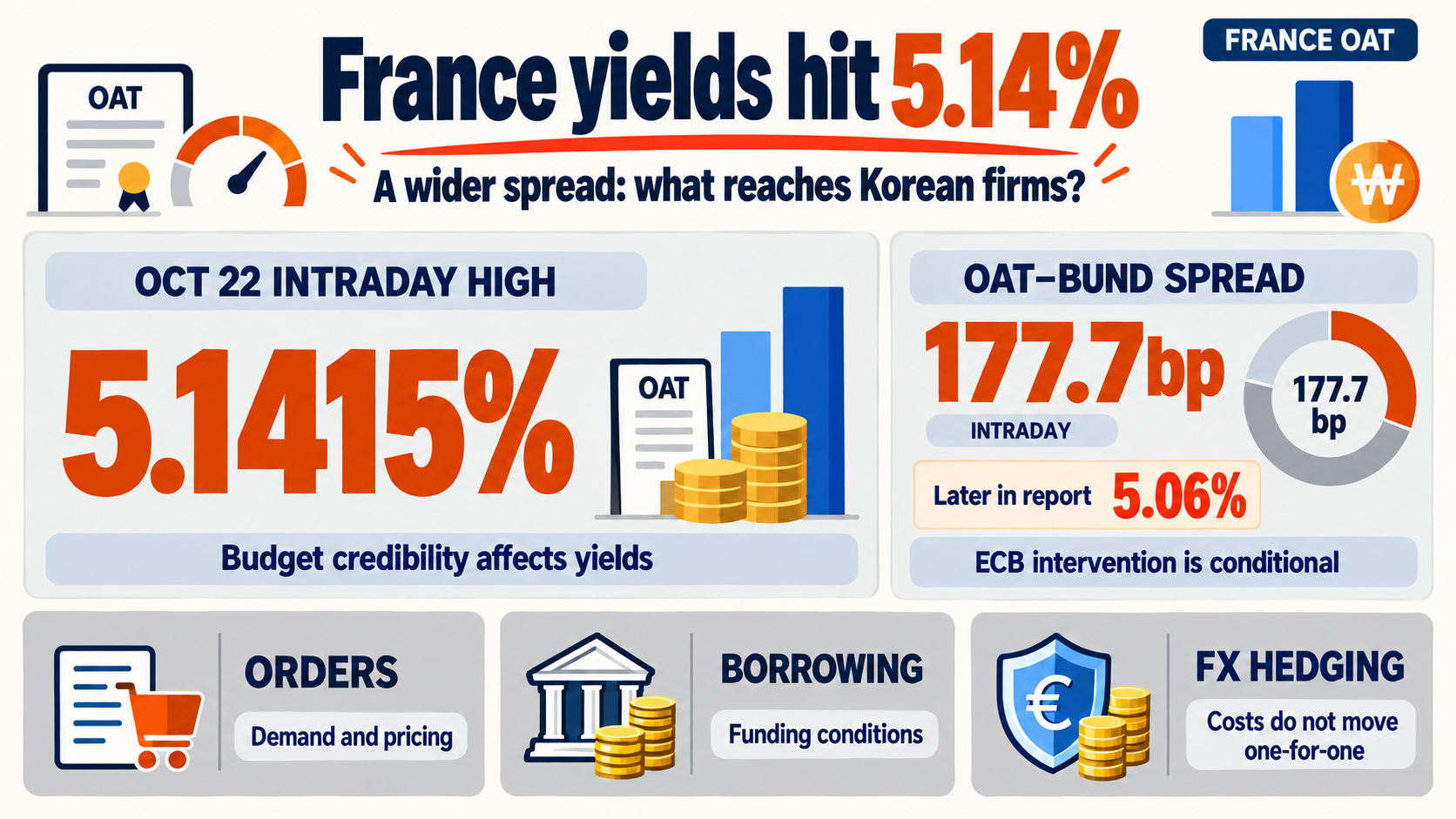
France’s 10-year government yield reached 5.1415% intraday on October 22. Its spread over Germany widened to 177.7 basis points. For Korean businesses, the potential consequences run through European demand, local borrowing and currency contracts, with different timing and direction in each channel. Source: Reuters, 10월 22일
France is a core euro-area economy. The episode shows that a substantial fiscal risk premium can emerge there too. A spread last seen in 2011 does not, by itself, mean that the crisis of that period has returned.
France OAT: a 5.14% yield is not a 177.7bp spread
OATs are French government bonds and Bunds are German government bonds. A spread compares yields at the same maturity. One basis point is 0.01 percentage point, so 177.7bp means a 1.777 percentage-point premium for lending to France rather than Germany.
Reuters identified 5.1415% as the intraday high and 5.06% as the later quoted yield. The spread reached its widest since November 2011. Germany was quoted at 3.34%. Subtracting observations from different times need not reproduce the peak spread; the chart is not a simultaneous pricing snapshot. Source: Reuters 시황
October 22 yield observations. Reuters. Not simultaneous quotes; differences do not reproduce the peak spread.
Bond prices move inversely to yields. If a bond’s promised payments are unchanged but buyers demand a higher return, its price must fall. Existing fixed-rate government debt does not all become more expensive overnight. The fiscal burden builds through new borrowing and refinancing.
One currency, different borrowing costs
Two forces overlap. Expensive energy can keep inflation elevated and limit room for rate cuts across the region. Whether a government can pass a budget and contain debt is country-specific. Political and budget uncertainty can therefore add a French premium on top of the common interest-rate burden.
If investors sell French bonds and buy Bunds, opposite price moves can amplify the spread. It measures more than default risk: safe-haven demand and liquidity also matter. The Reuters report did record a decline in German yields that day. Source: Reuters 시황
A separate Reuters analysis reported Belgium’s spread at 109bp and a 14bp weekly rise in Italy’s 10-year yield. A different timestamp in the market report put Belgium at 110bp. These are moving quotations, but they show scrutiny spreading to other indebted sovereigns. Source: Reuters 분석, 10월 22일 취재·23일 게시
Our earlier discussion of euro-area energy inflation focused on costs. This episode adds the government’s capacity to absorb the shock. Subsidies can help households immediately, but debt-financed support also depends on the interest rate lenders demand.
How far can the ECB step in?
On October 22, Nomura senior European economist Andrzej Szczepaniak told Reuters that the bar for ECB intervention was high. BlueBay market strategy head Mike Bell stressed that persistently high borrowing costs eventually feed into refinancing. These are market assessments, not ECB commitments. Source: Mike Bell / Reuters; Szczepaniak 출처는 아래 시황 원문
The ECB’s Transmission Protection Instrument addresses unwarranted, disorderly market dynamics that impair policy transmission. A common policy rate can lose effectiveness if financing conditions become disrupted in one country. There is no automatic purchase trigger at 177.7bp or 200bp. Source: ECB TPI, 2022-07-21
The ECB assesses fiscal sustainability and responses to EU fiscal requirements, among other criteria. Being in an excessive deficit procedure is not by itself a blanket exclusion; effective action in response to recommendations matters. The difficult distinction is between persistent country fundamentals and market dysfunction. Source: ECB 적격성·발동 기준
TPI
Transmission disruption and eligibility assessment
·
· · No automatic spread ceiling
PEPP reinvestment
Ended at end-2024
·
· · Holdings do not mean new purchases
PEPP was the pandemic emergency purchase programme. The ECB says reinvestments ended in late 2024. Remaining holdings are different from ongoing purchases, so PEPP reinvestment should not be presented as an automatically available response to this episode. Source: ECB PEPP 공식 안내
In its May 21, 2026 mission statement, IMF staff judged the pace of fiscal adjustment insufficient without further measures. It also described bank liquidity as robust while identifying indirect funding-cost exposure to sovereign conditions. This is a dated assessment, not a fresh October verdict, but it supports examining transmission without declaring a banking crisis. Source: IMF 조사단, 2026-05-21
The first two channels for Korean firms: orders and local loans
The first channel is customer demand. If sovereign stress feeds into bank loans, car finance and tighter public spending, households and businesses may postpone major purchases. Korean car and appliance exporters could face both lower volumes and higher financing support or promotional costs. That is a scenario, not an observed sales decline caused by one day’s trading.
The second is borrowing by local subsidiaries. Corporate loans are not mechanically priced as the French government yield plus a fixed number. Short-term euro benchmarks, bank funding, borrower credit and collateral all matter. A bank facing higher costs or tighter risk limits may seek a larger margin or stronger guarantees at renewal.
-
1
Sovereign funding
Credibility pressure and wider spreads
-
2
Banks and customers
Funding terms and credit standards may tighten
-
3
Korean companies
Orders, refinancing and payment cash flow
For illustration, a one-percentage-point increase on a constant €100 million balance adds €1 million of annual interest. This is not an estimate of actual pass-through from the sovereign spread. It shows why a company with long-term fixed funding can fare differently from one refinancing soon.
Financing differences can also reshape an industry. Cash-rich companies with diverse funding sources may keep investing. Smaller suppliers relying on one bank and short maturities may delay equipment purchases or seek quicker payment. Slower customer settlement also increases Korean suppliers’ working-capital needs.
Third channel: FX hedges do not reprice by 177.7bp
Currency exposure is the third channel. A fall in EUR/KRW can hurt an exporter converting euro receipts into won while helping a company importing European equipment. Euro revenues and euro costs can also offset one another within a local operation.
A forward contract fixes an exchange rate for a future date. Pricing reflects the currencies’ interest-rate differential, maturity and funding conditions. Cross-currency basis, bank credit limits and fees may also affect an executable hedge. The French sovereign spread is not interchangeable with any of these prices.
Sovereign stress could worsen hedge terms or credit limits if it strains bank funding, but higher hedging costs are not automatic. We have not verified an increase in actual quotes for Korean companies. A flight into dollars can affect both EUR/USD and USD/KRW, leaving EUR/KRW’s direction uncertain.
In practice, settlement currency, receivable collection periods and upcoming refinancing matter alongside European revenue share. Cash flow can deteriorate even with stable orders if customers pay later or hedges require more collateral.
A strong KOSPI does not shield firms from European funding stress
CNN’s Fear & Greed Index, a 0–100 gauge of US investor sentiment, read 21.0 (extreme fear) on October 23, down 1.1 points from a week earlier and 11.6 from a month earlier. GoldKimp’s October 22 KOSPI measure is 71.2, greed. Different methodologies prevent treating their gap as a measure of capital flows, but their classifications point to contrasting risk appetite. Source: CNN 제공 스냅샷; 한국 수치는 GoldKimp 참고자료
Comparable Korean readings from a week and a month earlier were unavailable. SentimenTrader’s public homepage was checked on October 25, but Smart Money and Dumb Money Confidence values and dates were not displayed. We therefore make no claim about which investor group moved first. Source: SentimenTrader 공개 페이지 확인
Even a strong Korean equity market cannot fix European bank credit standards or foreign investors’ liquidity needs. Whether French bond losses lead to selling elsewhere requires evidence on flows and collateral. As our article on Treasury auctions and liquidity risk explained, a safe-asset label does not eliminate interim price losses.
The next assessment depends on budget credibility, transmission into bank and corporate funding, and whether the ECB identifies a monetary-transmission problem. Restored credibility could narrow spreads. Persistent financing pressure and spending cuts could instead weaken consumption, investment and tax revenues. Neither outcome is certain.
European revenue exposure alone is insufficient to judge a Korean company. Local costs, debt maturities and settlement currencies can produce very different earnings and cash-flow outcomes. The useful question is whether those differences can be identified in company disclosures. This is economic analysis, not a recommendation to trade an asset.
Sources and references
- Reuters / Euronext, 2026-10-22 — French debt risk premium
- Reuters / Euronext, dateline 2026-10-22; posted 10-23 — French bond pain
- ECB, 2022-07-21 — Transmission Protection Instrument
- ECB — PEPP: reinvestments discontinued at end-2024
- IMF, 2026-05-21 — France Article IV mission concluding statement
- Reuters / MarketScreener, 2026-10-22 — same-wire cross-check
- CNN Fear & Greed — 2026-10-23 supplied snapshot
- GoldKimp KOSPI Fear & Greed — 2026-10-22 supplied snapshot
- SentimenTrader — public page checked 2026-10-25; values unavailable
For information only — this is not a recommendation to buy or sell any asset.
Comments 0