BOJ Holds at 1.25%: Why ETF Sales Will Rise 2.6 Times
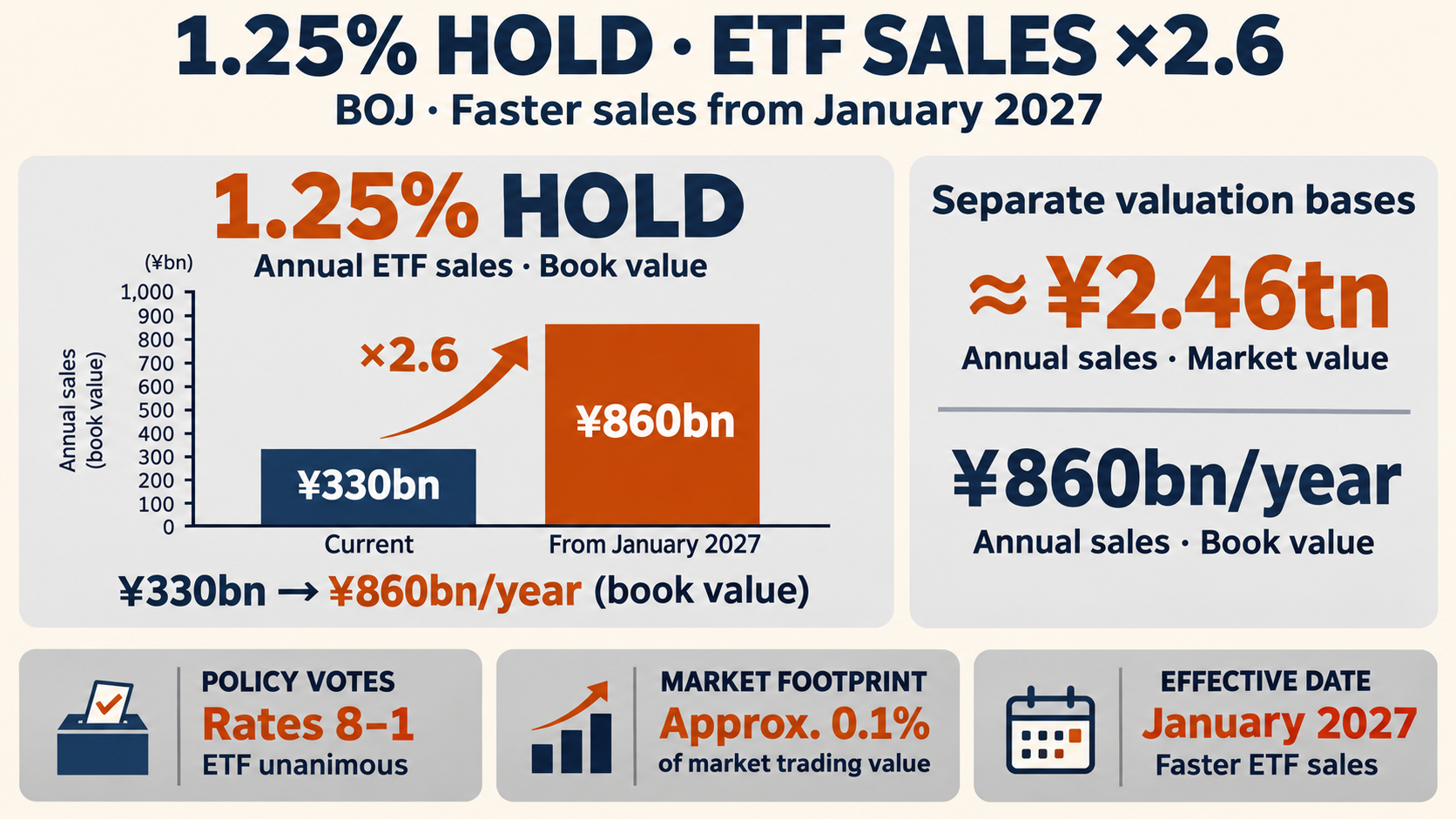
On October 30, the BOJ held its policy rate at 1.25% while deciding to accelerate sales of its ETF holdings. Private investors will absorb more equity exposure even with the policy rate unchanged. For Korean businesses, yen revenues and Japanese equipment costs can move in opposite directions. Source: BOJ, Statement on Monetary Policy, 2026-10-30
The faster sales begin in January 2027. Expectations can change immediately, but the larger flow did not start in October. This article uses the October decision, outlook and published press conference; it does not incorporate the November 10 Summary of Opinions. This is not investment advice or a recommendation to buy or sell any security. Source: BOJ, Statement on Monetary Policy, 2026-10-30 Source: BOJ 통화정책회의 및 공개 일정
Two BOJ decisions, two different votes
The rate decision passed eight to one. Hajime Takata proposed 1.5%, arguing that underlying inflation had reached the target. Underlying inflation means the persistent trend beneath temporary price swings. The faster ETF sales received unanimous support. Source: BOJ, Statement on Monetary Policy, 2026-10-30
Interest rates influence borrowing costs. An ETF is a fund traded on an exchange that holds a basket of securities. Selling equity ETFs transfers more equity risk to private holders. Changing the price of credit and reducing central-bank asset ownership operate through different channels.
Rate hold
1.25% · 8–1
·
· · Price of borrowing
Faster ETF sales
Unanimous · January 2027
·
· · Equity risk held privately
An eight-to-one vote is not a probability forecast for December. A minority favoring an immediate hike does not imply a commitment to another hold. Nor is there a reliable conversion from ETF sales into a number of interest-rate hikes.
¥860 billion and 0.1% measure different things
Annual ETF sales rise from ¥330 billion to ¥860 billion on a book-value basis, about 2.61 times the previous pace. Book value reflects recorded acquisition cost; market value reflects trading prices. The same holdings can therefore have different values. Source: BOJ, Statement on Monetary Policy, 2026-10-30
Annual ETF sales: book-value basis. Source: BOJ. 8,600/3,300≈2.61. Do not mix with market value or market capitalization.
The BOJ estimates the new pace at about ¥2.46 trillion at market value. Its roughly 0.1% share refers to market trading value, not total listed market capitalization. The share doubles from 0.05%, while book-value sales rise 2.6 times because turnover and valuation ratios also matter. Source: BOJ, Statement on Monetary Policy, 2026-10-30
The economic question is how much demand absorbs the supply. Spreading sales across an active market can reduce disruption. A small share of normal turnover does not guarantee a small impact in a selloff: the same supply can move prices more when buyers withdraw.
This is better read as a change in the pace of risk transfer than a prediction of an immediate stock decline. Sales may be adjusted or suspended as conditions change. Actual execution and private demand must be assessed together. Source: BOJ, Statement on Monetary Policy, 2026-10-30
Ueda, Takata and the IMF: the debate is about pace
At his October 30 press conference, published November 2, Governor Kazuo Ueda described further rate increases and adjustments to accommodation as dependent on economic, price and financial conditions. Read alongside Takata’s call for faster action, the debate appears to concern pace more than the direction of normalization. That is an interpretation, not confirmation of a December hike. Source: 우에다 총재 10월 30일 기자회견, 11월 2일 공개
The October outlook identifies wage pass-through, oil and semiconductor prices, and earlier yen depreciation as inflation pressures. AI demand can support output and investment while also lifting component costs. Growing sales need not produce equally strong profit growth when input costs and financing expenses rise. Source: BOJ, October 2026 Outlook Report
In its Japan consultation published April 3, the IMF supported monetary normalization and labor-market reforms that sustain real wage gains. This predates the October meeting and is not a response to it. The challenge of stabilizing prices while restoring household purchasing power remains relevant. Source: IMF 일본 연례협의, 2026-04-03
Further rate increases can burden borrowers and leveraged companies. Savers may earn more interest, while a stronger yen could reduce import costs. The net effect on consumption depends on wages, debt exposure and import prices.
Korean firms need to measure net yen exposure
The following is conditional transmission analysis. Relatively higher Japanese yields can make yen assets more attractive. US rates and demand for safety also influence currencies, so this announcement alone cannot establish that the yen will strengthen.
If the yen strengthens against the won, yen revenues translate into more won. Companies paying for Japanese equipment in yen face higher investment costs. Yen debt and currency hedges can change the result again. Net exposure matters more than Japanese sales alone.
-
1
Currency move
If yen gains against won
-
2
Revenue and costs
Higher translated sales / equipment costs
-
3
Net earnings
Depends on debt, hedges and pricing
Korean exporters competing with Japanese firms could gain pricing room. The benefit weakens if Japanese rivals absorb the currency change in margins or manufacture abroad. Contract renewals and production adjustments create a lag between currency moves and export volumes.
This distinction also matters when reading our earlier discussion of Japanese trade and Korean equipment flows. Higher exports alone do not establish stronger profits; invoicing currencies and imported equipment costs matter too.
Memory demand requires another step: Japanese AI investment must become server orders before it reaches Korean chip suppliers. Higher rates raise the hurdle for debt-funded projects, while cash-rich or contracted projects may proceed. Equating Japanese tightening with weaker memory demand is too simplistic.
Our earlier article on AI investment and borrowing points to the practical checks: funding sources, actual orders and commissioning dates, beyond headline budgets. This decision alone is insufficient to revise a particular Korean company’s revenue forecast.
Ahead of December, watch the conditions behind the words
As of November 9, CNN Fear & Greed stood at 31.7, in fear territory: up 12.3 points from 19.4 a week earlier, but down 11.8 from 43.5 a month earlier. GoldKimp’s Korean gauge was 79.7, extreme greed, on November 6. Different methods and dates prevent a direct numerical comparison; Korean weekly and monthly changes were not verified. Source: CNN Fear & Greed, 제공 스냅샷 2026-11-09 Source: GoldKimp KOSPI F&G, 2026-11-06
US fear has eased while the Korean gauge already signals optimism, useful context when assessing reactions to Japanese funding changes. Neither gauge proves that yen-funded capital is leaving Korean stocks. SentimentTrader displayed no Smart Money or Dumb Money readings or update date, so no directional conclusion is drawn from them. Source: SentimentTrader 공개 홈페이지, 수치 미표시
The Summary of Opinions is released on November 10 at 8:50 a.m. Japan and Korea time; the official schedule had no document link when this article was written. Watch the conditions attached to inflation risks. The summary is distinct from full minutes, and anonymous views should not be converted into named votes. The next meeting is December 17–18. Source: BOJ 통화정책회의 및 공개 일정
My reading is that normalization continues through asset sales even while the policy rate pauses. The more useful question for Korean readers is which exposures their businesses and assets carry. Separating rates, currencies and actual orders explains why the same Japanese policy news can produce very different earnings outcomes.
Sources and references
For information only — this is not a recommendation to buy or sell any asset.
Comments 0