Japan trade: exports up 16.7%, still a deficit — why chip tools to Korea surged
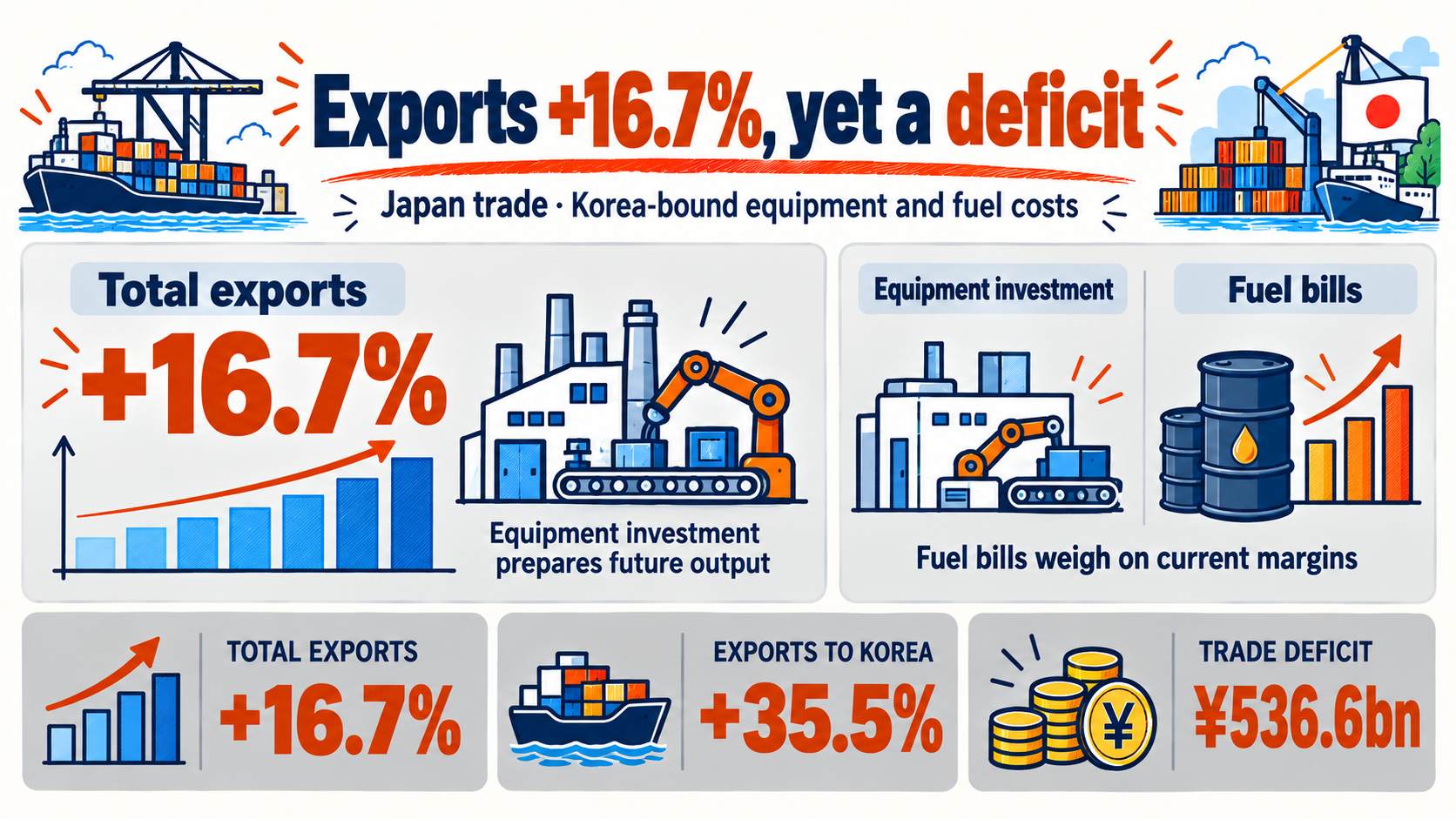
Japan’s September 2026 exports rose 16.7%, yet the trade deficit was about ¥536.6 billion. Shipments to South Korea grew 35.5%. Whether that helps Korean companies depends on what crossed the border. Source: 재무성 10월 21일 잠정치
Export orders and a country’s import bill tell different stories. A factory can buy equipment to expand while paying more for energy. This release captures both sides.
Japan trade statistics: why destination growth differs
Exports to the US grew 22.9%, versus 8.6% to China. These are year-on-year changes in yen value. Faster growth toward Korea establishes neither stronger household spending nor a competitive victory over Korean firms. Source: 재무성 국가별 표
Japanese export growth by destination. September 2026, provisional yen values. Source: Japan MOF. Product mixes differ.
Each destination buys a different mix. A large machinery shipment can move a monthly total; consumer-goods flows may respond more to household budgets and retail inventories. A weak comparison period can also exaggerate growth.
Export value reflects volume, prices and currency conversion. A shift toward expensive products raises value too. A useful country comparison therefore needs matched products and quantities. Reuters attributed export growth to AI-related demand as well as companies passing higher costs into prices. Source: Reuters 10월 21일
Chip equipment to Korea up 82.4%: read it as investment, not rivalry
Semiconductor-making machinery and related equipment sent to Korea rose 82.4% in value, contributing 7.6 percentage points to bilateral export growth. Mineral fuels contributed 8.6 points. Treating the whole increase as AI demand would miss a substantial energy component. Source: 재무성 대한 수출 품목표
Two contributions to Korea-bound export growth. MOF contributions, percentage points. Selected parts of the total 35.5% increase; other products omitted. · Axis starts at 7.1, not zero
The following business implications are analysis. A Japanese machine delivered to a Korean chip plant is a sale for the supplier and productive investment for the buyer. Both can benefit. Equipment suppliers and competitors in finished chips occupy different positions in the chain.
-
1
Procurement
Cash paid by buyer
-
2
Installation
Time needed for qualification and yield
-
3
Chip sales
Prices and costs determine profit
Korean buyers still need installation, qualification and improved yield—the share of production that works as intended. Cash leaves before saleable output arrives. Once equipment is in use, depreciation spreads its cost across future periods. Rising orders can coexist with weak early cash flow or margins.
The reported 81.6% quantity increase measures weight. It is not machine count or capacity growth. Identifying the buyer and process is essential before drawing conclusions about Korean memory producers or local equipment vendors. Source: 재무성 수량 단위 MT
Our earlier discussion of Japanese corporate investment offers context for following investment intentions into equipment activity. Tankan responses and cross-border shipments cover different populations and cannot be added together.
Imports rose 18.9%; the energy bill rose faster
Total imports rose 18.9%, while mineral-fuel imports increased 39.4%, contributing 6.9 percentage points. The 18.9% figure is not energy growth. Export gains cannot prevent a deficit when import spending exceeds receipts. Source: 재무성 전체 수입·품목표
Fuel import value grew faster than total imports. September 2026 yen values, provisional. Source: Japan MOF. Fuels are a subset of total imports.
LNG quantity fell 7.3% while value rose 39.2%. Those rounded rates imply an approximately 50.2% increase in average yen import value per unit. Japan paid more despite importing less. Source: 재무성 LNG 수량·금액
That unit-value increase is not a clean measure of global gas inflation. Exchange rates, contract lags and sourcing mix matter. Reuters also reported delayed crude arrivals after shipping routes changed. Monthly imports reflect arrival schedules as well as underlying demand. Source: Reuters 운송 경로 보도
Exports are valued FOB and imports CIF, including freight and insurance. This is a merchandise balance, not the current account, which also includes services and income from overseas investments. A trade deficit alone does not determine national income or the yen’s direction. Source: 재무성 집계 기준
IMF and TSMC: strong AI investment, higher costs
At an October 13 briefing, posted October 14, IMF chief economist Silvana Tenreyro distinguished an energy supply shock that hurts activity from AI demand that supports trade and investment. The IMF also warned that concentrated AI supply chains can create bottlenecks. This helps explain why strong Japanese trade can coexist with higher costs. Source: IMF 브리핑
TSMC chairman and CEO C.C. Wei described strong AI and advanced-process demand on October 15. CFO Wendell Huang reiterated a 2026 capital budget of $60–64 billion. That company plan supports the equipment-demand narrative; it is neither completed spending nor guaranteed revenue for Korean firms. Source: TSMC 3분기 실적설명회
Investment plans and market expectations can diverge. CNN Fear & Greed was 32.6, or fear, on October 27: up 3.0 points over a week but down 4.4 over a month. GoldKimp’s KOSPI measure was 73.7, or greed, on October 26. Different methodologies prevent a direct score-gap comparison. As an inference, Korean investors should check how much export optimism is already priced in. Source: CNN Source: GoldKimp
Comparable prior-week and prior-month Korean readings were unavailable. A direct October 28 check of SentimenTrader showed no Smart Money or Dumb Money Confidence values or update date. We therefore draw no institutional-buying or retail-crowding conclusion from them. Source: SentimenTrader
For Korean businesses, watch what remains after costs
Equipment imports may prepare Korean chipmakers for expansion. To earn a return, selling prices must cover machinery, materials and electricity. Korean equipment suppliers may see a larger market, but whether they win orders in their own process categories requires separate evidence.
Currency effects depend on the invoice. A weaker won against the yen raises the cost of yen-priced equipment. Dollar chip revenue might offset some of it, but timing and hedging prevent an automatic match. Higher yen export values do not mechanically mean higher won profits.
For energy-intensive chemicals and transport, the ability to pass costs through matters. Refiners depend on the gap between crude input costs and refined-product prices, not oil prices alone. Higher household fuel and living costs can squeeze other purchases, slowing any spillover from chip exports to domestic consumption.
This connects with our earlier analysis of Korea’s uneven export performance. Watch whether equipment deliveries lead to utilization, whether chip prices hold, and whether energy unit costs ease. Sustained AI orders with cheaper fuel could help firms and households together. Slower orders with sticky costs could instead expose expansion burdens. These are conditional scenarios, not forecasts.
The useful distinction in this Japanese trade release is between equipment that may expand future output and energy that costs more today. Their consequences for future earnings differ. This is economic analysis, not a recommendation to buy or sell assets.
Sources and references
For information only — this is not a recommendation to buy or sell any asset.
Comments 0